
Join Low Voltage Nation — Find project opportunities and showcase your company to thousands of industry professionals
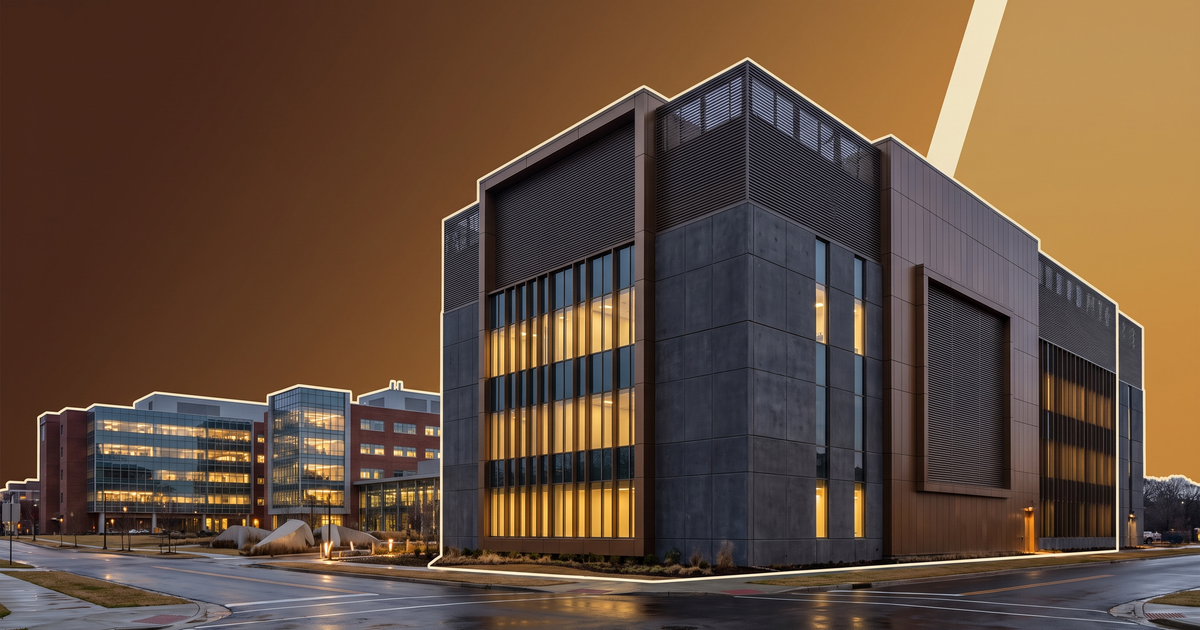
St. Jude filed a $40.86 million addition and interior-renovation permit for its Memphis research data center. Five source-supported low voltage packages create an estimated $2.8 million to $4.7 million planning range, with a $3.8 million midpoint.
A $40.86 million addition and interior renovation to St. Jude Children's Research Hospital's Memphis data center puts five source-supported low voltage packages on the board. Using the enterprise data-center benchmark for a construction-only permit, the planning range is approximately $2.8 million to $4.7 million, with a midpoint near $3.8 million.
Project Overview
Memphis and Shelby County permit records show a commercial-addition filing for “St. Jude Building Z - Phase 3 Expansion” at 262 Danny Thomas Place. Filed August 25, 2026, the record carries a construction value of $40,863,662. The written scope covers an addition to and interior renovation of an existing medical research data center, a fully sprinklered building, and associated site improvements. It also says exterior and interior materials will match the existing facility.
The permit is specific enough to establish the project, owner, value and broad construction type, but it does not publish the added square footage, added critical load, equipment schedule, construction start, systems bid date or award status. Those gaps matter. Contractors should treat this as an early planning signal and verify the issued drawings, specifications, addenda and procurement path before carrying a firm systems number.
This is not a generic speculative data center. St. Jude describes its high-performance computing environment as infrastructure that lets researchers process genetic, chemical and clinical data at a scale that would not be possible on local workstations. In a 2025 St. Jude research briefing, the institution said work that could take weeks or months can be reduced to minutes or hours through parallel computing. Availability, data integrity and secure campus connectivity therefore tie directly to the hospital's research mission.
| Project | St. Jude Building Z - Phase 3 Expansion |
| Location | 262 Danny Thomas Place, Memphis, Tennessee 38105 |
| Permit Value | $40,863,662 |
| Scope | Addition and interior renovation of an existing medical research data center |
| Permit Filed | August 25, 2026 |
| Signal LV Score | 10/10 |
| Validated LV Planning Targets | 5 systems |
| Source | Memphis Commercial Building Permits |
Known Project Team and Facility Context
St. Jude Children's Research Hospital is the confirmed owner and operator. Its campus map labels Building Z as the Data Center, separating it from patient-care and research towers while keeping it inside the operational medical campus. A Daily Memphian report places the expansion inside St. Jude's broader capital program.
Syska Hennessy's project record identifies the original facility as a three-story, 55,000-square-foot, 3.4-megawatt data center completed in 2017. Syska says the critical infrastructure was designed to Industry Tier III standards in a concurrently maintainable arrangement and sized for high-performance computational biology, healthcare IT and enterprise workloads. The original design included continuous cooling, mechanical UPS support for cooling equipment, thermal storage and resilience against water-supply interruption, seismic events and high wind.
That history is useful context, not an award announcement for Phase 3. Public sources reviewed for this spotlight do not name the current architect, engineer, general contractor or low voltage subcontractors. The Signal entity row labels Ryan Boyland as the general contractor and attaches an unrelated home-improvement domain; independent public records identify a similarly named person as an architect. LVN did not use that scraped relationship. Syska is listed below only as the documented designer of the existing data center, not as a confirmed Phase 3 consultant.
| Role | Organization | What Is Confirmed |
|---|---|---|
| Owner / Operator | St. Jude Children's Research Hospital | Named facility owner and operator; Phase 3 permit is on its Memphis campus. |
| Original Data Center Designer | Syska Hennessy | Designed the 2017 3.4 MW facility; no public confirmation of a Phase 3 role. |
| Phase 3 GC / Designer | Not publicly named | Confirm from issued permit documents and procurement records before outreach or pricing. |
Low Voltage Systems Breakdown
Signal originally inferred six systems from the project type, but one of them was Nurse Call. The permit describes a medical research data center rather than patient rooms, and none of the sources reviewed names a Nurse Call scope. LVN excluded that inference. The five packages below are planning targets supported by the facility type, the existing campus infrastructure and the documented need for secure, resilient research computing; they remain unawarded until the project documents say otherwise.
| System | Category | Likely Phase 3 Scope | Complexity |
|---|---|---|---|
| Structured Cabling | Data / Voice | New copper pathways, cabinet and patching extensions, equipment-room cross-connects, labeling and certification tied into the live Building Z standard. Phasing must prevent accidental disruption to active research and healthcare workloads. | High |
| Fiber Optic | Backbone | Redundant backbone extensions between the addition, existing data halls and campus duct bank. Expect strand-level documentation, loss-budget control, OTDR and insertion-loss testing, diverse routing and exact handoff records. | High |
| Access Control | Security | Controlled entries, equipment spaces and service interfaces integrated into the hospital's credential and event-management environment. Door hardware, life-safety release, alarming and commissioning sequences need coordinated ownership. | High |
| CCTV / Video Surveillance | Security | Coverage for perimeter, service areas, entrances, circulation routes and sensitive technical rooms, with storage, retention, cybersecurity and VMS integration defined by the owner's standard. | High |
| DAS / In-Building Wireless | Wireless | Coverage extension into the addition and any renovated shielded or high-density spaces. Survey, design, carrier or public-safety coordination and acceptance testing should be separated from ordinary Wi-Fi assumptions. | Medium-High |
The permit also calls the building fully sprinklered. Fire Alarm interfaces, sprinkler supervisory points and emergency-control sequences will require coordination, but the public permit summary does not name a Fire Alarm package. Contractors should keep life-safety integration visible in RFIs without representing it as an awarded or independently valued system.
Estimated Low Voltage Value
The $40,863,662 figure is a construction permit value for an enterprise data-center addition and renovation, not St. Jude's entire strategic plan and not a disclosed technology-hardware purchase. That makes the enterprise data-center method the most defensible benchmark: a 6% to 10% base range, with 8% as the midpoint, adjusted by a 1.15 coordination multiplier for five integrated systems.
| Permit Construction Value | $40,863,662 |
| Base LV Range | 6% to 10% |
| System Coordination Multiplier | 1.15x for five validated systems |
| Estimated LV Planning Range | $2.8 million to $4.7 million |
| Midpoint Planning Benchmark | Approximately $3.8 million |
The midpoint calculation is $40,863,662 multiplied by 8% and then by 1.15, producing approximately $3.76 million before rounding. This is a market-sizing benchmark, not a bid, budget line or contract award. It excludes server, storage and compute hardware unless those components are explicitly carried in the construction contract.
For bidders, the biggest swing factors are existing-condition reuse, pathway congestion, owner-furnished electronics, security-platform licensing, fiber strand counts, work-hour restrictions and the amount of live-system cutover. A renovation inside a concurrently maintainable facility can carry less new material than a greenfield build while demanding more labor for survey, temporary service, rollback plans, supervision, testing and documentation. Price those constraints separately instead of burying them inside a device allowance.
Skills and Certifications Required
This job favors crews that can work inside a live mission-critical healthcare research environment. Installation skill is necessary, but the differentiator is controlled execution: method-of-procedure review, outage windows, prefunctional checklists, rollback plans, redline discipline, testing and clean turnover.
| Discipline | Useful Credentials | Critical Skills |
|---|---|---|
| Structured Cabling | BICSI INST1, INSTC, TECH; RCDD oversight | Pathway planning, copper termination, rack work, firestopping, labeling and permanent-link certification |
| Fiber Optic | BICSI INSTF; manufacturer training; RCDD oversight | Fusion splicing, enclosure work, OTDR and insertion-loss testing, polarity control and strand-level records |
| Access Control | Owner-platform manufacturer certification; Tennessee alarm credentials where applicable | Door hardware interfaces, controller wiring, network integration, credential migration and life-safety release testing |
| CCTV | VMS and camera manufacturer certification; Network+ useful | PoE design, camera placement, bandwidth and storage calculations, cybersecurity and VMS commissioning |
| DAS / Wireless | RCDD; RF and carrier-specific training | Predictive design, spectrum survey, antenna placement, fiber transport, signal testing and acceptance documentation |
Tennessee separates contractor classification from alarm-system licensing. The state's contractor classification outline identifies CE-D work for sound, intercom, fire detection, signal, burglar alarm and security systems up to 70 volts, while telephone and cabling work use other electrical classifications. The Tennessee Alarm Systems Contractors program separately regulates Fire Alarm, Burglar Alarm, Monitoring and CCTV work and requires properly classified companies, qualifying agents and registered employees. Bidders should verify both the classification and monetary limit applicable to their exact package.
Entry-level technicians can contribute to pathway preparation, cable placement, device mounting and labeling under qualified supervision. Mid-level technicians should own termination and certification. Senior leads need the judgment to protect a live data hall, coordinate with hospital facilities and IT staff, manage security-sensitive documents, and prove that every cutover preserved redundancy.
What Contractors Should Clarify Before Pricing
- Whether the addition expands white space, support space, offices or a mixture, and how much critical IT load is being added.
- Which systems are owner-furnished, contractor-furnished or delivered under separate direct agreements.
- The required pathway diversity, fire ratings, grounding and bonding details, cable media, fiber counts and connector standards.
- Whether existing access-control, VMS, network-management and DAS platforms must be extended without substitution.
- Permitted outage windows, MOP approval authority, rollback requirements and witness-testing responsibility.
- Whether commissioning includes integrated systems testing, cybersecurity validation, record-drawing updates and owner training.
The most valuable early RFI may be the responsibility matrix. On a live data center renovation, scopes can split across electrical, technology, security, fire protection, IT operations and owner vendors. A clean matrix prevents duplicated controllers and licenses on one side and missed pathways, interfaces or testing on the other.
Market Signal
St. Jude's FY22-27 strategic plan is a $12.9 billion commitment that includes $2.3 billion for construction, renovation and capital needs. The plan calls for computing power to increase threefold and storage capacity to increase eightfold. Building Z Phase 3 is therefore better read as infrastructure behind a growing scientific program than as a standalone office alteration.
The campus network reinforces that conclusion. A St. Jude network-infrastructure profile describes miles of concrete-encased conduit linking campus buildings to the data center with fiber and copper. For contractors, the repeatable capability is not simply pulling cable inside one building. It is joining new work to an occupied research-campus backbone while preserving topology, pathway diversity, documentation and service continuity.
Memphis contractors should also separate enterprise research computing from the region's hyperscale narrative. This facility supports pediatric research and hospital operations, sits on an active medical campus and already follows a concurrently maintainable design philosophy. The competitive edge will come from healthcare-campus discipline plus mission-critical controls: security, badging, live-work planning, dust and access management, staged commissioning and complete turnover records.
No specialty low voltage award is public in the sources reviewed. That makes the current opportunity a qualification and relationship signal rather than proof that a package is open today. Firms with recent data-center testing records, BICSI-certified fiber crews, Tennessee alarm credentials and credible live-cutover procedures have the clearest case when the Phase 3 procurement path becomes visible.
Find Projects Like This on Signal
LVN Signal tracks thousands of construction projects with low voltage opportunities across the country. Filter by city, system type and project value to find your next bid.
Join 35,000+ Low Voltage Pros
Get weekly permit updates, tool deals, job opportunities, and industry news. No spam, unsubscribe anytime.