
Join Low Voltage Nation — Find project opportunities and showcase your company to thousands of industry professionals
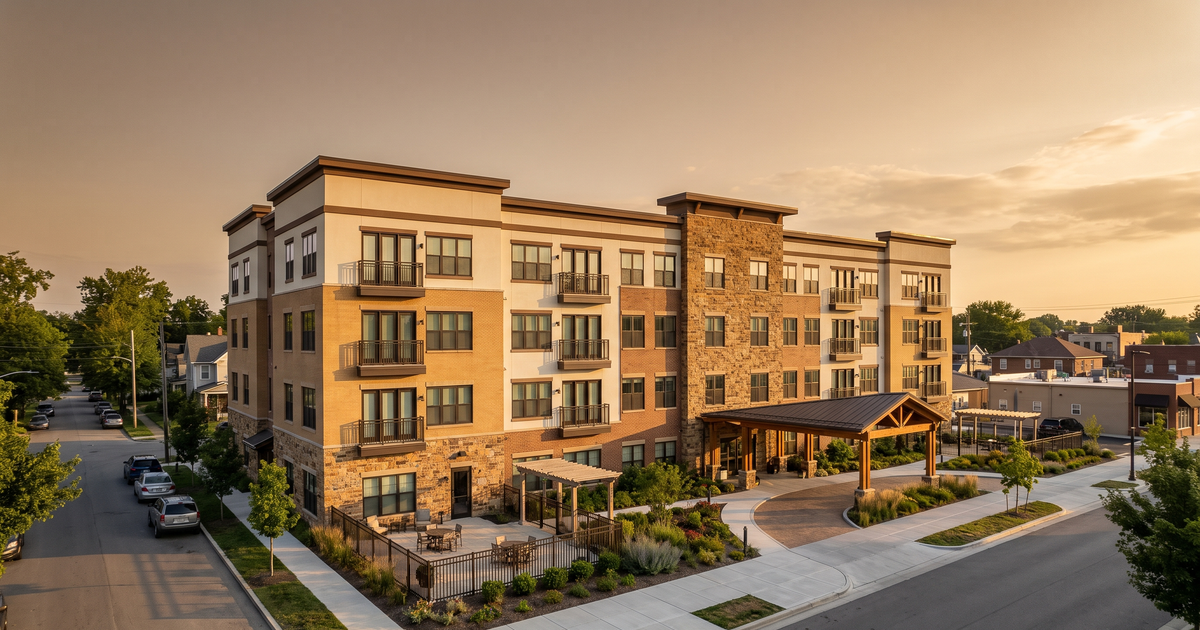
Vivera Brookshire is a 118-unit affordable assisted-living community at 2720 Briggs Road with a $23 million city permit record and $21.4 million in OHFA-listed hard construction costs. Signal tracks six likely low-voltage systems and a benchmark planning range of $1.1 million to $1.6 million, with no package awards public.
A $23 million permit record for Vivera Brookshire in Columbus points to a 118-unit affordable assisted-living community with six likely low-voltage systems and an estimated $1.1 million to $1.6 million technology opportunity.
Project Overview
Vivera Brookshire is a planned four-story assisted-living community at 2720 Briggs Road on Columbus's west side. The Signal record carries a $23 million estimated construction value and shows the primary building permit as issued on June 23, 2026. That record originally labeled the job as a hospital, but current public documents identify it more precisely as affordable assisted living with 118 apartments, not an acute-care hospital.
The Ohio Housing Finance Agency application describes one elevator-served building with 105,635 total square feet, including about 58,370 square feet of private living space. The unit mix is 50 studios and 68 one-bedroom apartments. Shared space includes dining, lounges, a theater, sunrooms, a fitness room, laundry, a salon, a garden, and a large patio. A Columbus zoning action approved the assisted-living use, 60-foot height, and 60-space parking plan for the 4.78-acre site.
The cost figures need a clean boundary. The city-derived Signal record carries $23 million, while the OHFA application lists $21,423,284 in hard construction costs and $46,384,166 in total development costs. The larger total includes financing, fees, reserves, and other non-construction uses; it should not be added to the permit figure or treated as the base for a low-voltage estimate. The project also reached the bond market in April 2026, supporting the conclusion that this is financed work rather than a conceptual rendering.
| Project | Vivera Brookshire |
| Location | 2720 Briggs Road, Columbus, Ohio |
| Permit Value | $23 million Signal record |
| Official Cost Cross-Check | $21.4 million hard construction; $46.4 million total development |
| Scale | 118 units; 105,635 square feet; four stories |
| Project Type | Affordable assisted living with an anticipated memory-care wing |
| Status | Financed and permitted; construction-team roles identified |
| LV Score | 10/10 |
| Primary Source | Columbus Building Permits |
Key Players
The public funding application names a vertically integrated development and construction team. That matters to specialty contractors because the practical path to the work is through the named builder and its design coordination process, not an unidentified future general contractor. No electrical, fire-alarm, security, communications, nurse-call, or technology subcontractor award was found in the reviewed sources.
| Role | Company | Project Context |
|---|---|---|
| Developer | Marian Development Group | Lead developer and creator of the Vivera affordable senior-living platform. |
| General Contractor | L&J Constructors d/b/a Marian Construction | Named general contractor in the OHFA application; the likely gatekeeper for systems-package qualification. |
| Architect of Record | Studio A Architecture | Architect of record with an established assisted-living and memory-care practice. |
| Operator | Gardant Management Solutions | Planned property manager and operator, bringing resident-care workflows that will shape technology acceptance. |
City materials say Gardant is expected to staff the community with about 55 employees across shifts and may operate a dedicated memory-care wing, subject to regulatory approval. Those facts make operational technology more important than a normal apartment amenity package. Call routing, access permissions, alarm response, camera policy, network resilience, and turnover training all need to match the operator's day-to-day procedures.
Low Voltage Systems Breakdown
Signal tracks six likely systems for the project: Structured Cabling, Access Control, CCTV, Fire Alarm, DAS, and Nurse Call. These are planning categories derived from the permit record and the assisted-living program. Public sources reviewed for this spotlight do not publish device counts, manufacturers, riser diagrams, an RF survey, or awarded scopes, so contractors should treat the list as a qualification map rather than a released bill of materials.
| System | Category | Likely Project Scope | Complexity |
|---|---|---|---|
| Structured Cabling | Data/Voice | Backbone and horizontal cabling for 118 apartments, staff work areas, shared amenities, security devices, wireless access points, and operator systems. The four-story layout makes MDF/IDF placement, pathway capacity, labeling, certification, and closeout records central bid issues. | High |
| Access Control | Security | Controlled entries, staff-only rooms, medication or records areas, service access, and possible memory-care boundaries. Door hardware, life-safety release, elevator operation, and operator permissions must be coordinated as one workflow. | High |
| CCTV / Video Surveillance | Security | Coverage is likely to prioritize entrances, lobbies, circulation, shared amenities, service zones, and the site perimeter while protecting resident privacy. Storage sizing, camera views, cybersecurity, and retention policy remain design questions. | Medium-High |
| Fire Alarm | Life Safety | A four-story assisted-living occupancy requires close coordination among notification, elevators, controlled doors, suppression interfaces, monitoring, and the authority having jurisdiction. The public record does not identify the panel brand or a separate fire-alarm permit. | High |
| Nurse Call / Resident Emergency Call | Resident Safety | Apartment and common-area call points, bathroom coverage, annunciation, mobile escalation, reporting, and staff-response workflows are likely planning needs. The operator should confirm whether the final standard is a listed nurse-call platform, an assisted-living emergency-call system, or a hybrid. | High |
| DAS / Emergency Responder Coverage | Wireless | The four-story building may need public-safety radio remediation or commercial in-building coverage, but no RF survey is public. Carry testing and pathway coordination early; price an active system only when the survey, code trigger, and carrier or AHJ requirements support it. | Conditional |
Estimated Low Voltage Value
The planning estimate uses the $23 million permit figure, not the $46.4 million total-development stack. Senior-living construction commonly carries a four-to-six-percent low-voltage planning allowance. Six tracked systems add coordination and shared-infrastructure complexity, so the benchmark applies a 1.15 system-count multiplier.
| Construction Value Used | $23 million |
| Senior-Living Benchmark | 4% to 6%; 5% midpoint |
| Six-System Multiplier | 1.15x |
| Estimated LV Planning Range | $1.1 million to $1.6 million |
| Planning Midpoint | Approximately $1.3 million |
The OHFA hard-cost figure provides a useful cross-check. Applying the same method to $21.4 million produces roughly $1.0 million to $1.5 million, close to the permit-based range. That consistency makes $1.3 million a reasonable early planning midpoint, but it is not a quoted contract, an awarded package, or a substitute for drawings.
Scope boundaries will move the number. Fire alarm may sit with the electrical contractor; nurse call may be owner-direct; cameras and access control may be combined under one integrator; and DAS may disappear if post-enclosure testing passes. Conversely, resident Wi-Fi, in-room network outlets, wandering-management interfaces, intercom, AV, and managed-service requirements could add work not represented by the six Signal categories. Qualify each allowance by system, basis, exclusions, and responsible party.
Skills and Certifications Required
This project rewards integrators who understand both multifamily repetition and care-environment commissioning. A fast apartment-by-apartment installation plan is valuable, but the operator also needs traceable testing, alarm escalation, door behavior, staff training, and privacy-aware turnover.
| System | Useful Certifications | Critical Skills |
|---|---|---|
| Structured Cabling | BICSI INST1/INSTC/INSTF; RCDD oversight | Pathway planning, copper and fiber termination, certification testing, racks, labeling, and as-builts |
| Fire Alarm | NICET Fire Alarm Level II+; applicable state and local credentials | NFPA 72 execution, SLC/NAC wiring, interface testing, inspection records, and AHJ coordination |
| Access Control | Manufacturer certification; ASIS PSP for senior oversight | Door hardware, egress logic, elevator interfaces, credential databases, and operator permissions |
| CCTV | VMS and camera-platform training; Network+ | PoE design, camera placement, privacy-aware coverage, storage calculations, and cybersecurity |
| Nurse / Resident Call | Selected-platform factory training | Room devices, call escalation, staff mobile workflows, reporting, integration testing, and end-user training |
| DAS / ERRCS | RCDD or RF-engineering lead; carrier or manufacturer training | RF surveys, antenna placement, fiber, acceptance testing, code documentation, and AHJ coordination |
Entry-level technicians can contribute to pathways, cable pulls, device rough-in, labeling, and apartment-level repetition under supervision. Mid-level technicians should own terminations, certification, device addressing, and punch-list closure. Senior leads need to coordinate life safety, doors, elevators, networks, resident-call escalation, RF testing, and integrated acceptance with the architect, GC, operator, and inspectors.
Contractors should verify Ohio and Columbus licensing, registration, permit, and inspection requirements before bidding. Fire alarm, security, communications, and radio-coverage responsibilities can be split differently across jurisdictions and contract packages. The safest bid identifies the credentialed party for every system and the party responsible for final acceptance.
Market Signal
Vivera Brookshire shows why affordable assisted living should not be priced like ordinary multifamily. The building repeats 118 residential units, but it also layers resident safety, controlled operations, staffed care, shared amenities, possible memory care, life safety, and operator reporting onto that unit count. The winning systems team must combine production installation with healthcare-adjacent commissioning discipline.
The development structure also creates a repeatable account opportunity. Marian's public materials identify Vivera as a growing senior-living platform, and Studio A publicly lists multiple Vivera communities across Ohio and Indiana. A contractor who documents a clean standard for apartment cabling, emergency call, controlled doors, cameras, network rooms, testing, and turnover can pursue a portfolio relationship rather than a one-building job.
Timing has moved beyond early entitlement. Columbus approved the use, the financing record shows 2026 bond activity, and the Signal permit record was issued June 23. The public sources still do not identify specialty-system awards, making the useful question less "Is this project real?" and more "Which scopes remain open under Marian Construction, and what operator standard will Gardant require?" Contractors should approach the named team with a system-by-system qualification package, recent assisted-living references, commissioning samples, and a clear approach to live operator training.
Bid Questions Worth Asking Now
- Which low-voltage systems are carried by Marian Construction, the electrical contractor, or the owner?
- What resident-call platform and escalation workflow has Gardant standardized across its portfolio?
- Will a memory-care wing require wandering-management, delayed-egress, or additional controlled-door interfaces?
- Are access control, CCTV, intercom, and visitor management expected on one security platform?
- What is the final MDF/IDF, wireless, fiber-backbone, and service-provider design?
- Who owns the RF survey and any ERRCS or commercial DAS remediation after enclosure?
- What integrated test scripts, training records, attic stock, and digital closeout format are required?
The core lesson is straightforward: separate verified project facts from design assumptions. The $23 million permit record, 118-unit program, financing, developer, builder, architect, and operator are source-backed. The six systems and $1.3 million midpoint are a disciplined planning model until released drawings or trade awards replace them.
Find Projects Like This on Signal
LVN Signal tracks thousands of construction projects with low voltage opportunities across the country. Filter by city, system type, and project value to find your next bid.
Join 35,000+ Low Voltage Pros
Get weekly permit updates, tool deals, job opportunities, and industry news. No spam, unsubscribe anytime.