
Join Low Voltage Nation — Find project opportunities and showcase your company to thousands of industry professionals
PsiQuantum's 80,700-square-foot Phase 1 development building is rising at Quantum Shore under a $100M core-and-shell permit, with a separate $30M cryoplant and a $5.645M revision tracked independently. Signal maps seven low-voltage systems and a $7.5M facility-wide planning benchmark; no specialty LV awards are public.
A $100 million PsiQuantum development building in Chicago is moving through active construction with seven low-voltage systems on the Signal planning map. The 80,700-square-foot facility is the first building at Quantum Shore, and a research-facility benchmark puts the potential facility-wide LV scope near $7.5 million before package boundaries, final design, and awards are known.
Project Overview
The Signal record tracks Chicago permit 101075599 at 3733 East 87th Street. That permit was issued April 30, 2026 with a reported value of $5.645 million and revises both the original core-and-shell permit and the interior buildout permit for the PsiQuantum computing facility. The revision changes the building to approximately 80,700 square feet, adds a mezzanine, lowers the building height, and modifies process-cooling water equipment, HVAC, and other disciplines.
The revision is only one layer of the permit history. The City of Chicago's permit data shows a $100 million core-and-shell permit for an approximately 84,979-square-foot quantum computing facility, issued October 1, 2025. A separate Phase 1C cryoplant buildout permit was issued July 10, 2026 with a reported value of $30 million. Those three values describe different permit scopes; they should not be collapsed into one contractor backlog number or presented as one awarded low-voltage contract.
The selected Signal row carries the $5.645 million revision value because that is the record it ingested. For opportunity planning, this spotlight uses the $100 million base-building permit as the cleanest denominator for the development building and excludes the $30 million cryoplant from the LV estimate. It also keeps the $5.645 million revision outside the denominator so potentially overlapping work is not counted twice.
| Project | PsiQuantum Phase 1 Development Building / Beta Building |
| Location | 3733 East 87th Street, Chicago, Illinois |
| Base Permit | $100 million core and shell, permit 101063081 |
| Tracked Revision | $5.645 million, permit 101075599 |
| Adjacent Scope | $30 million Phase 1C cryoplant, permit 101080637 |
| Revised Building Area | 80,700 square feet |
| Status | Active permits; construction underway |
| LV Score | 10/10 |
| Signal Systems | 7 planning categories |
What the First Building Actually Is
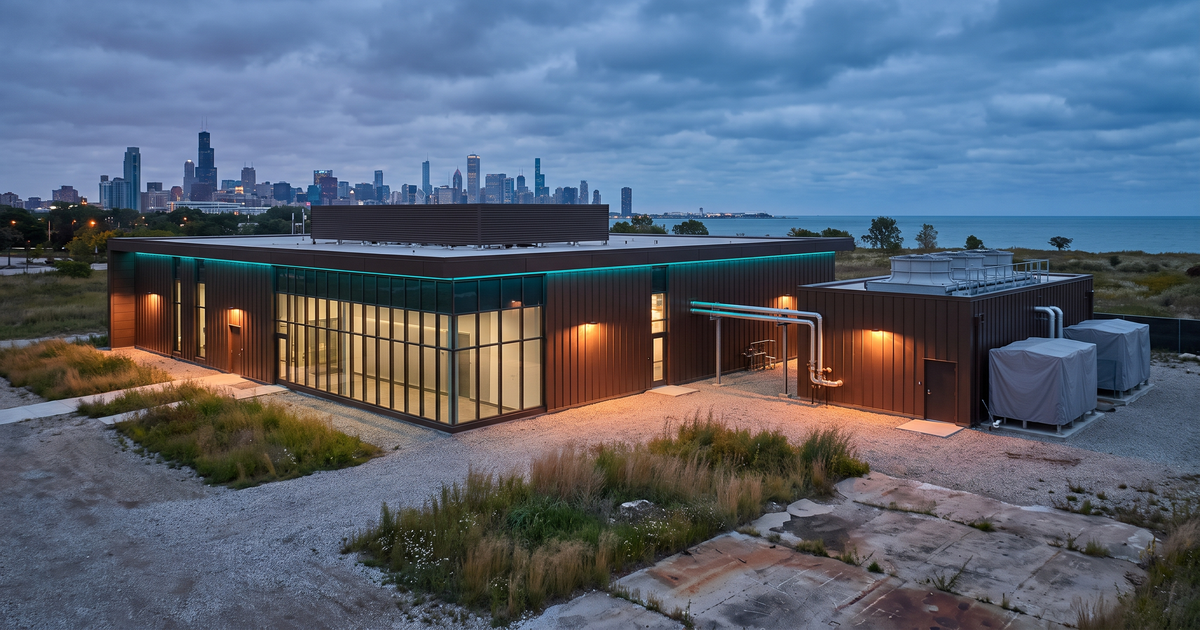
This is not yet the full utility-scale quantum computer described in long-range campus announcements. Lamar Johnson Collaborative identifies this 80,700-square-foot Phase 1 development building as a testing and validation environment for PsiQuantum technology ahead of the primary production facility. Its program includes a quantum computing hall, a stand-alone cryoplant, offices, support spaces, and exterior equipment pads.
That distinction matters for estimating. The building is more specialized than an ordinary office or warehouse, but its current permit package does not expose a complete tenant technology bill of materials. The public record supports a technically dense research and validation facility. It does not support claims about rack count, qubit count, final production capacity, or a specific structured-cabling, security, AV, or DAS contract award.
The broader setting is still material. Clayco describes the Illinois Quantum and Microelectronics Park as a 128-acre first phase within a 440-acre Quantum Shore master plan. PsiQuantum is an anchor tenant, while Related Midwest and CRG are co-developing the park. That puts this building at the front edge of a multi-tenant technical district rather than on an isolated industrial parcel.
Key Players
The active City of Chicago permits and project-team pages provide a unusually clear delivery chain. They do not, however, disclose a specialty low-voltage subcontractor or separate award values for the seven systems mapped by Signal.
| Role | Company | Source-Backed Detail |
|---|---|---|
| Tenant / Client | PsiQuantum | Anchor tenant and client for the Phase 1 development building; the company says construction has started at its Chicago site. |
| Developers | Related Midwest and CRG | Co-developers of Quantum Shore and the Illinois Quantum and Microelectronics Park first phase. |
| General Contractor | Clayco | Named as general contractor on the active city permit and by the project team. |
| Lead Designer | Lamar Johnson Collaborative | Lead designer for Phase 1; its project page defines the beta building's testing and validation mission. |
| Electrical Contractor | Gurtz Electric Company | Named as electrical contractor on the base, buildout, revision, and cryoplant permits. |
For LV contractors, Gurtz Electric is the most immediate package-interface relationship in the public record. Pathways, power supplies, fire-alarm interfaces, grounding, equipment-room coordination, and turnover documentation commonly cross the electrical and technology scopes. That does not prove Gurtz holds every LV package; it identifies the firm already named on the permits where those boundaries will be coordinated.
Low Voltage Systems Breakdown
Signal maps seven likely LV categories from the facility type and permit context. These are opportunity-planning categories, not a published subcontract schedule. Every bidder should confirm the issued drawings, specifications, division ownership, and owner-furnished equipment before carrying the scope.
| System | Category | Likely Facility Requirement | Complexity |
|---|---|---|---|
| Structured Cabling | Data / Voice | High-density copper and fiber connectivity for offices, validation spaces, controls, support rooms, and resilient equipment networks. Separation between enterprise, research, facilities, and vendor networks will drive pathway and labeling discipline. | High |
| Fiber Optic | Backbone | Diverse backbones between the development building, cryoplant interfaces, campus infrastructure, and outside carriers. Testing records, splice plans, loss budgets, and migration sequencing are likely to matter as much as strand count. | High |
| Access Control | Security | Credentialed zones around research, equipment, operations, loading, and support spaces, coordinated with life safety and door hardware. The design may require layered permissions and audit-ready event records. | High |
| CCTV / Video Surveillance | Security | Coverage of perimeter, entries, equipment areas, loading, circulation, and critical interior zones with resilient PoE switching, storage, and security-network coordination. | High |
| Fire Alarm | Life Safety | Detection, notification, monitoring, and interfaces with suppression, mechanical shutdown, process equipment, and the adjacent cryogenic program. Cause-and-effect testing will require disciplined multi-trade coordination. | High |
| Audio / Visual | Collaboration | Meeting, operations, training, and technical-review spaces may need secure presentation, conferencing, control, and room scheduling rather than generic display installation. | Medium |
| Distributed Antenna System | Wireless | Public-safety and commercial cellular coverage should be validated against the final building materials, equipment density, and local requirements. A survey and authority review must precede any final design assumption. | High |
The uncommon risk is integration, not device count. Process cooling, the cryoplant, building automation, research equipment, power monitoring, life safety, and cybersecurity all create interface points that can be missed when each trade prices only its own drawings. Contractors should build an interface matrix early, identify who supplies gateways and network drops, define control and alarm handoffs, and assign end-to-end test ownership before equipment submittals are approved.
Estimated Low Voltage Value
No public source reviewed for this spotlight discloses an awarded LV contract. The estimate below is a planning benchmark, not a bid price. It applies the 6% midpoint used for research-laboratory construction to the $100 million base-building permit, then applies a 1.25 complexity multiplier for seven mapped systems.
| Base-Building Permit | $100 million |
| Research Facility LV Benchmark | 6% |
| Seven-System Complexity Multiplier | 1.25x |
| Estimated Facility-Wide LV Planning Value | $7.5 million |
The $7.5 million figure is intentionally tied to the base building. The separate $30 million cryoplant permit is excluded because a large share of that scope is process and mechanical work, while the $5.645 million revision is excluded to avoid assuming that its reported value is additive to the original permit. If issued documents put specialty controls, fire alarm, security, communications, or instrumentation inside those packages, the addressable LV value could change materially.
This scale is large enough for package separation. Structured cabling and fiber could be procured together while security, fire alarm, AV, DAS, controls integration, and commissioning move through different vendors or tiers. The winning position may belong less to the lowest unit-price installer and more to the firm that can document interfaces, control change, protect testing windows, and produce owner-ready closeout records.
Skills and Certifications Required
| Discipline | Useful Credentials | Critical Skills |
|---|---|---|
| Copper and Fiber | BICSI INSTC, INSTF, TECH, and RCDD oversight | Cat6A termination, fusion splicing, OTDR and OLTS testing, loss-budget management, labeling, and as-builts |
| Fire Alarm | NICET Fire Alarm Level II or higher plus applicable contractor licensing | NFPA 72 execution, interface matrices, sequence testing, suppression and HVAC coordination, and AHJ turnover |
| Electronic Security | Manufacturer credentials for the selected access-control and VMS platforms; PSP-level design leadership where applicable | Door hardware coordination, PoE networking, identity integration, camera design, storage calculation, and audit trails |
| Audio / Visual | AVIXA CTS, CTS-I, or CTS-D | Secure conferencing, AV-over-IP, DSP, control programming, commissioning, and user acceptance |
| DAS / RF | RF design experience, BICSI RCDD, and carrier or OEM training | Predictive modeling, benchmark surveys, antenna placement, public-safety coordination, fiber transport, and acceptance testing |
Entry-level technicians can contribute to pathway preparation, cable placement, labeling, device rough-in, and supervised termination. Mid-level technicians should own testing, troubleshooting, rack work, device commissioning, and record quality. Senior staff will need to manage design review, cybersecurity boundaries, multi-system integration, owner witness tests, and the handoff between base-building infrastructure and PsiQuantum's specialized equipment.
Contractors should verify current Illinois and Chicago licensing, registration, permitting, and supervision requirements for every discipline they intend to self-perform. The active permits already name an electrical contractor, so proposed LV scopes should be qualified against that contractor's work and the final division assignments rather than priced from the Signal system list alone.
Market Signal
This building converts Chicago's former South Works industrial site into a new technical-infrastructure market. The public story is quantum computing, but the contractor story is repeatable integration: secure networks, fiber, life safety, AV, RF coverage, controls, process systems, and rigorous commissioning delivered inside one highly technical facility. Those capabilities transfer to semiconductor, advanced manufacturing, laboratory, and mission-critical projects across the region.
The immediate pursuit is no longer a speculative greenfield announcement. Active permits name the GC and electrical contractor, the project team reports construction activity, and the first building has a defined mission. That shifts outreach from asking whether the project will happen to identifying which specialty packages remain unawarded, who owns each interface, and when design releases and procurement milestones occur.
There is also portfolio leverage. Clayco, LJC, Related Midwest, CRG, and Gurtz Electric are participating in a campus intended to support multiple technical tenants. A contractor that performs well on documentation, testing, and turnover in the first building can use that record when later Quantum Shore buildings or adjacent research facilities reach procurement. The key is to treat the beta building as its own source-backed scope, not as proof that every future campus phase is already funded or awarded.
Find Projects Like This on Signal
LVN Signal tracks thousands of construction projects with low-voltage opportunities across the country. Filter by city, system type, and project value to find your next bid.
Join 35,000+ Low Voltage Pros
Get weekly permit updates, tool deals, job opportunities, and industry news. No spam, unsubscribe anytime.