
Join Low Voltage Nation — Find project opportunities and showcase your company to thousands of industry professionals
Verrus filed a 600,000-square-foot Phase 1 data center in Salem with more than $5 billion in projected investment, a future PGE substation, and major delivery packages still undisclosed.
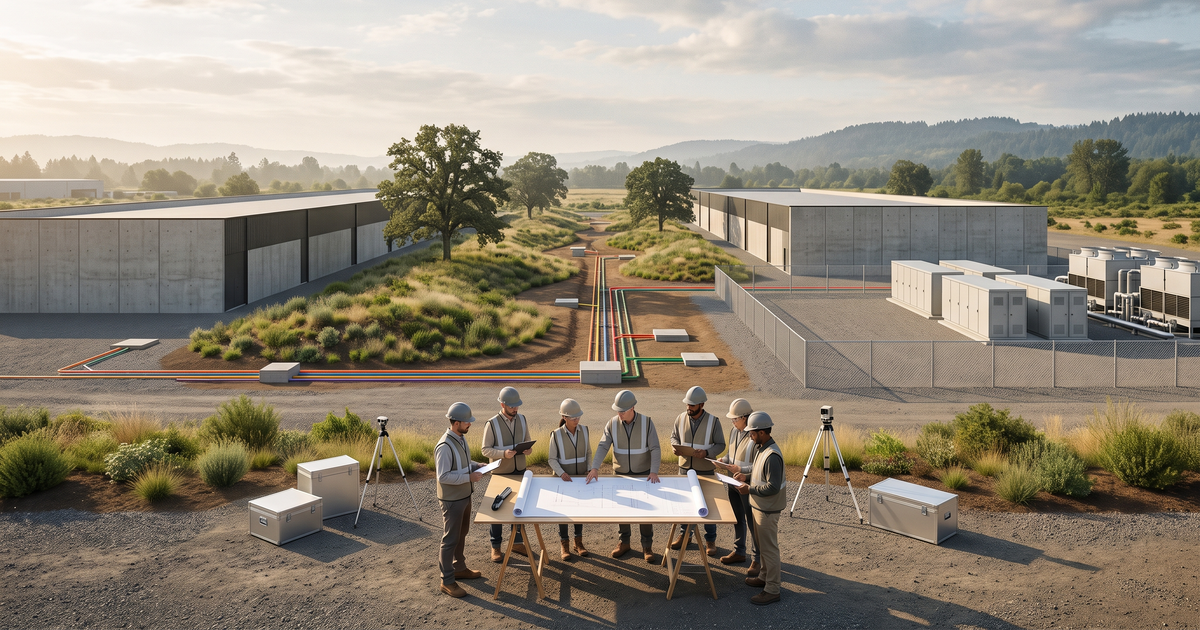
Verrus has moved Oakline at Mill Creek from a public concept into Salem's land-use review, creating an unusually early look at a proposed AI and cloud data-center campus before the construction team is public. The current filing covers two one-story Phase 1 buildings with a combined 600,000-square-foot footprint, equipment yards, parking, and a replat for a future utility substation. The City of Salem permit portal lists application 26 115385 00 PLN as received. Salem's August 28 update says the application is incomplete, so this is still a planning-stage opportunity rather than an approved or active construction project.
The scale is already meaningful for Low Voltage Nation readers. Salem describes more than $5 billion of projected investment and 75 permanent jobs. Verrus forecasts more than 1,000 local construction jobs across multiple trades and years. Those are planning estimates. They are not executed contract value, spend to date, current headcount, released bid packages, or open positions.
Oakline at Mill Creek project snapshot
| Item | Current public record |
|---|---|
| Location | 4720 Mill Creek Drive SE and related Waln Subdivision lots in Salem, Oregon |
| Filed Phase 1 | Two one-story data-center buildings; 600,000 square feet combined |
| Future phase | A third building is described by Verrus but is outside the current two-building filing |
| Current stage | Land-use application received; completeness review remains open |
| Investment | More than $5 billion projected by the City; executed construction value is undisclosed |
| Workforce | More than 1,000 projected local construction jobs; 75 projected permanent jobs |
| Power | Future PGE-owned substation parcel proposed; project MW and energization schedule undisclosed |
| Delivery team | Developer and applicant are known; prime, design, electrical, low-voltage, and commissioning teams are undisclosed |
The filed project is two buildings, not three
That distinction matters. The applicant's land-use narrative describes two Phase 1 buildings at about 300,000 square feet each on Lots 1, 2, and 4 of the Waln Subdivision. The narrative says those lots total approximately 100.2 acres. It also calls for equipment yards, parking, secured site infrastructure, and a separate parcel for a future substation.
The Oakline project page describes the long-range campus as three buildings plus a utility substation serving cloud computing, artificial intelligence, and enterprise workloads. An August water-use supplement separates the current two-building Phase 1 from the future third-building Phase 2. The third building should therefore be treated as a later plan subject to its own review, not as part of the current approval request.
No project-specific critical IT load, utility megawatt request, reserved capacity, tenant lease, or ready-for-service date is public. Verrus discusses a generic 70 MW technology model elsewhere in its company materials, but that reference is not proof that Oakline is a 70 MW project. The correct capacity entry for this campus remains undisclosed.
Power planning can become its own construction program
The Phase 1 filing proposes a parcel intended for ownership and operation by Portland General Electric. The substation itself requires a separate land-use application before construction. That future filing could expose a second layer of work: utility duct banks, control and protection wiring, relay and SCADA communications, security, station fiber, grounding, metering interfaces, and commissioning coordination.
PGE's public large-load study process says new loads of 1 MW or greater require utility review. PGE is currently accepting cluster-study applications for Marion County, and larger requests can move through pre-feasibility, system-impact, and facilities-study steps before a service agreement. That is useful market context. It does not establish Oakline's requested load, current study step, deposit status, network upgrades, or energization commitment.
Verrus says Oakline is being designed for grid-responsive operation and will use lithium-iron-phosphate battery storage as primary backup. The developer also says the campus can reduce demand during grid stress. Until utility agreements and equipment schedules become public, the battery capacity, topology, UPS relationship, switchgear, protection scheme, and backup-generator design remain open facts. For contractors, those details will determine where electrical scope stops and controls, life safety, network, and commissioning scope begins.
Water design is specific, but still preliminary
Oakline is proposed around closed-loop cooling with software-controlled adiabatic assistance during the hottest conditions. Verrus' Phase 1 water-use supplement estimates about 13 million gallons in an average year and 23 million gallons in a maximum year. It also models an extreme maximum-day case of about 2.1 million gallons per day. For the future three-building campus, the applicant estimates roughly 19.4 million gallons in an average year, 34.4 million gallons in a maximum year, and about 3.1 million gallons on an extreme maximum day.
Those are applicant design estimates rather than measured consumption or final permit limits. They still point toward substantial instrumentation and integration work: flow and pressure monitoring, leak detection, pump and valve controls, cooling-system alarms, trending, metering, and the documentation required to prove performance during commissioning.
Named companies and confirmed roles
| Organization | Confirmed role | Evidence |
|---|---|---|
| Verrus LLC | Data-center developer and landlord | Project and company pages |
| Alderstone LLC | Project company and land-use applicant | Salem application |
| Portland General Electric | Serving utility; intended future substation owner/operator | Applicant narrative |
| SEDCOR | Community economic-development and workforce partner | Oakline and SEDCOR pages |
| Scannell Properties LLC | Current owner of cited subject property | City project page |
| Capstone Mill Creek Logistics LLC | Current owner of cited subject property | City project page |
| City of Salem | Land-use, building, utility, and site regulator | Municipal project page and permit portal |
Verrus is the named developer, with Alderstone acting as applicant. SEDCOR says it worked with Verrus and City staff during site-fit discussions, including early questions about water, power, zoning, and infrastructure. Public sources do not currently identify a data-center general contractor or construction manager, architect, civil engineer, structural engineer, building MEP engineer, electrical contractor, fiber carrier, specialty low-voltage integrator, major equipment supplier, or independent commissioning authority.
That absence should not be filled with assumptions. The current record supports outreach and monitoring around confirmed participants. It does not support attaching an unannounced contractor to a package.
Where the low-voltage work is likely to emerge
| System lane | Why it fits the filed plan | Evidence to watch |
|---|---|---|
| Campus fiber and OSP | Two large buildings, utility interfaces, and future expansion require diverse routes | Carrier, duct-bank, entrance-facility, and splicing awards |
| Structured cabling | AI and cloud halls require dense pathways, labeling, testing, and turnover records | Integrator, rack/row, pathway, and test packages |
| Access control and CCTV | Secured buildings, yards, gates, and critical equipment need layered protection | Security design, VMS, credential, and perimeter packages |
| Fire alarm and BESS life safety | Battery-first backup adds detection, suppression, monitoring, and interface work | Fire strategy, AHJ review, supplier, and special-inspection milestones |
| BAS, BMS, EPMS, and DCIM | Cooling, batteries, utility response, and facility loads require coordinated controls | Controls architecture, integration boundaries, and sequence packages |
| DAS and radio coverage | Large hardened buildings can create public-safety and carrier coverage challenges | AHJ criteria, design surveys, and carrier coordination |
| Grounding and bonding | Telecom spaces, pathways, racks, and electrical systems share strict QA interfaces | Electrical coordination, test plans, and closeout requirements |
| Commissioning | Grid response, batteries, cooling, life safety, and controls must work as one system | Commissioning authority, scripts, witness testing, and turnover schedule |
The strongest near-term signals will come from the complete land-use response, a future substation application, named design firms, and prime-contractor selection. Those events usually precede clearer package boundaries. Fiber and security teams should look for campus civil plans, entrance facilities, telecom room layouts, carrier diversity requirements, security narratives, and data-hall phasing. Fire-alarm and controls teams should look for the BESS code approach, mechanical sequences, point lists, network ownership, and required interfaces with the emergency power and utility systems.
Commissioning will matter early because Oakline's public claims depend on coordinated behavior. A grid-responsive campus with battery-first backup and water-efficient cooling has to validate normal modes, peak reduction, utility signals, battery transitions, alarm escalation, cooling response, and recovery. The eventual commissioning plan will reveal which integrators must participate in factory tests, functional tests, integrated systems testing, and turnover documentation.
Jobs, trades, and preparation
Verrus projects more than 1,000 local construction jobs and says interested workers and businesses can register through the Oakline website. The City projects 75 permanent positions once the campus is operational. UA Local 290 has posted an Oakline notice for members, showing active workforce awareness. The public notice does not establish a project labor agreement, mechanical award, dispatch call, or released bid package.
Technicians preparing for mission-critical work can build useful readiness now. Fiber crews benefit from clean inspection, termination, testing, loss-budget, labeling, and documentation discipline. FOA workforce resources and BICSI optical-fiber training provide structured paths. Cabling and systems technicians should also be ready for tray and pathway coordination, grounding and bonding, QA records, lift work, controlled-material handling, and daily planning around energized electrical work. OSHA outreach training is a useful safety baseline, although each prime will set its own site requirements and prequalification rules.
The state land action remains a site-control caveat
One issue deserves careful separation from the active Salem filing. On July 30, the Oregon governor's office announced that the state would terminate a contract to sell approximately 32 acres at Mill Creek Corporate Center for a proposed data center. The Alderstone application was filed July 31 and remains listed by Salem as received and incomplete.
The public documents reviewed here do not fully reconcile the state parcel with the lots in the current application, the existing private-property owners, or the future Phase 2 footprint. The state action should therefore be treated as a material parcel and phasing question. It is not proof that Salem denied the current application, and it is not proof that every planned phase has secure site control.
Milestones that change the contracting picture
Several public events would move Oakline from early intelligence into executable construction work: a complete-response filing, the City's land-use decision and conditions, a reconciled parcel plan, the future PGE substation application, project-specific power-study and service milestones, building-permit filings, and a named prime and design team. After that, the useful package signals are electrical one-lines, telecom and security narratives, BESS fire strategy, carrier routes, controls architecture, equipment schedules, commissioning specifications, subcontractor prequalification, and procurement notices.
For now, Oakline is a high-confidence project with incomplete entitlements and a large amount of delivery detail still open. Follow the project in LVN Signal for company links, permit changes, contractor announcements, low-voltage packages, workforce signals, and the field milestones that convert a proposed campus into real bid and hiring activity.
Join 35,000+ Low Voltage Pros
Get weekly permit updates, tool deals, job opportunities, and industry news. No spam, unsubscribe anytime.