
Join Low Voltage Nation — Find project opportunities and showcase your company to thousands of industry professionals
Vantage Lighthouse in Port Washington is a $15B+ AI data-center campus with 902 MW of critical IT load, named general-contractor evidence, and major low-voltage package signals still ahead.
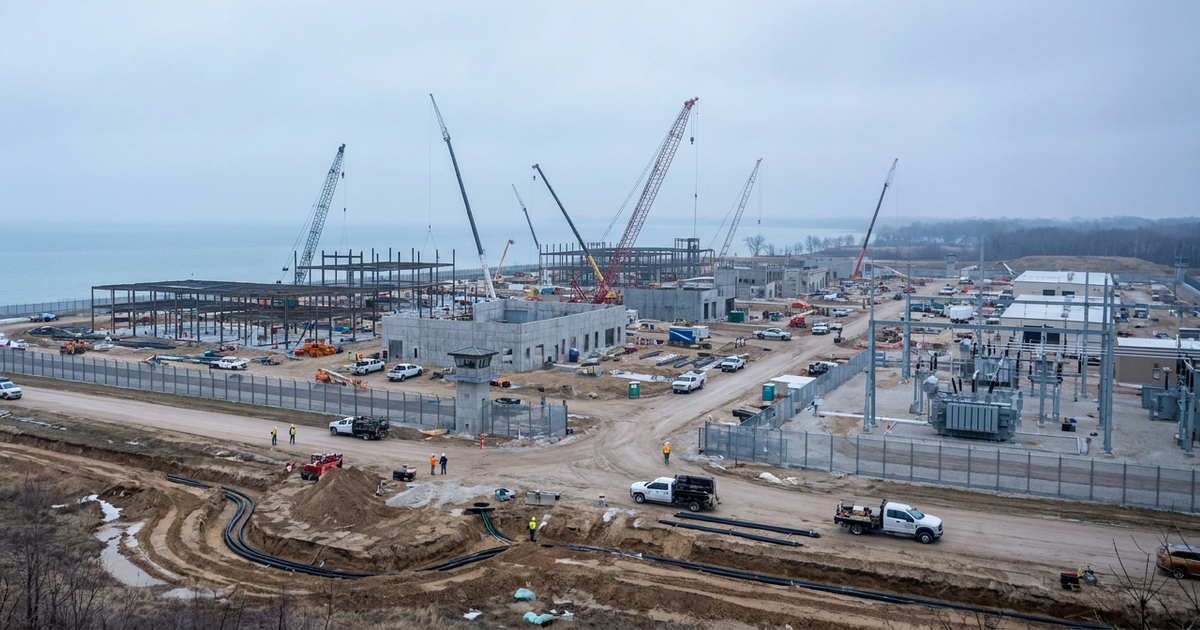
Vantage Data Centers' Lighthouse campus in Port Washington, Wisconsin is now one of the clearest public examples of how AI demand is turning data-center construction into a combined power, fiber, security, controls, and workforce story. The owner/operator's official campus page describes a 672-acre, four-building campus totaling 902 MW of critical IT load and 2.5 million square feet, scheduled for completion in 2028. That makes Lighthouse larger than a normal local real-estate announcement. It is a multi-year construction platform with enough scale to matter for electrical contractors, low-voltage integrators, fiber providers, controls teams, commissioning firms, safety managers, and workforce programs across Wisconsin and the upper Midwest.
The project is also tied directly to the Stargate AI infrastructure buildout. In its announcement with OpenAI and Oracle, Vantage said the Port Washington site will support Stargate capacity, carry more than $15 billion of investment, and create more than 4,000 construction jobs over three years. The dedicated Lighthouse community microsite adds local infrastructure commitments, permanent roles, customer jobs, and indirect job impact. For LVN readers, the point is straightforward: this is not just another AI headline. It is a live construction market that should generate long-running packages for pathways, OSP, fiber, physical security, life safety interfaces, BAS/BMS coordination, documentation, testing, and turnover.
| Project | Public Facts | Why It Matters |
|---|---|---|
| Campus scale | 672 acres, four data centers, 902 MW critical IT load, 2.5M sq ft. | Large enough to support multiple phases and specialty trade packages. |
| Schedule | Active construction with a 2028 completion target. | Creates a multi-year window for workforce, vendors, and subcontractors. |
| AI customer context | OpenAI and Oracle Stargate support is named by Vantage. | AI workloads raise density, cooling, security, and commissioning expectations. |
| Public review | Wisconsin DNR environmental review and city project pages are active. | Public records can expose utility, site, and construction milestones. |
What the public record confirms
The official Vantage campus page is the anchor source. It lists the Port Washington campus as Lighthouse, names the total acres, data-center count, critical IT load, square footage, and 2028 schedule. It also describes the campus features that matter directly to low-voltage and mission-critical contractors: multiple diverse fiber pathways, dark and lit fiber access, three meet-me-rooms per building, one point of entry per building, carrier-neutral connectivity, access control, CCTV, force-resistant perimeter security, security operations, visitor management, and biometric-reader use for critical areas.
The state and municipal layer matters because it gives contractors a second source of truth beyond marketing pages. The Wisconsin Department of Natural Resources project page confirms Vantage is developing the campus in Port Washington, Ozaukee County, on 672 acres about one mile inland from Lake Michigan. The DNR page also points to wetlands, stormwater, air, and transmission-related review, including a supplemental environmental analysis posted in June 2026. The City of Port Washington project page points residents to construction updates, project FAQs, DNR material, development agreement material, and a subcontractor or supplier database path.
On the construction side, the named general-contractor evidence is stronger than it is for many early AI-campus stories. Orascom Construction's Weitz update says The Weitz Company is one of the general contractors on the Lighthouse campus and documents the site groundbreaking. A public OSHA Project Lighthouse strategic partnership agreement names Vantage Data Centers and general-contractor entities including The Weitz Company, Turner McCarthy Joint Venture, and The Whiting-Turner Contracting Company. Turner Construction's public social post says the Turner McCarthy JV is general contractor for Phase 2 buildings 13 and 14, a 468 MW portion supporting Oracle and OpenAI Stargate.
| Company | Source-Backed Role | Evidence |
|---|---|---|
| Vantage Data Centers | Owner/operator/developer | Campus page |
| Oracle / OpenAI | Stargate customer context | Vantage announcement |
| The Weitz Company | General contractor entity | Orascom / Weitz update |
| Turner McCarthy JV | Phase 2 general contractor | Turner public post |
| Whiting-Turner | General-contractor entity in safety partnership | OSHA agreement |
| We Energies | Utility context | Vantage campus page |
Where low voltage shows up
The public sources do not yet name separate electrical, low-voltage, fiber/OSP, structured-cabling, security, fire-alarm, BAS/BMS, DAS, networking, grounding, or commissioning subcontractors. That is important. The right move is to keep named contractors source-backed and watch for package-level evidence as the campus advances. Still, the owner-published campus features make the low-voltage opportunity concrete. Three MMRs per building, a point of entry per building, multiple fiber pathways, carrier neutrality, dense AI power, closed-loop cooling, strong physical security, and a multi-year construction schedule all point toward large packages that require clean design coordination and careful field documentation.
| Scope | Why It Is Likely | Watch For |
|---|---|---|
| Fiber / OSP | Vantage lists diverse fiber pathways, dark/lit fiber, MMRs, and POEs. | Carrier routes, vaults, entrances, OSP permits, and fiber testing jobs. |
| Structured cabling | Four data centers and high-density AI halls require disciplined pathways. | Cable tray, labeling, test records, MMR/IDF work, and QA requirements. |
| Access control / CCTV | Vantage lists perimeter security, CCTV, visitor management, and biometric access. | Security integrator awards, device schedules, VMS, and commissioning. |
| Fire alarm / life safety | Large mission-critical buildings need AHJ-driven life-safety coordination. | FA contractor permits, inspections, suppression interfaces, and monitoring. |
| BAS/BMS / networking | AI cooling and facility systems require controls, alarms, and IT/OT coordination. | Controls integrator jobs, trend logs, network segmentation, and turnover docs. |
| Grounding / bonding | Telecom spaces, racks, pathways, and equipment rooms need clean bonding discipline. | Telecom grounding specs, QA punch lists, and commissioning records. |
There is also a useful contractor-readiness lesson in how the record is developing. The public sources name the owner, major customers, multiple general-contractor entities, utility context, environmental review, and safety partnership before they name every specialty trade. That is common on very large data-center campuses. The first public wave usually establishes the land, owner, public approvals, economic impact, power and water commitments, and general construction leadership. The second wave is where subcontractor, integrator, commissioning, staffing, and inspection evidence becomes more visible. Contractors who wait for a perfect bid announcement often enter the map late. Contractors who track owner pages, municipal records, OSHA partnerships, contractor updates, and job postings can understand the opportunity while the package map is still forming.
Lighthouse is especially relevant for low-voltage contractors because the Vantage campus specifications are unusually direct about the systems that touch their work. The campus page does not merely say the facility will be connected. It describes diverse fiber pathways into the campus, dark and lit fiber access, multiple carrier options, three meet-me-rooms per building, and one point-of-entry per building. It does not merely say the site will be secure. It lists perimeter gates and fencing, CCTV on access-control points, visitor management, badging, patrols, security operations, and biometric readers in customer and critical infrastructure areas. Those details matter because they turn a broad AI story into concrete scopes that require design coordination, device layout, pathway planning, labeling, testing, cybersecurity awareness, and closeout discipline.
The power and cooling context also raises the bar for supporting systems. Vantage says the campus will use We Energies power, multiple diverse power feeds, an on-site substation, N+1 redundancy, liquid-to-liquid cooling, and a closed-loop chilled-water design with near-zero water utilization. Those are not low-voltage packages by themselves, but they shape the low-voltage environment. Security networks, controls networks, monitoring points, alarm pathways, communications rooms, cable trays, bonding, and commissioning documentation all have to fit around high-density electrical and mechanical systems. On AI campuses, sloppy labeling, weak test records, or poor pathway coordination can become an expensive problem quickly.
Jobs, safety, and skills
The workforce signal is unusually explicit. Vantage's announcement and Lighthouse project site describe more than 4,000 skilled construction jobs over three years, more than 300 permanent Vantage roles, hundreds of customer roles, and broader indirect job impact. The OSHA strategic partnership is another useful clue: the site is large enough and complex enough to merit formal safety coordination among Vantage, OSHA, and named general-contractor entities. That means low-voltage and technology subcontractors should assume strict onboarding, documentation, PPE, lift, access, and QA expectations. Good field labor will matter, but documentation discipline will matter just as much.
For technicians trying to move into this market, the skill stack is practical rather than mysterious. Fiber techs need cleaning, inspection, loss testing, labeling, and closeout discipline. Structured-cabling teams need pathway coordination and standards-based installation habits. Security teams need access-control, camera, visitor-management, and commissioning experience. Controls teams need BAS/BMS integration literacy and the ability to work around mechanical, electrical, and IT/OT boundaries. Across all of it, BICSI fiber training, BICSI copper training, FOA workforce resources, and OSHA outreach training are credible preparation paths for contractors who want to compete on data-center sites.
What to watch from here
The next useful public signals are package-specific. Watch Vantage and the Lighthouse project site for construction updates, the City of Port Washington and Wisconsin DNR for permitting and environmental movement, OSHA partnership records for safety milestones, We Energies and Wisconsin utility records for service and transmission work, and the named general contractors for plan-room, prequalification, and subcontractor outreach. Watch the aliases too: Vantage Lighthouse, Project Lighthouse, Stargate Wisconsin, Port Washington Data Center, Ozaukee County data center, buildings 13 and 14, Weitz Lighthouse, Turner McCarthy JV, and Whiting-Turner Project Lighthouse.
For LVN Signal users, this is the kind of project worth following before the specialty trades are all named. The owner, customers, public agencies, and general-contractor entities are now source-backed. The low-voltage package names are still mostly ahead of the public record. That gap is the opportunity: track the evidence early, build the company map, and be ready when the fiber, security, controls, life-safety, networking, and commissioning work becomes visible.
Join 35,000+ Low Voltage Pros
Get weekly permit updates, tool deals, job opportunities, and industry news. No spam, unsubscribe anytime.