
Join Low Voltage Nation — Find project opportunities and showcase your company to thousands of industry professionals
TerraWatt proposes a 200 MW first block at the former Alton Steel property. The $2.64B investment forecast remains conditional, with city applications and utility service still ahead.
TerraWatt is proposing a 200 MW first block at the former Alton Steel property in Alton, Illinois. Riverbend Technology Center would put new data-center buildings on a 381-acre industrial site. The developer's investment forecast is $2.64 billion per block, giving contractors a substantial project to follow while land, utility and approval conditions remain unresolved.
As of October 25, the City of Alton's public notice says it has received no formal permit or rezoning application. That is the clearest guide to the project's present stage. Riverbend is a documented development proposal; a construction start, signed tenant lease and specialty trade awards have not been verified.
What is proposed at Cut Street
TerraWatt's October 21 announcement identifies 5 Cut Street and a contingent purchase agreement with Alton Steel Inc. Closing is targeted for 2027, subject to local land-use action, Ameren Illinois' study and due diligence. The seller retains ownership until closing. Existing mill buildings would be removed before the new development.
| Item | Reported scope | Current boundary |
|---|---|---|
| Location | 5 Cut Street, Alton | 381-acre mill property |
| First block | 200 MW building power | Proposed; IT load unknown |
| Expansion | Up to five blocks / 1 GW | Depends on utility service |
| Investment | $2.64B per block | Developer forecast |
| Demolition | 1.26M square feet | Existing mill structures |
| Local review | Application still pending | Per city notice |
The floor-area distinction matters when comparing this proposal with other projects. The 1.26 million square feet describes mill space to be cleared. Public material reviewed for this report does not establish the new data-center floor area. Estimating cabling quantities from that demolition number would start an estimate with the wrong building scope.
Understanding the power and investment numbers
The developer's project page describes 200 MW as the building's power use. Additional blocks, to a maximum of five, depend on Ameren confirming service. Published material does not disclose critical IT capacity or currently energized data-center load. It also does not establish a signed AI customer or a particular computing workload.
For suppliers, the useful next distinction is between the utility connection, the facility's electrical demand and the equipment installed by a tenant. Those boundaries affect who buys infrastructure, when designs become available and which contracts contain network or monitoring work. A campus-scale power headline alone supplies none of those procurement answers.
The community impact summary assigns $2.64 billion of investment to a 200 MW block. A funded construction budget and the allocation among buildings, equipment, land and other costs remain unverified. Multiplying this forecast by five would describe a hypothetical scenario, not a committed campus investment. LVN is leaving a low-voltage dollar estimate open until the scope and spending basis can support one.
The named organizations and the missing delivery team
The announcement identifies TerraWatt as the proposed developer and buyer, Alton Steel as the seller, and Steadfast City as the community-engagement lead. The developer's FAQ describes prospective utility connections. These relationships provide starting points for further reporting, with different responsibilities attached to each organization.
| Organization | Source-backed role | Qualification |
|---|---|---|
| TerraWatt | Proposed developer / buyer | Acquisition conditional |
| Alton Steel Inc. | Landowner / seller | Per developer release |
| Ameren Illinois | Prospective power utility | Service study pending |
| Steadfast City | Community engagement | Construction role unverified |
| Illinois American Water | Prospective water utility | Per developer FAQ |
| Construction team | GC and specialty trades | Awards unverified |
No general contractor, architect, MEP designer, demolition contractor or electrical and low-voltage installer was identified in the reviewed primary material. A consultant managing community discussions should not be treated as the party buying construction packages. Similarly, a named utility does not establish that utility's approval of the developer's schedule or capacity.
When procurement information appears, contractors should identify the legal entity issuing each package and the limits of its responsibility. Developer infrastructure, tenant fit-out, carrier entrances and utility-owned work can involve separate buyers. A documented introduction to the appropriate estimator or procurement contact will be more useful than a broad assumption about who controls the entire site.
Approvals and site preparation set the sequence
Alton says it plans to obtain independent civil-engineering, planning and environmental support. A submitted application with a detailed site plan would go through Plan Commission and City Council. Meeting dates depend on submission. The October 27 event at The Wedge, from 6 to 7:30 p.m. Central, is a developer open house; the city has not identified it as an approval vote.
TerraWatt's October 21 FAQ gives conditional targets: demolition and site work in 2027, first-block construction from late 2027 into early 2029, and possible full operation by 2031. It also states that no tenant lease has been signed. The release says TerraWatt would pay for demolition and regulated-material removal.
For an installer, those milestones are different planning events. Access to a former industrial property, safe work areas, permanent pathways and permission to install tenant equipment will not necessarily arrive together. Early coordination should establish which drawings are suitable for pricing, what temporary services are needed and who carries responsibility for existing buried infrastructure.
Public commitments about cooling, noise, emissions and utility costs still need project-specific engineering and permit support. The impact summary bases its neighborhood-noise comparison on another Illinois facility. That limits its usefulness as evidence of Riverbend's final performance. Procurement teams should ask for the applicable design criteria, approved equipment and acceptance requirements as those documents emerge.
Where low voltage could enter the project
The following is LVN's prospective trade analysis. The developer describes data transmission over fiber and a secure computing facility, but published installation drawings, quantities, vendors and bid packages were not available. Treat these systems as questions for design and procurement, with each opportunity contingent on the project advancing.
| System | Potential work | Evidence needed |
|---|---|---|
| Fiber / outside plant | Entrances, ducts, splicing | Carrier routes and ownership |
| Structured cabling | Support networks and labels | Tenant design and quantities |
| Access / CCTV | Doors, gates and surveillance | Security design and buyer |
| Fire alarm | Detection and interfaces | Approved life-safety scope |
| BMS / power monitoring | Networks and integration | Point lists and trade split |
| Commissioning | Testing and turnover records | Acceptance plan and authority |
Fiber contractors should ask where carrier responsibility ends, whether entrances are physically diverse and who supplies ducts, vaults, cable and termination hardware. On a redevelopment site, route planning also needs verified existing conditions. An early civil drawing without final carrier coordination is a starting point for discussion, not a complete fiber installation package.
Security and controls teams face a different set of interfaces. A camera location requires pathways, power, network capacity and an agreed operating platform. A monitoring point requires an owner, a communications method and a tested sequence. Clarifying those interfaces during design helps define a complete proposal and prevents essential integration work from falling between packages.
Acceptance documentation deserves attention before mobilization. Ask who approves test procedures, receives results and signs off on deficiencies. Cable identification, test-file naming, equipment records and as-built drawings should follow the buyer's requirements. These are practical preparation topics; Riverbend's actual turnover specification has not been disclosed.
Jobs forecasts and useful skills
The impact summary projects 4,846 construction jobs over two years and cites economic multipliers. The FAQ and announcement describe approximately 4,500. The summary also distinguishes 50 direct permanent jobs per block from 125 including indirect and induced employment. These figures do not establish peak onsite headcount, unique hires or current vacancies. Executed labor agreements and signatories remain unverified.
For technicians assessing a future opportunity, a useful preparation package is evidence of work they can perform: clean fiber inspection results, organized test records, readable labels and accurate drawings. The Fiber Optic Association's workforce resources provide a starting point for fiber training. BICSI offers information on ICT education and credentials. Neither link establishes a Riverbend hiring requirement.
Site safety and access requirements should come from the eventual employer and controlling contractor. OSHA's Outreach Training information is a general resource to discuss with an employer; a training card alone does not describe every task-specific or site-specific requirement. For this project, approved access arrangements, onboarding, lift use and work near existing industrial hazards need confirmation before crews are assigned.
The practical commercial question is when preparation becomes actionable demand. Contractors can organize capability statements around fiber, security, controls or commissioning now. Quoting a package, reserving labor or purchasing long-lead material calls for a named buyer, an issued scope and a credible schedule. That separation helps small firms avoid carrying costs on an announcement-stage project.
What would move Riverbend forward
The next useful evidence is a filed site plan and scheduled review, followed by utility service documentation, acquisition closing and environmental requirements. A named delivery team and an executed tenant agreement would make the construction and fit-out picture clearer. Issued packages would then establish the opportunity for individual trades.
Fiscal projections also need clarification. The project page labels $17.2 million as first-full-year property tax, while the announcement describes a ten-year annual average. The impact summary contains additional first-year and ten-year totals. Without the underlying model, these presentations should retain their source qualifications. They are not a basis for inferring a construction award or project funding.
Riverbend offers a useful early view of a proposed industrial redevelopment with a named site and developer. The value for low-voltage businesses lies in following its progression from proposal to defined scope. Read the linked primary documents, verify who is buying the work, and use LVN Signal to find and follow construction opportunities as the evidence develops.
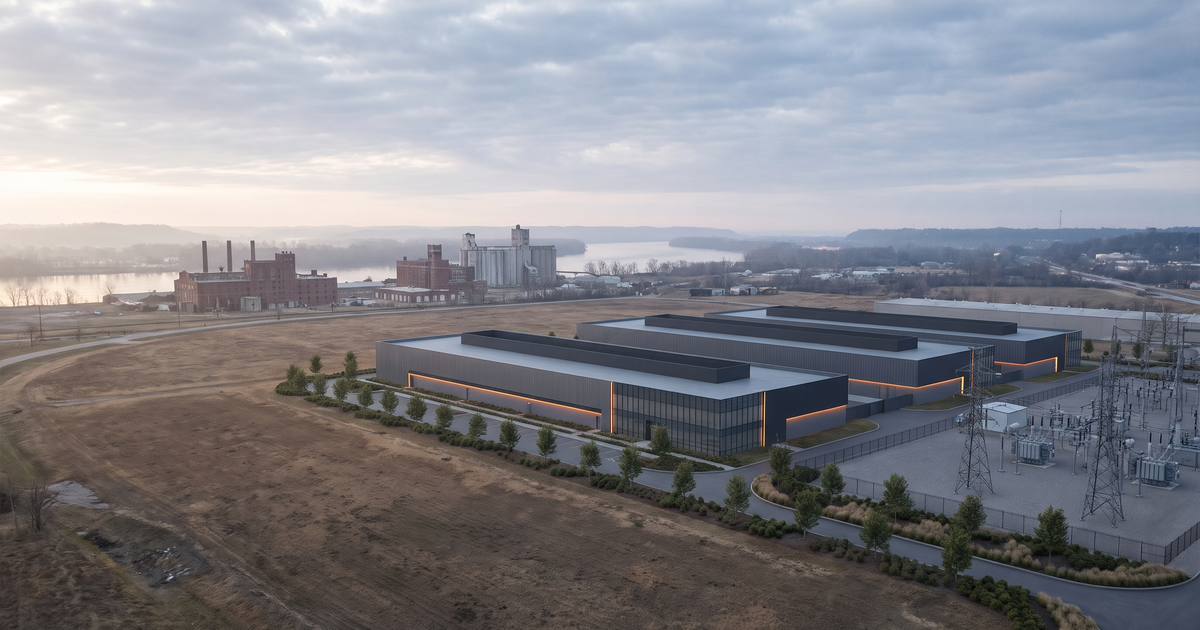
Reporting checked October 25, 2026. Featured and social artwork are AI-generated concept illustrations. They do not depict an approved Riverbend design or current construction progress.
Join 35,000+ Low Voltage Pros
Get weekly permit updates, tool deals, job opportunities, and industry news. No spam, unsubscribe anytime.