
Join Low Voltage Nation — Find project opportunities and showcase your company to thousands of industry professionals
Grayslake issued T5 Chicago IV's first building permit for an 800,000-square-foot data-center facility, opening the next watch window for power, fiber, security, controls and commissioning work.
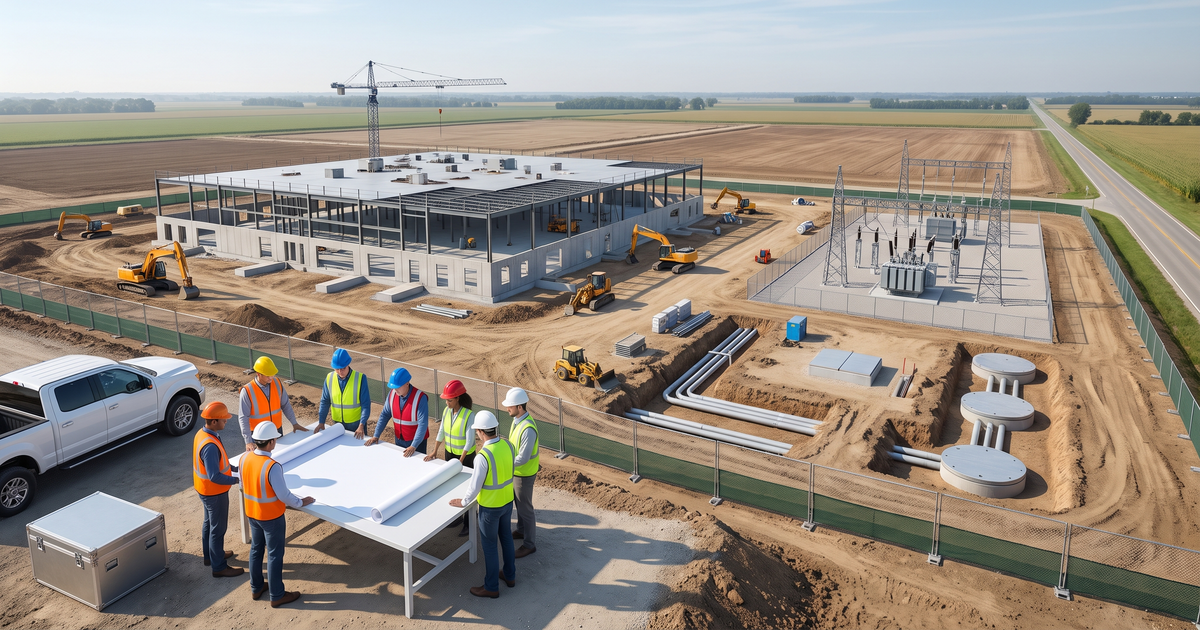
The first vertical phase of T5@Chicago IV has crossed a concrete threshold in Grayslake, Illinois. The Village of Grayslake issued the first building permit on September 1, 2026, for an 800,000-square-foot data-center facility at Peterson Road and Alleghany Road. Village officials said site work could begin immediately.
That permit moves one building into active construction, while the larger campus remains a multi-phase program. The Village's current plan covers 11 buildings, 6.75 million square feet and 473 acres over seven to ten years. The first permit does not disclose the building's critical IT load, tenant, permit valuation, design team, general contractor or specialty-trade awards.
For low-voltage contractors, manufacturers and technicians, the useful signal is the shift from campus approvals to a permitted facility. Building permits, on-site substation work, phased utility delivery and an 800,000-square-foot shell create a much more specific watch window for fiber, pathways, security, fire alarm, controls, monitoring and commissioning packages.
Project snapshot
| Item | Current fact | What remains open |
|---|---|---|
| First building | 800,000 square feet; permit issued September 1 | Permit number, value and plan set |
| Current campus plan | 11 buildings; 6.75 million square feet; 473 acres | Final phasing and individual building allocations |
| Construction stage | Site work authorized to begin immediately | Foundation, structure and trade mobilization dates |
| Power | ComEd agreements and developer-funded substation | First-building MW and energization schedule |
| Investment | $18 billion estimated for the full campus | First-building contract and committed spend |
| Workforce | 750-1,000 construction jobs per year forecast | Current openings and awarded subcontractors |
What the permit establishes
Independent local coverage confirms that Grayslake issued the initial building permit for the first facility inside the Cornerstone development. The announcement describes an 800,000-square-foot building and immediate site work. It also quotes T5 chairman and CEO Pete Marin calling the permit an important milestone.
The permit matters because the public record had previously centered on land assembly, zoning, site planning and early grading. A building permit gives the market a specific facility to track through excavation, foundations, shell construction, electrical infrastructure, fit-out and commissioning. It does not mean every planned campus building is under construction.
The Village's August 25 project packet is the best current source for the full-campus planning case. It describes 11 buildings totaling 6.75 million square feet across 473 acres. That is a revised plan and replaces the older 10.1-million-square-foot envelope as the current municipal description. The Village expects the development to unfold over seven to ten years.
The campus scale should therefore be read in layers: one permitted 800,000-square-foot facility, an 11-building current municipal plan, and a long-term construction program. Package timing will follow those layers. Contractors should verify the building, phase and issuing authority before treating any solicitation as Chicago IV work.
Power and capacity require careful labels
T5's original May 2024 announcement described a 160-acre campus with 480 MW of critical IT capacity and an initial 60 MW target in the fourth quarter of 2027. T5 also highlighted an on-site substation and the option to combine its development, construction and operations services.
The land and power plan later expanded. Data Center Dynamics reported direct T5 statements describing capacity for 1.2 GW of IT load and 1.6 GW of secured utility power, with three 60 MW Phase 1 buildings targeted for the fourth quarter of 2027.
Those figures describe different parts and versions of the development. The current municipal packet expresses the campus in buildings, acreage and square footage. The first building permit does not assign a critical-load figure to the 800,000-square-foot facility. Until T5, ComEd or a permit record publishes that allocation, 480 MW, 1.2 GW and 1.6 GW should not be mapped onto the first building.
The Village says agreements with Commonwealth Edison are in place and the developer will fund the on-site substation and related electric infrastructure. Public sources do not yet identify the substation designer, high-voltage contractor, protection-and-controls team, service voltage, feeder configuration or first energization milestone. Those are practical indicators for when campus fiber, SCADA, EPMS and integrated testing scopes begin to surface.
Named organizations and contracting status
| Organization | Public role | Contracting read |
|---|---|---|
| T5 Data Centers | Owner, operator and campus developer | First-building delivery team is incomplete publicly |
| T5 Construction Services | Integrated data-center construction platform | Project-specific GC assignment is unconfirmed |
| Village of Grayslake | Land-use and building-permit authority | Permit details and inspections are key records |
| Commonwealth Edison | Serving electric utility | Interconnection and substation packages undisclosed |
| PJM Interconnection | Regional transmission organization | Regional grid context; no specialty award implied |
| CLCJAWA | Regional water supplier | Municipal packet says capacity is available |
T5 markets a licensed general-contracting platform with procurement, supplier management, QA/QC and commissioning capabilities. Its construction-services page shows that T5 can deliver this work. The reviewed sources do not expressly name T5 Construction Services, or an outside firm, as general contractor for the permitted Chicago IV building. That distinction matters for outreach and bid qualification.
The same evidence rule applies downstream. No reviewed source names the architect, civil engineer, structural engineer, MEP engineer, electrical contractor, fiber contractor, structured-cabling integrator, security integrator, fire-alarm contractor, controls integrator, DAS provider or independent commissioning authority. Those roles remain open research questions rather than implied awards.
Where low voltage will show up
| System lane | Likely facility need | Public signal to watch |
|---|---|---|
| OSP and fiber | Diverse campus entrances, duct banks, vaults and backbone | Civil packages, carrier notices and route permits |
| Structured cabling | Pathways, support cabling, labeling and test records | Data-hall fit-out and integrator awards |
| Physical security | Perimeter, gates, access control, CCTV and visitor flow | Security-design and technology packages |
| Fire and life safety | Detection, monitoring, interfaces and acceptance tests | AHJ reviews and fire-alarm contractor filings |
| BAS, BMS and EPMS | Cooling, power, alarms, trending and OT networks | Controls, switchgear and commissioning awards |
| DAS and radio | Emergency-response and in-building coverage | Coverage studies and public-safety requirements |
| Commissioning | Integrated systems testing and turnover documentation | CxA selection and acceptance milestones |
An 800,000-square-foot data-center building creates a large coordination surface even before the tenant and rack plan become public. Fiber teams need diverse pathways, clean end faces, loss budgets, OTDR traces and disciplined labeling. Security contractors need perimeter-to-data-hall zoning, device schedules, power and network coordination, cyber-safe commissioning and evidence-quality turnover records. Fire-alarm and controls contractors need interface matrices that connect alarms, suppression, mechanical equipment, emergency power and operating sequences.
The developer-funded substation adds another boundary. Protection relays, SCADA communications, substation fiber, grounding, power-quality monitoring and EPMS integration may sit across utility, electrical, controls and commissioning contracts. Firms should confirm ownership and demarcation before assuming the utility controls all work inside the campus fence.
The Village's current plan also calls for closed-loop cooling. That points toward substantial BAS/BMS, leak-detection, monitoring, alarm-integration and functional-testing work, while the actual mechanical-controls design and awarded vendors remain undisclosed.
Jobs, skills and contractor readiness
Grayslake forecasts 750 to 1,000 construction jobs per year during the multi-year buildout and 1,200 to 1,600 operations jobs if the current campus is completed. The municipal packet specifically references electricians, HVAC technicians, masons and carpenters. These are planning estimates, not a count of current openings.
Technicians preparing for mission-critical work should focus on fiber cleaning and inspection, copper and optical testing, grounding and bonding, pathway coordination, labeling, documentation, lift and site safety, secure-facility conduct and formal turnover. The Fiber Optic Association workforce resources, BICSI optical-fiber training and OSHA Outreach Training Program provide useful preparation routes.
T5 maintains a company careers page, and its construction platform describes a nationwide subcontractor and supplier network. Applicants and vendors should verify that a role or package is tied to Grayslake, Chicago IV and the first permitted facility. The public materials reviewed for this report did not expose a stable project-specific bid board or vacancy roster.
Money: three figures, three meanings
The Village calls $18 billion an estimated private investment for the full campus. That is a long-range planning figure tied to the multi-building development. It is not the valuation of the first permit, an executed general-contractor agreement, financing capacity or spend to date.
Illinois' Data Center Investment Program report separately lists T5@Chicago IV, LP with a $250 million investment commitment, an estimated $15.625 million tax benefit and 20 new jobs. Those are state-program figures and should remain separate from the Village's $18 billion campus forecast.
The third missing figure is the one contractors will eventually price against: the first building's permit valuation, awarded construction value and package budgets. None was disclosed in the reviewed public sources. The permit number and plan set are therefore high-value next documents because they may identify the applicant, contractor and design professionals.
Schedule and risk signals
The current permit allows work to proceed on the first facility. A pending lawsuit challenges the Village's approvals, and local coverage reports an October 30 status hearing. T5 also withdrew a separate wetlands-remediation application before the building permit announcement. Neither fact establishes that the issued building permit has been stayed or invalidated.
The original Q4 2027 target for first 60 MW remains a milestone to test against visible construction, ComEd infrastructure, equipment delivery and commissioning progress. The current permit announcement does not say that the entire 800,000-square-foot building will deliver 60 MW on that date.
The strongest near-term signals are the complete building-permit record, foundation and inspection activity, a named GC or construction manager, design-team disclosures, substation procurement, long-lead electrical equipment, subcontractor prequalification and location-specific hiring. Any of those can narrow the path from an $18 billion campus headline to executable work.
The opportunity for the LVN community
T5 Chicago IV now has a permitted first building, a current municipal campus plan and a defined developer/utility framework. The specialty delivery chain is still largely private. That gap is exactly where disciplined contractors can prepare: document relevant hyperscale experience, separate company-wide capability from project-specific awards, build mission-critical QA packages, and follow the permit and procurement trail.
Follow T5 Chicago IV in LVN Signal for the project record, named organizations, low-voltage systems and future contractor, job and milestone updates.
Join 35,000+ Low Voltage Pros
Get weekly permit updates, tool deals, job opportunities, and industry news. No spam, unsubscribe anytime.