
Join Low Voltage Nation — Find project opportunities and showcase your company to thousands of industry professionals
A $550M Hutto data-center shell filing names Corgan and targets 2027. Explore the campus power figures, team and potential low-voltage work.
A new Texas filing puts a $550 million estimated construction cost against Skybox Hutto 4, a planned data-center core-and-shell project at PowerCampus Austin in Hutto. Registered September 30, 2026, the project has a filed January 20, 2027 start target and October 30, 2028 completion target. For contractors serving mission-critical facilities, it is an early lead with a named owner and design firm, while construction and tenant procurement remain unresolved.
The Texas Department of Licensing and Regulation record, TABS2027002367, identifies Hutto Data Center Campus, LLC as owner and Corgan Associates Inc. as design firm. Its scope covers site improvements and a new single-story shell intended for future data-center use, with an attached single-story office. The record's status is “Project Registered.” Actual construction start, a Building 4 tenant and contractor awards were not verified in the sources reviewed.
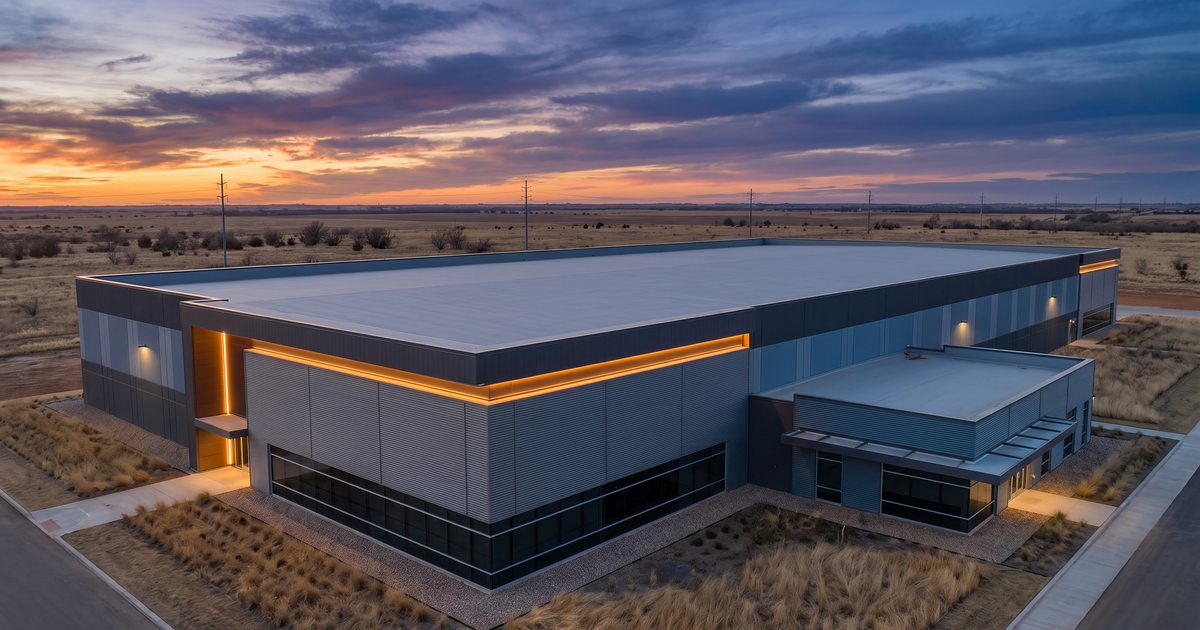
The featured artwork is an AI-generated architectural concept. It depicts neither a verified Building 4 design nor current site progress.
What the $550 million filing establishes
| Item | Filed detail | How to read it |
|---|---|---|
| Location | 3399 County Road 132, Hutto, TX | Building 4; Williamson County |
| Construction estimate | $550 million | Core, shell and site improvements |
| Target schedule | Jan. 2027–Oct. 2028 | Prospective filing dates |
| Total-area field | 846,300 square feet | Conflicts with scope components |
| Building capacity | Not verified | Campus MW cannot fill this gap |
| Stage | Project Registered | Construction start unverified |
The cost needs to travel with its scope. The filing describes a shell and associated site work, so $550 million should remain attached to that package. The sources reviewed do not establish a completed investment, financing close, executed construction contract or all-in tenant fit-out budget. Computing equipment, network systems and future tenant improvements cannot be priced by simply treating the registered estimate as a complete operating facility.
The schedule deserves the same discipline. A target in an accessibility registration helps identify a prospective project window. It does not independently demonstrate a building permit, notice to proceed, mobilization or guaranteed delivery. Firms considering business development should confirm those milestones and the identity of the procurement lead before allocating estimating time or reserving labor.
There is also a concrete discrepancy in the area figures. The total-area field says 846,300 square feet. The scope narrative separately describes approximately 844,300 square feet for the data center and 20,000 square feet for the office. Those components sum to 864,300 square feet, an 18,000-square-foot difference. Both figures remain relevant until the owner or design team provides a reconciliation. Neither should silently replace the other in a quantity takeoff or market comparison.
Campus power and Building 4 capacity are different questions
Skybox's PowerCampus Austin page describes a partnership with Prologis and markets a 160-acre campus with up to 600 MW of power availability. It places the campus in Oncor territory and describes nearby diverse long-haul fiber. These developer statements establish useful campus context, while Building 4 service commitments, operating load and telecommunications contracts remain unverified.
The developer's Austin market page separately advertises up to 400 MW of critical load for PowerCampus Austin. It also lists Skybox Austin I in Pflugerville as a separate property. Readers comparing Austin-area opportunities should keep those locations distinct and retain the stated basis alongside every capacity number.
An undated PowerCampus brochure adds historical design context. Its conceptual building table totals 576 MW of total load and 384 MW of critical load. Its Building 4 block also carries different area figures from the September filing. That numbering alone cannot establish the newly registered building's power allocation or approved footprint. The brochure provides a concept to investigate, with its vintage and current applicability still unresolved.
A second developer brochure explicitly labels 600 MW as total load and presents configurable power, cooling and security features. Marketing options describe what may be available to customers; selected Building 4 systems and procurement commitments require their own evidence. Neither document establishes current energized campus load, a Building 4 IT load or an awarded controls package.
For an integrator, the useful next documents are the project-specific service plan, issued design, equipment interfaces and tenant requirements. Campus-scale MW can indicate why a development matters. It cannot supply a fiber count, rack schedule, security device list or subcontract value.
The named team, with phase boundaries intact
| Organization | Supported relationship | Evidence boundary |
|---|---|---|
| Hutto Data Center Campus, LLC | Filed Building 4 owner | Named in TDLR registration |
| Skybox Datacenters | Campus developer partner | Developer's campus page |
| Prologis | Campus developer partner | Developer's campus page |
| Corgan | Building 4 design firm | Filed as Corgan Associates Inc. |
| Oncor | Developer-reported utility territory | Building 4 service approval unverified |
| GC and installation trades | Building 4 awards unknown | Confirm project and package |
The filing is the source for Corgan's project role. Corgan's data-center practice page provides broader company context, but photographs of its other work should retain their original project identity. Similarly, the developer's campus relationship with Prologis should not be expanded into an unsupported construction-management or installation role.
There is credible contractor evidence for an earlier building. An Alamo Structural Steel company post about Hutto Building 3 identifies Alamo as steel supplier, DPR Construction as general contractor and Deem Structural Services as steel erector. Those names provide a sourced view of Building 3's team. Building 4 awards still need separate confirmation. A photograph of Building 3 should also stay labeled with that phase.
This distinction affects outreach quality. A useful inquiry identifies the exact building, asks whether the recipient has a current role, and requests the correct procurement contact. Assuming every earlier campus participant carries forward can send proposals to the wrong team and make a developing opportunity look more mature than it is.
Where low-voltage work could emerge
The following scopes are LVN's analysis of a future data-center shell and the campus connectivity described by the developer. They are prospective coordination areas. No Building 4 quantities, integrator awards, bid deadlines or installation values were verified.
| Potential system | Practical work | What to confirm |
|---|---|---|
| Fiber and outside plant | Entrances, duct banks, splicing, testing | Routes, carriers and package owner |
| Structured cabling | Pathways, labeling, turnover records | Tenant layout and issued scope |
| Access control and CCTV | Doors, perimeter and monitoring interfaces | Platform, devices and integrator |
| Fire alarm | Life-safety interfaces and acceptance | Approved design and authority |
| BMS and controls | Alarms, equipment interfaces, OT links | Sequences, points and commissioning |
Outside-plant planning could be particularly consequential at the shell stage. Entrance locations, utility crossings and pathway ownership influence later installation. A contractor evaluating the opportunity should ask how the civil, electrical and communications packages divide responsibility, and whether the tenant will procure its own network work. Nearby fiber routes provide a reason to investigate connectivity; they do not verify diverse services into this building.
Inside the facility, the shell-to-fit-out boundary matters just as much. The office and base building may have different buyers, schedules and acceptance requirements from the eventual data halls. A package description should identify who supplies pathways, who installs cable, who tests it and who owns the final records. This is also where grounding and bonding coordination, labeling conventions and change documentation become practical estimating questions.
Security, controls and fire-alarm teams should seek approved interfaces and responsibility matrices before assuming a turnkey scope. Equipment monitoring, access events and life-safety functions can cross several contractors' boundaries. Public-safety radio or commercial wireless requirements would need project-specific confirmation as well. The current evidence supports asking these questions; it does not establish a DAS award or a prescribed Building 4 platform.
Jobs, trades and preparation
No Building 4 construction-job or permanent-job count was verified. The project should therefore be treated as a business-development and workforce-preparation lead. The reviewed sources do not provide a current hiring list, a labor call or a guaranteed number of openings.
Practical preparation includes fiber inspection and cleaning, splicing, optical testing, cable management, accurate labeling and organized turnover records. OSP crews benefit from clear coordination with civil and electrical teams. Security and controls technicians need to understand device documentation, network boundaries and witnessed acceptance. These are general capability areas, and employers must confirm the requirements for each actual package.
The Fiber Optic Association's workforce resources offer a starting point for fiber training. BICSI's training catalog provides communications education options. OSHA Outreach Training is a general construction-safety resource. None of these links establishes a credential mandate, hiring partnership or approved training provider for Hutto Building 4.
For company owners, preparation also means having relevant project references, testing examples and a clear account of available supervision. Ask the actual buyer about prequalification, insurance, bonding, site access, lift training and documentation requirements when a procurement path is confirmed. Avoid buying project-specific equipment or promising a crew against a date that currently appears only as a filing target.
The next evidence that would make this actionable
Several updates would materially sharpen this lead: a reconciled floor area; a Building 4 permit and verified construction start; a named tenant; project-specific utility commitments; and a confirmed GC or construction manager. Issued bid packages, trade awards and published qualification instructions would then help contractors judge timing and fit. The state filing already supplies enough detail to identify the project and its design team, while these remaining items determine how work reaches the market.
Explore LVN Signal for sourced construction intelligence and the AI/data-center project map for geographic context. Hutto Building 4's address has been mapped, but the address result does not independently identify its footprint or entrance. Use the project name, registration number and qualified scope to begin research, then verify the buyer and package before pursuing the work.
Join 35,000+ Low Voltage Pros
Get weekly permit updates, tool deals, job opportunities, and industry news. No spam, unsubscribe anytime.