
Join Low Voltage Nation — Find project opportunities and showcase your company to thousands of industry professionals
Serverfarm is building a four-building, 135-acre AI data center campus in Clarksville, Arkansas for an unnamed Fortune 10 hyperscaler. Nabholz has bid packages out at 60 percent drawings for Buildings 1 through 3 right now. Eleven low voltage systems, an estimated $144M to $264M in LV work campus-wide, and a town of 9,000 people that has to build it.
Most of the data center projects we write about are announcements. This one is a bid list.
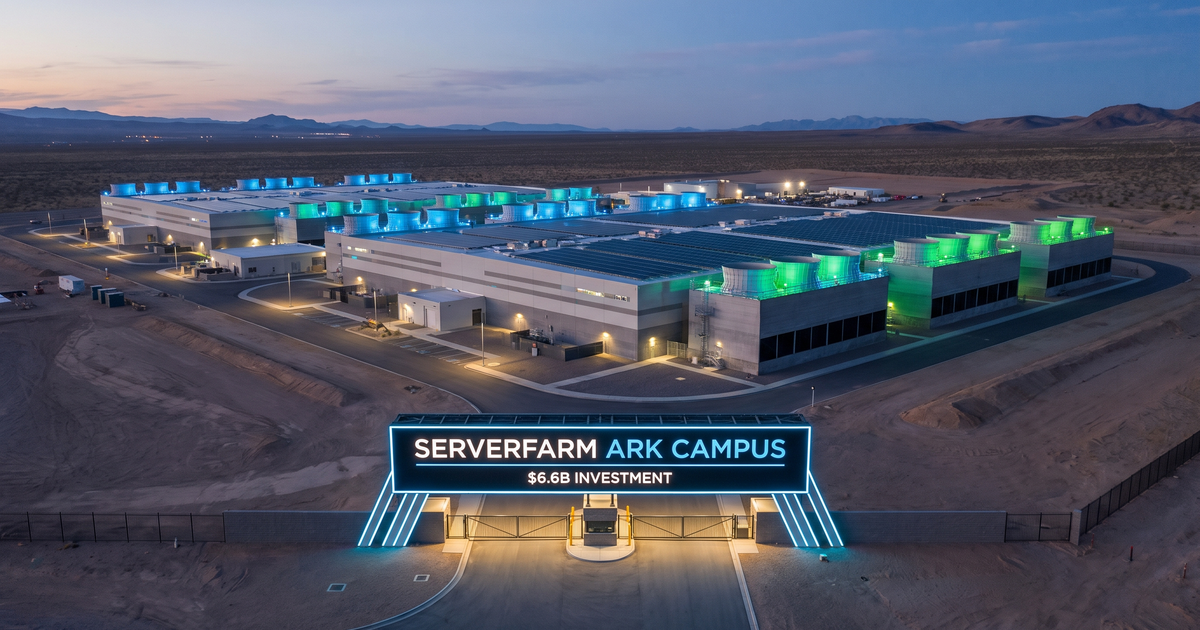
Serverfarm is under construction on ARK, a four-building data center campus at 101 Tech River Valley Road in Clarksville, Arkansas — 135 acres north of Interstate 40, in a Johnson County town of fewer than 10,000 people. Site clearing is done. All four building pads are prepared. Building 2 foundations are complete and drilling is underway on Building 3. And Nabholz Construction, the construction manager, has issued a bid bulletin covering mechanical, plumbing, fire protection, and electrical packages for Buildings 1 through 3, plus Building 1 concrete — at 60 percent drawings.
That last detail is the whole article. Sixty percent drawings means the design is far enough along to price and early enough to influence. If you are a low voltage contractor within a day's drive of the Arkansas River Valley, the window on this campus is open right now, not in 2027.
The Numbers, And What They Are Not
Serverfarm puts the investment at $6.6 billion and says that figure includes the major mechanical and electrical systems needed to support long-term operations. The company projects roughly $558 million in local public benefit through 2060 and thousands of construction jobs.
Now the numbers that are not the project cost, because this is where every contractor in Arkansas is about to get confused:
- $55 billion in industrial revenue bonds. On July 30 the Clarksville City Council approved two ordinances — up to $50 billion to Hatchbo LLC and up to $5 billion to SF ARK1 LLC, Serverfarm's project affiliate. Those are financing ceilings, a standard Arkansas structure that routes property through a public bond issuer for tax purposes. Nobody is spending $55 billion in Clarksville.
- 660 MW of adjacent generation. A separate Title V air permit application from Solaris Resolute, LLC covers a bridge-power plant using roughly forty 16.5 MW turbines. That is behind-the-meter generation to get the campus energized while the grid catches up. It is not IT load, and it is not the data center's construction budget.
- 18 emergency generators, about 55.2 MW. That is standby capacity in the air permit, a different thing again from either of the above.
The number that matters for sizing your scope is the building spec: ARK1 through ARK4, each roughly 300,000 square feet at 72 MW of IT capacity, with four points of entry, multiple fiber providers, and closed-loop air cooling. First two buildings target January 2028.
The Eleven Systems
LVN Signal scores this project a 10 out of 10 on low voltage opportunity, and it carries one of the widest system counts we have published:
- Fiber and outside plant — four points of entry, multiple carriers, and campus backbone between four buildings
- Structured cabling — 1.2 million square feet of it across the campus
- Access control and CCTV
- Fire alarm — with the detection and pre-action interfaces a data hall demands
- BMS and controls — closed-loop air cooling means a large controls integration scope
- Networking
- DAS
- Grounding and bonding
- Commissioning
Note that grounding/bonding and commissioning are called out as their own line items rather than folded into the other systems. On a mission-critical job that is correct, and it is also a warning: both are scope that inexperienced bidders assume belongs to somebody else, and both get discovered at Level 4 integrated systems testing when there is no schedule left.
What The LV Package Is Worth
Two defensible bases, and they do not agree, so here is both.
Capacity basis. Four buildings at 72 MW IT is 288 MW. Our anchor for compute-MW pricing is roughly $500,000 per MW of IT load, derived from a campus where the LV package and the megawatts were both published. That puts the campus at about $144 million, or $36 million per building.
Announced-investment basis. Four percent of a $1B-plus announced data center investment is our standard flat rate — no system-count multiplier, because these headline figures already bundle land, power infrastructure, and IT hardware. Four percent of $6.6 billion is $264 million.
Call the campus $144M to $264M in low voltage work. The near-term addressable slice is Phase 1 — Buildings 1 through 3, the ones Nabholz is bidding — which lands at roughly $108M to $198M.
The spread is wide because Serverfarm has not published a building-only construction figure, and we do not invent one. When an owner separates real property from IT equipment, that separation is the most valuable line in the filing. Serverfarm has not made it yet. Bid the drawings, not the press release.
The Tenant You Cannot See
Project representatives have described the customer as a Fortune 10 hyperscale company with a recognizable household name, without naming it. That is not coyness, it is how these deals work, and it has a direct effect on your bid.
A named hyperscaler comes with a published technology standard — approved manufacturers, pathway fill rules, labeling schemes, test result formats, handover documentation. An unnamed one means the tenant fit-out standards arrive under NDA after award, and the base building package you are pricing now has to be built to accommodate a spec you have not read.
Protect yourself in two places. First, price the shell and core scope precisely and carve the tenant-driven scope out as an allowance with a defined basis, not a lump sum. Second, ask in RFI what the cabling standard, labeling convention, and test documentation format will be. If the answer is "to be provided," that is a change order waiting to happen and it belongs in your qualifications.
Who Is Actually On This Job
Nabholz Construction Corporation is construction manager, general contractor, and bid administrator. Nabholz is headquartered in Conway, Arkansas — an Arkansas-grown contractor running an Arkansas megaproject, which means the relationship is winnable by regional subs in a way it would not be if a national data center builder had the CM contract. This is the single most actionable name on the project.
kW Mission Critical Engineering, a WSP member firm out of Troy, New York, is the design engineer for mission-critical MEP, fire and life safety, and information and communication technology. That matters more than it looks. kW MCE is 100 percent data-center focused and their ICT and security design sits in the same house as the MEP. One design authority for your systems means fewer coordination gaps — and a specification written by people who have done this several hundred times. Read it carefully; it will be specific.
Goodwyn Mills Cawood is the site civil engineer, which is your outside plant coordination path — duct bank routing, handhole locations, and the sequencing that determines whether your conduit goes in during earthwork or gets trenched back in later at four times the cost.
Clarksville Connected Utilities is the municipal utility and construction power provider. Not an investor-owned giant — a city utility that also happens to operate Arkansas's largest municipal solar plant and made Clarksville the first fully solar-powered city government in the state. Small utility, enormous new customer. Expect temporary power to be a scheduled, negotiated resource rather than an assumption.
The Constraint Nobody Puts In The Press Release
Clarksville has fewer than 10,000 residents. Johnson County has about 26,000. "Thousands of construction jobs" in a labor market that size is not a jobs number, it is a logistics problem, and it is the reason a qualified LV contractor from Little Rock, Fort Smith, Fayetteville, Tulsa, or Memphis can win here.
Price it accordingly. Per diem and lodging in a town with limited hotel stock. Travel time. Crew rotation. Retention — data center campuses run long, and a job that bleeds techs at month eight is a job that fails commissioning at month twenty. If you are bidding this as a local job with local rates, you are bidding somebody else's project.
There is a second-order opportunity here too. Six data center projects have been announced in Arkansas. We covered the West Memphis corridor last week from the opposite corner of the state. A contractor who staffs up correctly for Clarksville is positioned for the next five, and the qualification you build on ARK1 is the qualification that gets you shortlisted on the rest.
The Hospital Next Door
The campus sits near Johnson Regional Medical Center, and community reaction has been mixed — some optimism, some frustration from residents who say the project moved without answers. Air permitting for the generators has been the flashpoint; Arkansas DEQ declared SF ARK1's application administratively complete on June 22.
For a low voltage contractor this is not politics, it is site conditions. A hospital neighbor means noise windows on generator testing, constrained construction traffic routing, and a permitting process that can slip. Anything downstream of energization — and integrated systems testing is entirely downstream of energization — inherits that risk. Ask for the current air permit status before you commit to a commissioning date, and say so in your schedule qualifications.
How To Get On The List
- Call Nabholz, not Serverfarm. The CM administers the bid. Get on the plan room for the Buildings 1-3 packages.
- Show mission-critical references, not square footage. kW MCE's spec will assume the bidder has done redundant pathway, pre-action interface, and Level 1-5 commissioning support before. Lead with those.
- Qualify the tenant scope. Base building priced firm, tenant standard as a defined allowance.
- Get outside plant into the civil sequence. Talk to Goodwyn Mills Cawood's package before the pads go in, not after.
- Solve labor on paper before you bid. Housing, per diem, rotation. Put it in the number.
Sixty percent drawings, four buildings, 288 megawatts, and a general contractor headquartered ninety minutes away. Campuses like this get bought out once. This one is being bought out now.
Track projects like this before the bid drops. LVN Signal monitors permits, bids, and construction news across the country and scores every project for low voltage opportunity. See what is in your market.
Join 35,000+ Low Voltage Pros
Get weekly permit updates, tool deals, job opportunities, and industry news. No spam, unsubscribe anytime.