
Join Low Voltage Nation — Find project opportunities and showcase your company to thousands of industry professionals
Rowan Project Temple is under construction in Temple, Texas, with nearly $3B in financing, Oncor-backed power, a reported GC, and a clear low-voltage watchlist.
Rowan Project Temple is now a construction-stage AI campus story
Rowan Digital Infrastructure's Project Temple has moved past the generic announcement stage. On May 27, 2026, Rowan announced that it had secured nearly $3 billion in debt financing to support construction of a turnkey hyperscale data-center campus in Temple, Texas. Rowan says the financing is the largest transaction in company history and supports a 300 MW campus under its Green Finance Framework.
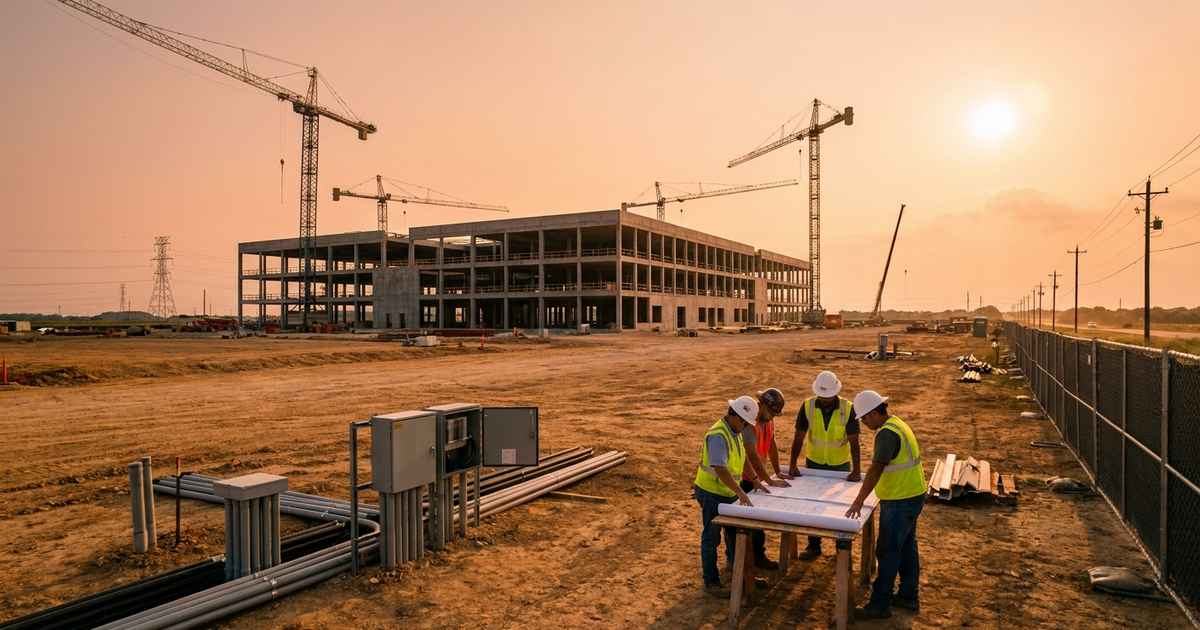
The construction signal did not start with the financing release. In January, Rowan said construction was underway at Project Temple, a roughly 700-acre development in Bell County serving a top global technology company. Rowan's construction release says operations are expected in 2027, power is secured through Oncor, and the project is expected to create approximately 600 construction jobs plus more than 40 permanent positions after it opens.
The local project site adds community and approval context. Rowan in Temple says the company is developing data-center facilities on land designated by the city and county for industrial and data-center use, and it points to a March 2, 2026 groundbreaking for a 300 MW sustainable data center. That matters for low-voltage contractors because the project has public owner confirmation, local approval context, a known utility partner, and a construction-stage timeline instead of only a speculative capacity headline.
Trade coverage fills in two practical construction details. Connect CRE reports that the 707-acre campus sits northeast of Bob White Road and Lorraine Avenue, includes a first project with a 1 million square-foot building, provides up to 300 MW of available power, and has recently ramped up work with HITT Contracting Inc. as general contractor. Baxtel's Project Temple profile also tracks the site as an under-construction Temple data-center project with Oncor as utility provider and 2027 as the planned year. Those are market-source details, so LVN treats them as corroborating context alongside Rowan's primary announcements.
| Item | Public detail | LVN read |
|---|---|---|
| Location | Temple, Bell County, Texas | Central Texas campus northeast of Bob White Road and Lorraine Avenue. |
| Stage | Construction underway; financing closed May 2026 | Active enough for contractor, vendor, and workforce monitoring now. |
| Scale | 300 MW campus on roughly 700 acres | Large enough for OSP, backbone, security, controls, and commissioning packages. |
| Building context | Trade coverage cites a first 1M-square-foot building | Expect phased data-hall, pathway, telecom, and turnover work. |
| Jobs | About 600 construction jobs and 40+ permanent roles | Construction labor, site safety, QA, testing, and documentation will matter early. |
The company map is clear at the top, thinner at the specialty level
The top of the account map is source-backed. Rowan Digital Infrastructure is the owner, developer, and campus sponsor. Rowan says the project is backed by strong capital partnerships, with the company supported by Quinbrook Infrastructure Partners and Blackstone. Rowan also identifies Oncor as the power partner for Project Temple, while the construction-start announcement names the Temple City Council and Bell County Commissioners Court as approval stakeholders.
HITT Contracting Inc. is the most important construction name in the public record after Rowan. Connect CRE names HITT as the general contractor, and HITT's mission-critical practice describes data-center construction capability, including complex mission-critical delivery. Because HITT's role in this packet comes from trade coverage rather than a direct HITT or Rowan project page, LVN is treating the GC attribution as medium-confidence and worth tracking closely.
What is not public yet is just as important. No source in this packet names the electrical contractor, low-voltage contractor, fiber or outside-plant contractor, structured cabling contractor, security/access-control/CCTV integrator, fire alarm contractor, BAS/BMS controls integrator, DAS or network integrator, grounding and bonding specialist, or commissioning agent. Those missing package names should not be invented. They should become the watchlist.
| Company or group | Public role | Evidence |
|---|---|---|
| Rowan Digital Infrastructure | Owner / developer | Financing and construction announcements |
| HITT Contracting Inc. | Reported general contractor | Connect CRE coverage; contractor capability page |
| Oncor | Power partner / utility | Rowan construction announcement |
| City of Temple | Local approval stakeholder | Rowan construction announcement and local project site |
| Bell County Commissioners Court | County approval stakeholder | Rowan construction announcement |
| Quinbrook / Blackstone | Capital partners | Rowan company and financing context |
Where low voltage shows up on Project Temple
A 300 MW AI and hyperscale campus is not a simple building job. Even when the public sources do not name low-voltage bidders yet, the systems are predictable enough to monitor. The low-voltage opportunity sits around outside plant, carrier coordination, campus backbone fiber, data-hall pathways, structured cabling, access control, CCTV, fire alarm interfaces, BAS/BMS controls, operational networking, DAS, grounding and bonding, labeling, test records, turnover packages, and commissioning.
Fiber and OSP are the first categories to watch. A campus-scale data center needs diverse pathways, duct banks, vaults, carrier entrances, meet-me connectivity, backbone routes, cleaning, inspection, testing, documentation, and coordinated handoff between civil, electrical, telecom, and operations teams. Technicians preparing for this kind of work should treat FOA workforce resources and BICSI optical fiber training as useful baseline references, not as proof of a project requirement.
Structured cabling and pathway work will be tied to the building sequence. The first 1M-square-foot building reported by Connect CRE implies large pathway planning, telecom spaces, support cabling, labeling standards, cable tray coordination, QA walks, test documentation, redlines, and punch-list discipline. BICSI copper training is relevant for technicians who need to show competence around copper pathways, terminations, testing, labeling, and documentation in a mission-critical environment.
Security, fire/life safety, and controls are the second cluster. A hyperscale campus needs perimeter systems, gates, access control, camera coverage, visitor and contractor management, fire alarm interfaces, public-safety communication awareness, BAS/BMS integration, alarms, trend data, and commissioning support. These scopes usually require close coordination with electrical rooms, mechanical equipment, network boundaries, AHJs, owner standards, and commissioning teams. Good low-voltage contractors will watch for security integrator, fire alarm, controls, DAS, networking, and commissioning movement rather than waiting for a public bid list to be obvious.
| System | Why it matters | Evidence to watch |
|---|---|---|
| Fiber / OSP | Carrier entrances and campus backbone support AI capacity. | Duct banks, vaults, fiber permits, carrier work, test packages. |
| Structured cabling | Data halls and support spaces need pathways and clean turnover records. | Cable tray, telecom spaces, labeling, installer postings, QA roles. |
| Access control / CCTV | Perimeter and building security are core campus systems. | Security integrator awards, gates, cameras, VMS, badge systems. |
| Fire alarm / DAS | Large facilities need AHJ coordination and life-safety interfaces. | FA permits, inspections, public-safety radio notes, closeout testing. |
| BAS / BMS controls | Cooling, alarms, energy monitoring, and operations need controls integration. | Controls postings, mechanical milestones, commissioning scopes. |
| Grounding / bonding | Telecom spaces, racks, trays, and equipment rooms need disciplined bonding. | Electrical specs, QA records, test reports, commissioning punch lists. |
Jobs, skills, and timing
Rowan's jobs number gives the workforce story a concrete base: approximately 600 construction jobs and more than 40 permanent positions. For LVN members, the near-term opportunity is the construction and commissioning path, not only permanent data-center operations jobs. A project of this size needs site-safe technicians who can follow owner standards, work around active heavy construction, coordinate with electrical and mechanical trades, document their work, test cleanly, and close out without sloppy labels or missing records.
Useful trade preparation is practical. Fiber cleaning and inspection, copper and fiber termination, cable tray and pathway coordination, lift safety, PPE, hot-work awareness, grounding and bonding, redline discipline, photo documentation, test-result management, fire alarm coordination, security rough-in, camera layout support, BAS/BMS coordination, network handoff awareness, and commissioning etiquette all translate to this kind of campus. OSHA outreach training is table stakes for the site environment. It does not replace data-center discipline, but it helps contractors clear the basic site-safety threshold.
The next evidence layer should come from Rowan, HITT, Oncor, Temple, Bell County, ERCOT, utility filings, permits, inspections, job postings, prequalification notices, and supplier or integrator announcements. Watch the naming variants: Project Temple, Rowan Temple, Rowan Digital Infrastructure Temple, Bob White Road, Lorraine Avenue, Bell County, and Rowan Temple Project. Keep this distinct from Rowan Cinco, Rowan Moriah, Meta Temple, and other Central Texas data-center projects that can blur together in generic market coverage.
Why LVN Signal is tracking it now
Project Temple is exactly the kind of AI data-center project LVN Signal should surface while the market is still forming. The owner, site, stage, financing, utility partner, job count, and reported general contractor are already public. The specialty package names are not. That combination creates a useful window for account mapping, workforce planning, vendor monitoring, and contractor outreach before everyone is reacting to the same recycled post-award headlines.
The practical takeaway is conservative but active: do not claim low-voltage awards that are not sourced, but do not wait until every package is named. The public record already supports a high-confidence construction intelligence item for fiber, OSP, structured cabling, security, fire/life safety, controls, networking, DAS, grounding, documentation, and commissioning. Track Rowan Project Temple in LVN Signal, then use the source links and company map above to decide where to monitor, hire, train, and build relationships next.
Join 35,000+ Low Voltage Pros
Get weekly permit updates, tool deals, job opportunities, and industry news. No spam, unsubscribe anytime.