
Join Low Voltage Nation — Find project opportunities and showcase your company to thousands of industry professionals
QTS and Lancium's Hall County campus brings a $10B-plus AI data-center watch lane near Turkey, Texas, with a 1GW campus interconnect context and open specialty packages.
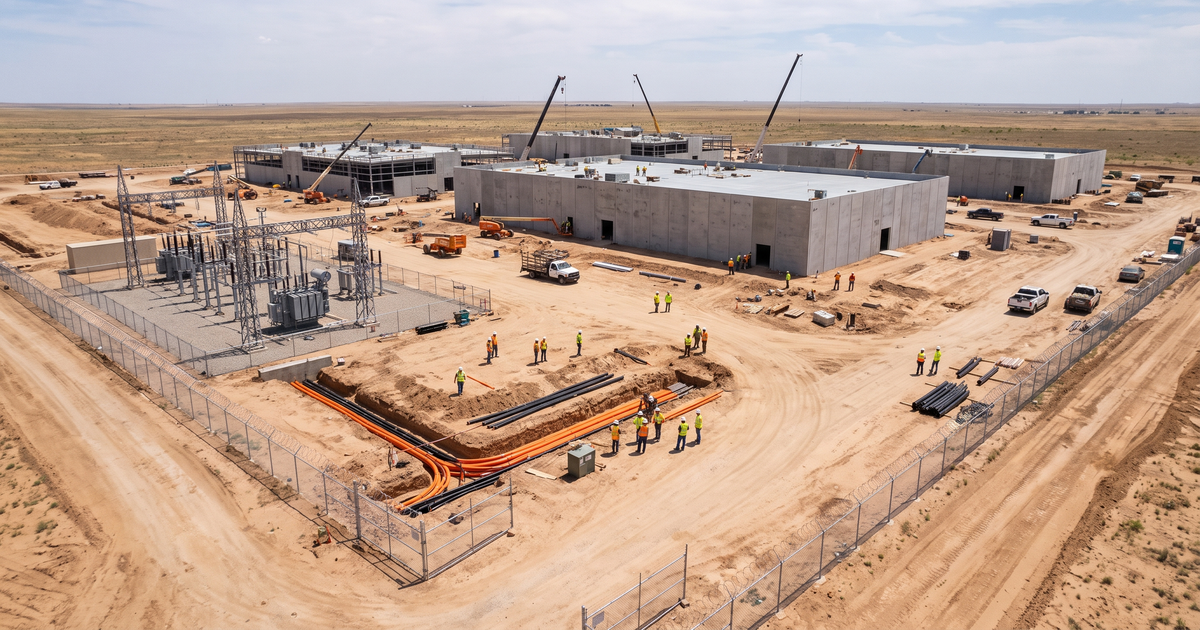
QTS / Lancium Hall County is the cleanest AI data-center construction watch item in today's LVN queue. The QTS announcement says QTS and Lancium plan a data-center campus on Lancium's Clean Campus near Turkey, Texas, with more than $10 billion in capital investment. QTS says it will design, build, and operate the data-center buildings while Lancium owns the campus and provides the electrical and civil infrastructure path.
The public facts are strong enough for Signal coverage, but they are not strong enough to invent the contractor stack. The QTS Hall County project page and Lancium Hall County Clean Campus page confirm the project family, the local community commitments, the power-infrastructure posture, and the water/cooling stance. Reviewed sources do not yet name a separate general contractor, EPCM, engineer of record, electrical contractor, low-voltage contractor, fiber or outside-plant contractor, structured-cabling firm, security integrator, fire alarm contractor, BAS/BMS/EPMS controls vendor, DAS/networking firm, grounding contractor, commissioning agent, or tenant/customer.
That is exactly why it matters for LVN. This is a source-backed, new-construction, AI infrastructure campus before most specialty packages are public. The useful contractor angle is not claiming work that has not been awarded. The useful angle is watching the project while site power, civil infrastructure, fiber entrances, building packages, physical security, controls, and commissioning requirements are still forming.
| Item | Source-backed detail | LVN read |
|---|---|---|
| Project | QTS / Lancium Hall County AI Data Center Campus | Large planned campus near Turkey, Texas. |
| Investment | More than $10B announced by QTS | Enough scale to justify long-term contractor tracking. |
| Power | Lancium says Hall County is anchored by a 1GW ERCOT interconnect | Power and substation movement should be watched separately from IT load. |
| Jobs | Up to 7,000 peak construction jobs and about 350 permanent jobs | Major workforce, safety, onboarding, and local vendor signal. |
| Cooling / water | Closed-loop cooling; no Turkey municipal-water draw expected | Controls, monitoring, and commissioning remain important even with low water consumption. |
The QTS release gives the clearest owner/operator view. It says the campus should generate new tax revenue, create up to 7,000 estimated construction jobs at peak construction, create approximately 350 permanent jobs across QTS, maintenance, security, and tenant roles, support local schools and workforce programs, and fund local priorities such as water infrastructure, schools, first responders, and other community needs.
The power structure is just as important as the building announcement. Lancium's Hall County page describes a gigawatt-scale AI campus anchored by a 1GW ERCOT interconnect. QTS says Lancium and QTS will fund 100% of the energy infrastructure improvements needed to support the campus, and that Lancium will provide electrical and civil infrastructure while planning to bring its own power with battery storage and solar resources.
That does not mean the data-center buildings have a disclosed 1GW critical IT load. The reviewed sources support 1GW as the campus grid interconnect / power-infrastructure figure. Building-level IT critical load, square footage per building, data-hall count, generator details, utility service design, and tenant/customer information remain open until owner, utility, permit, or public-record evidence provides more detail.
Trade coverage adds building-scale context. Data Center Dynamics and Baxtel report that QTS could build up to 11 data-center buildings across roughly 465 acres on the Lancium campus. LVN should treat those numbers as useful trade context unless direct local filings or owner pages break out building-by-building scopes. The current primary-source package is still enough to track the campus and its low-voltage watch lanes.
| Company / source | Role | Evidence |
|---|---|---|
| QTS Data Centers | Design / build / operate context for the data-center buildings | QTS announcement and QTS Hall County page |
| Lancium | Clean Campus owner and power / civil infrastructure context | Lancium Hall County page |
| Hall County | Local jurisdiction and tax-base beneficiary | QTS announcement |
| City of Turkey | Nearby local community and water-system context | QTS announcement |
| ERCOT | Grid-interconnection context | Lancium Hall County page |
For low-voltage contractors, the first practical takeaway is sequence. A multi-building AI campus does not wait until rack-and-stack to create low-voltage work. The opportunity begins with site planning, duct banks, handholes, telecom entrance facilities, MMR strategy, diverse carrier routes, perimeter security design, access-control rough-in, camera coverage, fire alarm coordination, BAS/BMS integration, EPMS interfaces, grounding and bonding, labeling standards, commissioning documentation, and turnover discipline.
The second takeaway is restraint. QTS is source-backed as the data-center building designer / builder / operator in the announcement language, and Lancium is source-backed as campus owner and power / civil infrastructure party. That does not name a separate GC, electrical contractor, fiber contractor, security integrator, fire alarm firm, controls contractor, DAS/networking vendor, or commissioning agent. Those package names should stay unknown until they surface through public records, owner updates, plan rooms, job postings, or subcontractor portfolios.
| System | Why it matters | Watch signal |
|---|---|---|
| Fiber / OSP | A gigawatt-scale AI campus needs diverse entrances, carrier coordination, duct banks, vaults, and tested backbone fiber. | Carrier routes, MMR, vault, splice, OTDR, entrance-facility, and long-haul fiber references. |
| Structured cabling | Data halls, support spaces, security rooms, and facility networks need disciplined pathway, labeling, and testing. | Cable tray, rack/row pathway, fiber/copper certification, labeling, test reports, and redlines. |
| Access control / CCTV | Campus perimeter, gates, buildings, equipment yards, and operations areas require layered security. | Gate controls, card readers, badging, VMS, camera poles, analytics, and perimeter detection. |
| Fire alarm | Large mission-critical buildings need AHJ coordination, suppression interfaces, monitoring, and acceptance testing. | Fire alarm permits, FA submittals, acceptance tests, monitoring, and inspection movement. |
| BMS / EPMS | Closed-loop cooling and high-density infrastructure still need controls, alarms, trend logs, and power monitoring. | BMS, BAS, EPMS, SCADA, point lists, panels, alarms, and commissioning records. |
| Grounding / commissioning | Mission-critical turnover depends on bonding, testing, QA/QC, and clean closeout documentation. | Grounding specs, prefunctional checks, commissioning agents, punch lists, and turnover packages. |
The jobs and skills angle is also concrete. QTS's 7,000 peak construction-job estimate suggests repeated waves of site access, contractor onboarding, safety training, lift work, documentation, and coordination. Low-voltage teams that want to be useful on a campus like this need OSHA/site readiness, fiber cleaning and inspection habits, OTDR and power-meter competency, copper certification, pathway coordination, labeling discipline, grounding awareness, access-control commissioning, VMS setup, fire alarm acceptance support, controls point verification, and clean closeout packages.
KFDA's local coverage adds a useful worker-housing and local-impact angle. That matters because a 7,000-worker peak can stress roads, lodging, staging, site access, security screening, and shift logistics. Those are not just community issues. They affect how specialty contractors staff the job, how quickly they can mobilize, and whether smaller local firms can support larger primes with pathway labor, fiber testing, documentation, camera rough-in, fire alarm support, lift operation, labeling, punch-list work, or closeout assistance.
For vendors, the campus points to long-cycle demand categories: fiber consumables, fusion splicing, test equipment, labeling systems, cable tray, ladder rack, cabinets, cameras, access-control hardware, door hardware interfaces, fire alarm devices, controls hardware, facility-network switches, grounding materials, commissioning documentation tools, lift rental, PPE, safety training, and contractor staffing support. The timing is still early, so vendor outreach should be framed around readiness and source-backed monitoring, not a claim that a specific package has been awarded.
The best next sources are predictable. Watch QTS, Lancium, Hall County, City of Turkey, ERCOT, Texas PUC, TCEQ, local permit portals, appraisal records, plan-room channels, utility filings, job postings, and subcontractor portfolio pages. The highest-value updates will be building filings, utility/substation milestones, onsite generation or battery filings, water/well records, civil-package movement, construction-start proof, GC/EPCM names if separate from QTS, and specialty package awards.
Alias control matters here. Track the project under QTS Hall County, QTS Turkey, Lancium Hall County Clean Campus, Hall County Clean Campus, Turkey TX data center, QTS Lancium campus, and Texas Panhandle AI data center. Keep it distinct from Lancium Abilene, Lancium Childress, Crusoe / Stargate Abilene, QTS Fort Worth, QTS Wilmer, QTS San Antonio, and any QTS / Lancium Big Spring or Howard County watch items.
Bottom line: QTS / Lancium Hall County belongs in LVN Signal because it is a source-backed AI data-center campus with more than $10 billion in announced investment, a 1GW campus interconnect context, thousands of construction jobs, and a large open low-voltage watch lane. The public facts are strong. The specialty-package names are still early. That is the window where Signal is most useful.
Join 35,000+ Low Voltage Pros
Get weekly permit updates, tool deals, job opportunities, and industry news. No spam, unsubscribe anytime.