
Join Low Voltage Nation — Find project opportunities and showcase your company to thousands of industry professionals
Prometheus has county approval for a 506-acre Evanston AI campus designed around 1.25 GW, with Lumen and power partners named while the GC and specialty package map remain open.
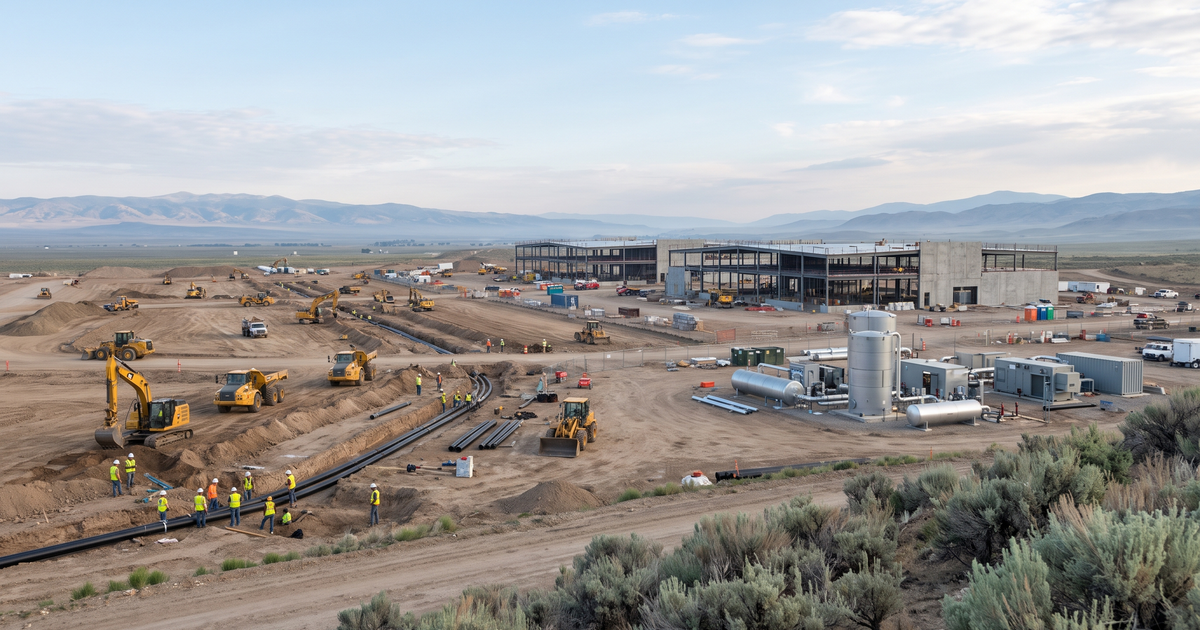
Prometheus Hyperscale has cleared a major local gate for a new AI data-center and onsite-power campus east of Evanston, Wyoming. The company's conditional-use permit announcement says Uinta County commissioners unanimously approved the 506-acre development, designed around 1.25 gigawatts of initial capacity with a path to 5 gigawatts.
That scale deserves attention, but the capacity language needs discipline. Prometheus describes campus design capacity, not commissioned critical IT load. The 5-gigawatt figure is a development path, not power already approved, installed, or energized. Public materials reviewed for this report do not disclose a tenant, building count, total square footage, data-hall count, or phase-by-phase IT load.
The permit site is in Section 13, Township 15 North, Range 119 West near County Roads 180 and 181. Local permit reporting identifies Prometheus Wyoming I LLC as the project entity and G&C Holdings LLC as the landowner/lessor. The county approved both the Atlas Industrial Park subdivision rezone and the conditional-use permit on June 16, subject to 15 conditions.
| Project fact | Source-backed detail | Current limit |
|---|---|---|
| Site | 506 acres east of Evanston | Parcel-level centroid still pending. |
| Stage | County CUP and rezone approved | Final permits still required. |
| Capacity | 1.25 GW initial design | Not verified IT critical load. |
| Buildout | 48-60 month phased plan | Formal start not confirmed. |
| Power | Islanded natural-gas microgrid | EPC and equipment roster unknown. |
| Cooling | Closed-loop liquid cooling | Controls vendors not named. |
The permit conditions turn the announcement into a practical construction watch. They cover annual inspections, onsite well reporting after commissioning, fire-code compliance, road maintenance and upgrades, emergency-service coordination, reclamation security, and a five-year deadline to establish construction commencement. Prometheus says construction is anticipated within six months after final permitting, but that is an owner expectation rather than a formal notice to proceed.
The company's Evanston project page calls the site its flagship campus and provides a direct vendor and partner interest route. That is useful for subcontractors and suppliers, but it should not be confused with an open bid invitation. No reviewed source names a general contractor, EPC, EPCM, architect, civil engineer, MEP engineer, electrical contractor, low-voltage integrator, fiber installer, security integrator, fire-alarm contractor, controls integrator, DAS contractor, grounding contractor, or commissioning authority.
The power concept is unusually important. Prometheus says the campus will operate on a fully islanded onsite microgrid using high-efficiency natural-gas engines and turbines, without drawing from the public grid. If built as described, the electrical and operational-technology boundary will be closer to a power campus plus data center than a conventional utility-fed facility.
Prometheus separately names PureWest Energy as its preferred natural-gas supplier and Frontier Carbon Solutions as its preferred carbon-management provider for the Wyoming development. Those are source-backed commercial roles, but neither announcement identifies the onsite-power EPC, generator or turbine supplier, electrical package holder, protection-and-control integrator, or campus SCADA contractor.
Energy storage is another moving piece. A Prometheus and XL Batteries agreement describes a 333-kilowatt demonstration system planned for 2027 and 12.5-megawatt / 125-megawatt-hour systems planned in 2028 and 2029 across Prometheus facilities. The agreement names XL Batteries as a vendor partner. It does not establish that every later system is assigned to Evanston or that an installation subcontract has been awarded.
| Organization | Source-backed role | Scope boundary |
|---|---|---|
| Prometheus Hyperscale | Owner / developer | GC role not established. |
| Prometheus Wyoming I | Permittee entity | Separate project LLC. |
| Lumen | Network partner | Installer award unknown. |
| PureWest / Frontier | Gas / carbon partners | Not GC or electrical awards. |
| XL Batteries | Storage vendor agreement | Site package not fully assigned. |
| Target Hyper/Scale | Workforce-hub applicant | Separate from permanent campus. |
Connectivity has a named enterprise partner. The Lumen agreement covers Private Connectivity Fabric, new routes, wavelength services, Dedicated Internet Access, and DDoS protection for Prometheus facilities, including the Wyoming flagship. That evidence supports Lumen's network-services role. It does not name the civil OSP contractor, duct-bank installer, splicing crew, structured-cabling firm, meet-me-room contractor, or local carrier-handoff team.
For low-voltage teams, that distinction creates a valuable watch window. Network service can be contracted before the physical campus route, diverse entrances, utility crossings, vaults, handholes, innerduct, fiber counts, splice plans, test standards, and turnover responsibilities appear publicly. Each of those details can surface through permits, easements, road work, supplier announcements, hiring, or subcontractor portfolios.
The onsite-power design broadens the systems map. Protection-and-control communications, relay networks, substation security, generation controls, fuel-system monitoring, emissions systems, carbon-management interfaces, energy-storage controls, EPMS, SCADA, BMS, alarm routing, time synchronization, cybersecurity zones, network operations, and integrated commissioning all have to work across the power and data-center boundary.
| Low-voltage lane | Why it matters | Watch signal |
|---|---|---|
| Fiber / OSP | Carrier and campus backbone | Routes, vaults, splicing, OTDR. |
| Structured cabling | Halls and support spaces | Pathways, labeling, certification. |
| Access / CCTV | 506-acre secure campus | Gates, perimeter, VMS, badging. |
| Fire alarm | Data, power and housing zones | Permits, interfaces, acceptance. |
| BMS / EPMS / SCADA | Power and liquid cooling | Point lists, networks, integrators. |
| DAS / wireless | Remote campus coverage | Public safety and carrier design. |
| Grounding | Power, racks and OSP | Specs, testing, responsibility. |
| Commissioning | Islanded mission-critical plant | CxA, scripts, integrated tests. |
Fiber and outside plant should be watched early. A remote hyperscale site needs resilient long-haul connectivity, physically diverse entrances, protected campus backbone routes, network rooms, operations links, security connectivity, and control-system transport. The package can span civil excavation, conduit, maintenance holes, building entrances, grounding, pulling, splicing, optical-loss testing, OTDR traces, route records, labeling, and as-built documentation.
Structured cabling will depend on the final building and tenant designs. Public records do not yet show data halls or floor plans. Even when high-density compute fabric is owner- or tenant-furnished, there is substantial infrastructure around meet-me rooms, operations centers, offices, security, facility networks, controls panels, wireless, support buildings, and the pathways tying those environments together.
Security will start at the property line. A 506-acre campus near county roads can require perimeter detection, vehicle gates, guard facilities, visitor processing, badging, access control, CCTV and video management, intercom, duress, key management, analytics, equipment-yard coverage, and disciplined temporary-to-permanent system transitions. The workforce hub should be treated as a separate security and life-safety package until sources connect it to the permanent campus program.
Fire and life safety will cross multiple occupancies. Data-center halls, power generation, fuel systems, battery storage, electrical rooms, cooling systems, support buildings, and temporary workforce facilities can each carry different detection, releasing, monitoring, emergency-power, egress, inspection, and authority-having-jurisdiction requirements. Coordination and cause-and-effect testing become as important as device installation.
Controls may be one of the most technically demanding lanes. Closed-loop liquid cooling requires instrumentation, leak detection, pump and valve control, alarming, trending, sequence verification, and integration with owner platforms. The islanded microgrid adds generation dispatch, power-quality monitoring, storage, protection, fuel and carbon systems, electrical distribution, and failure-mode coordination. Exact vendor and package boundaries remain undisclosed.
DAS and wireless needs are also unresolved. Rural location, large acreage, hardened buildings, equipment yards, temporary construction areas, and emergency-response requirements create coverage questions for public-safety radio, cellular, private wireless, Wi-Fi, operations, and contractor communications. Teams should wait for jurisdiction and owner requirements before assuming a specific DAS scope.
Grounding, bonding, and commissioning will tie the program together. Contractors should expect coordination across generation equipment, substations, structural steel, lightning protection, cable tray, racks, telecommunications rooms, security devices, OSP entrances, cooling systems, and controls networks. Turnover will depend on calibrated testing, traceable results, redlines, asset data, version control, witnessed procedures, training, and integrated-system evidence.
The workforce signal is unusually visible. Business Wyoming's community and workforce summary models nearly 8,000 construction jobs and 11,921 total jobs by 2029, with Build Wyoming and Western Wyoming Community College involved in training coordination. Those figures are modeled economic impact, not current job openings, awarded headcount, or a promise that every position will be local.
The supporting workforce-housing lane has also advanced. The Uinta County June agenda identifies Target Logistics Management LLC CUP 26-02, and local reporting says Target Hyper/Scale later received permit approval. Temporary housing can be an upstream mobilization indicator, but its utilities, networking, Wi-Fi, access control, CCTV, fire alarm, and operations work should not be assigned to the permanent data-center package without direct evidence.
Wyoming's state incentive record adds project history. Wyoming Business Council materials describe the former Wyoming Hyperscale Whitebox identity and a planned 1.2-gigawatt campus certified for the state's data-center sales-tax exemption. The current Prometheus announcement supersedes that earlier capacity framing with 1.25 gigawatts of initial design capacity.
Current sources cite roughly $3.1 billion of modeled economic impact through 2032, not project capital expenditure. Older Prometheus material called the flagship a $10 billion project, but the current permit-approval record does not restate a construction budget. LVN is leaving project value unset rather than merging an older marketing figure with a current permit scope.
Technicians and subcontractors can prepare before named packages surface. Useful readiness includes OSHA and mission-critical safety, Wyoming licensing where applicable, lift and site-access credentials, fiber cleaning and inspection, fusion splicing, optical-loss and OTDR testing, copper certification, pathway coordination, grounding and bonding, security and VMS commissioning, fire-alarm acceptance support, controls point-to-point verification, redline discipline, and structured electronic closeout.
A credible prequalification package should show labor capacity, regional supervision, safety and EMR history, insurance and bonding, data-center or industrial references, QA/QC plans, calibrated test equipment, manufacturer certifications, material tracking, prefab coordination, schedule control, cybersecurity awareness, commissioning experience, and examples of clean as-builts and turnover records. Prometheus says Wyoming contractors receive preference when commercially reasonable, which makes local and regional partnerships worth building now.
The next useful evidence will be final permits, grading or foundation activity, road improvements, temporary power and security, onsite-generation filings, building permits, named design firms, plan-room activity, subcontractor prequalification, carrier-route work, supplier releases, commissioning hiring, and formal construction commencement. Track Prometheus Evanston, Prometheus Wyoming I, Wyoming Hyperscale Whitebox, Atlas Industrial Park, Aspen Mountain data center, Section 13 T15N R119W, and County Roads 180 and 181.
Bottom line: Prometheus Evanston is a high-confidence planned AI-data-center project with a locally approved 506-acre site, a 1.25-gigawatt initial campus design, an islanded power concept, closed-loop liquid cooling, a named network partner, and visible workforce planning. The GC, design team, permanent electrical and low-voltage package holders, building area, tenant, verified IT load, construction budget, and formal start remain open. That is why the opportunity matters now, while the package map is still forming.
Join 35,000+ Low Voltage Pros
Get weekly permit updates, tool deals, job opportunities, and industry news. No spam, unsubscribe anytime.