
Join Low Voltage Nation — Find project opportunities and showcase your company to thousands of industry professionals
Related Digital plans a 5 GW Encinal campus beside a separate $22.3B power project. Explore the partners, forecast jobs and potential low-voltage work.
Related Digital plans a 5 GW data center campus near Encinal in La Salle County, Texas, beside Project Star, a separately budgeted gas-generation development. The September 30 developer announcement describes a privately funded data campus supported by the neighboring power investment. For low-voltage firms, this is an early lead with identifiable development partners and substantial unanswered procurement questions.
The headline numbers describe different assets. Project Star's $22.3 billion budget applies to the energy infrastructure campus. Its announced generation capacity is 6.47 GW; the Korean government's more precise figure is 6,472 MW. The adjacent data campus has its own 5 GW full-scale announcement, with no disclosed IT-versus-total-facility basis. Its budget, tenant, construction start and delivery schedule remain unverified in the sources reviewed for this report.
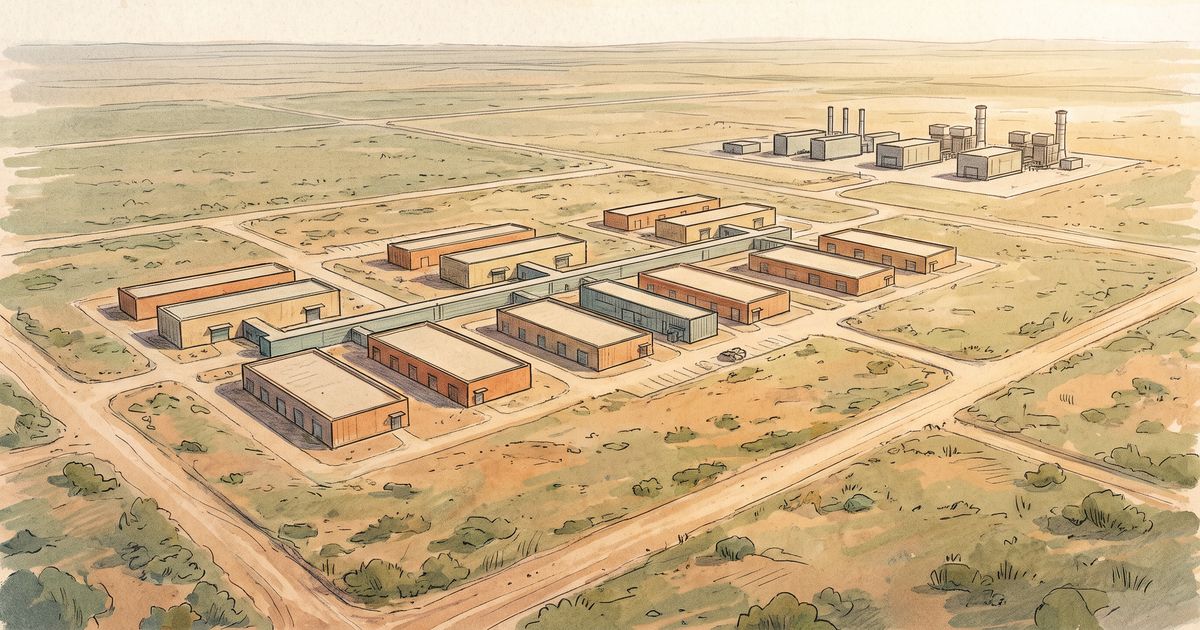
Reporting checked October 3, 2026. Featured and social artwork are AI concept illustrations, not construction photographs or approved site plans.
Two connected developments with separate milestones
| Item | Announced scope | Qualification |
|---|---|---|
| Location | Encinal, Texas | Parcel unverified |
| Data campus | 5 GW full scale | Capacity basis undisclosed |
| Power campus | 6,472 MW generation | Separate gas plant |
| Investment | $22.3B power project | Data-campus cost unknown |
| Power targets | 2029 initial; 2032 full | Conditional generation dates |
| Construction | Announced development | Start and trade awards unverified |
The October 1 Korean ministry release identifies Project Star as a gas combined-cycle project intended to supply nearby AI data centers. It gives the 2029 first-phase and 2032 full-operation targets and reports completion of Korea's domestic investment procedures. These are meaningful development milestones. They do not establish U.S. construction permits, released construction financing, or a data-center handover date.
The joint announcement hosted by NextEra makes initial generation conditional on required permits and approvals. It also describes planned exports of excess generation to the grid. That leaves commercial and engineering questions around phasing, electrical interfaces and delivery commitments. Subtracting 5 GW from 6.472 GW would not establish firm export capability: the two figures have different, incompletely disclosed measurement bases.
For a contractor, the useful unit of opportunity is an issued package with a buyer, defined boundaries and a schedule. A campus-scale announcement can precede those details by a long interval. Power commissioning, building completion, network acceptance and tenant readiness may each have their own milestones. Treating one announced operating year as the deadline for every trade would hide those dependencies.
Who is involved, and what their roles establish
| Organization | Announced role | Award boundary |
|---|---|---|
| Related Digital | Data-campus developer | Tenant undisclosed |
| Related Companies | Power JV partner | Campus GC unverified |
| NextEra Energy Resources | Power JV developer/operator | EPC award unverified |
| Lewis Energy Group | Land, gas and water partner | Installation awards unverified |
The joint release assigns the generation development, construction and operating venture to Related Companies and NextEra Energy Resources, with Lewis providing land, natural gas and produced-water infrastructure. The subsidiary name matters: a parent company's identity or historical portfolio does not identify the subcontracting entity for this project. The announced venture responsibility also does not reveal which outside firms, if any, will receive individual engineering or construction packages.
No general contractor, EPC contractor, architect, design engineer, electrical installer, low-voltage integrator, fiber carrier or equipment supplier award was verified for the campus. Those gaps should remain visible during business development. A vendor's general relationship with a developer, or its appearance on another campus, would be insufficient evidence of an Encinal assignment.
The ministry discusses participation opportunities for Korean equipment, engineering, construction and operations businesses. That is a supply-chain opening, not a named purchase order. Its separate nuclear initiative, Project Power, has a different scope; companies associated with that section should not be imported into Project Star's contractor list. Ask prospective partners to identify the exact contracting entity and work package before treating a relationship as an awarded role.
Where low voltage could become actionable
The following is LVN's prospective scope analysis. Public material reviewed does not provide approved low-voltage drawings, cable quantities, carrier routes or installation awards. The practical value is identifying the questions a bidder would need answered as procurement develops.
| Potential system | Coordination need | Evidence to obtain |
|---|---|---|
| Fiber / outside plant | Entrances and routes | Carrier and pathway scope |
| Structured cabling | Rooms and pathways | Issued design and quantities |
| Power OT networks | Plant/data interfaces | Network owner and tests |
| BMS / cooling controls | Monitoring and alarms | Points list and integrator |
| Access / video | Perimeter and buildings | Device schedule and award |
| Fire / life safety | System interfaces | Approved scope and authority |
Fiber and outside plant: Determine who owns each route from the property boundary to the network room. A campus backbone, carrier entrance and power-plant communications circuit can have different buyers and acceptance requirements. Useful bid documents would identify pathway capacity, spare ducts, crossings, handholes, termination locations and restoration responsibility. Route diversity should be demonstrated in the design; two cables sharing one vulnerable trench do not by themselves establish independent paths.
Cabling and turnover: Request the actual media types, connector requirements, termination details and test deliverables before estimating labor. The commercial conversation should include who approves labels, who supplies final port schedules and how changes reach the as-built documentation. A low material price can become a poor bid if access windows, retesting, remobilization or incomplete design information consume the margin. These are estimating considerations, not known defects in this project.
Controls and operational technology: The two-campus arrangement raises interface questions among generation, electrical distribution, cooling and facility monitoring. Ask which party owns each network, who approves connections and who witnesses acceptance. Equipment suppliers may bring proprietary controls while another contractor supplies pathways or communications cabling. A scope matrix would help separate those responsibilities and prevent an installer from assuming commissioning obligations that were never priced.
Security and life safety: Device schedules, software licensing, monitoring interfaces and authority approvals determine much more than a camera or reader count. Coordination should address doors, gates, emergency operation and access during construction. None of those details can be recovered reliably from an architectural concept image. The next useful evidence would be issued specifications, named integrators or procurement notices that establish actual responsibilities.
Jobs, trades and preparation
The announcement forecasts roughly 8,400 workers at peak construction for the investment and about 170 permanent jobs at the power campus. It separately describes hundreds of permanent data-campus roles. These figures have different scopes. They do not establish current vacancies, actual hires or a data-center-only construction workforce. No executed project labor agreement was verified in the reviewed material.
Potential trade relevance includes fiber technicians, cabling crews, controls specialists, security integrators, commissioning personnel and electrical/civil coordination. The workforce forecast does not break out those occupations. A subcontractor should avoid converting the overall headcount into a presumed cabling crew size or revenue estimate. Crew demand becomes more useful when tied to building phases, mobilization dates and measurable installation quantities.
The Fiber Optic Association's workforce resources offer a general starting point for fiber training. BICSI training provides another communications-infrastructure learning route, while OSHA Outreach covers general hazard-awareness training. These are preparation resources, not Project Star job advertisements or verified credential requirements. Employer onboarding and any project-specific qualifications still need confirmation.
For an existing crew, a useful readiness exercise is assembling a sample turnover package: a clear labeling scheme, example test records, documented instrument calibration, photographs where allowed, and a process for closing punch items. For a business owner, preparation also means understanding insurance, bonding, site access, payment terms and equipment rental exposure once a real package appears. Neither exercise requires assuming a contract exists today.
Cooling, water and the limits of the location evidence
Related Digital's Encinal project page proposes closed-loop cooling for the data campus and treatment of produced water for power-campus use. Its comparisons with office-building water consumption are developer claims. The reviewed sources do not establish permitted quantities, treatment vendors, operating performance or the final allocation of water-system responsibilities.
For controls and communications firms, a treatment concept suggests questions about instrumentation, alarm interfaces and commissioning ownership. It does not establish a purchase order. Before pricing, obtain the applicable design, equipment boundaries and acceptance requirements. Any later claim about water savings should identify its baseline and operating assumptions rather than relying on a promotional comparison alone.
The same project page contains a stale Cheyenne, Wyoming map despite its Encinal text and title. That map cannot locate the Texas site. The current location evidence supports an Encinal city-level reference; exact parcels, access points, acreage and a verified site address remain unresolved here. Estimators should obtain an authoritative site plan before assessing travel, logistics, utility crossings or available laydown space.
What to watch before committing bid resources
Five evidence categories would make this opportunity more concrete: parcel and permit records; data-campus tenant and financing commitments; power, grid and water arrangements; named design and construction teams; and issued trade packages with dates and acceptance criteria. Each answers a different commercial question. A government investment announcement alone cannot supply the missing scope, buyer or mobilization instruction.
For prospective suppliers, a focused introduction can ask which organization will procure fiber, OT communications, controls and security packages, and when qualification requirements will become public. For installers, the first decision is whether the available documents justify a detailed estimate or only early relationship development. Keep the proposed capacity and workforce forecasts attached to their original bases as the project evolves.
Explore projects and company relationships in LVN Signal, and use the LVN data-center map to compare the broader pipeline. Encinal belongs on an early research list. Verified permits, contracting decisions and phased delivery commitments will determine when the announced scale becomes practical low-voltage work.
Join 35,000+ Low Voltage Pros
Get weekly permit updates, tool deals, job opportunities, and industry news. No spam, unsubscribe anytime.