
Join Low Voltage Nation — Find project opportunities and showcase your company to thousands of industry professionals
Google has broken ground on Project Pyramid, its first Arkansas data center — five buildings on 1,178 acres off Bollinger Road in West Memphis, backed by a $4 billion commitment through 2027 and up to $10 billion more if conditions align. Ten low voltage systems and an estimated $160 million in LV work, with no GC, electrical prime, or specialty package holder named. The site sits fifteen minutes from Memphis, where LVN covered St. Jude's $810M research tower two weeks ago.
Google is building its first Arkansas data center in West Memphis — five buildings on 1,178 acres, a $4 billion commitment through 2027, and ten low voltage systems representing an estimated $160 million in LV work. Not one package has been awarded, and the site sits fifteen minutes from a market LVN covered two weeks ago.
Project Overview
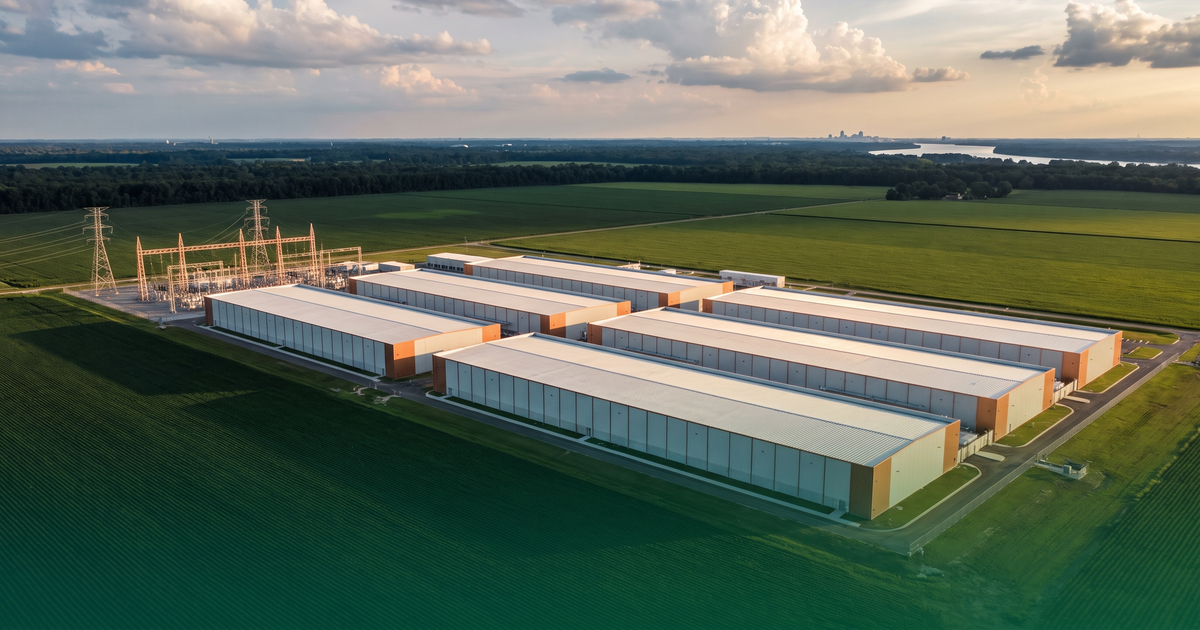
Project data shows Google developing a hyperscale campus known as Project Pyramid on the south side of Bollinger Road in West Memphis, Crittenden County, Arkansas. The campus spans a 1,178-acre property and is planned for five data center buildings plus an on-site substation. Google has broken ground.
The investment is $4 billion in Arkansas cloud and AI infrastructure through 2027, which state officials have described as among the largest economic investments in Arkansas history. The agreement contemplates roughly 50 permanent positions with reporting suggesting the operational headcount could run higher, thousands of construction jobs, and the possibility of up to $10 billion in additional data center construction if conditions align.
Power comes from Entergy Arkansas, with Google covering the full cost of its energy service. The contract also funds Cypress Solar — a 600 MW solar facility backed by 350 MW of battery storage near Pine Bluff in Jefferson County, to be built by Entergy Arkansas — along with electrical infrastructure improvements and peak-demand reduction programs.
| Project | Project Pyramid — Google West Memphis Data Center Campus |
| Location | Bollinger Road, West Memphis, Crittenden County, AR |
| Investment | $4 billion through 2027 (up to $10 billion possible) |
| Scale | 5 data center buildings on 1,178 acres + onsite substation |
| Utility | Entergy Arkansas; Google pays full energy cost |
| New Generation | Cypress Solar — 600 MW solar + 350 MW storage (Pine Bluff) |
| Status | Under construction — ground broken |
| LV Score | 9/10 |
One Labor Pool, Two Markets, Two States
West Memphis is not a separate market from Memphis. It is directly across the Mississippi River, roughly fifteen minutes from downtown, and the contractors who would staff this campus are largely the same people who staff work on the Tennessee side.
That matters right now because of what else is happening within a few miles. LVN covered St. Jude's $810 million ARC II research tower in Memphis two weeks ago — a 16-story, 865,000 square foot building with 130 labs, part of a capital program committing more than $2.3 billion through 2027. FedEx's global hub has anchored the region for decades. And now Google is putting a $4 billion hyperscale campus on the Arkansas bank.
Within one commute radius there are now three fundamentally different technology markets: research and clinical low voltage on the Tennessee side, logistics and industrial around the FedEx hub, and hyperscale mission-critical in Arkansas. Very few metros of this size offer that mix, and almost none of them offer it to the same crews.
The state line is the practical catch, and it is not trivial:
- Licensing is separate. Arkansas and Tennessee license electrical and low voltage work independently. A Memphis contractor with Tennessee credentials does not automatically hold Arkansas standing, and reciprocity is not something to assume the week a bid is due.
- Tax and incentive treatment differs. Arkansas structured a major incentive package around this project. Which side of the river a contract is performed on changes withholding, registration, and sometimes prevailing wage exposure.
- Crews cross a bridge with real constraints. Mississippi River crossings are limited, and shift timing against them is a genuine scheduling input on a campus needing thousands of construction workers.
The contractor who sorts out dual-state licensing now is positioned for both a decade of St. Jude work and a decade of Google work from a single office. That is an unusual amount of leverage from a piece of paperwork.
Google Is Funding Generation, Not Just Consuming It
LVN has covered the failure mode where a data center is built and then cannot energize — most directly in Santa Clara, where finished buildings sit dark waiting on interconnection. Project Pyramid is structured to avoid that.
Google is paying the full cost of its energy service rather than socializing it across Entergy's ratepayers, and the contract funds new generation rather than drawing on existing headroom: 600 MW of solar and 350 MW of storage at Cypress Solar, plus electrical infrastructure improvements and demand-reduction programs. The campus also carries its own substation.
For a low voltage contractor evaluating whether a data center opportunity is real, that structure is the tell. New dedicated generation, a funded utility partner, an onsite substation, and an owner absorbing the energy cost is the profile of a project that will energize, commission, close out, and release retention on something close to schedule.
Low Voltage Systems Breakdown
Signal tracks ten low voltage systems on this campus — the full hyperscale stack, delivered building by building across five structures.
| System | Category | Scope Description | Complexity |
|---|---|---|---|
| Fiber | Data | Single-mode backbone within and between five buildings, MPO/MTP trunk architecture, and high-density patching carrying east-west AI cluster traffic. Splice counts across a five-building campus run into the tens of thousands. | Very High |
| Outside Plant | Data | Campus duct bank, handholes and vaults, carrier entrance, and diverse-path routing across 1,178 acres. Mississippi Delta soils and a high water table make trenching, vault setting, and drainage design meaningfully harder than on high desert sites. | Very High |
| Structured Cabling | Data/Voice | Horizontal and backbone copper, cabinet-level patching, overhead pathway and ladder rack across all five buildings plus admin and operations space. Repetitive at volume — a production-labor package where crew depth decides schedule. | High |
| Access Control | Security | Layered perimeter-to-hall credentialing, mantraps, turnstiles, and biometric readers at data hall entries. Google's operational security standards are among the most demanding in the sector and carry documentation requirements a commercial integrator may not have practiced. | Very High |
| CCTV | Security | Perimeter, yard, substation approach, entry, corridor, and data hall coverage with long retention and analytics. Perimeter alone is substantial on a 1,178-acre parcel. | High |
| Fire Alarm | Life Safety | Addressable detection with very early warning aspirating smoke detection in data halls, integrated with clean-agent or pre-action release and sequenced against the electrical and mechanical shutdown matrix. Arkansas AHJ coordination on a first-of-kind facility in the county adds review time. | Very High |
| BMS / Controls | Building Automation | Cooling plant control, containment and thermal monitoring, generator and substation status integration, and EPMS tie-ins across five buildings with shared campus infrastructure. | Very High |
| Networking | Data | Facility, OT, and security network infrastructure separate from the compute fabric — the layer that keeps the campus observable and manageable. | High |
| DAS | Wireless | In-building cellular across large structures with heavy electrical infrastructure, plus public safety radio coverage verified by the local fire authority. Outdoor coverage across 1,178 acres is its own design problem. | Medium-High |
| Grounding & Bonding | Infrastructure | Signal reference and telecom bonding backbone, ground rings, cabinet and pathway bonding to IEEE and BICSI practice, coordinated with substation grounding. Delta soil resistivity and seasonal water table movement complicate ground system design and testing. | High |
Estimated Low Voltage Value
| Announced Investment | $4,000,000,000 through 2027 |
| Hyperscale LV Benchmark | approximately 4% |
| Estimated LV Contract Value | approximately $160 million |
The 4% benchmark applies because $4 billion is an announced capital investment figure covering land, buildings, IT hardware, and program cost through 2027 rather than a permitted construction value for specific structures. Stating the basis matters: the same building priced off a permit value would carry a higher percentage against a much smaller number.
Practically, $160 million across ten packages and five buildings produces awards in the $5 million to $30 million range, released as buildings come online. And if the additional $10 billion of future construction materializes, the same relationships carry forward against a figure several times larger.
Skills and Certifications Required
| System | Key Certifications | Critical Skills |
|---|---|---|
| Fiber & Outside Plant | BICSI INSTF, BICSI OSP, FOA CFOT/CFOS, BICSI RCDD | Mass fusion splicing, MPO/MTP polarity management, OTDR and Tier 2 testing, duct bank design in high-water-table Delta soils |
| Structured Cabling | BICSI RCDD, BICSI DCDC, INSTC, manufacturer certification | High-volume production installation, pathway and containment design, Fluke certification at scale, multi-building as-built discipline |
| Fire Alarm | NICET Fire Alarm Level III+, Arkansas licensing | VESDA and aspirating detection, clean-agent and pre-action release logic, NFPA 72, shutdown matrices, county AHJ coordination |
| Access Control & CCTV | ASIS PSP, manufacturer certification (Genetec, Lenel, Software House, Axis) | Hyperscale-grade credentialing and audit documentation, large-scale VMS architecture, long-retention storage design |
| BMS / Controls & Networking | Tridium Niagara N4, BACnet, IEC 62443 for OT security | Cooling sequences, EPMS integration, OT segmentation, multi-building campus controls |
| Grounding & Commissioning | BICSI/IEEE bonding practice, ACP/CxA credentials | Telecom bonding backbone, signal reference grids, soil resistivity testing, Level 4-5 integrated systems testing |
The gating item for most contractors reading this is not technical. Verify your Arkansas licensing standing before you chase this. A Tennessee-credentialed Memphis integrator needs to confirm what Arkansas requires for electrical and low voltage scopes at this value, and start that process well before an invitation to bid.
Market Signal
Public sources name Google and Entergy Arkansas. They do not name a general contractor or EPCM, an engineer of record, an electrical prime, or the holder of any technology package — not fiber and outside plant, not structured cabling, not security, not fire alarm, not BMS, not DAS and networking, not grounding, not commissioning. The campus has broken ground, which means those decisions are being made now.
The larger pattern is worth naming. This is the fifth mid-size American metro LVN has covered this summer where a single enormous owner is reshaping the local low voltage market: Meta in Tulsa, St. Jude in Memphis, Brookfield at Paducah, Micron in Boise, and now Google in West Memphis. In every case the demand is enormous, the local contractor base is thin relative to it, and the deciding factor is which firms position before the buyout rather than after.
West Memphis has an additional wrinkle the others do not: the labor is already there, fifteen minutes away, working on hospitals and a cargo hub. It just needs a license on the correct side of the river.
Find Projects Like This on Signal
LVN Signal tracks thousands of construction projects with low voltage opportunities across the country. Filter by city, system type, and project value to find your next bid.
Join 35,000+ Low Voltage Pros
Get weekly permit updates, tool deals, job opportunities, and industry news. No spam, unsubscribe anytime.