
Join Low Voltage Nation — Find project opportunities and showcase your company to thousands of industry professionals
Tampa's $235 million InVision Streetcar project extends the TECO Line 1.3 miles into Tampa Heights and modernizes the existing 2.7-mile system with ten new low-floor vehicles and rebuilt stations. Five low voltage systems and an estimated $17.6 million in LV work — in a discipline most building integrators have never bid. HDR holds the design contract; nothing on the construction side is awarded.
Tampa's $235 million InVision Streetcar extension and modernization requires five low voltage systems and an estimated $17.6 million in LV work — in a discipline almost no building low voltage contractor has ever bid.
Project Overview
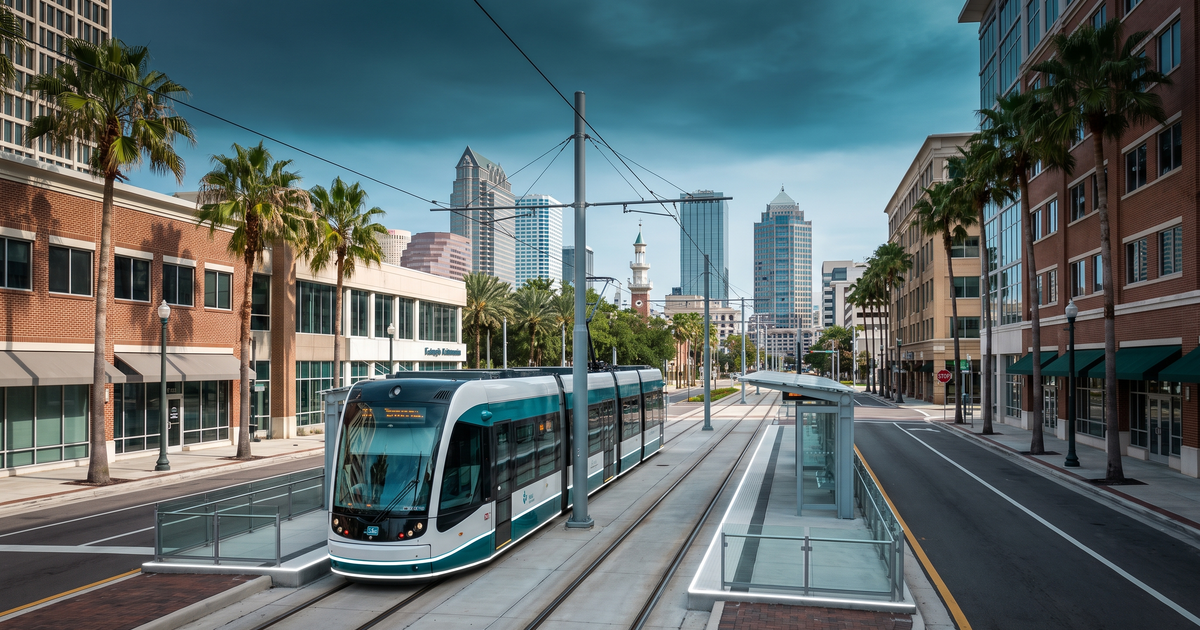
Project data from the City of Tampa's capital program shows the InVision Streetcar Extension and Modernization at a capital value of approximately $234.5 million. The project does two things at once: it extends the existing TECO Line Streetcar 1.3 miles north from its current downtown terminus, through the downtown core and into Tampa Heights, and it modernizes the existing 2.7-mile system that has run since 2002.
The modernization is substantial. It includes ten new modern low-floor streetcar vehicles replacing the current replica cars, reconstruction of existing stations and tight curves along the alignment to accommodate the new vehicles, adjustments to the overhead power supply along the route, and an expanded vehicle maintenance and storage facility. When complete the system runs roughly four miles.
The project is sponsored by the City of Tampa with the Hillsborough Area Regional Transit Authority (HART) and Tampa Historic Streetcar, Inc. Funding is assembled from the city, HART, the Federal Transit Administration's Small Starts capital investment program, and the Florida Department of Transportation, which awarded $67.3 million toward the project in early 2024. FTA approved entry into Project Development in 2018 and the project remains in active Small Starts evaluation. FTA projects the extension will add roughly 6,700 daily riders; the system currently operates fare-free, and FDOT has contributed to keeping it that way.
| Project | InVision Streetcar Extension & Modernization |
| Location | Downtown Tampa to Tampa Heights, Tampa, FL |
| Capital Value | approximately $234.5 million |
| Scope | 1.3-mile extension + modernization of the existing 2.7-mile line |
| Vehicles | 10 new modern low-floor streetcars |
| Phase | Preliminary design / active FTA Small Starts evaluation |
| Lead Consultant | HDR Engineering, Inc. |
| LV Score | 10/10 |
| Source | Tampa Capital Projects |
Why This One Is Different
Every other project LVN has spotlighted this month has been a building. This is not a building. It is roughly four miles of public right-of-way, and that changes nearly everything about how the low voltage scope is designed, installed, and inspected.
The work is outdoors, in traffic, and permanently exposed. Wayside cabinets, cameras, and communications equipment live in NEMA-rated enclosures on poles and in the street, not in a conditioned IDF closet. Surge protection is not optional. Lightning exposure in Florida is the highest in the continental United States, and every wayside device on a four-mile alignment is a potential entry point.
Stray current is a real design constraint. A streetcar runs on an overhead contact system in the 600 to 750 volt DC range with the running rails as the return path. Imperfect rail-to-earth isolation puts stray DC current into the ground, which drives corrosion on buried utilities and can play havoc with grounding and reference potentials for nearby electronics. Grounding and bonding on a rail project is engineered around that reality, and it is not the same conversation as a telecom bonding backbone in an office tower.
Signaling here means traffic, not railroad. A downtown streetcar in mixed traffic does not use conventional railroad block signaling. The systems scope is transit signal priority, wayside vehicle detection, and grade-crossing and intersection interfaces that tie into the city's existing traffic signal network. That means your work integrates with a municipal traffic operations center, and the agency owning that interface is the traffic engineer, not the building AHJ.
Federal money brings federal rules. FTA Small Starts and FDOT participation mean Buy America requirements on materials, Disadvantaged Business Enterprise participation goals, federal wage determinations, and procurement processes that look nothing like a private negotiated buyout. Contractors who have never held a federally funded transit contract should understand that qualifying takes real time.
Low Voltage Systems Breakdown
Signal tracks five low voltage systems on this project. On a rail program these are usually procured as a single "systems" package or a small set of them, rather than as the dozen separate trade awards a building generates.
| System | Category | Scope Description | Complexity |
|---|---|---|---|
| Signaling | Transit Systems | Transit signal priority at intersections along the alignment, wayside vehicle detection, and interfaces to the City of Tampa traffic signal system. Includes the controller cabinets, detection, and communications back to traffic operations. This is the scope most building integrators have never touched, and it is the one that most clearly separates qualified bidders. | Very High |
| Structured Cabling | Data/Communications | The communications backbone along the alignment — fiber connecting stops, traction power substations, the maintenance and storage facility, and a central control point. Outside plant discipline dominates: duct bank, handholes, pull boxes, and splice enclosures in an active urban street, coordinated with every other utility under that street. | High |
| CCTV | Security | Platform and stop coverage across the extended alignment, plus the maintenance and storage facility, traction power substations, and yard. Outdoor camera selection, pole mounting, PoE reach over long runs, and backhaul to a monitoring point. Public transit video also carries retention and public-records considerations a private building does not. | High |
| Access Control | Security | Restricted areas rather than a whole building: the expanded vehicle maintenance and storage facility, traction power substations, control and communications rooms, and equipment cabinets along the alignment. Substation and wayside cabinet intrusion monitoring is part of the scope. | Medium-High |
| DAS / Radio | Wireless | Operations radio coverage along the alignment and inside the maintenance facility, plus public safety radio coverage where the alignment passes through or under structures. Passenger information and real-time arrival displays at rebuilt stations depend on this connectivity layer. | Medium-High |
Two adjacent scopes are worth watching even though Signal does not currently track them here. SCADA for traction power — monitoring and control of the substations feeding the overhead line — is standard on rail modernization and is squarely low voltage work. And fare collection is conspicuously absent, because the system runs fare-free today; if that policy changes during the program, a fare collection package appears.
Estimated Low Voltage Value
| Capital Value | approximately $234,500,000 |
| Estimated LV Percentage | 6.5% (transportation midpoint) |
| System Count Multiplier | 1.15x (5 systems) |
| Estimated LV Contract Value | approximately $17.6 million |
Treat this figure as directional, and understand why. A streetcar's capital cost is dominated by things that are not low voltage: track and civil work, the overhead contact system and traction power substations, ten vehicles, station reconstruction, and the maintenance facility expansion. The systems scope is a smaller slice than it would be in a data center or a hospital.
The counterweight is that the project is still in preliminary design. The systems split is not fixed, and on rail programs the communications and signaling package frequently grows once the operations concept is finalized. A range of roughly $15 million to $22 million is a more honest planning envelope than a single number.
Skills and Certifications Required
| System | Key Certifications | Critical Skills |
|---|---|---|
| Signaling | IMSA Traffic Signal Field Technician / Signal Inspector, state traffic signal certifications | Transit signal priority, controller cabinet wiring and programming, vehicle detection, traffic operations center interfaces |
| Communications / Cabling | BICSI RCDD, BICSI OSP, INSTF, FOA CFOT/CFOS | Outside plant design, duct bank and handhole coordination, fusion splicing, OTDR testing, utility conflict resolution in active streets |
| CCTV | Manufacturer certification (Axis, Avigilon, Genetec, Milestone) | Outdoor and pole-mounted camera design, long-run PoE and media conversion, environmental hardening, VMS architecture |
| Access Control | ASIS PSP, manufacturer certification | Facility and substation credentialing, cabinet intrusion monitoring, integration with agency operations |
| Grounding & Bonding | IEEE and BICSI bonding practice; familiarity with stray current mitigation | Rail-to-earth isolation awareness, DC stray current effects, surge protection coordination, lightning protection in a high-strike region |
Beyond the technical credentials, three qualifications gate this work. Contractors need maintenance-of-traffic certification and experience, because the work happens in live travel lanes. They need right-of-way and rail safety training to work near an energized overhead system and operating vehicles. And they need to be set up for federally funded procurement — Buy America documentation, DBE participation, certified payroll. In Florida, contractors should also verify their state electrical or alarm licensing covers this scope.
Market Signal
The useful takeaway here is not this one project. It is the category.
Rail transit systems work is an adjacent market that most building low voltage integrators have never seriously pursued, and the barriers are more procedural than technical. A contractor who can pull fiber, terminate Cat6A, design outdoor camera coverage, and engineer a grounding system already owns most of the underlying skill. What they lack is IMSA-certified signal staff, maintenance-of-traffic experience, rail safety training, and a federal procurement track record — all acquirable, none quick.
Tampa is a good place to notice this because the city is running an unusually broad capital program. Alongside the streetcar, LVN's data currently shows a wastewater treatment plant rehabilitation above $77 million, water treatment plant improvements at $52.9 million and $41 million, a $65 million flood relief and stormwater program, a $19.7 million pumping station rehabilitation, and a $34.7 million community and senior center. That is a municipal owner buying a lot of instrumentation, SCADA, security, and communications across several years, through the same procurement office.
The strategic read: get qualified with the City of Tampa now, on the water and stormwater work where a building integrator's skills transfer most directly. Use those contracts to build the certified payroll and DBE history that federally funded transit procurement demands. Then the streetcar systems package — which is years from award and currently has nothing but a design consultant attached to it — becomes a project you can credibly bid rather than one you read about.
Find Projects Like This on Signal
LVN Signal tracks thousands of construction projects with low voltage opportunities across the country. Filter by city, system type, and project value to find your next bid.
Join 35,000+ Low Voltage Pros
Get weekly permit updates, tool deals, job opportunities, and industry news. No spam, unsubscribe anytime.