
Join Low Voltage Nation — Find project opportunities and showcase your company to thousands of industry professionals
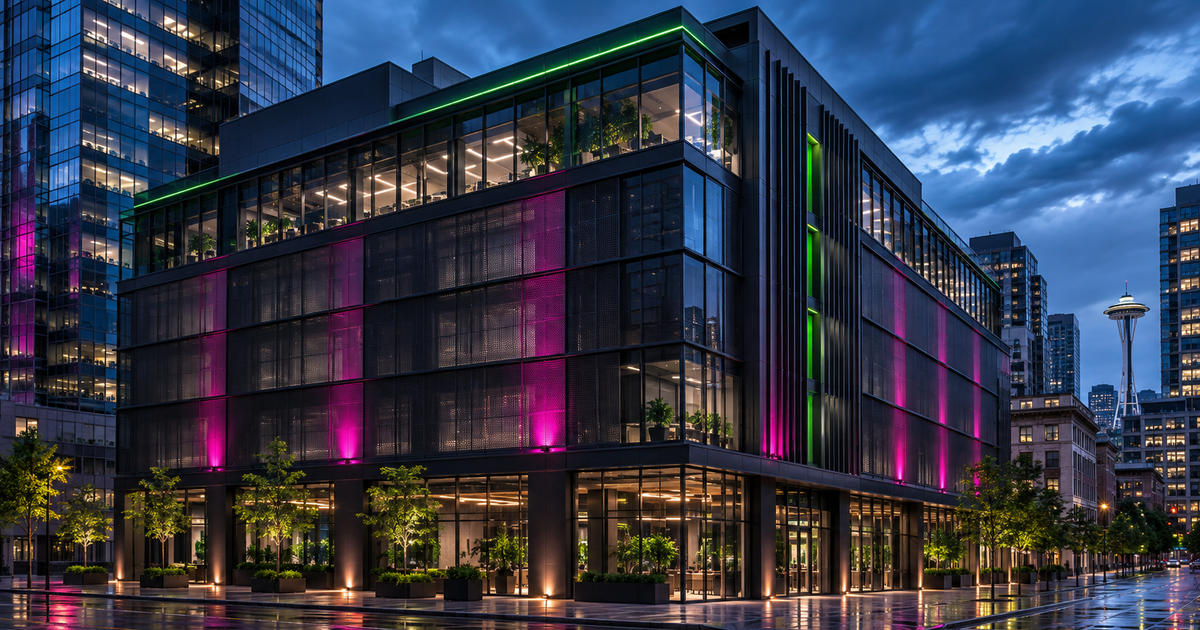
Digital Realty's proposed six-story urban data center at 301 Virginia Street carries a $10 million filing valuation and six modeled low-voltage systems. The planning range is $600,000 to $1 million, with permitting and Seattle's data-center moratorium making preconstruction timing the real story.
A $10 million downtown Seattle data-center filing puts six low-voltage systems on the planning board at 301 Virginia Street. Using the tracked filing valuation as the pricing base, the modeled specialty scope lands between $600,000 and $1 million—before servers, utility upgrades, mechanical cooling, and owner-furnished network electronics.
Project Overview
Seattle permit records identify two linked applications for the same development: demolition filing 7150832-DM and construction filing 7150881-CN. The proposal would replace the former retail building and parking garage at 301 Virginia Street, also associated with 1930 Third Avenue, with a six-story research-and-development laboratory, office, retail, and business-support building that includes a colocation data center. The Signal record carries a $10 million estimated filing value and a 9/10 low-voltage opportunity score.
The tracked amount should not be mistaken for a final construction contract or total installed program budget. Public reporting describes a roughly 58,000-square-foot site and four data-center floors within the six-story building, but no verified gross building area, trade award, or final electrical capacity has been published. Digital Realty described the concept as a highly connected, network-dense facility rather than an AI training campus, which changes the low-voltage emphasis from hyperscale compute hardware to carrier access, interconnection, physical security, life safety, and tenant-ready pathways.
The entitlement clock is unusually important here. Seattle adopted a one-year moratorium for new data centers above 20 megavolt-amperes in June 2026, while this project's land-use drawings were filed before the vote. KUOW reported that the application is likely to continue because it may fall below that threshold and was submitted before the moratorium. Seattle's Department of Construction and Inspections scheduled a public meeting in October, so the defensible status is proposed and in review—not awarded, permitted for vertical work, or under construction.
| Project | Digital Realty Block 50 / 301 Virginia Street data center |
| Location | 301 Virginia Street / 1930 Third Avenue, Seattle, Washington |
| Tracked Filing Value | $10 million |
| Program Value | Not publicly verified |
| Project Type | Urban colocation data center, R&D lab, office, and retail |
| Status | Proposed; permit and public-review process active |
| LV Score | 9/10 |
| Signal Systems | 6 |
| Source | Seattle Building Permits |
Key Players and the Open Seats
The public record resolves the operator and property owner, but not the team that would hold the construction and specialty packages. That gap matters: this is still a preconstruction account-development play, not a late-stage bid notice. Contractors should treat every unfilled role below as unverified until a permit filing, owner announcement, or direct procurement contact names the firm.
| Role | Organization | What Is Verified |
|---|---|---|
| Proposed developer / operator | Digital Realty | Publicly identified with the 301 Virginia proposal; company says the concept is network-dense colocation, not an AI data center. |
| Property owner | Clise Properties | Owns the full city block that includes the project site, according to local reporting. |
| Permitting authority | Seattle SDCI | Reviewing the linked demolition, construction, and land-use applications. |
| GC / architect / MEP engineer | Not publicly verified | No source-backed award should be inferred from a directory listing or scraped domain. |
| LV integrators | Not publicly verified | No structured-cabling, security, fire-alarm, DAS, or AV award has been announced. |
Low-Voltage Systems Breakdown
Signal models six system lanes from the filed use, urban colocation profile, and life-safety requirements. These are opportunity categories, not awarded scopes. The strongest commercial angle is coordination: a compact multi-story facility forces carrier, tenant, landlord, security, and fire-alarm pathways to share risers and floor transitions without collapsing their ownership boundaries.
| System | Category | Likely Scope | Complexity |
|---|---|---|---|
| Structured Cabling | Data / Voice | Carrier entrances, meet-me-room pathways, diverse risers, tenant cross-connect routes, copper service cabling, fiber backbone, labeling, testing, and turnover documentation. A network-dense colocation model makes pathway diversity and demarcation discipline more valuable than raw cable volume alone. | High |
| Access Control | Security | Layered credential zones from the public-facing retail edge through loading, operations, white-space, and roof or equipment areas. Door hardware coordination, anti-passback logic, visitor workflows, and tenant-versus-operator permissions will drive programming effort. | High |
| CCTV / Video Surveillance | Security | Perimeter, garage and loading coverage, lobbies, critical corridors, equipment access points, and audit-quality retention. Camera placement must respect the mixed-use street frontage while preserving evidence coverage inside controlled areas. | High |
| Fire Alarm | Life Safety | Addressable detection and notification across data halls, labs, offices, retail, back-of-house rooms, and mechanical spaces, with interfaces to suppression, smoke control, elevators, and emergency operations. Phased occupancy would make cause-and-effect testing especially important. | High |
| Distributed Antenna System | Wireless | Public-safety radio and in-building cellular coverage through a dense steel-and-concrete urban structure. Survey, design, carrier or AHJ coordination, donor-path planning, fiber distribution, and acceptance testing should be separated from unverified carrier commitments. | High |
| Audio / Visual | AV | Operations rooms, meeting and lab collaboration spaces, digital wayfinding, incident-briefing displays, and retail or public-area interfaces. This is the smallest modeled lane, but it touches both workplace and network standards. | Medium |
Estimated Low-Voltage Value
This spotlight applies the edge-data-center benchmark to the $10 million filing valuation, not to an undisclosed campus investment. For a data-center project under roughly $100 million, LVN uses a planning range of 6% to 10% when the tracked scope includes multiple security, life-safety, wireless, and communications systems. That produces an estimated $600,000 to $1 million low-voltage range, with an $800,000 planning midpoint.
| Tracked Filing Value | $10,000,000 |
| Planning Benchmark | 6% to 10% for a sub-$100M edge / colocation data-center filing |
| Estimated LV Range | $600,000 to $1,000,000 |
| Planning Midpoint | $800,000 |
| Confidence | Moderate-low until gross area, capacity, design package, and procurement structure are public |
The six-system breadth is already reflected in the published range; no extra system-count multiplier is stacked on top. The midpoint is useful for account sizing, not for a takeoff. If the $10 million figure covers only early permitting, demolition, or a partial building package, the actual LV opportunity could move materially. Conversely, active network hardware, servers, storage, utility service, switchgear, UPS equipment, generators, and cooling plant do not become low-voltage revenue simply because they appear in the same data-center budget.
Scope Boundary Contractors Should Carry
The contractor-addressable base should include pathways, backbone and horizontal cabling, splicing, testing, racks and cabinets when assigned, physical-security devices and integration, fire-alarm devices and interfaces, DAS infrastructure, AV endpoints, software configuration, commissioning support, as-builts, and training. It should exclude owner-furnished servers and network electronics, tenant IT equipment, utility interconnection, medium-voltage distribution, major mechanical cooling, and the base-building electrical package except where explicit low-voltage interfaces are assigned. A bid that blurs those lines will look larger on paper and weaker in procurement.
Skills and Certifications Required
| Workstream | Useful Credentials | Critical Skills |
|---|---|---|
| Cabling and fiber | BICSI INST1, INSTC, INSTF, TECH; RCDD for design oversight | Diverse-pathway planning, fiber splicing, copper certification, cross-connect documentation, grounding and bonding |
| Access control and CCTV | Washington limited-energy qualification; PSP for senior security leadership | Door hardware, PoE networking, camera placement, identity workflows, VMS and access-control integration |
| Fire alarm | NICET Fire Alarm Level II or higher; applicable Washington electrical certification | NFPA 72, SLC and NAC wiring, sequence testing, elevator and suppression interfaces, AHJ coordination |
| DAS | RCDD or RF engineering background; project-specific public-safety radio qualifications | RF survey, antenna layout, fiber distribution, interference testing, AHJ acceptance |
| AV | AVIXA CTS, CTS-I, or CTS-D as role-appropriate | AV-over-IP, display and control integration, room commissioning, network coordination |
Washington licensing needs to be settled before pricing labor. The state's Department of Labor & Industries requires electrical contractors to hold the appropriate license, and the limited-energy systems specialty covers power-limited signaling work such as fire protection, intrusion, controls, and communications. A telecommunications contractor license alone does not automatically cover every security, fire-alarm, or control-system task. Contractors should map each package to the correct business license, administrator, electrician certificates, permits, and inspection authority before staffing the job.
Market Signal: Urban Fiber Density Beats Greenfield Scale
This proposal is not another remote hyperscale campus. It is an urban infill facility placed near Seattle's established carrier ecosystem and Digital Realty's existing SEA10 presence in the Westin Building. That location supports a different sales case: low-latency interconnection, diverse carrier access, dense cross-connects, tenant turnover, and high security per square foot. For LV contractors, the address is a reminder that smaller megawatt projects can carry unusually demanding pathways and commissioning requirements.
The regulatory context is equally commercial. Seattle's moratorium and policy framework uses a 20 MVA threshold, while Seattle City Light's new large-load policy begins at 10 MVA. Capacity, service-queue position, curtailment obligations, and infrastructure cost responsibility can now move a project schedule as much as design review. Integrators should qualify power and entitlement milestones before treating a conceptual completion date as a purchasing date.
The near-term business-development move is preconstruction outreach, not a hard bid chase. Digital Realty and Clise Properties have source-backed roles, but no GC, architect, engineer, or LV package holder is public. A contractor with urban fiber, occupied-block logistics, multi-tenant security, fire-alarm integration, and commissioning depth has a credible reason to open the conversation now: define demarcations, reserve diverse riser space, price test documentation, and prevent landlord-versus-tenant scope gaps before drawings harden.
Find Projects Like This on Signal
LVN Signal tracks thousands of construction projects with low-voltage opportunities across the country. Filter by city, system type, project value, and stage to find your next bid.
Join 35,000+ Low Voltage Pros
Get weekly permit updates, tool deals, job opportunities, and industry news. No spam, unsubscribe anytime.