
Join Low Voltage Nation — Find project opportunities and showcase your company to thousands of industry professionals
The U.S. Coast Guard''s $137 million Base Seattle modernization requires six low voltage systems including structured cabling, access control, CCTV, fire alarm, DAS, and lighting control. Whiting-Turner leads this Phase 1A waterfront recapitalization with an estimated $7.9 million in LV contract value.
$137 million Coast Guard base modernization in Seattle requires 6 low voltage systems, creating an estimated $7.9 million opportunity for contractors in the Washington market. This Phase 1A project is the opening salvo of a $323 million program to prepare Base Seattle for the nation's next-generation polar security cutters.
Project Overview
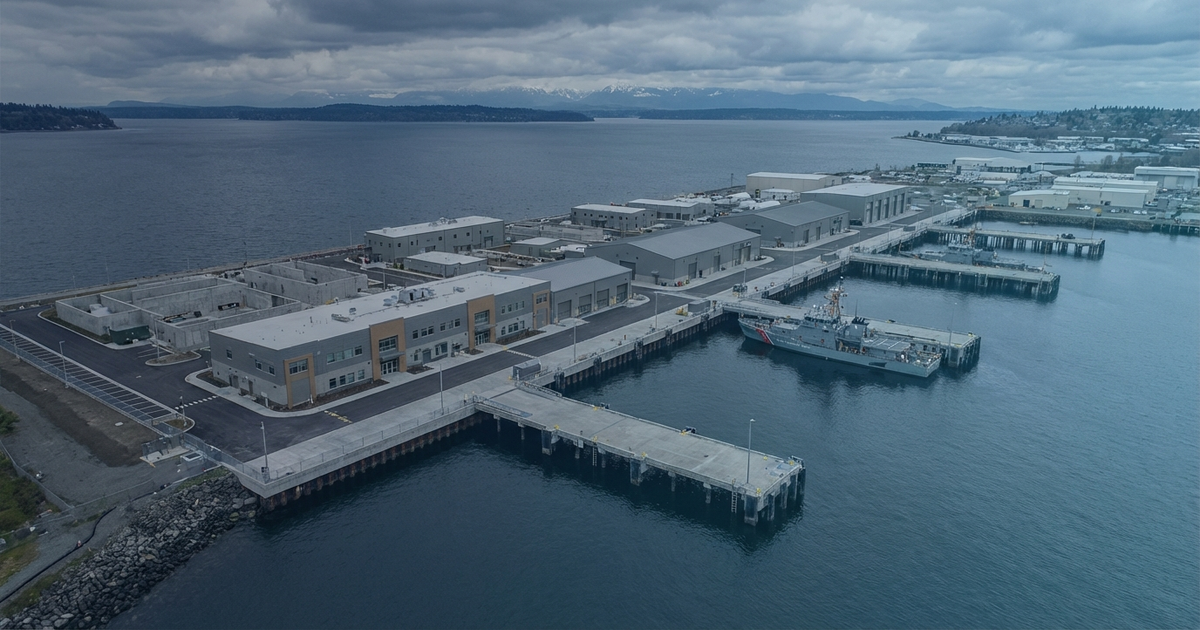
The U.S. Coast Guard is investing $137 million in Phase 1A of its Base Seattle Modernization and Homeporting Program, a sweeping effort to transform 54 acres of Seattle waterfront into a world-class facility capable of supporting Polar Security Cutter (PSC) operations in the Arctic and Antarctic. The project is located at 1519 Alaskan Way S in Seattle, Washington, along the city's industrial waterfront south of Pioneer Square.
Phase 1A encompasses the CERCLA (Comprehensive Environmental Response, Compensation and Liability Act) cleanup of Slip 36 — the largest CERCLA action and removal of hazardous substances in Coast Guard history — along with major waterfront recapitalization work. The contract was awarded in August 2025 through a performance-based design-build bridging process, giving the contractor flexibility in execution while maintaining strict performance accountability.
The scope includes widening the slip between berths 36B and 37B, upgrading berths 37A and 37B with modernized utilities capable of hosting two new polar security cutters, demolishing an existing building, stabilizing the waterfront at Berth 36B, and recapitalizing Station Seattle's small boat docks and boathouse. Future phases 1B and 1C will deliver four major cutter berths and further modernize base facilities.
| Project | Base Seattle Slip 36 CERCLA Clean Up and Waterfront Recapitalization Phase 1A |
| Location | 1519 Alaskan Way S, Seattle, WA |
| Total Value | $137 million (Phase 1A) / $323 million (full program) |
| Project Type | Government / Military Base Modernization |
| Status | Active — Contract Awarded |
| LV Score | 7/10 |
| Source | Seattle Building Permits |
Key Players
This project brings together a major national general contractor with one of the largest federal agencies in the United States. The contract was awarded through the Coast Guard's Facilities Design and Construction Center (FDCC).
| Role | Company | Details |
|---|---|---|
| Owner | U.S. Coast Guard | Federal agency responsible for maritime safety, security, and environmental stewardship. Base Seattle is the future homeport for Polar Security Cutters supporting Arctic and Antarctic operations. |
| General Contractor | The Whiting-Turner Contracting Company | Founded in 1909, Whiting-Turner is one of the largest general contractors in the U.S., providing construction management, general contracting, and design-build services nationwide. Their Seattle office in Bellevue manages Pacific Northwest operations. |
Low Voltage Systems Breakdown
This project requires six low voltage systems spanning security, life safety, wireless communications, and building automation — a comprehensive scope reflecting the operational demands of a military installation supporting polar operations. The base must maintain communications in extreme conditions and provide robust security across a 54-acre waterfront campus.
| System | Category | Scope Description | Complexity |
|---|---|---|---|
| Structured Cabling | Data/Voice | Backbone and horizontal cabling infrastructure for the modernized base facilities, including fiber optic runs between buildings and berths. Marine and waterfront environments demand ruggedized pathways, sealed conduit, and corrosion-resistant hardware. The cabling plant must support both administrative operations and cutter vessel shore-power data connectivity. | High |
| Access Control | Security | Military-grade access control across a 54-acre federal installation with multiple entry points, berths, and restricted zones. Expect HSPD-12 compliant card readers, turnstiles, vehicle barriers, and integration with the Coast Guard's identity management systems. Waterfront gates and dock access points require weather-hardened hardware. | High |
| CCTV / Video Surveillance | Security | Comprehensive video surveillance covering waterfront perimeters, berths, building exteriors, and interior spaces. Maritime facilities require cameras with enhanced weather protection, salt-air resistance, and marine-rated housings. Video analytics for perimeter intrusion detection are standard for military installations of this scale. | High |
| Fire Alarm | Life Safety | Complete fire alarm system for new and renovated facilities, including waterfront structures and the recapitalized boathouse. Federal facilities must comply with UFC (Unified Facilities Criteria) fire protection standards in addition to NFPA 72. Marine-adjacent structures introduce unique detection challenges due to salt air and humidity. | High |
| DAS (Distributed Antenna System) | Wireless | In-building and campus wireless coverage for reliable communications across the base. Military installations require robust DAS infrastructure to support both commercial carrier signals and potential FirstNet/public safety communications. Waterfront signal propagation is complicated by large metal vessel hulls and industrial structures. | High |
| Lighting Control | Building Automation | Intelligent lighting control systems for modernized facilities, including exterior waterfront lighting, dock illumination, and interior building automation. Federal energy mandates require advanced controls with occupancy sensing, daylight harvesting, and centralized scheduling. Maritime safety lighting at berths adds regulatory complexity. | Medium |
Estimated Low Voltage Value
The estimated low voltage contract value for this project is calculated using industry benchmarks for government and military facility construction with six integrated systems. Given that a significant portion of the $137 million budget covers heavy civil work (dredging, waterfront stabilization, environmental remediation), the LV percentage has been adjusted from the standard government/municipal midpoint.
| Total Project Value | $137 million (Phase 1A) |
| Estimated LV Percentage | 5% of total project value |
| System Count Multiplier | 1.15x (6 systems) |
| Estimated LV Contract Value | $7.9 million |
At approximately $7.9 million, this represents one of the larger LV contract opportunities in the Pacific Northwest. The structured cabling and access control systems alone could account for $3 million to $4 million of that total, with DAS and fire alarm each commanding $800,000 to $1.5 million depending on scope. Contractors should note that this is Phase 1A only — the full $323 million program across all phases could yield $15 million to $20 million in total LV work.
Federal military projects typically carry higher margins than commercial work due to security clearance requirements, prevailing wage obligations, and the complexity of UFC compliance. However, the competitive pool is smaller — firms without experience in federal contracting and security-sensitive environments will face barriers to entry.
Skills and Certifications Required
This project demands a workforce with both technical LV expertise and federal facility clearance. The combination of military-grade security, maritime environmental challenges, and CERCLA remediation creates a complex working environment that favors experienced teams.
| System | Key Certifications | Critical Skills |
|---|---|---|
| Structured Cabling | BICSI INST2, RCDD (design), CommScope/Panduit certs | Fiber splicing, Cat6A termination, marine-rated conduit, Fluke certification testing |
| Access Control | PSP (ASIS), HSPD-12 compliance training, Lenel/Genetec certs | Federal PACS integration, vehicle barrier systems, IP networking, credential management |
| CCTV | Axis/Avigilon manufacturer certs, CompTIA Network+ | Marine-rated camera installation, video analytics, NVR/VMS configuration, PoE networking |
| Fire Alarm | NICET Level II+, State License, UFC fire protection training | NFPA 72 + UFC compliance, SLC/NAC wiring, marine environment detection |
| DAS | BICSI RCDD, RF engineering, carrier certifications | RF design for waterfront propagation, FirstNet integration, antenna placement |
| Lighting Control | Manufacturer certs (Lutron, Crestron), BACnet certification | Federal energy compliance, occupancy sensing, maritime safety lighting, centralized scheduling |
Entry-level technicians with BICSI Installer 1 or NICET Level I can contribute to cable pulling, device mounting, and basic terminations. Mid-level technicians with NICET Level II or BICSI INSTC will handle system wiring, testing, and commissioning. This project will require at least one RCDD for cabling design oversight, a NICET Level III+ for fire alarm engineering, and RF engineers for the DAS design.
Critically, contractors bidding on this project must be prepared to meet federal security requirements. Working on a military installation typically requires background checks for all personnel, and certain areas may require additional clearances. Firms should verify their Washington State low voltage contractor license and federal contracting credentials before pursuing this opportunity.
Market Signal
The Base Seattle modernization is part of a broader trend of federal investment in military infrastructure across the Pacific Northwest. The Coast Guard's commitment to spending $323 million on this single base — driven by the need to homeport its new Polar Security Cutter fleet — signals sustained construction demand in the Seattle market that will extend well into the next decade.
For low voltage contractors in Washington State, this project represents a gateway into federal military work. The multi-phase structure means that firms performing well on Phase 1A will be positioned for follow-on opportunities in phases 1B and 1C, which could double or triple their initial contract scope. This is exactly the type of relationship-building project that can anchor a firm's government practice for years.
Seattle's construction market is already robust, driven by commercial tech campus development, transit expansion, and residential high-rise activity. Adding a $323 million federal program to the mix tightens the labor market further. Contractors with military base experience, security clearances, and maritime installation capabilities will command premium rates in this environment.
Find Projects Like This on Signal
LVN Signal tracks thousands of construction projects with low voltage opportunities across the country. Filter by city, system type, and project value to find your next bid.
Join 35,000+ Low Voltage Pros
Get weekly permit updates, tool deals, job opportunities, and industry news. No spam, unsubscribe anytime.