
Join Low Voltage Nation — Find project opportunities and showcase your company to thousands of industry professionals
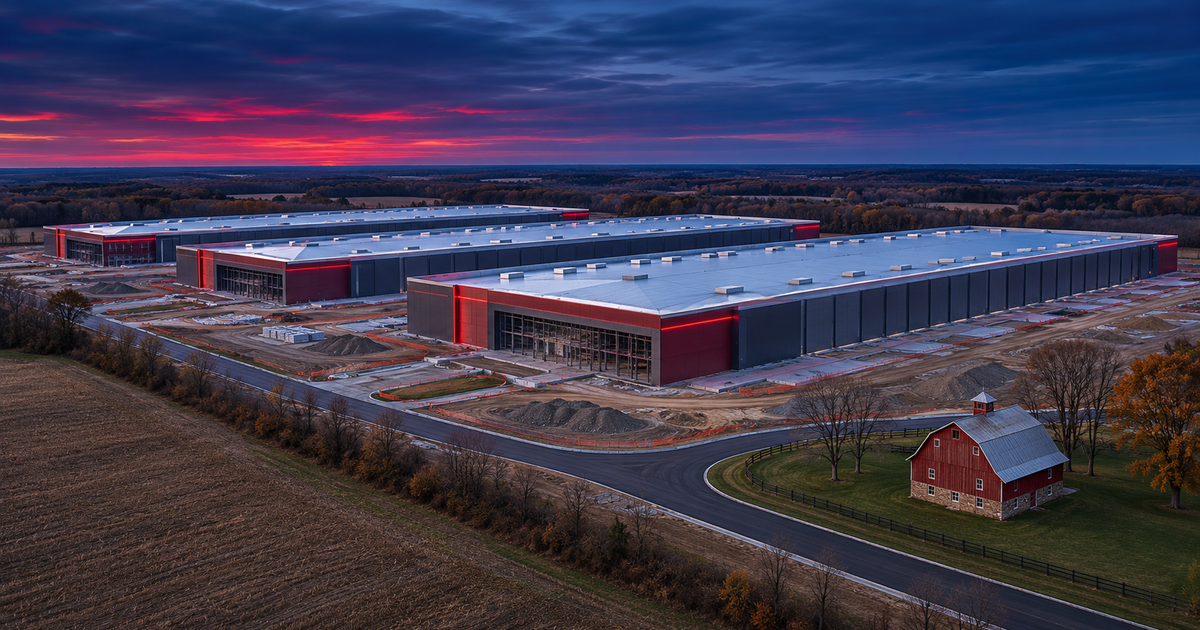
Related Digital’s three-building The Barn campus in Saline Township is under construction with 10 tracked low-voltage systems and 240,000 feet of low- and medium-voltage duct already installed. A planning model places addressable LV scope at roughly $480 million to $800 million, while current union calls prove the delivery phase is active.
Related Digital's $16 billion The Barn data center campus in Saline Township is under construction with 10 tracked low-voltage systems across three hyperscale halls. A scope model built for contractors places the addressable low-voltage envelope at approximately $480 million to $800 million, with a $640 million planning midpoint. That estimate is not a bid value or awarded contract; it is a disciplined way to size the opportunity while separating building systems from servers, utility infrastructure, financing, and owner-furnished compute hardware.
Project Overview
The Barn is a gigawatt-scale data center campus being developed by Related Digital for Oracle and OpenAI along Michigan Avenue in Saline Township, Michigan. Walbridge identifies itself as the general contractor and describes three single-story data halls of approximately 550,000 square feet each, totaling more than 1.65 million square feet of LEED-certified data center space. The developer's project site says construction began in the first quarter of 2026, the first buildings are targeted to become operational in the first quarter of 2027, and phased delivery continues through 2027.
The $16 billion figure is a development and financing figure, not a low-voltage construction package. Kirkland & Ellis reported the financing closed on April 30, 2026, with equity from Related Digital and Blackstone-affiliated funds and long-term debt anchored by PIMCO-managed funds and accounts. Because that capital stack can cover real estate, buildings, utility interconnection, mechanical and electrical infrastructure, and other development costs, contractors should not apply a conventional data-center percentage blindly.
| Project | The Barn / Stargate Michigan |
| Location | Michigan Avenue, Saline Township, Michigan |
| Announced Development Value | $16 billion |
| Physical Program | Three approximately 550,000-square-foot data halls |
| Status | Under construction; phased delivery through 2027 |
| LV Opportunity Score | 10/10 |
| Tracked LV Systems | 10 |
| Source Basis | Developer, general contractor, regulator, financing counsel, and union records |
Key Players and the Contracting Path
Related Digital is the developer. Oracle is the cloud customer and OpenAI is the compute partner. Walbridge is the general contractor and has named Motor City Electric, Progressive Mechanical, John E. Green, Shaw / E-J Electric, Superior Electric Great Lakes, Triangle Electric, and Universal Piping Industries as trade partners. The source names those firms at the project level; it does not establish that any one of them holds the complete fiber, security, controls, or communications package.
| Role | Company | Verified Context |
|---|---|---|
| Developer | Related Digital | Developing the campus for Oracle and OpenAI. |
| General Contractor | Walbridge | Leads delivery and the project labor agreement. |
| Cloud Customer | Oracle | Campus is being developed for Oracle's AI infrastructure program. |
| Utility | DTE Energy | Special energy contracts cover a 1,383 MW utility load. |
| Workforce Route | IBEW Local 252 | Current dispatch page lists Barn electrical and testing calls. |
The practical entry point is not a generic cold bid. The project operates under a first-in-the-nation project labor agreement covering 14 signatory affiliated trades, and Walbridge maintains a subcontractor onboarding path. Firms pursuing work should determine whether they belong under an existing electrical prime, a controls or security vendor, an owner-furnished equipment integrator, or the GC's formal subcontracting channel before pricing labor. Union eligibility, Michigan electrical licensing, drug-testing requirements, site safety training, and project-specific quality procedures are gating items, not paperwork to solve after award.
Low Voltage Systems Breakdown
Signal tracks 10 relevant systems on the project: fiber, structured cabling, outside plant, access control, CCTV, fire alarm, BMS controls, networking, DAS, and grounding and bonding. The scale is already visible in installed pathway. Related Digital reported 240,000 feet of low- and medium-voltage duct installed by August 27, alongside one million craft hours. Duct footage is not cable footage and does not prove an open package, but it shows how much campus backbone and underground coordination this program requires.
| System | Scope Lens | Contractor Risk | Complexity |
|---|---|---|---|
| Fiber and Outside Plant | Campus backbone, diverse pathways, building entrances, splice enclosures, testing, and route documentation across three halls. | Pathway sequencing, bend-radius control, restoration, and acceptance testing must match phased turnover. | Very High |
| Structured Cabling | Operations, security, facilities, support spaces, controls networks, and selected white-space connectivity outside owner-furnished compute. | Scope boundaries with rack integration and tenant standards can move quantities between packages. | High |
| Access Control | Perimeter gates, mantraps, loading and service areas, operations rooms, and tiered credentials. | Door hardware, identity systems, and cybersecurity ownership must be coordinated early. | Very High |
| CCTV | Perimeter analytics, roads, yards, entrances, interior circulation, and critical-room coverage. | Retention, low-light performance, network segmentation, and owner security standards drive storage and commissioning. | High |
| Fire Alarm | Addressable detection, releasing interfaces, notification, monitoring, and phased acceptance for very large footprints. | AHJ coordination and cause-and-effect testing become schedule-critical at turnover. | Very High |
| BMS Controls | Monitoring and control interfaces for closed-loop cooling, mechanical plants, environmental sensors, alarms, and sequences. | Protocol ownership, point lists, graphics, and integrated systems testing must align with commissioning. | Very High |
| Networking | Facilities, operations, security, commissioning, and out-of-band networks supporting the building platform. | Network responsibilities must stay separate from Oracle's compute fabric unless documents say otherwise. | Very High |
| DAS | Public-safety radio coverage and possible carrier service across large, equipment-dense buildings. | RF surveys, AHJ criteria, carrier coordination, and system ownership may sit in different contracts. | High |
| Grounding and Bonding | Telecommunications bonding backbone, racks, pathways, entrance facilities, and equipment rooms. | Testing and documentation must coordinate with the electrical grounding system without duplicating scope. | High |
Estimated Low Voltage Value
The planning envelope is $480 million to $800 million, with a $640 million midpoint. The model applies a three-to-five-percent building-systems range to the announced $16 billion development and uses four percent as the midpoint. That is deliberately lower than a standard six-to-ten-percent data-center benchmark because the public value can include non-addressable development costs and owner-furnished infrastructure. It is still broad enough to cover the extraordinary campus backbone, security, life safety, facilities networking, controls, and commissioning burden implied by three hyperscale halls.
| Announced Development Value | $16.0 billion |
| Modeled LV Range | 3% to 5% |
| Planning Midpoint | 4% |
| Estimated LV Envelope | $480 million to $800 million |
| Stored Planning Estimate | $640 million |
A capacity cross-check cannot be responsibly completed from the public record. The developer describes more than one gigawatt of total or gross campus capacity, while the Michigan Public Service Commission cites 1,383 MW of contracted utility load. Neither number is a published critical IT load, so neither is valid for a per-critical-megawatt LV model. Utility draw includes conversion losses, cooling, support systems, and operating headroom. Treating it as IT load would inflate the estimate and imply precision the sources do not support.
The envelope also excludes servers, GPUs, cloud subscriptions, utility generation, the project-financed battery system, land, financing fees, and ordinary medium-voltage power distribution. RESA Power's current low-voltage test-technician calls refer to electrical testing and NETA experience; they do not prove a structured cabling, AV, security, or fiber award. Contractors should price only the documented package they can access and use the campus estimate as territory planning, not as a quote.
Skills and Certifications Required
| Workstream | Useful Credentials | Critical Skills |
|---|---|---|
| Fiber / Structured Cabling | BICSI INSTF, TECH, RCDD; manufacturer certification | OSP splicing, OTDR and OLTS testing, high-count fiber management, turnover records |
| Fire Alarm | NICET Fire Alarm II or higher; Michigan licensing as applicable | NFPA 72, networked panels, releasing interfaces, phased testing, AHJ closeout |
| Access Control / CCTV | Manufacturer platform credentials; PSP for design leadership | Door hardware, video analytics, PoE design, credential databases, cybersecurity coordination |
| BMS and Facilities Networks | BACnet training, Niagara N4 or specified controls certification | Point-to-point checkout, protocol integration, trending, alarms, functional performance testing |
| DAS / Public Safety Radio | RCDD or RF engineering background; OEM training | Benchmark testing, antenna placement, fiber remotes, AHJ and carrier coordination |
| Grounding / Testing | BICSI grounding knowledge; NETA credentials for electrical testing scope | Bonding verification, test documentation, safe energization, deficiency tracking |
The site currently demonstrates that labor readiness is immediate. IBEW Local 252's page, last updated November 25 for November 30 dispatch, lists Barn calls from A.F. Smith, Motor City Electric, Shaw, Superior Electric Tri County, and RESA Power. The page requires a Michigan electrical license or state apprentice registration and a current drug test for Barn JIW calls; Motor City splicer calls additionally require Raychem medium-voltage certification. The VDV section currently lists no calls, so contractors should not convert the electrical labor demand into an unsupported claim that the communications package is open.
Entry-level technicians can contribute to material staging, pathway work, device mounting, labeling, and supervised installation, but this site will reward crews that arrive with hyperscale turnover discipline. Senior leads need experience with phased commissioning, owner standards, quality-control hold points, digital documentation, and work in an energized mission-critical environment. Walbridge's project Safety and Quality Center reinforces that site-specific training and demonstrated competence are part of delivery.
Market Signal
The Barn is a workforce and supply-chain signal for the Great Lakes region. A three-hall campus of this scale requires repeatable installation methods, enough supervision to run parallel work fronts, and the ability to close thousands of test records without sacrificing schedule. The practical opportunity extends beyond a single prime contract: preconstruction, fiber splicing, acceptance testing, commissioning support, deficiency work, documentation, security integration, and later operational changes can create separate entry points.
It is also a warning against top-line-only selling. The named hyperscaler and AI customer will bring owner standards, nondisclosure constraints, equipment boundaries, and strict change control. The PLA means labor strategy precedes the bid list. Contractors without the correct union pathway, Michigan credentials, or site onboarding should partner before pursuing a package. Contractors already working for named electrical primes have a warmer route than firms approaching the owner with a generic capability deck.
For business development, the most defensible message is specific: LVN has documented a live, under-construction Michigan campus with 10 tracked systems, installed duct, named delivery partners, and dated workforce calls. The next move is to ask the GC or an incumbent prime where responsibility sits for fiber backbone, facilities networking, access control, video, fire alarm interfaces, DAS, testing, and commissioning. Ask for the package map and turnover schedule. Do not ask whether the project “needs low voltage”; the evidence already answers that.
Find Projects Like This on Signal
LVN Signal tracks thousands of construction projects with low voltage opportunities across the country. Filter by city, system type, and project value to find your next bid.
Join 35,000+ Low Voltage Pros
Get weekly permit updates, tool deals, job opportunities, and industry news. No spam, unsubscribe anytime.