
Join Low Voltage Nation — Find project opportunities and showcase your company to thousands of industry professionals
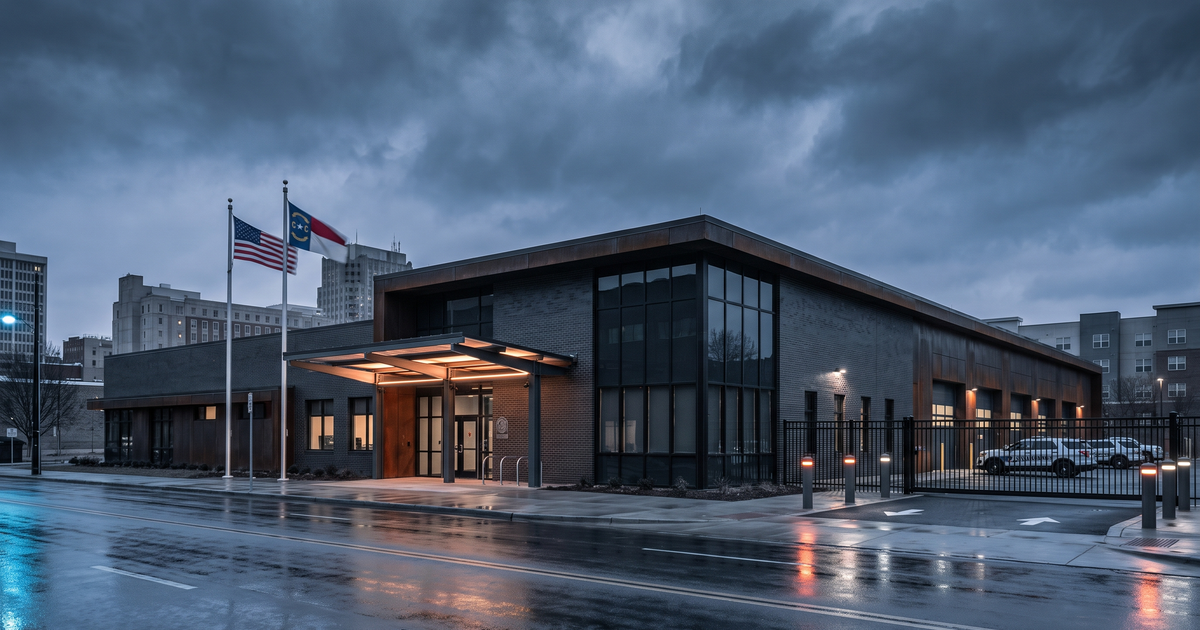
Permit records show a $15.1 million renovation of a Raleigh police facility on Atlantic Avenue that requires eight low voltage systems — nearly all security and communications — with an estimated $1.2 million in LV work. Here's what low voltage contractors need to know.
A $15.1 million renovation of a Raleigh police facility is one of the most security-intensive low voltage opportunities Signal is tracking in North Carolina. Permit records show the Level III alteration at 2315 Atlantic Avenue will require eight low voltage systems — nearly all of them security and communications — with an estimated $1.2 million in low voltage work.
Project Overview
Building permit data from the City of Raleigh shows a $15,056,810 Level III alteration of an existing single-story facility at 2315 Atlantic Avenue, described as a police facility renovation with new demising walls and a significant security-infrastructure upgrade. The address is a large mid-century single-level building in Midtown Raleigh, and the City has been consolidating police operations along the Atlantic Avenue corridor — making this a textbook adaptive-reuse conversion of an existing structure into a modern, secure law-enforcement facility.
- Project value: $15.1 million (permit-estimated construction value)
- Location: 2315 Atlantic Avenue, Raleigh, NC (Midtown)
- Scope: Level III alteration — new demising walls, full security-infrastructure upgrade
- Facility type: Government / public safety (law enforcement)
- Source: Raleigh open building-permit records
The Signal record carries an LV opportunity score of 9 out of 10, driven by the concentration of security and communications systems a police facility demands.
Why This Project Matters
Unlike a typical office fit-out, a law-enforcement facility is a security building first. Public records indicate the City of Raleigh has been relocating police functions onto the Atlantic Avenue corridor, and converting an older single-story structure into a hardened, code-compliant police facility puts low voltage at the center of the budget. Access control, video surveillance, intrusion detection, and dispatch communications are not finishing touches here — they are the reason the renovation exists. For LV integrators with public-safety experience, this is a high-value, credential-gated scope with limited qualified competition.
Low Voltage Systems Breakdown
Signal identifies eight low voltage systems in scope — a security-dominated stack:
| System | Scope | Complexity |
|---|---|---|
| Access Control | Credentialed entry, sally ports, evidence and armory zones, holding-area control | Very High |
| CCTV / Video Surveillance | Interior and exterior IP video, evidence-grade retention, analytics | Very High |
| Intrusion Detection | Door/window contacts, motion, duress and panic alarms | High |
| Perimeter Security | Fence-line detection, gates, exterior lighting integration | High |
| Dispatch Communications | Public-safety radio, console interfaces, backup communications | Very High |
| Intercom | Interview-room, holding, and door-station intercom | Medium |
| Structured Cabling | CJIS-compliant network backbone and horizontal cabling | High |
| Fire Alarm & Detection | Addressable detection, notification, and monitoring | High |
Estimated Low Voltage Value
Signal estimates the low voltage opportunity at approximately $1.2 million — roughly 8% of the $15.1 million project value. That percentage sits above the typical institutional benchmark because this renovation is fundamentally a security-systems project: eight of the building’s core systems are low voltage, and the security and communications scope carries a disproportionate share of the construction budget.
This is an estimate derived from industry benchmarks, not a published award. The actual LV package could run higher if the facility requires evidence-room monitoring, armory access control, or a public-safety radio enhancement (ERRCS/DAS) system beyond the base scope.
Skills & Certifications
Public-safety work is one of the most credential-gated corners of the low voltage market. Expect requirements such as:
- CJIS Security Awareness certification and background clearance for anyone touching law-enforcement networks
- NICET Fire Alarm Level II+ for detection and notification design and installation
- Manufacturer certifications for enterprise access control and video (Genetec, Lenel S2, Software House, Avigilon, Axis)
- BICSI structured cabling competency (RCDD for design-heavy scopes)
- UL-listed central-station / intrusion experience and familiarity with duress and panic systems
- Public-safety radio / P25 and dispatch-console integration familiarity
- ERRCS / public-safety DAS knowledge where local fire code requires responder radio coverage
Market Signal
Municipal public-safety modernization is a steady, recession-resistant lane for low voltage contractors, and Raleigh is actively investing in it — from a new Law Enforcement Training Center to this Atlantic Avenue facility conversion. Government security projects reward integrators who hold the right clearances and manufacturer certifications, and they tend to lead to long-term service relationships once the systems are in place.
For contractors in the Triangle, this $15.1M renovation is a signal that Raleigh’s public-safety buildout is generating security-heavy scopes with real budget behind them — the kind of work that favors specialists over generalists.
Find Projects Like This on Signal
LVN Signal tracks thousands of construction projects with low voltage opportunities across the country. Filter by city, system type, and project value to find your next bid.
Join 35,000+ Low Voltage Pros
Get weekly permit updates, tool deals, job opportunities, and industry news. No spam, unsubscribe anytime.