
Join Low Voltage Nation — Find project opportunities and showcase your company to thousands of industry professionals
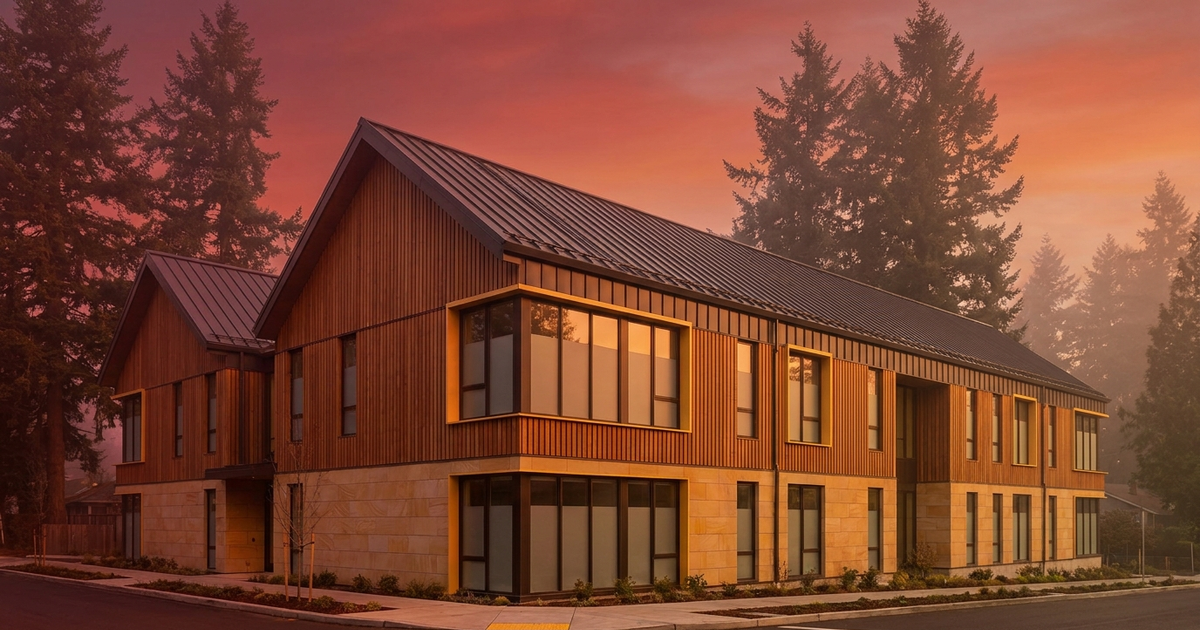
A $1.745 million Jackson House MLK behavioral health facility in Portland, Oregon requires seven low voltage systems for a 16-bed secure residential treatment facility. The estimated LV contract value is approximately $130,000.
A $1.75 million Jackson House MLK behavioral health facility in Portland, Oregon requires seven low voltage systems for a 16-bed secure residential treatment facility, creating an estimated $130,000 opportunity for healthcare-experienced LV contractors with anti-ligature and secure-egress expertise.
Project Overview
According to permit records filed with the City of Portland Bureau of Development Services (work order 24-034218-MT), the Jackson House MLK project is a new ground-up building with parking lot, trash enclosure, and bike parking. The facility will house behavioral health services including administration, 16 residential treatment beds (no cap stay), supporting staff areas, and shared bathrooms.
The project is a partnership between Jackson House (the behavioral health operator) and DECA Inc (architect of record), with development by Sturgeon Development Partners. The site is on Portland''s NE side near Martin Luther King Jr Boulevard, addressing what local press has described as a critical gap in residential mental health treatment capacity in the Portland metro area.
Designated as a Secure Residential Treatment Facility (SRTF), this is a higher-acuity behavioral health build than a standard outpatient clinic. SRTFs are licensed by the Oregon Health Authority and bridge the gap between acute inpatient psychiatric hospitals and lower-level residential settings. Every aspect of the design — including the LV scope — must reconcile patient safety with therapeutic environment.
| Project | Jackson House MLK Behavioral Health Facility |
| Location | Portland, OR (MLK Jr Blvd corridor, NE side) |
| Total Value | $1.745 million |
| Beds | 16 residential treatment beds |
| Project Type | Healthcare / Secure Residential Treatment |
| Status | Active permit (new construction) |
| LV Score | 10/10 |
| Source | Portland Bureau of Development Services |
Key Players
Web research surfaced a clear team structure for this project. All three principals have public-facing project pages or web presence that confirm involvement.
| Role | Company | Details |
|---|---|---|
| Operator | Jackson House | Behavioral health and residential treatment provider with locations across Southern California and Oregon. Operates short-term residential mental health facilities that bridge inpatient psychiatric hospitals and outpatient care. |
| Developer | Sturgeon Development Partners | Portland-based developer that previously converted the Premier Gear & Machine Works Building into office space. Partnering with Jackson House to expand secure residential treatment capacity. |
| Architect | DECA Inc | Portland-based architecture firm with healthcare experience. Project page confirms work on the Jackson House SRTF MLK facility. |
The general contractor for the LV trades had not been disclosed in the public permit at the time of this report. LV contractors interested in this work should track Sturgeon Development Partners'' GC selection process and engage early — secure residential builds typically pre-qualify a short list of LV partners with healthcare and ASA-compliant hardware experience.
Low Voltage Systems Breakdown
Seven LV systems on a 16-bed SRTF reflects the behavioral health design problem: every system must support both clinical workflow and patient safety. Anti-ligature hardware, anti-tamper enclosures, and secure-egress integration appear in nearly every scope.
| System | Category | Scope Description | Complexity |
|---|---|---|---|
| Structured Cabling | Data/Voice | Cat6A horizontal cabling and fiber backbone for the EHR system, staff workstations, telehealth carts, and the centralized monitoring station. Cabling penetrations in patient rooms require recessed, anti-tamper coverplates. | Medium |
| Fire Alarm | Life Safety | Addressable system meeting NFPA 72, 99, and 101 for I-2 institutional behavioral health occupancy. Pull stations and notification appliances in patient areas must be anti-ligature listed (recessed, sloped-top hardware). | High |
| Access Control | Security | Card-and-PIN readers on all unit boundaries, staff-only zones, medication rooms, and intake. Integration with electromagnetic locks and delayed-egress hardware. Critical for the "secure" designation in SRTF licensing. | High |
| CCTV / Video Surveillance | Security | IP cameras at exterior, common areas, corridors, and intake. Strict patient-room privacy zones to comply with HIPAA and Oregon behavioral health rules. PoE backbone shared with structured cabling. | Medium |
| Audio/Visual | AV | Group therapy room AV, staff training and conference rooms, lobby digital signage, and integration with telehealth platforms used by Jackson House clinicians. | Medium |
| DAS (Distributed Antenna System) | Wireless | In-building cellular for staff phones, panic devices, and visitor coverage. Critical in a secure facility where staff response times depend on reliable mobile communication. | High |
| Nurse Call (Behavioral) | Life Safety | Staff-assist and emergency call stations with anti-ligature, anti-tamper hardware. Integrated with a centralized monitoring station and tied into staff badge wireless duress devices. UL 1069 listed. | High |
Estimated Low Voltage Value
Using industry benchmarks for healthcare projects with elevated security and anti-ligature requirements, the estimated LV contract value for this facility is approximately $130,000. Behavioral health builds carry healthcare-grade LV percentages because anti-ligature hardware costs more than standard fixtures, and access control integration with delayed-egress doors adds engineering hours.
| Total Project Value | $1,745,000 |
| Estimated LV Percentage (healthcare/secure) | 6% |
| System Count Multiplier (7 systems) | 1.25x |
| Estimated LV Contract Value | ~$130,000 |
For context, a $130K LV scope on a 16-bed SRTF might split roughly: $30K structured cabling and fiber, $25K fire alarm with anti-ligature notification, $25K access control and electromagnetic locking integration, $15K CCTV, $15K nurse call with duress integration, $10K DAS, and $10K AV. The numbers are guides — anti-ligature device pricing alone can push the nurse call and fire alarm splits up by 15–25 percent over a comparable medical-surgical project.
For specialty LV contractors with behavioral health experience, this is exactly the kind of single-prime opportunity worth pursuing. For larger integrators, the value lies in establishing a relationship with Jackson House — which is actively expanding across Oregon and California — and with Sturgeon Development Partners'' Portland pipeline.
Skills and Certifications Required
Behavioral health work narrows the field of qualified contractors. Anti-ligature device knowledge, ASA-compliance familiarity, and secure-egress integration are not standard skills on a typical commercial crew.
| System | Key Certifications | Critical Skills |
|---|---|---|
| Structured Cabling | BICSI INSTC, INSTF, RCDD | Cat6A termination, anti-tamper coverplate install, fiber splicing, healthcare cleanroom protocols |
| Fire Alarm | NICET Level II+, OR State License | NFPA 72/99/101, anti-ligature device selection, behavioral health AHJ coordination |
| Access Control | Manufacturer (Lenel, Genetec, HID), DSC/PSP | Delayed-egress integration, electromagnetic lock UL 294, secure-zone programming |
| CCTV | Manufacturer (Axis, Avigilon, Milestone) | Privacy-zone configuration, HIPAA-aware placement, IP networking |
| DAS | BICSI RCDD, RF survey, carrier training | Public-safety overlay considerations, antenna placement, wood/metal stud penetration loss modeling |
| Nurse Call (Behavioral) | Manufacturer (Rauland, Jeron, Cornell), UL 1069 | Anti-ligature hardware install, staff duress integration, behavioral health code-blue workflow |
| AV | AVIXA CTS, CTS-I | Group therapy room acoustics, telehealth platform integration, signage |
Entry-level techs with BICSI Installer 1 can pull cable, mount devices, and assist with rough-in. Mid-level techs with NICET Level II will lead the fire alarm and access control trades. The project will benefit from at least one RCDD or NICET Level III for design oversight on the DAS and fire alarm submittals — both packages need to thread the needle between code compliance and behavioral health design constraints.
Oregon requires a Limited Energy Technician license (Class A) for low voltage work, plus a separate Limited Energy Contractor license at the company level. Behavioral health-specific manufacturer training (anti-ligature nurse call, ASA-compliant fixtures) is non-negotiable for this kind of build.
Market Signal
Oregon has been investing heavily in behavioral health infrastructure since 2022, driven by Measure 110 reforms, federal opioid settlement funding, and recurring legislative budget allocations to expand residential treatment capacity. The Portland metro area in particular has a documented shortage of secure residential treatment beds — a single existing facility serving the broader metropolis, by Jackson House''s public statements.
For LV contractors, this matters in three ways. First, behavioral health builds are frequent across the state — every Oregon Health Authority funding cycle authorizes new beds, and each facility cycles through LV scope every 7–10 years for tech refresh. Second, the bidder pool is small: contractors with anti-ligature experience and OR Limited Energy licensing are a specialized subset of the healthcare LV market. Third, the design requirements are sticky — once a contractor learns the anti-ligature device line, the next project becomes faster and more profitable.
Portland''s healthcare construction pipeline has been heavy through 2025 and into 2026, with concurrent activity at OHSU, Legacy Health, Providence, and now the behavioral health expansion driven by Jackson House and other operators. LV contractors who track behavioral health permits — not just hospital permits — are best positioned to win this specialty work.
Find Projects Like This on Signal
LVN Signal tracks thousands of construction projects with low voltage opportunities across the country. Filter by city, system type, and project value to find your next bid.
Join 35,000+ Low Voltage Pros
Get weekly permit updates, tool deals, job opportunities, and industry news. No spam, unsubscribe anytime.