
Join Low Voltage Nation — Find project opportunities and showcase your company to thousands of industry professionals
Nscale's Monarch Compute Campus pairs 1.35 GW of Phase 1 AI compute with a private microgrid north of Point Pleasant, West Virginia. Signal tracks 13 low-voltage systems and a modeled $675 million Phase 1 opportunity before servers, GPUs, and generation equipment.
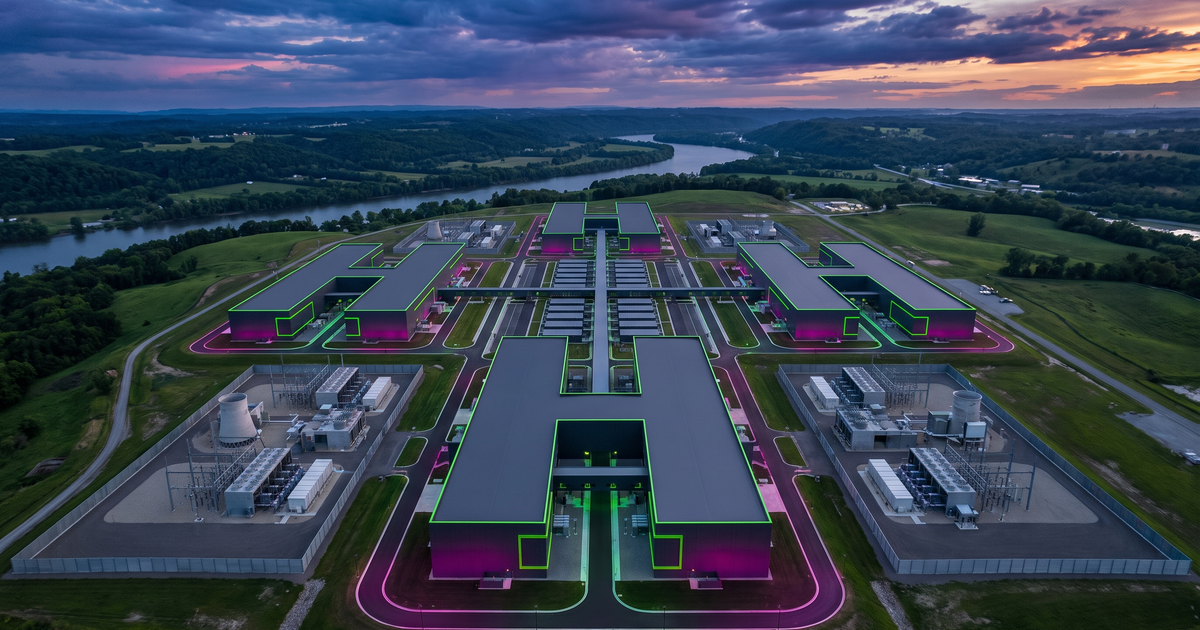
Nscale's more-than-$20-billion Monarch Compute Campus north of Point Pleasant, West Virginia, is moving from civil work toward vertical construction with 13 modeled low-voltage systems. Phase 1 is engineered around 1.35 gigawatts of AI compute, a private power plant, three data-center buildings in the air-permit package, and an early-2028 delivery target. Using compute capacity rather than the headline investment as the denominator, LVN models approximately $675 million in Phase 1 building technology, controls, fiber, security, life-safety, and commissioning work.
The distinction matters. Nscale's $20 billion-plus figure is a planned capital-investment statement, not an executed construction contract, a specialty-systems award, or money spent to date. The site also combines land, power generation, cooling, data-center buildings, and tenant compute hardware. A percentage applied blindly to all of that would price generators, GPUs, and other non-low-voltage assets as though they were cabling and controls.
Project Overview
Nscale describes Monarch as a 2,250-plus-acre AI campus with 1.35 GW of Phase 1 compute capacity, more than $20 billion in planned investment, and an expansion path beyond 8 GW. The developer says the campus will generate its own power, operate independently of the public grid, and use closed-loop cooling without municipal drinking water during operations. Nscale names NVIDIA and Caterpillar as development partners and targets Phase 1 delivery in early 2028.
This is no longer a presentation-only project. A September 20 field update reported that civil construction was continuing, vertical construction was approaching, and approximately 900 people were working across the site and pipeline effort. The site manager told MetroNews that the workforce could reach roughly 2,000 as vertical activity accelerates. No data-center general contractor, building architect, MEP engineer, electrical contractor, fiber carrier, low-voltage integrator, controls contractor, or independent commissioning authority is publicly named in the sources reviewed for this spotlight.
| Project | Monarch Compute Campus |
| Location | WV Route 62 north of Point Pleasant, Mason County, WV 25550 |
| Developer / Operator | Nscale through Monarch Cloud Campus LLC |
| Planned Investment | More than $20 billion |
| Phase 1 Compute Capacity | 1.35 GW |
| Phase 1 Target | Early 2028; deployment tranches announced to begin in late 2027 |
| Status | Civil work under way; vertical construction approaching |
| Signal Score | 10/10 across 13 systems |
| Modeled LV Value | Approximately $675 million for Phase 1 |
Key Players and the Unawarded Seats
Nscale acquired the campus and its development organization with American Intelligence & Power Corporation in March 2026. Nscale says it will construct and operate the AI infrastructure. Monarch Cloud Campus LLC is the project company and applicant on the active West Virginia environmental filings.
The compute platform is unusually specific for a project at this stage. In its March collaboration announcement, Nscale said it had signed a letter of intent with Microsoft for up to 1.35 GW of AI compute using NVIDIA Vera Rubin NVL72 systems engineered around NVIDIA's DSX AI Factory reference design. The announcement calls for multiple deployment tranches beginning in late 2027. That named reference architecture gives designers more to work with than the common "future hyperscale tenant" placeholder, but a letter of intent is not the same thing as a final specialty-contract award.
Caterpillar is the named onsite-power collaborator. Nscale says enough G3500-series natural-gas generation is planned to reach 2 GW by the first half of 2028. The R14-0042 application goes deeper, describing 864 proposed Caterpillar G3520K generator units plus emergency and fire-pump engines. Those model references establish a design basis; they should not be presented as proof that every unit has been purchased or delivered.
| Role | Source-Backed Party | What Is Known |
|---|---|---|
| Developer / Operator | Nscale | Owns and is developing the campus; says it will construct and operate the AI infrastructure. |
| Project Company | Monarch Cloud Campus LLC | Applicant on current air and state-waters permit packages. |
| Compute Framework | Microsoft | Named in Nscale's letter of intent for up to 1.35 GW; final package boundaries remain undisclosed. |
| Compute Architecture | NVIDIA | Vera Rubin NVL72 and DSX reference architecture are the announced platform basis. |
| Onsite Power | Caterpillar | Named generation collaborator; the permit application identifies proposed engine models. |
| GC / CM and Specialty Integrators | Not publicly identified | The most commercially important seats in the delivery chain remain unresolved. |
The Permit Stack Is Part of the Schedule
The power plant and the data-center buildings are moving through separate but connected approvals. The WVDEP air-permit register lists construction permit R14-0042 for the Point Pleasant campus with an October 30, 2026 comment deadline. The application describes three H-shaped data-center buildings, approximately 1.8 GW of peak site demand, and 2.16 GW of onsite generating nameplate. Those are different measures from Nscale's 1.35 GW Phase 1 AI-compute figure and should never be collapsed into one capacity number.
WVDEP also opened state-waters review for Data Center No. 2 and Data Center No. 3, each with four associated power nodes. The agency's October public-participation notice sets an October 26 meeting and comment deadline for those wetland-impact applications. The same notice says the air package anticipates an April 2027 facility startup, while Nscale's public compute schedule begins deployment tranches in late 2027 and targets Phase 1 delivery in early 2028. Bidders should treat those dates as milestones for different scopes, not as a contradiction to be averaged away.
There is also an active civil-risk lesson. In July, WVDEP issued an enforcement order after stormwater-control failures contributed to flooding and sediment impacts. The order required corrective work and stopped land disturbance in one drainage area until required controls were installed and verified. That was not described as a campus-wide stop-work order, but it is direct evidence that civil sequencing, inspection hold points, and environmental compliance can move downstream technology dates.
Thirteen Low-Voltage Systems, Not One Cabling Package
Signal tracks 13 systems because Monarch is both a data center and a privately powered industrial campus. The building network cannot be priced independently from the microgrid control environment, the outside plant, or the integrated-systems-testing plan. Scope boundaries will decide whether one integrator owns a coherent turnover package or several contractors each deliver a technically complete island that fails at the interfaces.
| System | Likely Monarch Scope | Primary Coordination Risk |
|---|---|---|
| Fiber Optic | Carrier entrance, interbuilding backbone, diverse routes, and high-count splicing | Route diversity that shares no concealed single point of failure |
| Outside Plant | Campus duct bank, handholes, building entrances, and power-node connectivity | Civil phasing, wetlands, drainage, and as-built accuracy |
| Structured Cabling | White-space, operations, security, support, and equipment-room distribution | Tenant standard, pathway fill, labeling, and test-format acceptance |
| Access Control | Layered perimeter, gate, building, room, and equipment-cage security | Credential ownership and interfaces with life safety and video |
| Video Surveillance | Perimeter analytics, vehicle lanes, yards, entrances, and critical rooms | Coverage changes across a fast-moving construction site |
| Fire Alarm | Detection, notification, releasing and supervisory interfaces, and power-plant coordination | Cause-and-effect ownership across buildings and generation nodes |
| BMS Controls | Mechanical plant, cooling, environmental sensing, alarming, and trend data | Points lists, gateway responsibility, and sequence validation |
| Networking | Operational network transport for building and campus systems | IT/OT segmentation, cybersecurity, addressing, and handoff |
| DAS | Public-safety radio and commercial in-building wireless coverage | Post-construction surveys, carrier/AHJ acceptance, and remediation |
| Grounding and Bonding | Telecommunications bonding across data halls, support buildings, and OSP | Coordination with electrical grounding and high-fault-current infrastructure |
| EPMS / DCIM | Electrical power monitoring, capacity visibility, asset data, and operations dashboards | Meter ownership, naming conventions, data normalization, and acceptance |
| SCADA Controls | Private generation, fuel, switchgear, protection, and microgrid supervisory control | OT cybersecurity, protocol gateways, and black-start/load-step sequences |
| Commissioning | Factory, component, functional, and integrated systems testing | One traceable script across power, cooling, network, controls, and alarms |
The named NVIDIA reference architecture is valuable because it gives the bidder a defined compute platform against which rack density, network topology, power quality, and acceptance documentation can be developed. It does not eliminate RFIs. The contractor still needs the issued cabling standard, approved manufacturers, redundancy classification, connector types, loss budgets, labeling convention, cybersecurity boundary, testing platform, electronic closeout schema, and authority for approving deviations.
Estimated Low-Voltage Value
LVN uses a capacity basis here because the $20 billion-plus headline bundles assets with radically different technology intensity. Applying the national planning anchor of approximately $500,000 per megawatt to the 1,350 MW Phase 1 compute load produces $675 million. A separate four-percent check against the announced $20 billion investment yields $800 million. The two approaches create a practical Phase 1 planning range of approximately $675 million to $800 million.
| Phase 1 Compute Denominator | 1,350 MW |
| National Capacity Anchor | Approximately $500,000 per compute MW |
| Capacity-Based Estimate | $675 million |
| Capital-Investment Cross-Check | 4% of $20 billion = $800 million |
| Planning Range | $675 million-$800 million |
This range is not a bid and does not include GPUs, servers, tenant compute hardware, natural-gas engines, utility-scale switchgear, fuel infrastructure, or general electrical power distribution. It is a planning model for building and campus fiber, communications, security, life safety, controls, monitoring, grounding, wireless, and commissioning. Package awards, final design, owner-furnished equipment, and tenant standards can move the actual buyout materially.
Skills and Certifications Required
| Workstream | Relevant Credentials | Critical Skills |
|---|---|---|
| Fiber / Structured Cabling / OSP | BICSI RCDD, INSTC, INSTF; FOA CFOT | High-count fiber, diverse pathways, fusion splicing, loss budgets, certification, and digital closeout |
| Fire Alarm | NICET Fire Alarm Level II-III; applicable state licensing | NFPA 72, networked panels, interfaces, sequence testing, and AHJ coordination |
| Security | Manufacturer platform training; ASIS PSP for senior design roles | Layered access, video analytics, credential architecture, VMS storage, and IP networking |
| BMS / EPMS / DCIM | BACnet, Niagara N4, and selected-platform training | Points databases, protocol integration, alarms, trends, graphics, and capacity data |
| SCADA / OT Networking | Vendor controls training and network-security qualifications | Industrial protocols, redundant control, segmentation, time synchronization, and change management |
| Commissioning | Commissioning-provider experience plus system-specific credentials | Functional scripts, integrated systems testing, deficiency tracking, evidence capture, and turnover |
Entry-level technicians can contribute to pathway installation, cable placement, device mounting, labeling, and supervised terminations. Mid-level technicians will own fiber splicing, copper and optical certification, controller wiring, device configuration, and first-pass functional checks. Senior staff need to bridge RCDD-level design, NICET-led life safety, OT network architecture, power-monitoring data, and integrated commissioning without letting responsibility disappear between contracts.
The workforce plan is already a project issue. The West Virginia and Tri-State Building & Construction Trades councils announced an MOU with Nscale covering the data center and power-generating facility. Contractors pursuing the work should map craft jurisdiction, apprenticeship ratios, badging, shift coverage, lodging, travel, and supervision before treating the local labor number as an unlimited pool. They should also verify current West Virginia and local licensing requirements for every alarm, electrical, communications, and controls scope before bidding.
Market Signal
Monarch is a new kind of Ohio River Valley infrastructure project: compute capacity, private generation, environmental permitting, and labor strategy are one delivery problem. LVN has already tracked enormous AI campuses at the former federal enrichment complexes in Paducah, Kentucky, and Piketon, Ohio. Point Pleasant adds a privately powered greenfield model between major eastern and midwestern cloud markets. Credentials earned here can travel across a corridor where power plants, substations, fiber routes, data halls, and controls are increasingly procured together.
The immediate commercial signal is the missing delivery chain. Nscale, Microsoft, NVIDIA, Caterpillar, the project company, and the labor councils are source-backed. The GC/CM, architect, building MEP team, electrical contractor, fiber and OSP contractor, security integrator, fire-alarm contractor, BMS/EPMS/DCIM integrator, SCADA team, DAS contractor, and commissioning authority are not publicly disclosed. With civil work active and vertical construction approaching, those are not academic blanks. They are the accounts and award paths contractors should be qualifying now.
The second signal is that permitting cannot be separated from technology scheduling. Wetland mitigation moves duct-bank access. Stormwater hold points move foundations and underground pathways. Air-permit timing moves generation commissioning. Generation commissioning moves energized testing. Energized testing moves integrated systems testing, and integrated systems testing moves compute turnover. On a campus this large, one late civil or regulatory interface can echo through every low-voltage package.
Find Projects Like This on Signal
LVN Signal tracks thousands of construction projects with low voltage opportunities across the country. Filter by city, system type, and project value to find your next bid.
Join 35,000+ Low Voltage Pros
Get weekly permit updates, tool deals, job opportunities, and industry news. No spam, unsubscribe anytime.