
Join Low Voltage Nation — Find project opportunities and showcase your company to thousands of industry professionals
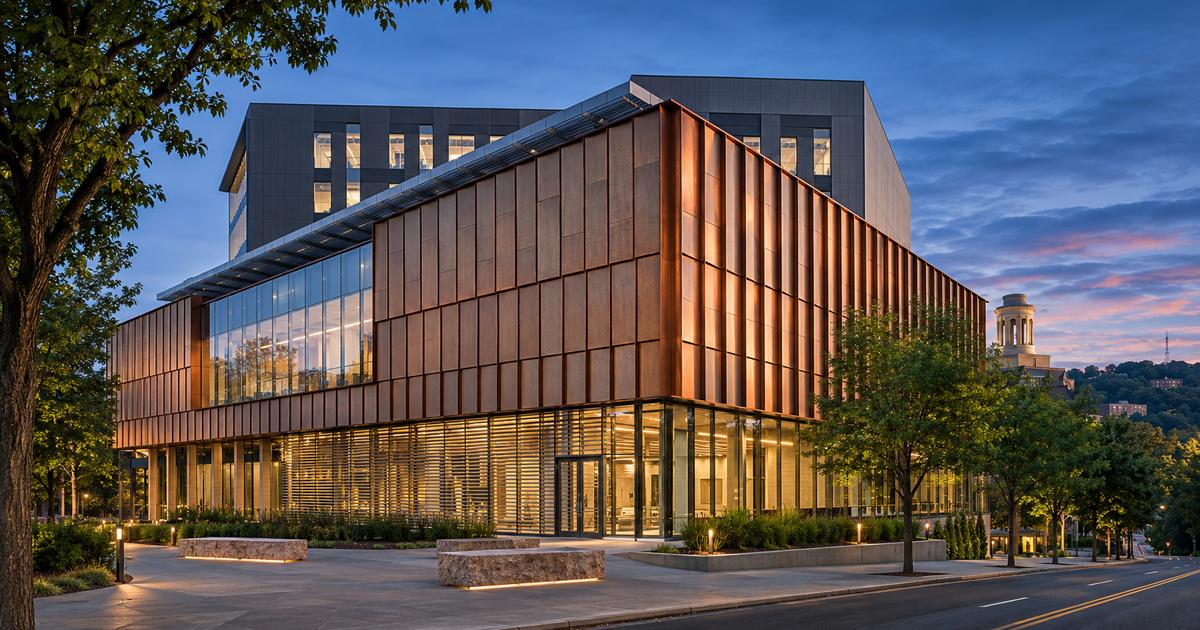
Carnegie Mellon's 12-story Richard King Mellon Hall of Sciences is moving into enclosure and interior work with five identifiable low-voltage packages. Against the $68.3 million building permit—not the $252 million program—LVN models roughly $3.4 million to $4.1 million in LV scope.
A $68.3 million building permit for Carnegie Mellon University's Richard King Mellon Hall of Sciences puts a dense mix of laboratory, computer science, teaching, gallery, parking and public spaces into one vertical project in Pittsburgh. Signal identifies four core technology categories on the primary record, and a companion city permit confirms a fifth package: emergency voice alarm communications with VESDA aspirating smoke detection. Using the issued building permit as the denominator, LVN models approximately $3.4 million to $4.1 million in low-voltage scope.
Project Overview
The Richard King Mellon Hall of Sciences is rising at 4644 Forbes Avenue, where Carnegie Mellon's campus meets Pittsburgh's North Oakland neighborhood. The city's issued building record, permit BDA-2024-06423, describes shell construction and fit-out for a 12-story university laboratory, office and gallery building with an integral parking garage. That record carries a declared value of $68.315 million and an issue date of September 25, 2025.
The permit value is only one accounting layer. Carnegie Mellon described the broader development as a $252 million program when it unveiled the design, and the university lists research, teaching, computer science and public gallery uses. LVN keeps those figures separate: the $252 million program gives context, while the $68.315 million building permit is the basis for this low-voltage estimate. Combining them would double-count overlapping scope and inflate the addressable number.
The project is current, not a stale plan-set artifact. Carnegie Mellon reported that the final structural beam was placed in June 2026 and that interior and exterior finishing would follow. The university still targets completion in 2027, which moves contractor attention from concrete and steel toward enclosure, pathways, equipment rooms, device rough-in, system integration, testing and owner turnover.
| Project | Richard King Mellon Hall of Sciences |
| Location | 4644 Forbes Avenue, Pittsburgh, PA 15213 |
| Issued Building Permit | BDA-2024-06423 |
| Permit Value Used for LV Model | $68.315 million |
| Broader Program Value | $252 million; context only, excluded from the estimate |
| Primary Uses | Research laboratories, computer science, teaching, offices, galleries and parking |
| Signal LV Score | 8/10 |
| Current Phase | Structure topped out; enclosure and interior work underway |
| Target Completion | 2027 |
Key Players and Contracting Map
Carnegie Mellon's own project team roster identifies the owner-side and delivery organizations contractors should map before making outreach. Carnegie Mellon University is the owner. ZGF Architects is the design architect, R3A Architecture is the local architect, PJ Dick Mascaro Joint Venture is the construction manager, Affiliated Engineers Inc. is the MEP engineer, Langan Engineering is the civil engineer, and Stoss Landscape Urbanism leads landscape design.
| Role | Organization | Why It Matters to LV Contractors |
|---|---|---|
| Owner | Carnegie Mellon University | Controls campus standards, cybersecurity expectations, owner-furnished technology and final acceptance. |
| Construction Manager | PJ Dick / Mascaro Joint Venture | Coordinates trade sequencing, bid packages, site logistics, commissioning and closeout. |
| Design Architect | ZGF Architects | Sets the architectural framework for public, gallery, academic and research environments. |
| Local Architect | R3A Architecture | Supports local documentation, permitting and construction-phase coordination. |
| MEP Engineer | Affiliated Engineers Inc. | MEP coordination is central to pathways, emergency power interfaces, lab controls and system commissioning. |
| Fire Alarm Contractor of Record | Clista Electric Inc. | The issued $580,000 fire alarm permit names Clista for emergency voice alarm, VESDA and suppression monitoring. |
The named team does not mean every technology package is open. The fire alarm package is already tied to an issued permit, and major backbone awards may also be committed. The practical business-development lane is to verify the actual package holders, find late-stage vendor and commissioning needs, and position for changes, supplemental coverage, integration work, owner-furnished systems and turnover support without pretending the entire modeled amount is still unawarded.
Low Voltage Systems Breakdown
This is not a generic classroom building. Wet and dry laboratories, computational research, public galleries, collaboration rooms, parking and service levels place different performance and code demands on a shared backbone. Signal's primary project record tracks Structured Cabling, AV, Access Control and Security. The separate issued fire alarm permit FAS-2025-09040 adds a confirmed emergency voice alarm, VESDA detection and suppression-monitoring package valued at $580,000.
| System Package | Project-Specific Scope | Complexity | Commercial Read |
|---|---|---|---|
| Structured Cabling and Fiber Backbone | High-density horizontal cabling, fiber risers, telecom rooms, redundant pathways and certified links serving laboratories, research offices, classrooms, galleries and computer-science users. | High | Laboratory and computational users raise port density, pathway coordination and documentation requirements. Active network electronics and research computing hardware are excluded unless specifically contracted. |
| Audio/Visual and Collaboration | Teaching rooms, hybrid collaboration spaces, presentation systems, gallery media, public-event support, control systems and AV-over-IP transport on the converged network. | High | The building mixes academic and public-facing uses, so acoustics, control programming, accessibility and content workflows matter as much as display counts. |
| Access Control | Controlled boundaries between public galleries, academic areas, laboratories, service zones, parking and restricted research spaces, integrated with door hardware and campus identity systems. | High | Door schedules, fail-safe behavior, elevator and parking interfaces, and university credential standards drive coordination. |
| Video Surveillance and Security | Coverage of entries, public circulation, parking, loading, research boundaries and exterior approaches, with storage, analytics and incident-response integration. | High | Public access beside sensitive research creates competing needs for openness, privacy, retention and secure operations. |
| Emergency Voice Alarm, VESDA and Monitoring | An issued package covers emergency voice communications, aspirating smoke detection and suppression-system monitoring across the new 12-story facility. | Very High | The confirmed $580,000 permit requires life-safety programming, cause-and-effect verification, clean interfaces and witnessed acceptance. |
Other systems may appear in final procurement—Wi-Fi, in-building wireless, environmental monitoring, lighting controls and specialized laboratory alarms are plausible in a facility of this type—but LVN does not count them as confirmed packages without project-specific evidence. That distinction matters. A good opportunity model identifies where to ask questions; it does not turn every technically possible device into booked revenue.
Estimated Low Voltage Value
LVN applies a 5% to 6% institutional research-laboratory benchmark to the $68.315 million building permit. The low end reflects the possibility that major scientific instruments, compute platforms, active network hardware and some owner systems sit outside the construction contract. The high end reflects five integrated system packages, laboratory coordination, a large computer-science presence, public gallery AV and a confirmed VESDA-based life-safety design.
| Issued Building Permit Value | $68.315 million |
| Applied LV Benchmark | 5% to 6% |
| Modeled LV Range | $3.4 million to $4.1 million |
| Modeled Midpoint | Approximately $3.76 million |
| Confirmed Fire Alarm Permit | $580,000; evidence inside the broader project, not added on top of the model |
| Excluded Program Figure | $252 million broader development value |
The estimate is a market model, not a disclosed subcontract. It excludes owner-furnished lab instruments, scientific equipment, research-computing servers, storage and software; gallery art, exhibits and content production; furniture; active network and endpoint hardware unless carried by the installer; and non-LV mechanical, electrical, suppression and architectural work. It also avoids adding the $580,000 fire alarm permit to the range because that package is part of the same building, not a separate facility.
For a contractor, the useful number is not simply the midpoint. A structured-cabling prime may only touch a portion of it, while a multi-discipline integrator with AV, security and life-safety partners can address more. The range should drive account mapping, manpower and bonding questions—not an assumption that one vendor owns every system.
Skills and Certifications Required
| Discipline | Useful Credentials | Critical Execution Skills |
|---|---|---|
| Cabling and Fiber | BICSI INSTC, INSTF, TECH and RCDD | Lab-grade pathway planning, copper and fiber certification, riser coordination, labeling and as-built documentation. |
| Audio/Visual | AVIXA CTS, CTS-I and CTS-D | AV-over-IP, DSP and control programming, accessible presentation systems, commissioning and user acceptance. |
| Access Control and Security | Manufacturer training, ASIS PSP and networking credentials | Door hardware coordination, credential databases, PoE, camera design, VMS configuration and privacy-aware coverage. |
| Fire Alarm and VESDA | NICET Fire Alarm Level II or III, manufacturer training and required jurisdictional credentials | Emergency voice design, sampling-pipe layout, suppression monitoring, NFPA 72 testing, cause-and-effect verification and AHJ coordination. |
| Integrated Commissioning | RCDD or senior discipline leads plus documented test procedures | Cross-system matrices, network segmentation, sequence validation, punch-list control, owner training and closeout. |
Entry-level technicians can contribute to pathway installation, cable placement, device mounting, labeling and supervised terminations. Mid-level technicians should be able to certify links, troubleshoot PoE and network transport, read door and reflected-ceiling schedules, and execute disciplined change control. Senior leads will carry design coordination, VESDA and emergency-voice programming, AV control, cybersecurity interfaces, witness testing and owner acceptance.
Contractors should verify current Pennsylvania and City of Pittsburgh licensing, permit and inspection requirements for the exact package they pursue. Life-safety work should be staffed around the permit holder's responsibilities and AHJ plan rather than treated as a generic low-voltage add-on.
Market Signal and Business-Development Angle
The Hall of Sciences is a useful Pittsburgh signal because it combines three technology-heavy occupancies instead of repeating a standard campus prototype. Foundational science needs reliable laboratory infrastructure. Computer science drives data density and flexible collaboration. ICA Pittsburgh adds public gallery, presentation and event requirements. The shared building forces those environments to coexist on one campus-standard network and security framework.
City planning materials show the building as a major campus gateway with research, teaching, gallery and public-realm functions. That mixed-use institutional profile rewards integrators that can document boundaries: public versus restricted, owner-furnished versus construction-furnished, life safety versus operational monitoring, and base building versus exhibit technology. Those boundaries are where scope gaps and change orders usually appear.
The timing is equally important. Steel is topped out and interior work is advancing toward a 2027 completion, so cold outreach framed as an untouched bid is late. Better outreach is specific: ask the PJ Dick Mascaro team who holds each remaining technology and commissioning package; offer fiber certification, AV programming, security integration, VESDA testing or closeout capacity; and show experience coordinating active campus standards with laboratory turnover. Clista Electric's issued fire alarm package is also a coordination map, not a reason to pitch the owner as if life safety were unassigned.
For contractors watching western Pennsylvania, the larger lesson is that research and higher-education projects create durable demand beyond device installation. The work follows documentation, commissioning, training, cybersecurity review and lifecycle support. Firms that can prove those capabilities have a stronger path into campus account work than firms selling only labor by the drop.
Find Projects Like This on Signal
LVN Signal tracks construction permits, bids and project updates with system-level low-voltage intelligence. Filter by city, vertical, project value and technology scope to find projects before the package map hardens.
Join 35,000+ Low Voltage Pros
Get weekly permit updates, tool deals, job opportunities, and industry news. No spam, unsubscribe anytime.