
Join Low Voltage Nation — Find project opportunities and showcase your company to thousands of industry professionals
A $33.6 million BSL-3 state laboratory replacement in Nashville requires 6 low voltage systems worth an estimated $1.7 million. Fire alarm, DAS, access control, CCTV, structured cabling, and AV — all at containment-grade specifications.
A $33.6 million state laboratory replacement in Nashville, Tennessee requires 6 low voltage systems, creating an estimated $1.7 million opportunity for contractors in the Tennessee market.
Project Overview
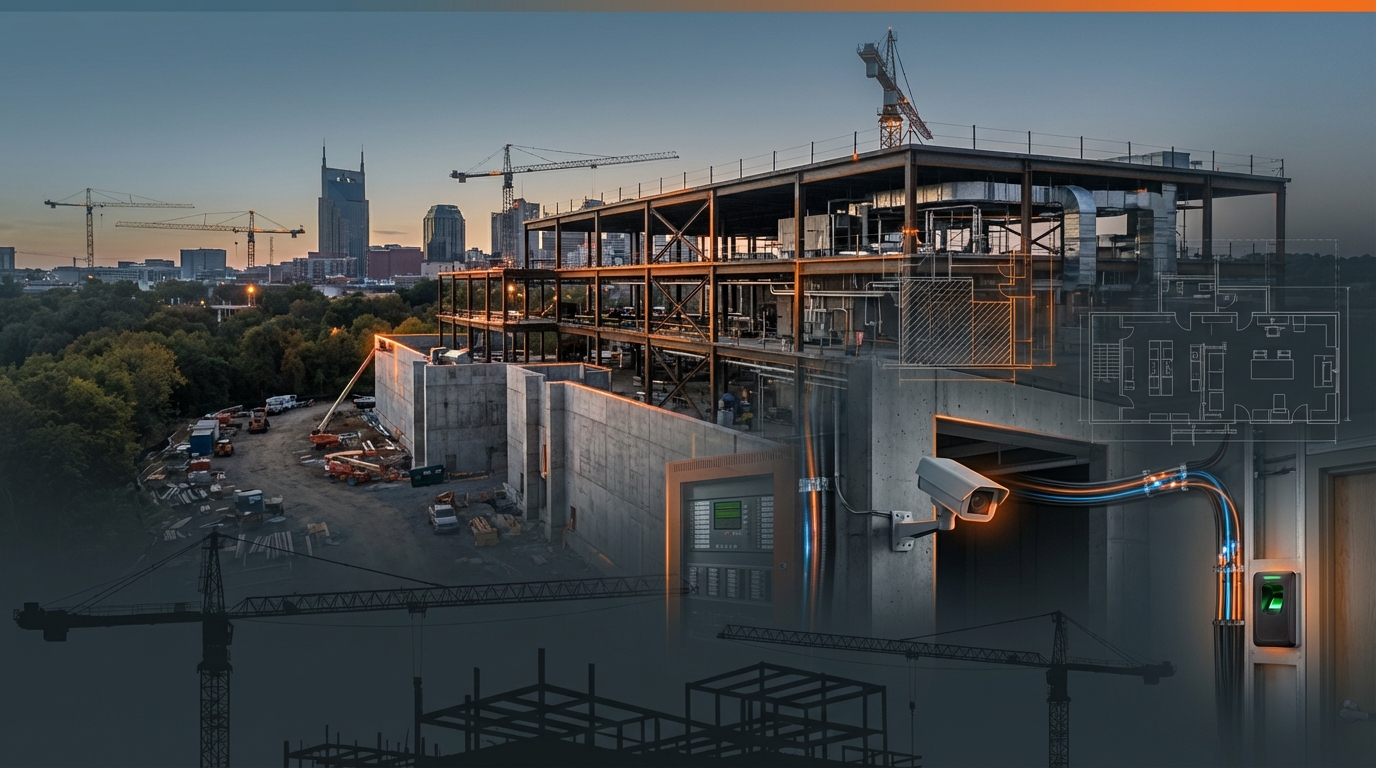
The R.S. Gass State Laboratory Facility Replacement is one of the most technically demanding construction projects to hit Nashville permits in recent years. Located at the corner of Ellington Parkway and Hart Lane on Nashville's east side, this 180,000-gross-square-foot facility will replace a seven-story former tuberculosis hospital built in the 1950s that was repurposed as the state's primary public health laboratory in the 1980s. The aging infrastructure has reached the end of its useful life, and Tennessee is building from the ground up.
Permit records filed with Nashville's Department of Building and Codes show the project valued at $33,579,740. Funding comes from the federal American Rescue Plan Act (ARPA) through Tennessee's STREAM Act — part of a statewide push to modernize critical public health infrastructure. The new facility will sit on the 172-acre R.S. Gass Complex, which also houses the Tennessee Bureau of Investigation forensic lab and the state medical examiner's office.
This isn't a standard commercial buildout. A BSL-3 (Biosafety Level 3) laboratory demands some of the most rigorous construction standards in the industry — specialized containment, redundant environmental controls, and security systems that go far beyond a typical office or hospital. For low voltage contractors, that translates directly into complex, high-specification system installations.
| Project | R.S. Gass State Laboratory Facility Replacement |
| Location | Ellington Pkwy & Hart Ln, Nashville, TN 37216 |
| Total Value | $33,579,740 |
| Size | 180,000 GSF |
| Project Type | Government / Laboratory |
| Status | Active — Permitted |
| LV Score | 10/10 |
| Source | Nashville ArcGIS Permit Data |
Key Players
This project has attracted some of the top architecture and engineering firms in the Southeast. The team brings deep healthcare and laboratory design experience — a critical factor for a facility handling dangerous pathogens at BSL-3 containment levels.
| Role | Company | Details |
|---|---|---|
| Owner | Tennessee Department of General Services / Tennessee Department of Health | State agency overseeing construction and operations of public health laboratory facilities |
| Architect (Design) | ESa (Earl Swensson Associates) | Nashville-based architecture firm with 60+ years of healthcare and institutional design, partnering with HDR on this project |
| Architect (Partner) | HDR | Global architecture-engineering firm with extensive laboratory and science facility portfolio |
| Programming Consultant | A2H | Engineers, architects, and planners who led the facility programming and needs assessment phase |
| GC Contact | Jerry Fannin | Listed general contractor contact on permit records — (615) 760-6731 |
Low Voltage Systems Breakdown
With six low voltage systems spanning life safety, security, wireless, data, and AV categories, this project demands a broad and technically deep workforce. A BSL-3 laboratory elevates every system's complexity — containment zones create unique routing challenges, security requirements are heightened, and redundancy is non-negotiable.
| System | Category | Scope Description | Complexity |
|---|---|---|---|
| Fire Alarm | Life Safety | Full addressable fire alarm system across 180,000 GSF of laboratory, warehouse, and educational space. BSL-3 containment zones require specialized detector placement that maintains negative pressure integrity. Expect smoke detection, heat detection in chemical storage areas, duct detection for the HVAC system, and integration with the building's emergency shutdown protocols. NFPA 72 and NFPA 45 (fire protection for labs using chemicals) both apply. | Very High |
| Distributed Antenna System (DAS) | Wireless | In-building cellular coverage is critical for a government facility housing emergency response laboratories. The concrete-heavy construction of a BSL-3 lab creates significant signal attenuation. A DAS will ensure first responders, lab staff, and administrators maintain reliable cellular connectivity throughout the complex, including containment areas where personal devices may be restricted but emergency communication must function. | High |
| Access Control | Security | Multi-tier access control spanning public areas, general laboratory zones, and BSL-3 restricted containment areas. Expect biometric readers at containment boundaries, card access throughout general areas, mantrap configurations at BSL-3 entry points, and integration with visitor management systems. The facility's proximity to TBI forensic labs and the medical examiner adds inter-agency security coordination requirements. | Very High |
| CCTV / Video Surveillance | Security | Comprehensive video surveillance covering the 172-acre R.S. Gass Complex perimeter, building entrances, parking areas, the pedestrian bridge connecting campus buildings, and interior corridors. BSL-3 labs typically require camera coverage at containment entry/exit points for security audit trails. Expect 100+ cameras with a mix of indoor/outdoor, PTZ for perimeter, and fixed cameras for interior monitoring. | High |
| Structured Cabling | Data/Voice | The backbone of every other system. A 180,000 GSF laboratory requires extensive Cat6A and fiber optic infrastructure serving lab workstations, environmental monitoring systems, building automation integration points, and general office connectivity. Open lab concepts increase data drop density. Expect multiple telecommunications rooms serving distinct building zones with redundant fiber backbone runs. | High |
| Audio/Visual (AV) | AV | Educational laboratories and conference spaces require presentation systems, displays, and audio reinforcement. The facility's educational mission — training the next generation of public health lab workers — means purpose-built AV in training rooms, auditorium-style spaces, and potentially video conferencing infrastructure for coordination with other state agencies and the CDC. | Medium |
Estimated Low Voltage Value
Signal's analysis places the total low voltage contract value for this project at approximately $1.7 million. This figure accounts for the project's six integrated systems and the elevated complexity of BSL-3 laboratory construction, where containment protocols, redundancy requirements, and government compliance standards push installation costs above typical commercial rates.
| Total Project Value | $33,579,740 |
| LV Systems | 6 systems |
| Estimated LV Contract Value | $1,678,987 |
| LV as % of Total | ~5.0% |
Here's how that value roughly breaks down across the six systems:
| System | Estimated Share | Approximate Value |
|---|---|---|
| Structured Cabling | 25% | $420,000 |
| Fire Alarm | 22% | $369,000 |
| DAS | 18% | $302,000 |
| Access Control | 14% | $235,000 |
| CCTV | 12% | $201,000 |
| AV | 9% | $151,000 |
For mid-size low voltage contractors in the Nashville market, $1.7 million represents a substantial single-project opportunity. The BSL-3 specification also means the bidding pool will be narrower than a typical commercial project — contractors need demonstrated experience with government laboratory facilities and the clearances to match. That's good news for qualified firms: less competition, better margins.
Skills and Certifications Required
This project's six systems span life safety, security, wireless, data infrastructure, and AV — demanding a workforce with both breadth and depth. BSL-3 laboratory construction adds a layer of specialized knowledge that separates this from standard commercial work.
| System | Key Certifications | Critical Skills |
|---|---|---|
| Fire Alarm | NICET Level II+, TN State Fire Alarm License | NFPA 72 & NFPA 45 compliance, addressable SLC/NAC wiring, lab-specific detector placement, AHJ coordination |
| DAS | BICSI RCDD, RF Engineering background | Antenna placement in high-attenuation environments, carrier coordination (AT&T, Verizon, T-Mobile), signal testing, fiber optic splicing |
| Access Control | PSP (ASIS), Manufacturer certs (Genetec/Lenel/HID) | Biometric reader installation, mantrap configuration, IP networking, multi-tier credential management, government security protocols |
| CCTV | Manufacturer certs (Axis/Avigilon/Milestone) | PoE networking, outdoor camera installation across large campus, VMS configuration, video analytics, storage sizing for 100+ cameras |
| Structured Cabling | BICSI INST2, BICSI RCDD (design) | Cat6A termination, fiber splicing, Fluke DSX certification testing, TR buildouts, pathway planning for containment zones |
| AV | CTS (AVIXA), CTS-I (Installation) | Display mounting, DSP programming, video conferencing systems, room acoustics for educational spaces |
Entry-level technicians with BICSI Installer 1 or NICET Level I can contribute to cable pulling, device mounting, and basic terminations across the project. Mid-level techs with NICET Level II or BICSI INSTC will handle system wiring, testing, and supervision of installation crews. The project will need at least one RCDD for cabling design oversight, a NICET Level III+ for fire alarm system engineering, and RF engineers for the DAS deployment.
Contractors bidding on this project should verify their Tennessee low voltage contractor license is current. Tennessee requires a Limited Licensed Electrician (LLE) or Electrical Contractor license for fire alarm and security system installations. Background checks and facility clearances are also likely given the government ownership and BSL-3 classification.
Market Signal
Nashville's construction market continues to rank among the hottest in the Southeast. The metro area has seen sustained growth in healthcare, government, and institutional construction driven by Tennessee's business-friendly tax environment and population growth exceeding 100 people per day in the broader metro. This state laboratory project is part of a larger wave of government infrastructure modernization funded by federal dollars — a trend that's creating opportunities across the state.
For low voltage contractors, the BSL-3 laboratory niche is particularly interesting. These facilities are rare — most states have only one or two — and the technical requirements create a barrier to entry that rewards specialized firms. If your team has experience with containment-grade security, lab-rated fire alarm systems, or government facility DAS installations, this project is exactly the kind of differentiator that builds a portfolio and opens doors to similar work nationwide.
The R.S. Gass Complex itself is evolving into a major state campus, with the TBI forensic lab and medical examiner already on-site. Future phases could bring additional infrastructure work as Tennessee continues to consolidate and modernize its public safety and health facilities in this corridor. Contractors who get on this project now are positioning themselves for long-term relationships with state procurement.
Find Projects Like This on Signal
LVN Signal tracks thousands of construction projects with low voltage opportunities across the country. This Nashville state lab is one of over 2,500 active projects in the Nashville metro alone — and new permits hit the feed every day.
Filter by city, system type, project value, and LV opportunity score to find your next bid before your competitors even know it exists.
Join 35,000+ Low Voltage Pros
Get weekly permit updates, tool deals, job opportunities, and industry news. No spam, unsubscribe anytime.