
Join Low Voltage Nation — Find project opportunities and showcase your company to thousands of industry professionals
Nashville's $226.1 million new-stadium building permit tracks an estimated $18.1 million low-voltage scope across nine systems. The $2.23 billion program is separate, and named AV, Wi-Fi, DAS, and BMS partners define where package boundaries already sit.
Nashville's $226.1 million new-stadium building permit tracks nine low-voltage systems and an estimated $18.1 million permit-scoped LV opportunity. The number is deliberately tied to the full-building permit—not the separate $2.23 billion stadium program—so contractors can see the addressable infrastructure without counting land, financing, general construction, or owner-furnished technology twice.
Project Overview
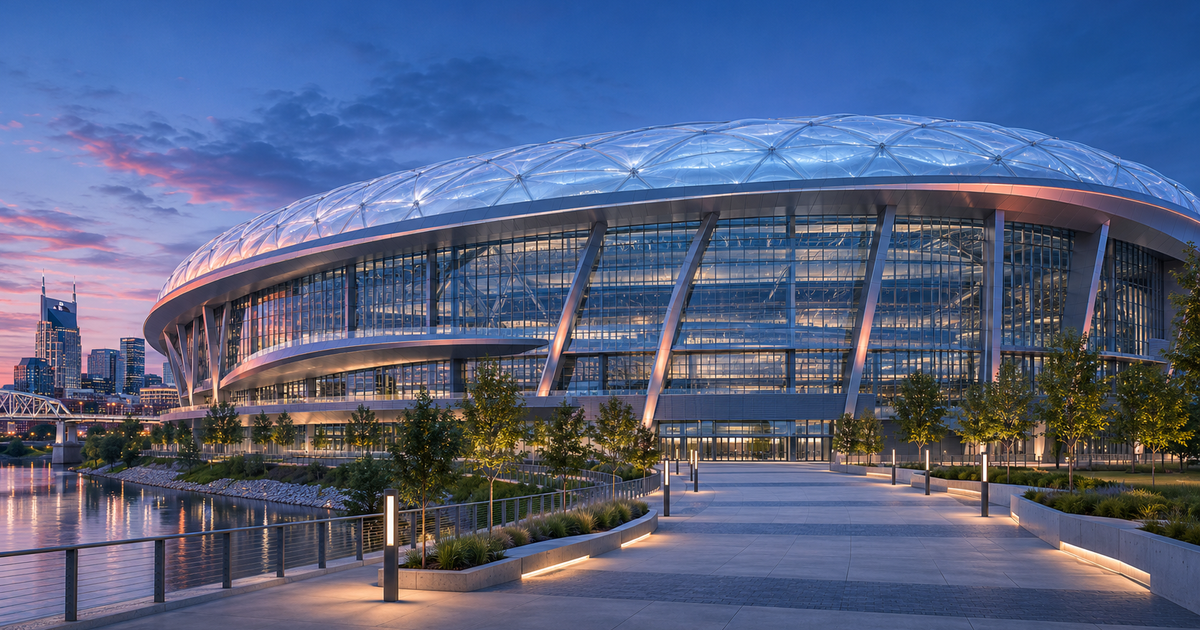
Metro Nashville's current open-data record for permit 2024073883 identifies a new commercial stadium at 300 Interstate Drive. The permit was issued April 1, 2025 with a declared construction cost of $226,068,759 and a scope to construct the Tennessee Titans' new domed stadium. That is the permit value used in this spotlight.
The permit is one slice of a much larger program. A 2026 Metro Nashville performance audit places total construction cost at approximately $2.23 billion, notes the February 29, 2024 groundbreaking, and targets substantial completion in February 2027. Those figures overlap with the building permit and other contracts; they are shown separately and are never added together here.
The project is current, not a stale permit artifact. Metro's Q3 2026 East Bank report says work advanced during the quarter on the building envelope, interior build-out, mechanical, electrical, plumbing, vertical transportation, and other major building systems. The report continues to target February 2027 substantial completion. For low-voltage firms, that phase points less toward chasing a prime package and more toward integration, testing, commissioning, changes, punch work, and operational turnover.
| Project | New Nissan Stadium |
| Location | 300 Interstate Drive, Nashville, Tennessee |
| Building Permit | 2024073883, issued April 1, 2025 |
| Permit Value | $226,068,759 |
| Program Cost | Approximately $2.23 billion, reported separately |
| Facility | Enclosed 60,000-seat sports and entertainment stadium |
| Current Phase | Active interior build-out and building-systems installation |
| Target | February 2027 substantial completion |
| Signal LV Score | 8/10 across nine tracked systems |
Key Players and Package Boundaries
The Tennessee Titans are leading the stadium project with the Metropolitan Sports Authority as the public owner framework. The official groundbreaking announcement identifies Tennessee Builders Alliance as construction manager. That alliance combines I.C.F. Builders, Polk & Associates, Turner Construction, and AECOM Hunt. The design side is led by TVS as architect of record and MANICA as lead design architect; TVS lists the venue at 1.8 million square feet, 60,000 seats, and a 2027 completion.
Several technology lanes are already source-backed. Audio Visual Design Group is the official AV integrator for key areas and is responsible for design, engineering, installation, commissioning, and optimization of those assigned systems. Extreme Networks has been selected for the venue's Wi-Fi 7 network, including its multi-beam wireless architecture. ANDREW has been selected for the digital DAS platform. Schneider Electric is delivering energy-management technology, backup power, IT physical infrastructure, electrical distribution and controls, and the integrated building-management system.
Those announcements are useful scope evidence, but they are not an invitation to relabel committed work as open opportunity. The business-development angle is the work around the named packages: pathways, passive backbone, device connectivity, cross-system interfaces, documentation, testing, commissioning support, late changes, and closeout. Firms approaching the project should verify package ownership with Tennessee Builders Alliance before treating any line item as available.
| Role | Organization | Source-backed position |
|---|---|---|
| Team / operator | Tennessee Titans | Project lead and future stadium operator |
| Construction manager | Tennessee Builders Alliance | I.C.F. Builders, Polk & Associates, Turner, and AECOM Hunt |
| Architecture | TVS + MANICA | Architect of record and lead design architect |
| AV integration | Audio Visual Design Group | Official integrator for assigned key areas |
| Wi-Fi platform | Extreme Networks | Wi-Fi 7 and multi-beam wireless architecture |
| DAS platform | ANDREW | Digital distributed antenna system |
| Energy / BMS | Schneider Electric | Energy management, power controls, IT physical infrastructure, and BMS |
Low Voltage Systems Breakdown
Signal tracks nine systems on the project. A stadium concentrates life safety, security, wireless, broadcast, and fan-experience technology in one building, and every package shares pathways, rooms, fiber, timing, network services, and commissioning dependencies. That coordination load is the real reason the opportunity is larger than a simple per-device count.
| System | Category | Likely permit-scoped work | Complexity |
|---|---|---|---|
| Structured Cabling | Data / Voice | Entrance facilities, telecom rooms, copper and fiber backbone, horizontal distribution, labeling, testing, and turnover records across concourses, suites, offices, concessions, and operations spaces. | High |
| Access Control | Security | Door controllers, readers, credentials infrastructure, monitored openings, elevator and gate interfaces, emergency-release logic, and integration with venue operations. | High |
| CCTV / Video Surveillance | Security | High-density IP camera infrastructure, PoE access, resilient network paths, command-center connectivity, storage coordination, and coverage validation for crowds and back-of-house areas. | High |
| Audio / Visual | Fan Experience | Signal transport, control cabling, displays, presentation systems, bowl and premium-space audio interfaces, equipment-room infrastructure, tuning, and commissioning around already assigned integrator work. | Very High |
| Fire Alarm | Life Safety | Addressable detection and notification, voice evacuation, smoke-control interfaces, elevator recall, sprinkler monitoring, phased testing, and authority coordination for a large assembly occupancy. | Very High |
| Distributed Antenna System | Wireless | Passive fiber and coax distribution, remote-unit locations, antenna pathways, grounding, firestopping, test points, and coordination around the selected digital DAS platform. | Very High |
| Wi-Fi Infrastructure | Wireless | Fiber and copper feeds, mounting locations, power and pathway coordination, high-density coverage validation, and handoff support for the selected Wi-Fi 7 system. | Very High |
| Digital Signage | Specialty | Networked display connectivity, menu boards, wayfinding, ribbon-board interfaces, content-distribution pathways, device control, and monitoring across public and premium areas. | High |
| Broadcast Infrastructure | Media | Production fiber, camera and announce positions, patching, timing, intercom, control-room connectivity, truck interfaces, venue feeds, redundancy, and event-day commissioning. | Very High |
Estimated Low Voltage Value
Signal stores an estimated low-voltage value of $18,085,500.75 for this project. Rounded for planning, that is approximately $18.1 million. The figure equals about 8% of the $226.1 million full-building permit, consistent with the stadium benchmark for a high-density assembly venue with security, life safety, wireless, AV, signage, and broadcast scope.
| Permit Value Used | $226.1 million |
| Stadium LV Benchmark | Approximately 8% |
| Estimated Permit-Scoped LV Value | $18.1 million |
| Program Cost Not Used | Approximately $2.23 billion |
The estimate is not a bid tab, an awarded contract value, or a claim that $18.1 million remains uncommitted. It is a planning model for the LV content inside the cited permit. It includes passive copper and fiber infrastructure, pathways, firestopping, security and life-safety field work, device connectivity, portions of AV and broadcast signal infrastructure, DAS and Wi-Fi distribution support, labeling, testing, and commissioning.
It excludes the overlapping $2.23 billion program total; owner-furnished or separately contracted active Wi-Fi 7 electronics; digital DAS headend and active RF equipment; large-format LED displays; broadcast production equipment; AV content and software; Schneider's electrical distribution and energy-management products; general electrical work; and non-LV trades. Named vendor packages are evidence for the system model, not dollars added on top. Keeping those boundaries visible prevents a flashy stadium number from becoming a fictional addressable market.
Skills and Certifications Required
This is a systems-integration job as much as an installation job. Cable placement and device mounting matter, but the difficult work sits at the interfaces: fire alarm to smoke control and public address, access control to gates and elevators, cameras to command operations, AV to broadcast, Wi-Fi to the wired core, and DAS to carrier and venue requirements.
| Workstream | Useful credentials | Critical skills |
|---|---|---|
| Cabling and fiber | BICSI INSTC / INSTF, TECH, RCDD | High-count fiber, pathway planning, room build-out, Fluke certification, labeling, and as-built discipline |
| Fire alarm | NICET Fire Alarm Level II or higher, applicable state and local licensing | NFPA 72, voice evacuation, SLC and NAC design, smoke-control interfaces, phased acceptance, and AHJ coordination |
| Security | Manufacturer training, ASIS PSP for design leadership, Network+ | Door hardware, IP video, PoE, resilient switching, camera coverage, database integration, and emergency logic |
| Wi-Fi and DAS | RCDD, RF engineering experience, fiber-splicing credentials, platform and carrier training | High-density RF, antenna placement, spectrum and PIM testing, grounding, optical loss budgets, and coverage validation |
| AV, signage, and broadcast | AVIXA CTS-I / CTS-D plus assigned-platform training | AV-over-IP, DSP, control, production fiber, timing, intercom, signal-flow troubleshooting, and integrated commissioning |
Entry-level technicians can contribute to pathway preparation, pulling, dressing, device mounting, labeling, and supervised termination. Mid-level technicians will carry testing, troubleshooting, rack and field-device work, while senior leads should own design interpretation, cross-trade coordination, acceptance procedures, and turnover documentation. Contractors should confirm Tennessee and Nashville licensing, permit, and registration requirements for the exact systems they intend to perform before pursuing work.
Market Signal
The latest official reporting places the project in the phase where digital infrastructure becomes visible to every other trade. Envelope and roof work are nearing completion while interior systems advance. That creates schedule pressure around telecom rooms, risers, device locations, network readiness, integrated testing, and owner training. On a venue this large, a late pathway conflict or incomplete interface matrix can ripple across security, AV, wireless, concessions, ticketing, signage, and life safety.
The named partners also reveal a procurement reality contractors should respect. AVDG, Extreme, ANDREW, and Schneider already anchor major technology lanes. The remaining leverage is not pretending those packages are open; it is demonstrating capacity at the seams. Firms with clean documentation, certified fiber crews, RF testing, commissioning leadership, and stadium-scale change management can support prime contractors and integrators through the final construction year and into event-readiness work.
For Nashville-area contractors, the practical move is to map the contract holder for each system, document labor and commissioning capacity, and approach Tennessee Builders Alliance or the named integrators with a specific gap they can close. Good pitches are concrete: high-count fiber testing, overnight integrated-system testing, life-safety acceptance support, DAS sweep and PIM work, broadcast-fiber certification, or punch-list surge labor. Generic “we do low voltage” outreach will disappear inside a program this complex.
The broader market signal is that sports venues are becoming converged critical infrastructure. Wireless, media, security, building automation, and commerce now depend on the same physical pathways and operational data. Contractors who can prove not only installation quality but also interface ownership, commissioning evidence, and disciplined turnover will be better positioned for the next arena, convention, and entertainment project across the region.
Find Projects Like This on Signal
LVN Signal tracks thousands of construction projects with low voltage opportunities across the country. Filter by city, system type, and project value to find your next bid.
Join 35,000+ Low Voltage Pros
Get weekly permit updates, tool deals, job opportunities, and industry news. No spam, unsubscribe anytime.