
Join Low Voltage Nation — Find project opportunities and showcase your company to thousands of industry professionals
CityGolf USA is converting a roughly 174,000-square-foot Nashville warehouse into a full 18-hole indoor golf flagship. Signal tracks a $6 million build-out with nine likely low-voltage packages and a modeled $525,000 LV opportunity.
A $6 million interior build-out in Nashville is turning a roughly 174,000-square-foot warehouse into CityGolf USA’s first full 18-hole indoor golf flagship. The venue combines simulator technology, real putting surfaces, food and beverage, private events, retail, offices, locker rooms, security, life safety, and guest connectivity. Signal tracks nine relevant low-voltage packages and models approximately $525,000 in building technology work before proprietary golf hardware and software.
Project Overview
Nashville Metro permit data describes the rehabilitation of Building 6 at 141 Crestline Crossing for CityGolf USA. The filed scope converts an existing warehouse into an indoor commercial-amusement venue with golf areas, a bar and dining program, hospitality space, retail, offices, locker rooms, and back-of-house support. Signal carries an estimated construction value of $6 million for the tracked build-out and last saw the project in the permit feed on October 12, 2026.
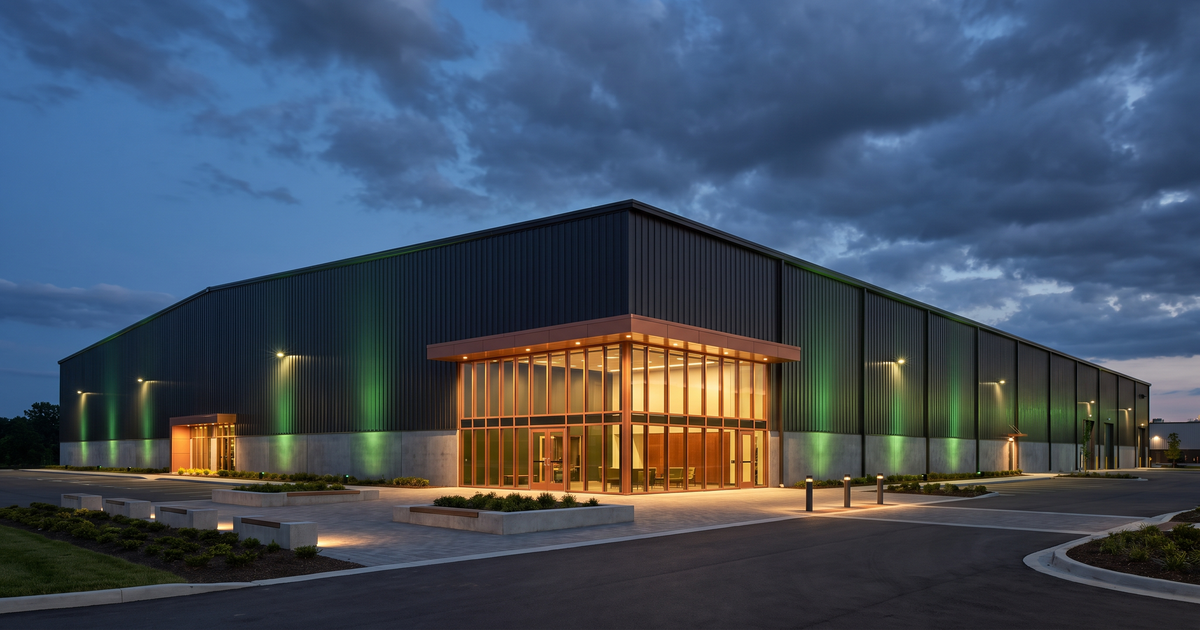
The address is not a generic tenant shell. It is Prologis City View Building 6, a 174,160-square-foot industrial building with 36-foot clear height, 4,000-amp electrical service, LED lighting, and an ESFR sprinkler system. Those dimensions matter to low-voltage bidders: long pathways, high mounting elevations, large radio cells, broad camera views, and widely distributed golf and hospitality zones all raise coordination demands above a typical restaurant or simulator suite.
CityGolf USA says the Nashville location will be America’s first full 18-hole indoor golf experience and is targeting a Winter 2026 opening. Its format pairs GOLFZON simulation with physical greens and bunkers, plus a full restaurant and bar, private event rooms, and corporate presentation capability. A separate company announcement says Fazio Design Technologies is creating eight digital courses for the platform and identifies Nashville as the first site in a broader rollout.
That mix makes this less like a row of golf bays and more like a technology-driven hospitality campus inside an industrial shell. The low-voltage package has to support gameplay, guest services, commercial operations, public safety, and a launch-day experience that cannot tolerate weak wireless coverage or unstable networks.
| Project | CityGolf USA Nashville flagship |
| Location | 141 Crestline Crossing, Nashville, Tennessee |
| Tracked Construction Value | $6 million |
| Facility | Approximately 174,000 square feet in Prologis City View Building 6 |
| Use | Indoor golf, restaurant and bar, events, retail, offices, locker rooms, and support space |
| Opening Target | Winter 2026, according to CityGolf USA |
| LV Opportunity Score | 9/10 in Signal |
| Source | Nashville Metro Building Permits |
Key Players
The permit and public launch material provide a credible view of the operating brand, property, construction contact, and technology platform. Specialty low-voltage awards have not been disclosed, so the names below should be treated as account intelligence rather than a subcontractor list.
| Role | Organization | Why It Matters |
|---|---|---|
| Operator / Tenant | CityGolf USA | Sets the guest-experience, gameplay, event, restaurant, and technology standards for the flagship and future locations. |
| Permit Contact / GC Record | R.C. Mathews Contractor | The permit contact uses the R.C. Mathews domain, and Signal’s entity record identifies the Nashville builder in the GC role. |
| Property / Campus | Prologis City View | Building 6 supplies the large industrial shell, utility capacity, and campus constraints around the tenant conversion. |
| Golf Technology Partner | GOLFZON | The simulation platform connects digital ball-flight capture with the venue’s physical short-game components. |
| Course Design Technology | Fazio Design Technologies | The announced digital-course program adds specialized audiovisual, control, calibration, and acceptance requirements. |
For business development, the most valuable relationship is not limited to one Nashville install. CityGolf USA describes this facility as a flagship and says additional locations are planned. A contractor that documents the network, AV, security, wireless, and commissioning standards here could be building a repeatable prototype for a multi-market program.
Low Voltage Systems Breakdown
The permit does not publish awarded low-voltage subcontracts. The system list below combines Signal’s valid project fields with requirements reasonably indicated by the official golf, hospitality, restaurant, and event program. One bad database field was removed: nurse call belongs to healthcare, not this venue. Wi-Fi and point-of-sale infrastructure replace it in the working scope because they align with the public operating model.
| System | Category | Likely Scope | Complexity |
|---|---|---|---|
| Structured Cabling | Data / Voice | Category cabling and pathways for golf stations, restaurant devices, offices, event rooms, access points, cameras, controls, displays, and back-of-house operations. The warehouse geometry makes pathway zoning and intermediate distribution planning critical. | High |
| Fiber Optic Backbone | Data / Voice | High-capacity links between telecom rooms and distant venue zones, with spare strands for future course technology. The long building footprint favors fiber over extended copper runs for aggregation and growth. | High |
| Audio / Visual | Experience | Simulator displays, control interfaces, distributed audio, restaurant screens, private-event presentation systems, digital routing, and room controls. Simulator AV must be coordinated with lighting, acoustics, ceilings, sensors, and physical play surfaces. | Very High |
| Wi-Fi Infrastructure | Wireless | Dense guest and operational coverage for bookings, mobile devices, staff workflows, event use, and connected gameplay. Radio design must account for high ceilings, open volume, partitions, people density, and potential interference from many electronic systems. | High |
| Access Control | Security | Staff entries, offices, IT rooms, kitchen and service doors, inventory areas, event rooms, and controlled back-of-house circulation. Door hardware coordination should be settled before finishes and millwork close pathways. | Medium |
| CCTV / Video Surveillance | Security | Coverage of entrances, play areas, cash-handling zones, retail, loading, parking approaches, and service corridors. High-bay mounting may improve views but increases lift access, lens-selection, maintenance, and identification-distance requirements. | High |
| Fire Alarm | Life Safety | Occupancy-change coordination, notification coverage, kitchen interfaces, sprinkler supervision, shutdowns, and inspection testing across a large assembly and hospitality venue. Acoustic and visual notification performance must be verified under operating conditions. | High |
| In-Building Wireless / DAS | Wireless | Public-safety radio and commercial cellular coverage may need testing once the new interior, equipment, and occupied conditions are in place. The metal industrial shell makes early baseline and post-build measurements worth carrying. | High |
| Point of Sale Network | Hospitality | Resilient connectivity for the restaurant, bar, retail, memberships, reservations, and event billing. Segmentation, redundant switching, UPS support, and documented handoff between the operator and payment vendors are more important than the device count alone. | Medium |
Estimated Low Voltage Value
Signal does not carry a reported low-voltage contract value for this permit, so LVN modeled the opportunity from the tracked $6 million construction value. Entertainment projects commonly carry a midrange low-voltage allowance near 7% before complexity adjustments. Nine coordinated systems justify the 1.25 multiplier used for projects with seven or more systems.
| Tracked Construction Value | $6,000,000 |
| Entertainment LV Benchmark | 5% to 9%; 7% midpoint |
| System Count Multiplier | 1.25x for nine systems |
| Modeled LV Planning Range | $375,000 to $675,000 |
| Modeled Midpoint | $525,000 |
The midpoint is a building-systems planning figure, not an awarded contract. It excludes the price of proprietary GOLFZON simulator hardware and software, Fazio course-design content, kitchen equipment, golf surfaces, and owner-furnished devices unless those items are specifically carried through the low-voltage integrator. It also assumes the $6 million record represents the active tenant build-out rather than the full value of every operator investment.
Package boundaries could move the subcontract value sharply. A single integrator carrying cabling, fiber, Wi-Fi, AV, security, and commissioning would see a much larger opportunity than a contractor limited to rough-in. Fire alarm and public-safety radio may remain separate licensed scopes. Point-of-sale and simulator vendors may furnish endpoints while expecting the construction team to provide power, network, supports, cooling coordination, and certified links.
Where Bidders Can Lose Margin
The first risk is treating every golf station like a conventional display location. A hybrid simulator-to-real-green sequence adds tracking sensors, screen motion, control logic, calibrated geometry, player circulation, and protection from club and ball impact. Cabling, supports, and equipment access have to be coordinated with the simulator vendor before framing and ceiling decisions become expensive.
The second risk is underestimating the industrial shell. A 174,000-square-foot footprint and 36-foot clear height can turn ordinary device work into lift-intensive production. Camera focal lengths, speaker aiming, wireless cell placement, cable support, fire-alarm notification, and service access should be mocked up and tested. Labor assumptions need to include work-at-height controls, remobilization, and final aiming or calibration after the golf and hospitality finishes are installed.
The third risk is ownership of acceptance testing. Gameplay technology, AV, Wi-Fi, POS, access control, CCTV, and fire alarm all have different commissioning parties. The bid should name who supplies test plans, who witnesses each test, what data must be retained, and who resolves problems that cross vendor boundaries. Without that matrix, every late integration issue lands on the contractor already holding the cable tester.
Skills and Certifications Required
| Discipline | Useful Credentials | Critical Field Skills |
|---|---|---|
| Cabling and Fiber | BICSI INSTC, INSTF, TECH; RCDD for design oversight | Pathway planning, copper certification, fiber splicing and OTDR testing, labeling, rack buildout, as-built documentation |
| Audio / Visual | AVIXA CTS, CTS-I, CTS-D; platform training where specified | Signal distribution, display and sensor coordination, control programming, acoustics, commissioning, user handoff |
| Wi-Fi and Networking | Vendor wireless certification; CompTIA Network+ or equivalent | Predictive design, onsite survey, channel planning, segmentation, switch configuration, capacity and roaming validation |
| Security | Manufacturer training for the selected access and VMS platforms; applicable state alarm credentials | Door hardware coordination, camera design, PoE budgets, identity management, recording retention, cybersecurity handoff |
| Fire Alarm | NICET Fire Alarm Level II or higher; manufacturer certification | NFPA 72 execution, notification design support, interfaces, programming, testing, AHJ coordination |
| DAS / Public Safety Radio | RCDD or RF engineering background; carrier and equipment training | Benchmark testing, antenna placement, donor-path planning, fiber integration, acceptance documentation |
Entry-level technicians can contribute to pathway installation, pulling, device mounting, labeling, and supervised termination. Mid-level leads should own testing, telecom-room buildout, device addressing, and punch-list control. Senior staff need to manage RF, AV, network, life-safety, and vendor coordination as one commissioning program rather than nine isolated closeout folders.
Tennessee requires a contractor license for covered contracting work at $25,000 or more, and alarm work has separate regulatory considerations. The state’s Limited Licensed Electrician credential applies only in specific jurisdictions and to work below $25,000, so bidders should verify their classification, monetary limit, alarm authority, and Metro Nashville permit requirements before pricing. The Tennessee Board for Licensing Contractors is the current source for license verification and requirements.
Market Signal
CityGolf USA is a useful signal because it puts entertainment technology into a repeatable real-estate format. The company is not opening a small simulator lounge; it is using an entire industrial building for a hybrid digital and physical course, hospitality, events, and corporate use. That turns the network and AV layer into part of the product being sold, not a back-office utility.
The rollout language matters to contractors. CityGolf USA identifies Nashville as the flagship and says more locations will follow. A clean prototype package can travel: telecom-room standards, rack elevations, cable schedules, wireless design criteria, camera naming, AV control templates, acceptance tests, and closeout formats can all be reused. The contractor that helps write those standards in Nashville has leverage beyond the first address.
The project also shows a different path for large industrial buildings. High-cube space can become experience-driven real estate where technology density is closer to entertainment and hospitality than warehousing. That creates work for firms that can bridge construction cabling with AV, wireless, security, and operational networks while still coordinating life safety in an assembly environment.
For local integrators, the practical move is to qualify early with R.C. Mathews and CityGolf USA, ask whether the simulator, AV, Wi-Fi, security, and POS packages are separate or bundled, and request the vendor responsibility matrix before bidding. The biggest number may not be the first contract. It may be the reference design that follows the operator into its next markets.
Find Projects Like This on Signal
LVN Signal tracks thousands of construction projects with low-voltage opportunities across the country. Filter by city, system type, and project value to find your next bid.
Join 35,000+ Low Voltage Pros
Get weekly permit updates, tool deals, job opportunities, and industry news. No spam, unsubscribe anytime.