
Join Low Voltage Nation — Find project opportunities and showcase your company to thousands of industry professionals
A $14.9 million Nashville permit covers a 31,537-square-foot second data hall inside RadiusDC's Nashville I colocation facility. Six low-voltage categories are worth tracking, with a $1.37 million planning midpoint and future tenant electrical fit-out explicitly outside this package.
A $14.9 million interior construction package at RadiusDC Nashville I covers a 31,537-square-foot second data hall and puts six low-voltage categories on the planning board. Using a data-center benchmark against the permit value produces an estimated $1.37 million low-voltage planning midpoint, but the permit record draws an important boundary: future tenant electrical fit-out is not included in this package.
Project Overview
Nashville Metro permit data describes a commercial spec-suite renovation at 2902 Brick Church Pike to construct Data Hall 2, the second of two halls inside an existing single-story building. The stated work area is 31,537 square feet and includes the computer room, electrical rooms, mechanical rooms, and related equipment. Signal carries an estimated permit value of $14,904,730 and an LV opportunity score of 10 out of 10.
The permit narrative is unusually useful because it says what is not part of the current package. Future tenant electrical fit-out will require a separate submission. It also excludes new land disturbance, site infrastructure, and underground site utilities, pointing instead to previously approved grading, stormwater, utility, and shell packages. Contractors should therefore read this as a defined data-hall interior package inside a broader campus program—not as the value of the entire facility and not as an award for every system Signal tracks.
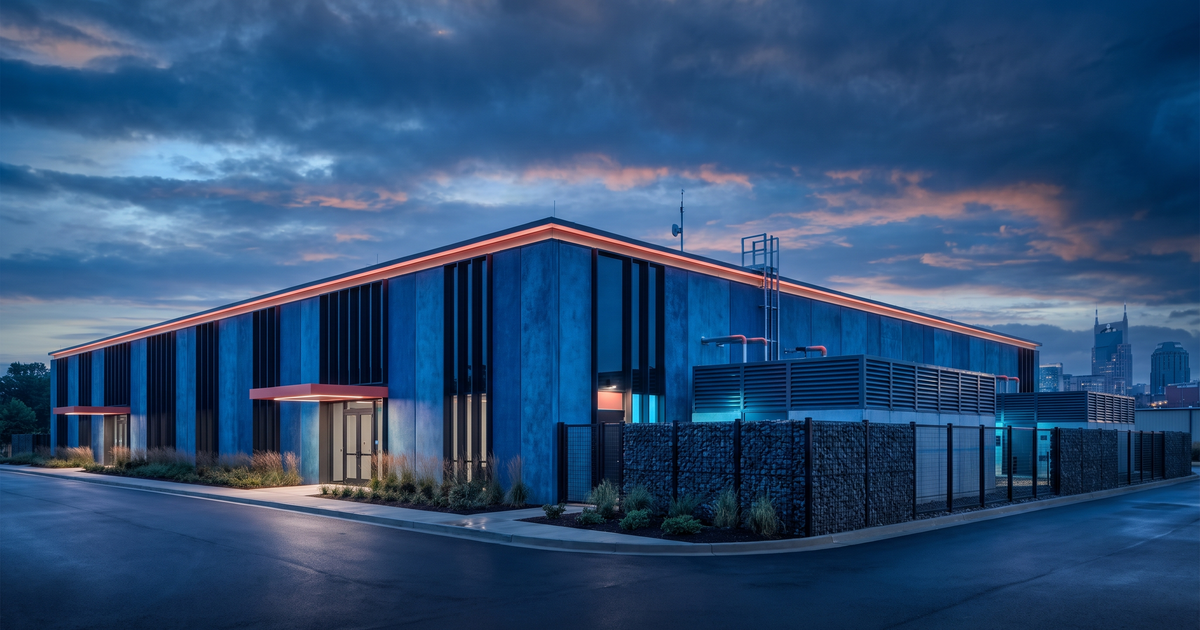
The broader project is RadiusDC's Nashville I colocation facility in the Trinity Hills area. RadiusDC's groundbreaking announcement describes a purpose-built 102,500-square-foot facility on approximately 12 acres with 12 megawatts of critical power, enhanced high-density cooling, near-zero-water closed-loop cooling, and multiple local and long-haul carriers. The operator's current platform page lists roughly 102,000 square feet, 20 megawatts of building utility capacity, and seven carriers. Those figures measure different layers: critical IT power versus total utility capacity.
Current public status also needs a timestamp. The Signal permit row was last updated September 17, 2026, while RadiusDC's current Nashville market page says Nashville I opened in 2026 and is fully leased. This spotlight therefore analyzes the recorded Data Hall 2 package and its contractor implications; it does not represent the six tracked systems as open bids. The expressly excluded tenant fit-out is the next boundary contractors should watch.
| Project | RadiusDC Nashville I — Data Hall 2 |
| Location | 2902 Brick Church Pike, Nashville, Tennessee |
| Permit Package Value | $14,904,730 |
| Current Package Area | 31,537 square feet |
| Facility Context | Approximately 102,500 square feet; 12 MW critical power |
| Project Type | Colocation data center interior build-out |
| Signal Status | Active permit record; updated September 17, 2026 |
| LV Score | 10/10 |
| Source | Nashville Metro Building Permits |
Key Players
Public sources establish the developer/operator, capital partner, and builder. They do not identify a specialty low-voltage award or a named architect for this permit package. That distinction matters: a company appearing in the project team does not prove it holds any particular technology scope.
| Role | Company | Source-Backed Context |
|---|---|---|
| Owner / Developer / Operator | RadiusDC | Develops and operates Nashville I; the company's release defines the facility's size, critical power, cooling approach, and carrier strategy. |
| General Contractor | DPR Construction | DPR publicly describes its partnership with RadiusDC on the ground-up 12 MW facility, and local reporting identifies DPR as the builder. |
| Capital Partner | Blue Owl Capital | RadiusDC identifies Blue Owl as the financial backer of the Nashville facility. |
The scraped Signal entity attached to this permit is not reliable for branding: an individual's name was paired with the unrelated JR Industries domain. The spotlight uses RadiusDC's independently verified official domain and logo instead. No named party matched a record in LVN's low-voltage contractor directory, so the editorial post is linked to the construction project while its company rollup remains unset.
Low Voltage Systems Breakdown
Signal tracks Structured Cabling, Fire Alarm, CCTV, Access Control, DAS, and Building Management System controls on this row. The permit summary confirms a computer room plus electrical and mechanical spaces, which makes backbone connectivity, controls, life-safety coordination, and security planning credible. It does not publish a low-voltage specification, bill of materials, vendor list, or award notice. The six categories below are therefore bid-planning lanes to verify against drawings, addenda, and the separate tenant package.
| System | Category | Likely Data-Hall Coordination | Complexity |
|---|---|---|---|
| Structured Cabling | Data / Voice | Backbone fiber, meet-me-room and carrier pathways, equipment-room racks, copper support links, labeling, testing, and documentation. Tenant rack-level cabling may sit in the later fit-out. | High |
| Fire Alarm | Life Safety | Detection, notification, releasing and supervisory interfaces must coordinate with suppression, mechanical shutdowns, electrical rooms, and the authority having jurisdiction. | High |
| CCTV / Video Surveillance | Security | Perimeter, loading, service corridor, equipment-room, and controlled-hall coverage with PoE switching, storage, cybersecurity, and commissioning requirements. | High |
| Access Control | Security | Layered credentials across site, building, support rooms, and data hall boundaries; likely coordination with door hardware, visitor management, and video events. | High |
| Distributed Antenna System | Wireless / Public Safety | Radio-frequency survey, pathway and riser planning, survivability, and AHJ acceptance if public-safety radio coverage triggers a system. A DAS requirement is not confirmed by the permit summary. | High |
| Building Management System | Controls | Monitoring and alarm integration for cooling, electrical distribution, environmental conditions, and equipment rooms using owner-standard points, naming, trends, and handoff documentation. | High |
Package Boundaries That Change the Bid
The words “future tenant electrical fit-out improvements are not included” should drive the estimate structure. A base-building technology contractor may carry backbone pathways, shared security, fire alarm interfaces, common monitoring, and carrier entry work while a later tenant package adds customer-specific racks, cross-connects, containment monitoring, cabinet access, and acceptance testing. Mixing those scopes creates either a high bid now or an expensive gap later.
Price the current package with an inclusions matrix that names the room, pathway, device, control point, software license, test standard, and responsible trade. Then create a separate allowance or alternates sheet for tenant-dependent quantities. The most valuable early RFIs are not “Is low voltage included?” but “Where does owner backbone stop?”, “Which tenant standard controls labeling and test records?”, and “Who owns integration between BMS, electrical monitoring, fire alarm, and security?”
Estimated Low Voltage Value
No public source reviewed for this spotlight gives an awarded low-voltage contract value. The planning model applies an 8% data-center midpoint to the $14.90473 million permit package and then uses a 1.15 multiplier for six tracked systems. That produces approximately $1.37 million. A 6% to 10% base range, using the same multiplier, produces a wider planning band of approximately $1.03 million to $1.71 million.
| Permit Package Value | $14,904,730 |
| Data Center LV Benchmark | 6% to 10%; 8% midpoint |
| Six-System Multiplier | 1.15x |
| Estimated LV Planning Range | $1.03 million to $1.71 million |
| Estimated LV Midpoint | $1.37 million |
This is a market-planning estimate, not a quote, budget release, or award. The denominator is the Data Hall 2 permit package, not the full Nashville I development, its land purchase, or the facility's power capacity. The current permit also excludes the future tenant electrical fit-out, so a tenant's active network, rack, cabinet-security, or workload-specific monitoring package should not be silently loaded into the $1.37 million midpoint.
The estimate can still overstate the current opportunity if major controls and life-safety systems were bought under the shell package, or understate it if owner-furnished equipment requires extensive field integration. Contractors should reconcile the permit set against prior shell and utility packages, identify reused systems, and price shutdown, tie-in, testing, and documentation labor separately from new device counts.
Skills and Certifications Required
A data hall concentrates multiple technical disciplines into a small footprint. Winning the work requires more than labor capacity: the team must prove its fiber-testing process, security and controls integration experience, commissioning discipline, and ability to deliver documentation that an operator can use after turnover.
| System | Useful Certifications | Critical Skills |
|---|---|---|
| Structured Cabling | BICSI INSTF / INSTC, TECH, RCDD; specified manufacturer credentials | Fiber splicing and loss testing, copper certification, pathway coordination, labeling, as-builts |
| Fire Alarm | NICET Fire Alarm Level II or higher; required contractor and manufacturer credentials | NFPA 72 execution, interfaces, cause-and-effect testing, AHJ coordination, turnover records |
| Access Control | Owner-selected platform certification; ASIS PSP for senior security design roles | Door hardware, reader and controller wiring, database configuration, event integration, commissioning |
| CCTV | VMS and camera manufacturer credentials; Network+ or equivalent networking depth | PoE design, camera placement, storage calculations, secure configuration, analytics validation |
| DAS | RCDD, RF engineering background, carrier or public-safety platform training | RF survey, antenna and donor design, fiber transport, survivability, acceptance testing |
| BMS Controls | BACnet training, Tridium Niagara N4, specified controls-vendor credentials | Point mapping, sequences, alarming, trending, protocol integration, functional performance testing |
Entry-level installers can support pathway, device mounting, cable placement, labeling, and supervised termination. Experienced technicians should own fiber certification, controller and panel work, network configuration, and point-to-point testing. Senior leads need to coordinate integrated systems, review submittals, manage change control, and defend the final test record during owner commissioning.
Contractors should verify current Tennessee and Nashville licensing, permitting, inspection, and alarm requirements before bidding. They should also confirm the operator's approved manufacturers and whether credentials must be held by the company, the qualifying agent, or the individual technician. A generic certification list is not a substitute for the issued specification.
Market Signal
Nashville I is an urban edge-colocation signal, not a remote hyperscale campus story. RadiusDC positioned the facility close to the city, carrier routes, and enterprise customers that need low latency and local interconnection. The fact that the operator now describes it as fully leased supports the demand thesis: Nashville's enterprise market can absorb purpose-built capacity even when the individual construction package is much smaller than the multibillion-dollar campuses dominating national headlines.
The separation between a 12 MW critical-power figure and a current 20 MW building-utility figure is also a useful estimating lesson. Capacity labels are not construction budgets. Low-voltage contractors need the building phase, data-hall boundary, customer load, redundancy topology, and owner standard before turning megawatts into quantities. This permit gives a better denominator: a 31,537-square-foot, $14.9 million hall package with named exclusions.
For business development, DPR Construction is the relationship with the clearest package leverage because the builder coordinates trade buyout and turnover across the facility. RadiusDC is the portfolio relationship: owner standards, documentation formats, security philosophy, and carrier-entry practices can repeat across Nashville, Indianapolis, Denver, Miami, Atlanta, and Phoenix. A contractor that performs cleanly on one hall gains a stronger qualification story for later tenant work and other markets.
The practical move is to track three separate lanes: remaining base-building closeout, future tenant fit-outs, and operator service work after occupancy. Keep each lane attached to its own scope and timing. The current permit supports a serious planning estimate, but the next award may appear under a tenant name, a facilities integrator, or a service contract rather than under the original construction title.
Find Projects Like This on Signal
LVN Signal tracks thousands of construction projects with low voltage opportunities across the country. Filter by city, system type, and project value to find your next bid.
Join 35,000+ Low Voltage Pros
Get weekly permit updates, tool deals, job opportunities, and industry news. No spam, unsubscribe anytime.