
Join Low Voltage Nation — Find project opportunities and showcase your company to thousands of industry professionals
A $6.2 million emergency department remodel at Hennepin County Medical Center in downtown Minneapolis requires 7 low voltage systems including nurse call, DAS, and fire alarm. Part of a $2.5 billion campus overhaul, this project creates an estimated $500K LV opportunity.
A $6.2 million emergency department remodel at Hennepin County Medical Center in downtown Minneapolis requires 7 low voltage systems, creating an estimated $500,000 opportunity for contractors in the Minnesota market.
Project Overview
Hennepin County Medical Center — Minneapolis's only Level 1 Adult Trauma Center — is remodeling its 66-bed emergency department at 730 8th Street South. The $6.2 million permit, filed with Minneapolis Commercial Permits, covers a comprehensive overhaul of psychiatric intake, triage, and critical care areas within the hospital's I2 occupancy classification under 2020 Minnesota State Building Codes.
This ER remodel is one piece of a much larger puzzle. Hennepin Healthcare has outlined a $2.5 billion campus transformation running through 2032, which includes a new 500-bed inpatient tower, a mental health facility, a 1,000-space parking ramp, and extensive infrastructure upgrades. The ER renovation addresses immediate capacity concerns — long wait times and insufficient stabilization beds — while the broader campus plan reshapes the hospital's downtown Minneapolis footprint.
For low voltage contractors in the Twin Cities, this permit represents a near-term opportunity with a clear scope, while the multi-year campus buildout signals sustained demand for healthcare-grade LV work through the end of the decade.
| Project | Emergency Department Remodel |
| Location | 730 8th Street South, Minneapolis, MN |
| Total Value | $6.2 million |
| Project Type | Hospital |
| Status | Active |
| LV Score | 10/10 |
| Source | Minneapolis Commercial Permits |
Project Context
Hennepin Healthcare is a public, safety-net hospital system serving Hennepin County. HCMC is its flagship facility, operating as a Level 1 Trauma Center and teaching hospital affiliated with the University of Minnesota. Under CEO Jennifer DeCubellis, Hennepin Healthcare has been driving the $2.5 billion campus master plan to modernize aging infrastructure and expand capacity.
The campus master plan was designed by CannonDesign, an international architecture firm hired under a $1.7 million contract approved by the Hennepin County Board. CannonDesign has designed hospital campuses across the U.S., including Parkland Memorial Hospital in Dallas and the Wexner Medical Center in Columbus.
Previous campus construction — including the Hennepin Healthcare Clinic and Specialty Center completed in 2018 — was built by Mortenson Construction, one of the largest builders in the Upper Midwest. A general contractor for the current ER remodel phase has not been publicly identified, which may indicate the project is still in the bidding or early construction phase.
Low Voltage Systems Breakdown
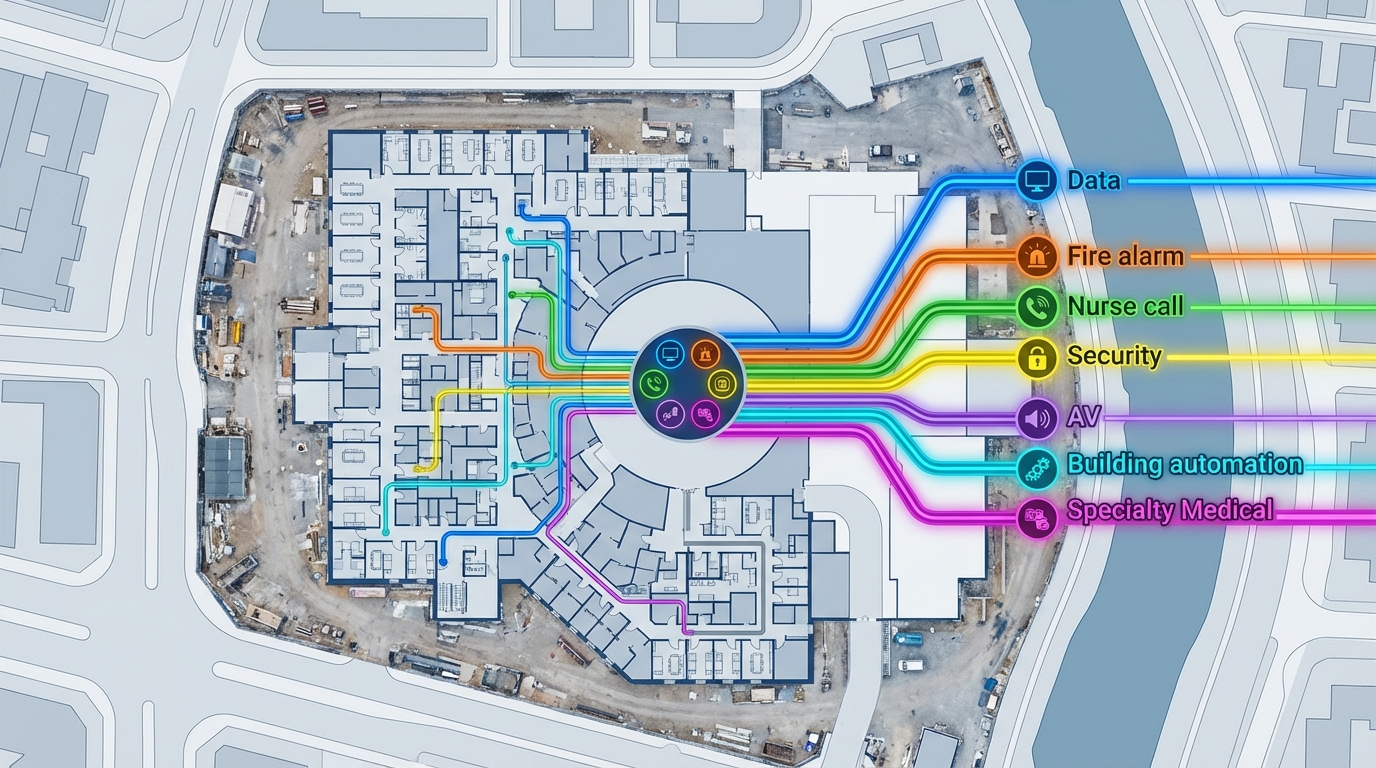
This emergency department remodel requires seven integrated low voltage systems spanning security, life safety, wireless, data, and audiovisual categories. The psychiatric care component adds significant complexity to several of these systems, particularly access control and CCTV.
| System | Category | Scope Description | Complexity |
|---|---|---|---|
| Nurse Call | Life Safety | Critical for psychiatric intake and triage areas. Staff duress buttons, patient call stations, and code alert integration across all care zones. Psychiatric environments require tamper-resistant devices and ligature-resistant mounting. | High |
| Access Control | Security | Psychiatric emergency departments require multi-tiered access zones: public waiting, triage, staff-only, and secured psychiatric holding. Electromagnetic locks, card readers, and anti-tailgating systems with integration to nurse call for duress response. | High |
| CCTV | Security | Full coverage of psychiatric intake areas, hallways, waiting rooms, and external entrances. Cameras in psychiatric care areas must be ligature-resistant with tamper-proof housings. Integration with access control for event-triggered recording. | High |
| Fire Alarm | Life Safety | NFPA 72 compliant system for I2 occupancy under 2020 MSBC codes. Smoke detection, manual pull stations, notification appliances, and integration with building fire suppression. Hospital-grade systems require AHJ coordination with the Minneapolis Fire Department. | High |
| Structured Cabling | Data/Voice | Category 6A infrastructure supporting all networked systems, EMR workstations, nurse stations, and wireless access points. Healthcare environments require plenum-rated cable and redundant pathways for critical care areas. | Medium |
| Audio/Visual | AV | Patient information displays, waiting room notification systems, and clinical collaboration screens. Triage areas need real-time patient tracking displays. Psychiatric areas may require ceiling-mounted, tamper-resistant installations. | Medium |
| DAS | Wireless | Distributed Antenna System ensuring first responder radio coverage (required by IFC) and cellular service throughout the emergency department. Hospital construction with heavy concrete and lead shielding makes DAS essential for reliable indoor wireless. | High |
Estimated Low Voltage Value
With no database-provided LV estimate, we calculated the opportunity using industry benchmarks for hospital construction with 7 integrated systems.
| Total Project Value | $6,195,773 |
| Estimated LV Percentage | 6.5% (Hospital midpoint) |
| System Count Multiplier | 1.25x (7 systems) |
| Estimated LV Contract Value | $503,000 |
The estimated low voltage contract value for this project is approximately $500,000, based on industry benchmarks for hospital ER remodels with 7 integrated systems. In practice, the psychiatric care component could push this toward the higher end of the range. Ligature-resistant hardware for nurse call, CCTV, and AV systems carries a significant premium over standard hospital installations, and the multi-zone access control architecture adds engineering complexity.
For context, a $500K LV contract on a single ER remodel is meaningful for mid-sized contractors, and the work feeds directly into the larger HCMC campus pipeline. Contractors who perform well on this phase position themselves for the $2.5 billion buildout that follows.
Skills and Certifications Required
This project's seven LV systems span life safety, security, data, wireless, and AV disciplines. The psychiatric healthcare setting adds specialized requirements that not every contractor can meet.
| System | Key Certifications | Critical Skills |
|---|---|---|
| Nurse Call | Manufacturer certs (Hill-Rom, Rauland), MN low voltage license | Ligature-resistant installation, healthcare protocols, staff duress integration |
| Access Control | PSP (ASIS), Manufacturer certs (Genetec, Lenel, HID) | Multi-zone architecture, electromagnetic lock wiring, IP networking |
| CCTV | Manufacturer certs (Axis, Avigilon), CompTIA Network+ | Tamper-proof camera mounting, VMS configuration, PoE networking |
| Fire Alarm | NICET Level II+, MN Fire Alarm License | NFPA 72 compliance, SLC/NAC wiring, AHJ coordination |
| Structured Cabling | BICSI INST2, RCDD (design) | Cat6A termination, plenum-rated cable, Fluke certification |
| Audio/Visual | CTS (AVIXA), CTS-I (Installation) | Healthcare display mounting, patient tracking integration, tamper-resistant AV |
| DAS | RCDD, RF engineering background | Carrier coordination, signal testing, IFC compliance for first responder coverage |
Entry-level technicians with BICSI Installer 1 or NICET Level I can contribute to cable pulling, device mounting, and basic terminations. Mid-level techs with NICET Level II or manufacturer certifications will handle system wiring, camera installation, and reader mounting. The project will need senior technicians with NICET Level III+ for fire alarm engineering and an RCDD for DAS design oversight.
The psychiatric care setting is a differentiator. Contractors who have experience with behavioral health facilities — including ligature-resistant hardware, anti-tamper enclosures, and duress alarm systems — will have a significant competitive advantage during the bidding process.
Market Signal
This permit is a leading indicator of what's coming in the Twin Cities healthcare construction market. HCMC's $2.5 billion campus plan is the largest hospital construction program in Minnesota, and it will generate LV work continuously through 2032. The ER remodel is likely one of the earliest permitted phases, with the 500-bed inpatient tower and mental health facility still ahead.
Minneapolis-St. Paul has a dense healthcare ecosystem — Mayo Clinic, Allina Health, M Health Fairview, and HealthPartners all operate major facilities in the metro. When one system invests at this scale, competitors typically follow. Contractors who build healthcare LV capabilities now are positioning for a multi-year run of hospital work across the region.
The psychiatric component is especially relevant. Behavioral health facility construction has surged nationally as health systems invest in dedicated psychiatric emergency departments. These projects carry higher LV complexity and correspondingly higher margins for contractors with the right experience.
Find Projects Like This on Signal
LVN Signal tracks thousands of construction projects with low voltage opportunities across the country. Filter by city, system type, and project value to find your next bid.
Join 35,000+ Low Voltage Pros
Get weekly permit updates, tool deals, job opportunities, and industry news. No spam, unsubscribe anytime.