
Join Low Voltage Nation — Find project opportunities and showcase your company to thousands of industry professionals
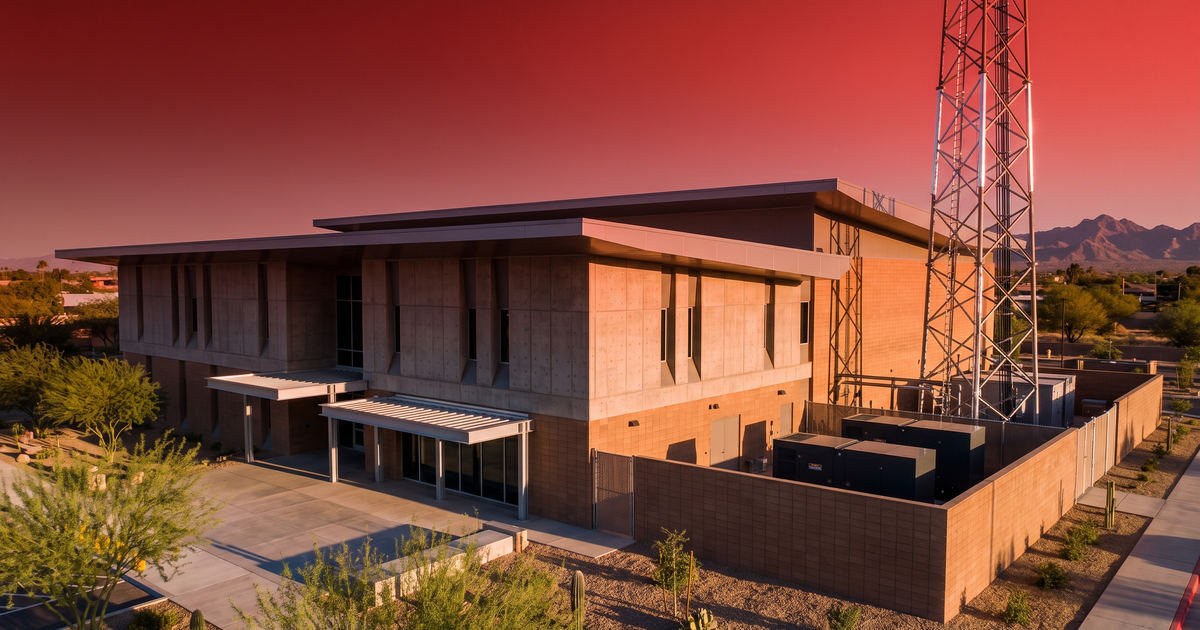
Mesa, Arizona is building a $53.9 million public safety communications facility with Willmeng Construction as general contractor — five low voltage systems and an estimated $6.2 million in LV work. The differentiator is not size, it is qualification: radio and dispatch facilities are grounded to Motorola R56 rather than the NEC alone, and the P25 radio system is usually procured separately by the agency, so knowing where your scope ends is half the bid.
A public safety communications facility is a data center that people work inside — and it is never allowed to go down. Mesa, Arizona is building a $53.9 million one, requiring five low voltage systems and an estimated $6.2 million in LV work, on a job where the grounding spec is not the one most building integrators know.
Project Overview
Project data from the City of Mesa's active capital improvement program shows a new Public Safety Communications Facility valued at $53,936,799, with Willmeng Construction as general contractor and the Mesa Public Safety Department as owner.
Mesa already operates communications infrastructure worth understanding as context. The city's Regional 911 Dispatch Facility is a roughly 14,800 square foot civic dispatch and emergency operations center housing fire and medical emergency communications, built with dispatcher workstations, a fire training room, a nursing station, a dedicated quiet room for dispatchers, a large panel video wall, an upgraded server room, emergency generators, and a UPS plant for uninterrupted power. Separately, Mesa's Northeast Public Safety Facility is a 50,000 square foot mixed-use emergency response campus shared by Police and Fire that also serves as a backup Emergency Operations Center.
At $53.9 million, the CIP-tracked facility in this spotlight is substantially larger than either. Mesa is also moving to a universal call-taker model in 2026, in which all 911 calls — emergency and non-emergency — are handled by a single call taker who enters information into a system accessed by Fire or Police dispatchers. That is an operational change that reshapes console counts, workflow, and the systems behind them.
| Project | Mesa Public Safety Communications Facility |
| Location | Mesa, Arizona |
| Project Value | $53,936,799 |
| Owner | Mesa Public Safety Department / City of Mesa |
| General Contractor | Willmeng Construction |
| Status | Active in Mesa's capital improvement program |
| LV Score | 9/10 |
| Source | Mesa CIP Active Projects |
The Grounding Spec Is Different Here
This is the single most useful thing on this page, and it is the detail that separates a qualified bidder from a hopeful one.
Radio and public safety communications facilities are not grounded to the NEC alone. They are built to Motorola R56 — Standards and Guidelines for Communication Sites — which is the de facto specification across the land mobile radio world for grounding, bonding, lightning protection, surge suppression, and site installation practice.
R56 is prescriptive in ways general building work is not: external ground ring geometry and conductor sizing, ground rod spacing and depth, bonding of every entry point through a single-point ground window, cable tray and rack bonding, transient protection on every conductive path entering the equipment room, and testing with documented resistance values. Antenna and tower systems carry their own requirements on top of that.
Get it wrong and the failure mode is not a tripped breaker. It is noise on the radio system that nobody can trace, intermittent receiver desense, and equipment damage during a monsoon season that Arizona has plenty of. Radio shops will point at the building. The building contractor will point at the radio shop. That argument is expensive, and it happens on projects where nobody read R56 during the bid.
If you can demonstrate R56 experience and produce grounding test documentation, you are in a very different conversation than a contractor pricing this like a municipal office building.
Know What Is Not in Your Contract
The second thing that trips up first-time bidders on public safety work is scope boundaries.
The P25 land mobile radio system itself — the repeaters, simulcast infrastructure, dispatch console head-end, and often the console furniture — is typically procured directly by the agency from the radio vendor under a separate contract, not through the general contractor. The same is frequently true of the CAD system and the logging recorder.
What is usually in the construction package is the technology infrastructure around all of it: pathways and cable tray, structured cabling, the equipment and server rooms, grounding and bonding, the DAS, physical security, fire detection and suppression interfaces, and often the video wall and operations AV.
That split matters two ways. It keeps you from pricing equipment that was never yours, and it tells you where the coordination risk lives — because the radio vendor's install crew will show up expecting your infrastructure to be ready, grounded, and documented to their standard.
Low Voltage Systems Breakdown
Signal tracks five low voltage systems on this facility. The count understates it; a dispatch center packs more systems density per square foot than almost any building type outside a data center.
| System | Category | Scope Description | Complexity |
|---|---|---|---|
| Structured Cabling | Data/Voice | Redundant, often physically diverse pathways serving dispatch consoles, the equipment room, and the server room. Console positions are dense and every one is mission critical, so A/B diversity and the ability to work on live infrastructure without dropping a position drive the design. Labeling and as-built documentation are held to a higher standard because the people troubleshooting at 3 a.m. are not you. | Very High |
| DAS | Wireless | Two distinct requirements. Public safety and emergency responder radio coverage inside a hardened structure is code-driven and verified by the fire authority. Separately, in-building coverage for staff and for the agency's own radio operations has to work through hardened construction, which is exactly the construction that blocks RF. | Very High |
| Access Control | Security | A secured facility with layered zones: public lobby, staff areas, dispatch floor, equipment and server rooms, generator and UPS spaces, and radio equipment areas. Credentialing is auditable and tied to background-screened personnel. Doors are typically monitored and alarmed rather than merely controlled. | High |
| CCTV | Security | Perimeter, entries, parking, equipment yards, generator enclosures, and interior circulation, with retention driven by public-records and evidentiary considerations rather than convenience. Camera health monitoring matters because an outage in a public safety facility is a reportable gap. | High |
| Fire Alarm | Life Safety | Detection in a continuously occupied facility that cannot evacuate the way a normal building does — dispatchers do not leave mid-call. Expect early-warning detection in equipment and server rooms, clean-agent or pre-action suppression with release interfaces, and coordination with UPS and generator systems. This is life safety designed around an operation that must continue. | Very High |
Two more scopes usually ride along even when they are not tagged separately: the operations video wall and its processing and source management, and UPS and generator monitoring integrated to a building or facility management system so power status is visible on the dispatch floor.
Estimated Low Voltage Value
| Project Value | $53,936,799 |
| Estimated LV Percentage | 10% (purpose-built communications facility) |
| System Count Multiplier | 1.15x (5 systems) |
| Estimated LV Contract Value | approximately $6.2 million |
| Planning Range | $5.0 million – $8.0 million |
The 10% base sits well above LVN's usual 4–7% government and municipal benchmark, and the reason is purpose. A city hall is a building that happens to contain systems. A communications facility is a building that exists to house systems — the technology is the program, and the architecture is wrapped around it. That pushes the low voltage share toward data center territory.
Note again that this figure covers the building technology package. The radio system, CAD, and logging recorder procured separately by the agency are additional spend that will not appear in the construction contract.
Skills and Certifications Required
| System | Key Certifications | Critical Skills |
|---|---|---|
| Grounding & Bonding | Motorola R56 familiarity, BICSI/IEEE bonding practice, NFPA 780 lightning protection | Ground ring design and installation, single-point ground window, transient protection at every entry, documented resistance testing |
| Structured Cabling | BICSI RCDD, BICSI DCDC, INSTC, INSTF | Redundant and diverse pathway design, console-density cabling, live-facility work practices, rigorous labeling and as-builts |
| DAS | BICSI RCDD, RF background, IFC/NFPA 1225 public safety radio | RF design through hardened construction, distributed antenna layout, fire authority acceptance testing, coordination with the agency's radio system |
| Fire Alarm | NICET Fire Alarm Level III+, Arizona alarm licensing | Early-warning detection in equipment rooms, clean-agent and pre-action release logic, continuous-operation sequencing, NFPA 72 |
| Access Control & CCTV | ASIS PSP, manufacturer certification (Genetec, Lenel, Software House, Axis) | Layered zone design, auditable credentialing, evidentiary retention, camera health monitoring |
Two non-technical qualifications matter as much as any of the above. Personnel screening — technicians working in a dispatch facility will face background checks, and agencies increasingly require CJIS-aware handling for anyone near systems that touch criminal justice information. And public procurement discipline — this is a municipal capital project, which means prevailing wage where applicable, bonding, and documentation obligations that a private negotiated job does not carry.
Market Signal
Public safety communications is a quietly large and underserved category. Nearly every county and mid-size city in the country operates a PSAP, most of them were built or last renovated well before Next Generation 911, and the transition to NG911 plus aging P25 infrastructure is pushing a wave of replacement facilities. Mesa is doing at $53.9 million what a lot of jurisdictions are about to do at a range of scales.
What makes it attractive for a low voltage contractor is not the size — it is the qualification barrier. R56 grounding, live-facility work practices, screened personnel, and public procurement experience are all learnable, but they are not things a competitor picks up between an invitation and a bid date. The field that can credibly bid a dispatch center is much smaller than the field that can bid a $54 million office building.
It also compounds. An agency that trusts you with its communications facility is the same agency buying fire station alerting, body-camera infrastructure, training facility AV, and the next station remodel. LVN covered exactly this dynamic in Cleveland, where a single police station renovation turned out to be one visible piece of a $21 million public safety modernization program. Municipal public safety work is rarely one job.
Find Projects Like This on Signal
LVN Signal tracks thousands of construction projects with low voltage opportunities across the country. Filter by city, system type, and project value to find your next bid.
Join 35,000+ Low Voltage Pros
Get weekly permit updates, tool deals, job opportunities, and industry news. No spam, unsubscribe anytime.