
Join Low Voltage Nation — Find project opportunities and showcase your company to thousands of industry professionals
A fresh $400 million permit advances Memphis airport's terminal modernization and seismic program, part of a broader $700 million-plus capital plan. Signal tracks seven low voltage systems and an estimated $32.5 million LV opportunity across security, data, passenger-processing, and communications scope.
A fresh $400 million permit at Memphis airport moves the Terminal Modernization and Seismic Program into detailed code review with seven low voltage systems tracked by Signal. Applying the airport benchmark to the permit value produces an estimated $32.5 million low voltage opportunity, with a planning range of roughly $25 million to $40 million.
Project Overview
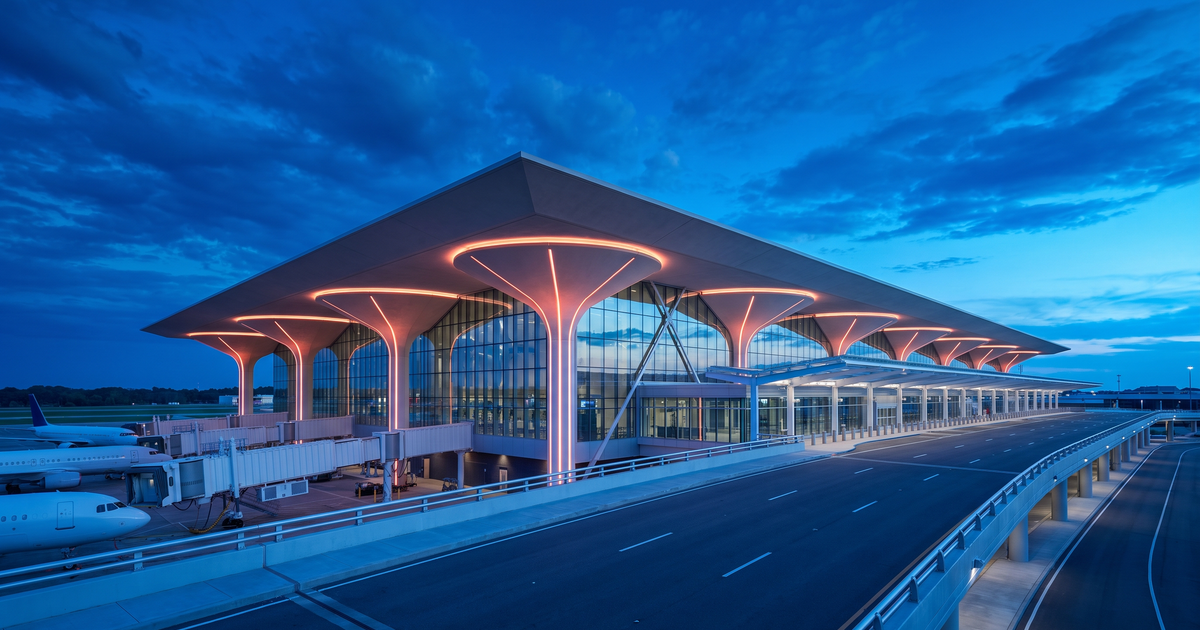
Memphis permit records filed September 18, 2026 describe a commercial alteration package for the Terminal Modernization and Seismic Program, or TMSP, at 2491 Winchester Road. The permit carries a $400 million value and covers seismic retrofit and expansion of Terminal B, new roofing and building-envelope work, passenger circulation changes, elevators and escalators, ticketing and office updates, a larger security checkpoint, expanded baggage claim, restrooms, and broad mechanical, electrical, plumbing, fire-protection, fire-alarm, data, and security work.
The terminal package is one part of a larger program. Turner Construction describes TMSP as a program exceeding $700 million, the largest capital project in the airport's history. The airport, renamed Frederick W. Smith International Airport in August 2026, says the work is intended to modernize facilities that are more than 60 years old while improving seismic resilience, life safety, accessibility, passenger flow, and operational flexibility.
| Project | Terminal Modernization and Seismic Program - Terminal Package |
| Location | 2491 Winchester Road, Memphis, Tennessee 38116 |
| Permit Value | $400 million |
| Broader Program | More than $700 million |
| Primary Work | Terminal expansion, seismic retrofit, screening, baggage, circulation, MEP, fire protection, data, and security |
| Signal LV Score | 9/10 |
| Tracked LV Systems | 7 |
| Source | Memphis Commercial Building Permits |
Why This Permit Matters Now
This is not a concept-stage airport rendering. The permit record identifies a 50 percent construction-document review intended to capture code comments before the 100 percent submission. That detail matters to low voltage contractors because pathway, equipment-room, door-hardware, screening, baggage, fire-alarm, and network decisions become expensive to change once structural and MEP coordination hardens.
The airport's MEM on the Move program page places the main Terminal B modernization in the 2027-to-2030 window. Enabling work is already visible: Concourse A demolition, commercial-lane work, outer-drive replacement, and the September 2026 reopening of the Pedestrian B Tunnel. The terminal permit therefore connects an active construction sequence to the larger technology buyout still ahead.
The public procurement path is equally important. A 2025 MEFPLV request for qualifications sought design-assist and preconstruction-assist teams for mechanical, electrical, fire-protection, and low voltage packages. The TAC team's current opportunity page lists Terminal B seismic work for a first-quarter 2027 RFP and Terminal B interior buildout for a fourth-quarter 2027 RFP, with dates expressly subject to change. Contractors that missed the early design-assist gate should still watch the downstream packages rather than treating the program as fully bought out.
Key Players
The source-backed team is unusually clear. Signal's scraped entity link points to an unrelated company and was not used. The organizations below come from the airport, program-manager, and construction-manager sources.
| Role | Organization | Project Relevance |
|---|---|---|
| Owner | Memphis-Shelby County Airport Authority | Owns and operates the airport and controls the capital program. |
| Construction Manager | TAC Tri-Venture | Turner Construction, Ardmore Roderick, and Chris Woods Construction lead construction management and package procurement. |
| Program Manager | MFA Program Management | Coordinates the multi-package modernization and identifies the design and construction team. |
| Prime Architect | UrbanARCH | Local prime architect for the terminal modernization design. |
| Terminal Architect | Alliiance | Aviation design partner responsible for the terminal architecture and published concept renderings. |
Low Voltage Systems Breakdown
Signal tracks Integrated Security, CCTV, Access Control, Public Address, Flight Information Display Systems, Structured Cabling, and Audio/Visual. The permit explicitly confirms fire alarm plus low voltage data and security. Official program material separately confirms expanded passenger and employee screening, checked-baggage inspection, ticketing, baggage claim, and facilities designed for evolving technology. Exact device counts, manufacturers, interface points, and responsibility splits still belong in the contract documents.
| System | Scope Driver | Contractor Focus | Complexity |
|---|---|---|---|
| Structured Cabling | Ticketing, offices, screening, baggage, airline, TSA, and airport operations spaces | Backbone diversity, telecom-room phasing, fiber testing, labeling, and live-network cutovers | High |
| Integrated Security | Larger passenger checkpoint, employee screening, sterile-area boundaries, and baggage-service areas | Security-system integration, interface matrices, acceptance testing, and operational continuity | High |
| Access Control | New circulation paths, offices, secure doors, elevators, and restricted work zones | Door-hardware coordination, credentialing, alarm monitoring, and phased commissioning | High |
| CCTV | Expanded public spaces, screening queues, baggage claim, and circulation changes | Coverage studies, PoE design, storage, analytics, and migration from existing views | High |
| Public Address | Reconfigured ticketing, baggage, vertical circulation, and passenger-processing spaces | Speech intelligibility, zoning, emergency override, amplifier loading, and phased audio testing | High |
| Flight Information Displays | Passenger flow and common-use processing across renovated terminal zones | Display power and data, mounting coordination, content feeds, failover, and time synchronization | Medium-High |
| Audio/Visual | Wayfinding, operations, public messaging, meeting rooms, and passenger information | AV-over-IP coordination, control, rack integration, and owner training | Medium-High |
| Fire Alarm Interface | Permit-confirmed fire-alarm work across altered terminal and life-safety zones | NFPA 72 sequencing, smoke-control and elevator interfaces, voice evacuation, testing, and AHJ signoff | High |
Estimated Low Voltage Value
The database does not carry an awarded low voltage contract value, so this spotlight uses the reported $400 million permit value as the estimating base. Airport and transportation projects commonly allocate 5 percent to 8 percent of construction value to low voltage, communications, security, life-safety, and passenger-processing technology. Seven tracked systems add a 1.25 coordination multiplier under Signal's methodology.
| Permit Value | $400 million |
| Airport LV Midpoint | 6.5 percent |
| Seven-System Multiplier | 1.25x |
| Estimated LV Value | $32.5 million |
| Planning Range | $25 million to $40 million |
The estimate should be treated as a program-level planning number, not a single bid package. Fire alarm may sit with electrical or fire-protection trades. Baggage screening equipment can be owner-, TSA-, or specialty-vendor furnished. Security, network, displays, and AV may be divided among multiple packages. The most important estimating task is a responsibility matrix that separates equipment supply, cable and pathway, power, software, licensing, integration, testing, and owner training.
The broader $700 million-plus program is useful market context, but this estimate does not apply the percentage to that larger figure. Doing so would mix terminal, roadway, parking, structural, and enabling packages that do not all carry the same technology density.
Skills and Certifications Required
Airport work adds operational constraints to ordinary low voltage installation. Teams must plan around secure-area access, passenger traffic, temporary conditions, night work, live system cutovers, and multiple owner and agency stakeholders. A technically correct installation can still fail if the method of procedure interrupts screening, baggage, dispatch, paging, or life-safety service.
| Discipline | Useful Credentials | Critical Skills |
|---|---|---|
| Structured Cabling and Fiber | BICSI INSTC/INSTF, TECH, RCDD | Backbone design, fiber splicing, DSX/OTDR testing, labeling, telecom-room migration |
| Access Control and CCTV | Manufacturer certifications, PSP, Network+ | Door hardware, IP networking, VMS configuration, camera coverage, storage calculations |
| Public Address and AV | AVIXA CTS, CTS-I, CTS-D | Speech intelligibility, DSP, audio zoning, AV-over-IP, control programming |
| Fire Alarm | NICET Fire Alarm Level II or higher, required state/local licenses | NFPA 72, emergency voice, elevator and smoke-control interfaces, acceptance testing |
| FIDS and Common-Use Systems | Vendor training, Network+, airport systems experience | Data feeds, content endpoints, redundancy, time synchronization, monitoring, commissioning |
Entry-level technicians can support cable placement, device rough-in, labeling, and documentation under supervision. Mid-level technicians will own terminations, field testing, device installation, and deficiency closure. Senior leads need to manage integration meetings, operational shutdown requests, interface-control documents, cybersecurity boundaries, owner demonstrations, and final turnover records.
Contractors should verify Tennessee licensing, airport badging, background-screening, insurance, prequalification, and any participation requirements before pursuing a package. No manufacturer platform is identified in the public summary, so bidders should not build a price around an assumed security, AV, fire-alarm, or display brand.
Procurement and Phasing Signal
The TAC bid-opportunities page is the practical watch point. Its published sequence separates enabling work, seismic upgrades, temporary ticketing, Terminal B interior buildout, baggage facilities, facade work, and the later Terminal A and C buildout. That fragmentation creates repeat opportunities, but it also creates interface risk: a pathway installed under one package may serve equipment bought under another two years later.
Contractors should ask early who owns backbone capacity, temporary service, demolition and salvage, patching into existing networks, software migrations, testing scripts, and final record drawings. They should also price repeated mobilization, after-hours cutovers, protection of active public areas, and re-testing after adjacent construction. On an operating airport, the calendar is not a scheduling footnote; it is part of the scope.
Market Signal
This project is a strong Memphis signal because it combines a fresh municipal permit with a source-backed multiyear procurement program. The airport is not merely replacing finishes. It is changing the geometry of ticketing, security, baggage, and passenger circulation while retrofitting a mid-century terminal for seismic resilience. Each physical move creates a technology move, and many of those systems must remain available until their replacements pass acceptance.
The commercial lesson extends beyond aviation. Seismic and renovation programs concentrate risk at interfaces: existing conditions, temporary operation, phased turnover, and responsibility boundaries. Contractors with disciplined survey, labeling, cutover, commissioning, and closeout processes can compete on execution certainty rather than commodity labor alone.
For Memphis integrators, the near-term move is specific: monitor TAC's plan room, confirm prequalification, map capabilities to the package sequence, and start relationships with the construction manager and design team before the 2027 terminal packages hit the street. A $32.5 million modeled LV opportunity will not land as one clean contract. It will be won through package intelligence and coordination.
Find Projects Like This on Signal
LVN Signal tracks thousands of construction projects with low voltage opportunities across the country. Filter by city, system type, and project value to find your next bid.
Join 35,000+ Low Voltage Pros
Get weekly permit updates, tool deals, job opportunities, and industry news. No spam, unsubscribe anytime.