
Join Low Voltage Nation — Find project opportunities and showcase your company to thousands of industry professionals
5C filed a $575 million Phase IV permit application covering about 504,000 square feet inside MEM01 in Memphis. Five tracked systems support a $39.7 million permit-based LV planning midpoint, while an 84 MW capacity cross-check reaches $42 million.
A $575 million Phase IV permit application for 5C's MEM01 data center in Memphis covers approximately 504,000 square feet of an adaptive-reuse AI facility. Signal tracks five low-voltage planning lanes on the project, supporting an estimated $39.7 million permit-based LV midpoint and a separate $42 million capacity cross-check.
Project Overview
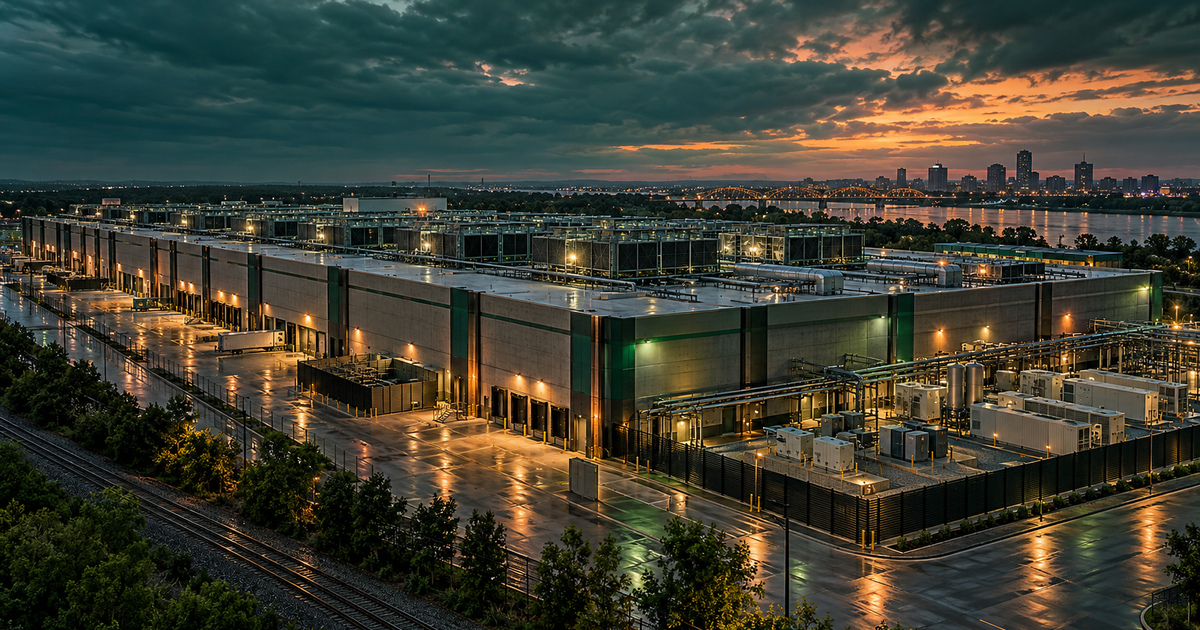
5C MEM01 is taking another major step at 4300 Getwell Road. The commercial alteration filing identifies Phase IV of the data center and carries a reported value of $575 million. Local reporting says the phase covers about 504,000 square feet inside the former Fred's headquarters and distribution complex, a roughly 1.1 million-square-foot property near Memphis International Airport. This is an application in review, not an issued permit or a completed contract value, so contractors should treat the figure as a pricing signal rather than booked revenue.
The project is an industrial adaptive-reuse job, not a clean-sheet hyperscale campus. Existing walls and floor area give the owner a head start, but an AI data center must add the pathways, separation, cooling interfaces, security zones, fiber topology and testing discipline needed for high-density compute. Earlier city permits at the same address included a $25 million initial deployment, a $100 million interior phase and $8 million of exterior accessory work. Phase IV is the largest filing in the sequence, but those earlier values are not added to the $575 million figure because the public record does not establish whether scopes overlap.
5C's current facility portfolio lists MEM01 at 20 MW for 2026, fully committed, with selective expansion capacity shown for later years. Separate October reporting says 5C intends to move from about 20 MW to 84 MW of available power over roughly six months using fuel cells for the added capacity. The portfolio's 20 MW, 64 MW and 35 MW entries are not automatically additive; their exact commercial meaning should be confirmed before anyone sizes a package against them.
| Project | 5C MEM01 Data Center Phase IV |
| Location | 4300 Getwell Road, Memphis, Tennessee 38118 |
| Phase IV Filing | $575 million commercial alteration application |
| Phase Area | Approximately 504,000 square feet |
| Facility Context | Approximately 1.1 million square feet; 20 MW listed for 2026 |
| Status | Permit application filed / in review |
| Signal LV Score | 10/10 |
| Tracked Systems | 5 |
Key Players and Package Boundaries
5C Group is the owner, developer and operator behind MEM01. The company describes itself as an integrated AI infrastructure provider that combines data-center delivery, cluster deployment and ongoing operations. Its August financing announcement says a $605 million Brookfield-led debt package supports acquisition and construction of the Memphis campus along with sites in Ohio and Phoenix. That financing is company-wide and should not be substituted for the Memphis construction value.
The Phase IV permit reporting names Walker General Contractors as the filing contractor. That is the most commercially useful relationship in the public record: Walker sits on the active construction path, while no structured-cabling, fiber, security, DAS or specialty commissioning subcontractor has been publicly named. The Signal entity attached to the row is a person with an unrelated website, so it is not used here.
| Role | Organization | What the Source Supports |
|---|---|---|
| Owner / Developer / Operator | 5C Group | MEM01 operator, capacity plan and integrated AI-infrastructure delivery |
| General Contractor | Walker General Contractors | Named as contractor on the Phase IV filing |
| AI Platform Collaborator | Together AI | Collaborator on the Memphis Frontier AI Factory platform |
| Capital Partner | Brookfield-led financing | Supports 5C's broader portfolio, including Memphis acquisition and construction |
5C's published Memphis technology story includes NVIDIA rack-scale compute, Dell liquid-cooled infrastructure, VAST Data storage and high-bandwidth networking. Those names describe the intended compute platform; they do not prove that the corresponding construction, cabling, controls or commissioning packages have been awarded. For estimators, the practical move is to separate owner-furnished compute and storage from the contractor-furnished physical network, pathways, security, grounding and test documentation.
Low Voltage Systems Breakdown
Signal currently tracks five low-voltage systems on Phase IV. They should be treated as planning and qualification lanes, not awarded scopes. The conversion of half a million square feet into high-density AI space makes shared pathways and turnover sequencing as important as device counts: backbone fiber has to arrive before clusters can commission, security zones must track phased occupancy, and every copper or fiber link must be documented against the owner platform's acceptance format.
| System | Likely Phase IV Work | Primary Risk | Complexity |
|---|---|---|---|
| Fiber Optic | Carrier entrances, diverse backbone routes, meet-me and data-hall distribution, high-count splicing, labeling and optical-loss testing | Route diversity that is physically separate on paper but converges in the existing building | High |
| Structured Cabling | Operations, support-space and out-of-band networks; cabinet connectivity; pathways; racks; grounding coordination; certification records | Mixing owner-furnished cluster cabling with contractor-furnished base-building links | High |
| Access Control | Layered credentials from site and building perimeter through security vestibules, support rooms and data halls | Door hardware, life-safety release and phased database turnover falling between trades | High |
| CCTV / Video Surveillance | Perimeter, loading, circulation, cage and critical-room coverage tied to the site's operational security plan | Storage, analytics, field of view and retention requirements arriving after rough-in | High |
| DAS / In-Building Wireless | Radio-frequency design and coverage for a deep, equipment-dense industrial footprint | Final attenuation changing with rack rows, shielding, electrical rooms and liquid-cooling infrastructure | High |
Interfaces That Need an RFI
Five tracked systems do not describe every interface on a project this technical. BMS, EPMS or DCIM integration, fire alarm, emergency communications, leak detection, grounding and bonding, fuel-cell monitoring and independent commissioning all deserve explicit responsibility lines. They are not added to the Signal system count because the reviewed sources do not award those packages. A bid should identify who furnishes gateways, who owns points lists, which network carries monitoring traffic, and whether integrated systems testing is inside the trade package or retained by the owner.
Estimated Low Voltage Value
Because $575 million is a reported construction-permit value, the data-center construction benchmark is the appropriate first method: 6% of construction value, adjusted by a 1.15 coordination multiplier for five tracked systems. That produces an estimated LV planning midpoint of $39.7 million. It is not a quote, an award or a forecast of 5C's actual procurement; it is a contractor-side sizing model for the combined physical technology scope.
| Phase IV Permit Value | $575,000,000 |
| Construction-Based LV Benchmark | 6% |
| Five-System Multiplier | 1.15x |
| Permit-Based LV Midpoint | $39,675,000 |
| Capacity Cross-Check | 84 MW x $500,000/MW = $42,000,000 |
The two methods land within about 6% of each other. That convergence is useful: it suggests the $575 million filing is directionally consistent with an 84 MW buildout rather than an obviously bundled multistate financing number. Still, the methods answer different questions. The permit method sizes the Phase IV construction program; the capacity method checks the physical infrastructure implied by the publicly discussed power target.
The estimate excludes GPUs, servers, storage hardware, software, financing, land acquisition, fuel-cell generation equipment and any package already contained in owner-furnished integrated racks. It also excludes earlier phases rather than stacking permit values with unknown overlap. Contractors should carry the estimate as a range of planning allowances and insist on a clear bill-of-material and test-document boundary before assigning it to a single subcontract.
Skills and Certifications Required
This job rewards data-center process discipline more than generic cable-pulling capacity. The field team has to work around live or progressively commissioned infrastructure, preserve separation and bend radius in an existing industrial shell, coordinate security and wireless coverage with changing rack layouts, and deliver test records that survive owner acceptance.
| Workstream | Useful Certifications | Critical Skills |
|---|---|---|
| Fiber and Backbone | BICSI INSTF, TECH or RCDD; FOA CFOT; system-manufacturer training | High-count splicing, OTDR and OLTS testing, polarity control, route-diversity documentation |
| Structured Cabling | BICSI INSTC or RCDD; manufacturer warranty credentials | Pathway planning, rack build, labeling, copper certification and turnover-database accuracy |
| Access Control | Relevant manufacturer certification; Tennessee licensing as applicable | Door hardware, controller networking, life-safety interfaces, phased credential migration |
| CCTV | VMS and camera manufacturer certification; CompTIA Network+ or equivalent | PoE design, coverage studies, analytics, storage sizing, secure VMS configuration |
| DAS / Wireless | RCDD, RF training and carrier or public-safety system credentials | Predictive design, sweep testing, fiber transport, authority and carrier coordination |
| Integrated Testing | Commissioning experience appropriate to mission-critical facilities | Method-of-procedure writing, dependency mapping, failure testing and evidence-based closeout |
Entry-level technicians can support pathway installation, labeling, device mounting and supervised terminations. Mid-level technicians should own copper and fiber testing, rack quality and corrective work. Senior field leadership needs authority over redlines, change control, shutdown windows and the integrated test plan. Contractors should verify current Tennessee alarm, communications and electrical licensing requirements before bidding and should not assume a general low-voltage credential covers every security or life-safety interface.
Market Signal
MEM01 reinforces Memphis as a two-sided data-center market: enormous demand is arriving, and the local approval environment is getting more specific at the same time. On October 20, the City Council rejected a longer moratorium on a tie vote but adopted permanent large-data-center standards paired with a 135-day pause on new applications. Public meeting records note that the Phase IV filing was submitted October 5, before that vote. That timing does not replace a project-specific legal determination, but it does mean bidders should distinguish this in-flight phase from a brand-new application.
The adopted rules emphasize closed-loop cooling, water limits, energy sourcing, disclosure and oversight. Even where those requirements do not reopen an existing filing, they will shape change orders, later phases and the documentation owners expect. For low-voltage contractors, environmental and power scrutiny becomes controls work: metering networks, monitoring gateways, auditable trends, alarm routing and clean separation between owner operational data and base-building systems.
The deeper commercial signal is adaptive reuse. Memphis already has large industrial buildings, utility relationships, fiber corridors and a mission-critical labor market being stretched by multiple data-center programs. A contractor that can survey undocumented pathways, keep live systems online, coordinate phased cutovers and produce defensible closeout records is selling a repeatable capability, not a one-project crew. Walker is the current construction gateway, while 5C's published expansion and fully committed capacity indicate follow-on work beyond a single permit.
The bid question is not whether MEM01 will contain fiber, security and wireless systems. It is where those scopes stop, who controls the technology standard, which hardware is owner-furnished, and when each data hall must be ready for integrated commissioning. The firms that turn those four questions into written qualifications will be easier to buy than firms that simply quote a large number against a large permit.
Find Projects Like This on Signal
LVN Signal tracks thousands of construction projects with low-voltage opportunities across the country. Filter by city, system type and project value to find your next bid.
Join 35,000+ Low Voltage Pros
Get weekly permit updates, tool deals, job opportunities, and industry news. No spam, unsubscribe anytime.