
Join Low Voltage Nation — Find project opportunities and showcase your company to thousands of industry professionals
A $7 million Los Angeles data center retrofit replaces eight aging CRAC units, adds 14 more and lays out new interior data cages. The permit supports a conservative $420,000-$480,000 low-voltage planning range for controls, data pathways, security and life-safety coordination—not servers or mechanical equipment.
A $7 million data center retrofit at 1501 W Francisco Street in Los Angeles is replacing eight end-of-life computer-room air-conditioning units, adding 14 more and creating an interior cage layout for future data infrastructure. The permit does not award a low-voltage contract, but the combined cooling, structural, electrical and cage work supports a conservative $420,000 to $480,000 low-voltage planning range across controls, data pathways, security and life-safety coordination.
Project Overview
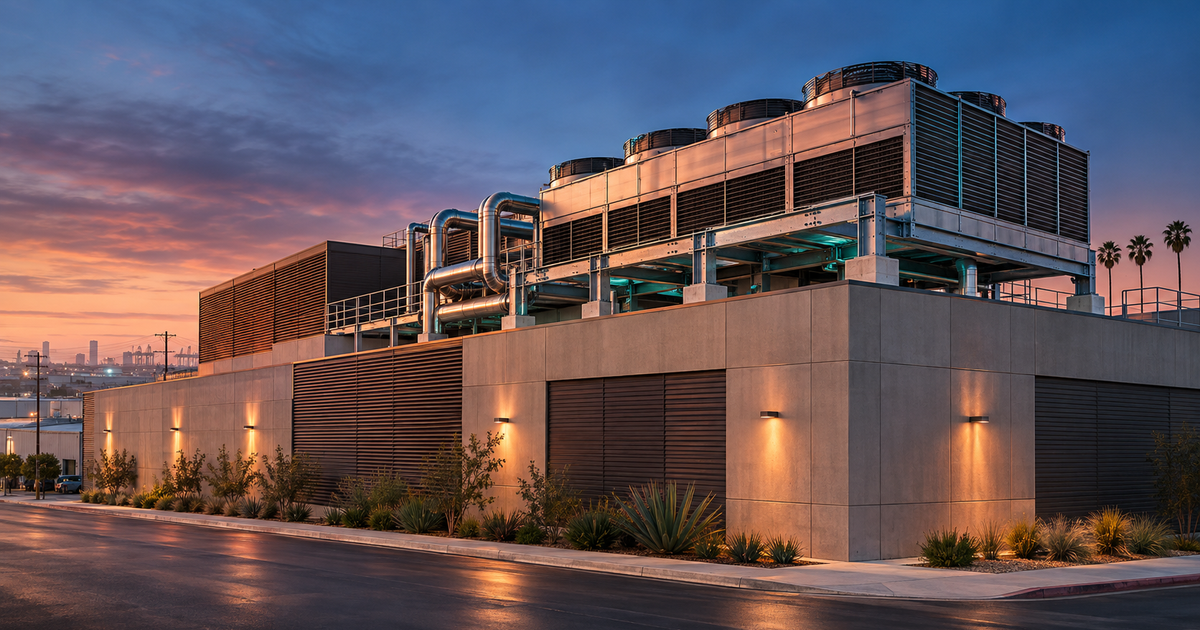
Los Angeles permit records describe an alteration to an existing data center building in the Harbor Gateway area. The filed scope removes eight existing direct-expansion CRAC units, replaces them like for like, and installs 14 additional units. Structural curbs are included to support the new rooftop equipment. That is 22 cooling-unit interventions inside a live mission-critical building envelope, even though the public record does not identify the operator, tenant, IT load or data-hall count.
The same permit description adds an interior cage layout intended to support future data infrastructure, with structural drawings for the added cage work. That sentence is the low-voltage trigger. New cages change pathway endpoints, security zones, camera views, access-control door counts and the physical handoff between base-building systems and tenant equipment. The cooling work also creates controls, alarms and monitoring interfaces that must be coordinated before equipment cutovers.
The Los Angeles Department of Building and Safety permit page is the primary record for permit 26016-10000-13551. Independent permit indexes from Savrn and Builtie record a $7 million valuation and an October 1, 2026 issue date. The permit is the project-value basis used here; no larger program value has been added.
| Project | 1501 W Francisco Street data center retrofit |
| Location | 1501 W Francisco Street, Los Angeles, California |
| Permit Value | $7,000,000 |
| Permit | 26016-10000-13551 |
| Permit Status | Issued October 1, 2026 |
| Signal LV Score | 10/10 |
| Tracked Systems | Six; final package ownership remains unverified |
| Source | Los Angeles building permit records |
What the Permit Actually Covers
This is first a cooling and structural retrofit, not a standalone cabling permit. The eight replacements, 14 additions, rooftop support work and related electrical coordination account for most of the filed construction value. Low-voltage contractors should not treat the full $7 million as available LV spend. CRAC equipment, refrigerant work, piping, steel, curbs, feeders and mechanical installation belong to other packages unless the prime contract deliberately combines scopes.
The LV opportunity sits at the interfaces. Each new or replaced unit may require controller wiring, network drops, alarm points, environmental sensors, equipment-address updates and integration into the building-management or data-center monitoring platform. Meanwhile, the future cage layout can trigger new fiber and copper pathways, card readers, door contacts, request-to-exit devices, cameras, rack-row monitoring and revisions to the life-safety sequence. None of those individual awards is public yet, so the article treats them as planning targets rather than confirmed subcontracts.
Timing matters more than raw system count. Controls points must be settled before equipment start-up. Security coverage must be laid out before cage fabrication locks in sight lines and door hardware. Fiber routes and tray capacity must be coordinated before overhead congestion increases. For a facility that may remain operational during construction, method-of-procedure reviews, change windows, temporary monitoring and rollback plans can be as commercially important as device counts.
Key Player and Procurement Boundary
Builtie’s permit index identifies DPR Construction as the builder named on the permit. DPR publicly lists data centers as a core market, making its mission-critical team the clearest source-backed outreach target. The facility owner, operator and end tenant are not named in the reviewed public record, and no electrical, controls, security, cabling or fire-alarm subcontractor has been confirmed.
| Role | Company | What Is Public |
|---|---|---|
| Builder on permit index | DPR Construction | Source-backed through the permit index; specialty package holders are not public. |
| Owner / Operator | Undisclosed | The address and retrofit scope are public; the operating company and tenant standards are not. |
| LV Integrators | Not identified | No controls, security, cabling, fire-alarm or commissioning award was found. |
For business development, the useful question is not “Who owns the building?” alone. It is “Who owns each interface?” A controls contractor may carry CRAC communications and alarm points. A security integrator may own cage readers and cameras. A structured-cabling contractor may receive only pathways and backbone extensions, while the tenant furnishes racks, switches and optics under a separate standard. Contractors should ask DPR’s data-center team for the responsibility matrix, cage plans, controls points list and owner-furnished equipment schedule.
Low Voltage Systems Breakdown
Signal tracks six LV categories on this record. The permit text directly confirms future data infrastructure and broad mechanical/electrical work; it does not explicitly award every system below. The most defensible opportunity is coordination around new cooling equipment and the cage layout.
| System | Project-Specific Scope | Confidence | Complexity |
|---|---|---|---|
| Controls and Environmental Monitoring | CRAC controller communications, alarm points, temperature and humidity sensing, addressing, trend verification and BMS/DCIM handoff for 22 unit interventions. | High interface confidence; vendor and package holder unverified | High |
| Structured Cabling | Copper drops, tray and pathway extensions supporting the future cage layout, controls panels and monitoring endpoints. | Medium; future data infrastructure is explicit | Medium |
| Fiber Backbone | Backbone extensions and diverse routing may be needed for new cages, but strand counts, entrances and tenant demarcations are not public. | Medium-low until drawings are released | High |
| Access Control | Readers, electrified hardware, door contacts, request-to-exit and credential zoning at new cage gates. | Medium; cage security is a design implication, not a named award | High |
| CCTV | Camera relocation or additions to preserve coverage after cage walls and doors change sight lines. | Medium-low; verify owner security standard | Medium |
| Fire Alarm and Life Safety | Monitoring, shutdown sequences and device coordination where rooftop equipment, structural supports and cage construction affect the approved life-safety design. | Medium; exact device scope is not public | High |
DAS and AV appear in the enriched Signal system list, but the public permit description does not support pricing them here. They remain qualification questions, not forecast revenue. That distinction keeps the estimate tied to the cited permit instead of turning a mechanical retrofit into an imaginary full data-hall build.
Estimated Low Voltage Value
For a reported data-center construction value, LVN’s benchmark starts at approximately 6% of the filed construction value, then applies a limited coordination allowance when five or six systems touch the same work. Six percent of $7 million is $420,000. Applying the 1.15 system-complexity multiplier produces approximately $483,000, rounded to a $420,000-$480,000 planning range.
| Filed Construction Value | $7,000,000 |
| Base Data Center LV Benchmark | 6% of reported construction value |
| System Complexity Allowance | Up to 1.15x for six coordinated categories |
| Estimated LV Planning Range | $420,000-$480,000 |
This is not a bid, contract award or statement that every tracked system is included. The lower end is the disciplined starting point because the permit is mechanical-heavy. The upper end assumes that controls, data pathways, security and life-safety coordination travel with the retrofit instead of being deferred or absorbed into existing service agreements. Contractors should replace the benchmark with quantity takeoffs as soon as the controls points list, cage plan and security responsibility matrix are available.
Owner-furnished and tenant-furnished technology is excluded: servers, storage arrays, GPU systems, tenant racks, switches, routers, optics, software licenses and movable IT equipment. The estimate also excludes CRAC equipment, mechanical piping, structural steel, roofing and primary power distribution. Those boundaries prevent hardware spend or mechanical scope from masquerading as low-voltage revenue.
Skills and Certifications Required
| Workstream | Useful Certifications | Critical Skills |
|---|---|---|
| Fiber and Structured Cabling | BICSI INSTF, TECH or RCDD | Pathway coordination, fiber splicing, certification testing, labeling and live-facility change control |
| Controls and Monitoring | BACnet training, Tridium Niagara or the selected controls manufacturer | Points mapping, IP integration, sensor calibration, alarm logic, trend verification and commissioning |
| Access Control and CCTV | Selected security-platform manufacturer; networking fundamentals | Door hardware coordination, PoE, camera coverage, credential zoning and VMS integration |
| Fire Alarm Interfaces | NICET Fire Alarm and manufacturer training as required | Shutdown sequences, monitoring modules, testing, documentation and AHJ coordination |
Entry-level technicians can support pathway installation, labeling, device mounting and basic terminations under supervision. Senior technicians should own live-system cutovers, fiber certification, controls integration, security database changes and acceptance testing. The project also needs disciplined commissioning documentation because a successful mechanical start-up is incomplete if alarms, trends, access events or camera views do not land in the correct platform.
Contractors should verify current California and local licensing requirements before bidding and confirm whether the prime contract requires union labor, background screening or site-specific mission-critical training. None of those requirements is stated in the public permit record.
Market Signal and Bid Timing
This permit is a useful signal for Southern California contractors because it is retrofit work, not a speculative greenfield campus. Existing data centers are extending useful life by increasing cooling density and reshaping white space for new infrastructure. Those projects often move in smaller packages than hyperscale campuses, but they reward contractors who can work around uptime constraints, document every change and coordinate across mechanical, electrical, controls and security teams.
The immediate sales angle is the interface package. Controls firms should ask who owns CRAC communications, sensor replacement, alarm migration and trend validation. Cabling contractors should ask whether the cage layout changes overhead tray, diverse fiber routes or meet-me-room capacity. Security integrators should request cage door and camera plans before fabrication. Fire-alarm contractors should confirm shutdown and monitoring sequences before rooftop cutovers.
The permit issue date places those questions in the current coordination window. Waiting until cage walls are installed or cooling equipment is commissioned turns design questions into change orders. A contractor that can combine field verification, method-of-procedure planning, after-hours cutovers and complete closeout records has a stronger position than one selling devices alone.
Find Projects Like This on Signal
LVN Signal tracks thousands of construction projects with low voltage opportunities across the country. Filter by city, system type and project value to find your next bid.
Join 35,000+ Low Voltage Pros
Get weekly permit updates, tool deals, job opportunities, and industry news. No spam, unsubscribe anytime.