
Join Low Voltage Nation — Find project opportunities and showcase your company to thousands of industry professionals
Southeast Community College's $31 million Life Sciences Center in Lincoln is a 45,000-square-foot, three-story academic laboratory building tracking four core low-voltage systems. The permit-backed structured cabling, access control, CCTV, and AV scope represents an estimated $1.55 million to $1.86 million opportunity, with package availability subject to the active construction schedule.
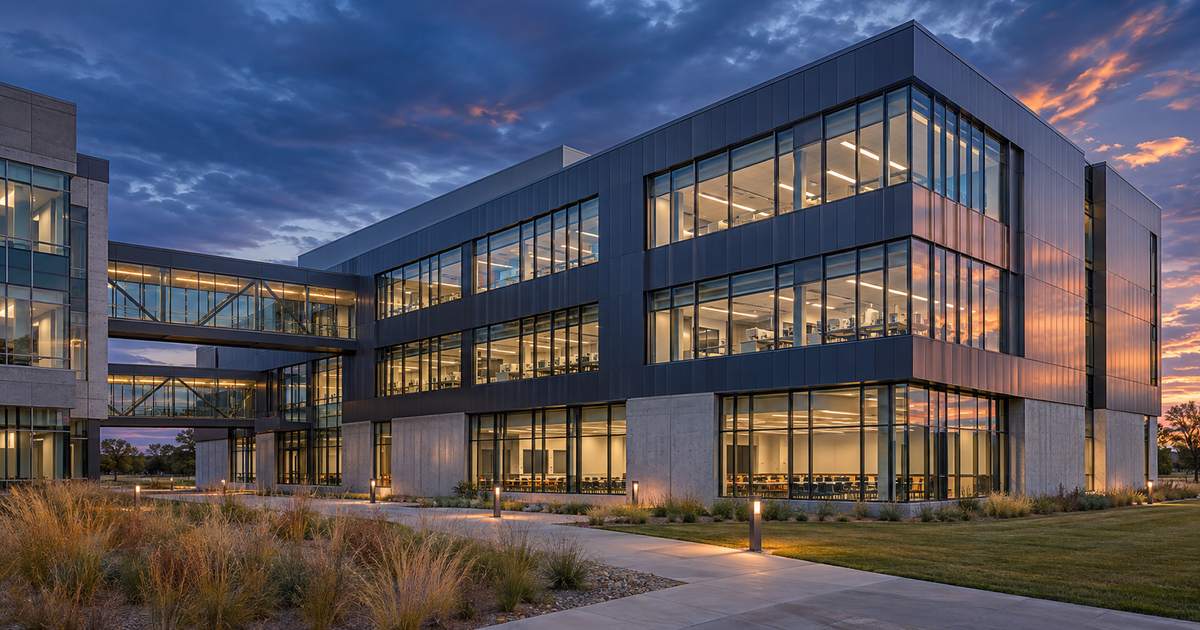
A $31 million Life Sciences Center is under construction in Lincoln, Nebraska, with four core low-voltage systems and an estimated $1.55 million to $1.86 million contractor scope. The 45,000-square-foot Southeast Community College project combines classrooms, teaching laboratories, offices, and shared spaces in a three-story building scheduled to open for the Fall 2028 semester.
Project Overview
Lincoln permit records identify the project as Southeast Community College's Life Sciences Center at 8940 O Street. Permit B2600763 covers a new three-story higher-education building with steel and concrete construction, a fully sprinklered shell, and second- and third-floor connections to an existing campus building. The permit was applied for on April 6, 2026, issued on August 3, 2026, and carries a listed valuation of $31 million.
The city's live commercial new-construction permit layer describes offices, classrooms, laboratories, and common areas. That mix puts several use cases inside one building: high-density instructional connectivity, controlled laboratory access, campus security coverage, and classroom audiovisual systems. The physical links to the adjacent building also make backbone pathways and campus-standard integration more important than they would be in a stand-alone classroom building.
Southeast Community College says it broke ground on the Lincoln facility on April 28, 2026. The college describes a program serving biology, anatomy, physiology, organismal biology, BSL biology, and microbiology, with completion targeted for the Fall 2028 semester. SCC also reports record enrollment in its health-sciences and physical-sciences transfer programs, making this a long-term academic platform rather than a generic classroom addition.
The project is already in construction, so this is not an open-bid announcement. Specialty contractors should verify current package status with the construction team before treating any scope as available. The practical opportunity may now sit in awarded-package support, coordination changes, later technology procurement, commissioning, owner-direct systems, or service relationships after occupancy.
| Project | Southeast Community College Life Sciences Center |
| Location | 8940 O Street, Lincoln, Nebraska 68520 |
| Permit | B2600763, issued August 3, 2026 |
| Permit Valuation | $31 million |
| Building | 45,000 square feet, three stories |
| Target Opening | Fall 2028 |
| LV Score | 10/10 |
| Tracked LV Systems | 4 |
Key Players
Southeast Community College is the owner and campus operator. The owner is central on a project like this because classroom technology, security standards, network architecture, and long-term support must match existing campus systems. Contractors should expect submittal reviews to involve both the construction team and SCC's facilities or information-technology stakeholders.
The Weitz Company published the project's $31 million groundbreaking update and is the source-backed construction partner associated with the work. Weitz notes that the steel-and-concrete building connects to the Sandhills Global Technology Center at the second and third floors. No architect or low-voltage specialty contractor was identified in the reviewed sources, so those roles are intentionally left unattributed.
| Role | Organization | Why It Matters |
|---|---|---|
| Owner | Southeast Community College | Controls campus standards, acceptance, operations, and long-term service expectations. |
| Construction Partner | The Weitz Company | Coordinates building delivery, trade sequencing, pathways, submittals, and schedule interfaces. |
| Permitting Authority | City of Lincoln | Issued permit B2600763 and publishes the underlying record. |
Low Voltage Systems Breakdown
Signal tracks four systems: Structured Cabling, Access Control, CCTV / Video Surveillance, and Audio/Visual. They share pathways, rooms, network services, and commissioning dependencies, but each has a different acceptance process. The strongest delivery plan will treat them as one coordinated technology package while keeping testing, programming, cybersecurity, and owner training responsibilities clear.
| System | Category | Likely Project Scope | Complexity |
|---|---|---|---|
| Structured Cabling | Data / Voice | Campus backbone extensions, telecommunications rooms, copper and fiber distribution, classroom and laboratory outlets, wireless access-point cabling, labeling, testing, and records. Elevated connections require careful pathway and backbone coordination with the existing technology center. | High |
| Access Control | Security | Controlled entries, staff-only rooms, laboratory zones, equipment areas, and after-hours access. Readers, locks, request-to-exit devices, power supplies, fire interfaces, and credentials cross several trade boundaries. | High |
| CCTV / Video Surveillance | Security | IP camera coverage at entrances, circulation areas, common spaces, and selected asset-protection locations. Contractors need to validate views, network capacity, PoE budgets, storage, privacy rules, and integration with the college's existing VMS. | Medium-High |
| Audio/Visual | Instructional Technology | Teaching displays, presentation and collaboration systems, room control, instructor connectivity, audio reinforcement, and possible lecture-capture interfaces. Laboratory demonstrations and flexible layouts raise the value of consistent controls and owner training. | High |
The four-system count is deliberately conservative. Permit records say the building is fully sprinklered, which creates life-safety coordination obligations, but Signal did not identify Fire Alarm as a scored low-voltage system. This estimate does not add a separate fire-alarm package without source support. It also does not assume specialty lab controls, building automation, wireless coverage, or public-safety radio systems belong to the same contractor unless documents explicitly assign them.
Laboratory environments make coordination demanding even when the counted list looks ordinary. Casework, equipment clearances, specialty finishes, ceiling service carriers, controlled rooms, and changing instructional layouts can all move outlets, cameras, speakers, and devices. Early clash review and disciplined room-by-room documentation can protect margin better than resolving those conflicts during trim-out.
Estimated Low Voltage Value
The estimated low-voltage value is $1.55 million to $1.86 million. The range applies a 5% to 6% higher-education benchmark to the $31 million permit valuation. Four tracked systems use the baseline 1.00 system-count multiplier, producing a midpoint planning value of approximately $1.7 million.
| Permit Valuation | $31,000,000 |
| Higher-Education Benchmark | 5% to 6% |
| System-Count Multiplier | 1.00x for four systems |
| Estimated LV Range | $1,550,000 to $1,860,000 |
| Planning Midpoint | $1,705,000 |
This is a market estimate, not a disclosed subcontract value. The permit valuation and construction program describe the same building and should not be added together. A separate public bid listing showed a roughly $28.94 million construction package; that figure appears to overlap the same $31 million program and is also non-additive.
The estimate covers installed pathways, cable, field devices, racks and termination hardware, programming, testing, documentation, training, and reasonable project-management effort for the four tracked systems. It excludes owner-furnished scientific instruments, laboratory equipment, computers, network electronics, loose classroom devices, software subscriptions, furniture, utility service, and unrelated electrical work. If SCC directly purchases displays, cameras, switches, servers, or processors, the installer's contract could land below the midpoint while coordination labor remains substantial.
Package timing matters as much as percentage. Bid reporting indicates the main Life Sciences Center work moved through bid and award earlier in 2026, and construction has started. Contractors approaching now should ask about unawarded technology procurement, design revisions, commissioning support, add-alternate work, warranty handoff, and campus service agreements instead of assuming the base-building scope is open.
Skills and Certifications Required
This building needs technicians who can work inside an institutional construction process and document systems to campus standards. The labor plan should combine installers for pathways and terminations with senior staff who can coordinate design intent, network requirements, programming, testing, and closeout.
| System | Relevant Certifications | Critical Skills |
|---|---|---|
| Structured Cabling | BICSI INST1, INSTC or INSTF; BICSI TECH; RCDD oversight | Copper and fiber termination, backbone routing, Fluke certification, rack layout, labeling, and as-builts |
| Access Control | State or local credentials; ASIS PSP for senior security staff | Door hardware coordination, controller wiring, life-safety interfaces, IP networking, database setup, and credential workflows |
| CCTV | CompTIA Network+ or equivalent; applicable VMS and camera-platform training | Camera placement, PoE design, bandwidth and storage planning, VMS configuration, and acceptance testing |
| Audio/Visual | AVIXA CTS, CTS-I, and CTS-D for design leadership | Display and audio installation, DSP setup, control programming, AV-over-IP, commissioning, and user training |
Entry-level technicians can contribute to pathway preparation, cable placement, labeling, device mounting, and basic terminations under supervision. Mid-level installers should own certification testing, troubleshooting, rack dressing, and subsystem checkout. An RCDD or similarly experienced designer should oversee backbone, room, and pathway coordination, while a CTS-D or senior AV lead should confirm teaching workflows before equipment is ordered.
Security work requires attention to doors, frames, power, and fire interfaces. Access-control teams need to coordinate with the door-hardware supplier and electrical contractor before rough-in closes. CCTV and AV teams should confirm owner network rules, VLANs, addressing, cybersecurity review, and acceptance-test procedures early enough to avoid a late commissioning pileup.
Contractors should verify Nebraska and City of Lincoln licensing, permit, and registration requirements before performing work. Requirements can vary by scope and by whether a package includes alarm, electrical, communications, or door-hardware work.
Business Development Angle
The warm path is not a generic “we saw your project” message. SCC is building a specialized academic facility that must integrate with an existing campus technology environment and remain supportable through a Fall 2028 opening. A useful approach is to offer a focused review of backbone interfaces, room standards, security integration, AV commissioning, or closeout documentation rather than pitching every low-voltage service at once.
Weitz is the construction-side relationship for sequencing and trade coordination; SCC is the long-term account for standards, acceptance, and service. Even if base packages are awarded, the project can create follow-on leverage through changes, testing support, warranty response, staff training, or maintenance after turnover. Contractors should request current scope and procurement status before investing estimating time.
Market Signal
This project is part of a broader SCC capacity program, not an isolated building. The college says it broke ground on three facilities across its service area in spring 2026 and added nearly 1,800 students over two years. The Lincoln Life Sciences Center is tied to record enrollment in health and physical-science transfer programs and is expected to support Nebraska's healthcare workforce.
For low-voltage contractors, the signal is that community colleges are buying technology-dense buildings with many of the same coordination demands as larger universities: campus backbones, controlled academic spaces, IP security, and standardized classroom AV. A 45,000-square-foot building can support a seven-figure technology scope when laboratories and campus integration are involved.
The schedule extends to Fall 2028, leaving a long window for technology decisions, commissioning, and turnover even though primary construction is underway. Firms that document cleanly, work across owner and construction teams, and remain available through acceptance and warranty are positioned better than firms competing only on rough-in labor.
Find Projects Like This on Signal
LVN Signal tracks thousands of construction projects with low voltage opportunities across the country. Filter by city, system type, and project value to find your next bid.
Join 35,000+ Low Voltage Pros
Get weekly permit updates, tool deals, job opportunities, and industry news. No spam, unsubscribe anytime.