
Join Low Voltage Nation — Find project opportunities and showcase your company to thousands of industry professionals
Jacksonville Marine Fire Station 39 puts five low-voltage systems inside a $7 million waterfront public-safety build. Using the vertical permit rather than the broader $37.59 million museum, dock, and dredging program, LVN estimates a $320,000-$560,000 planning range.
A $7 million building permit for Jacksonville Marine Fire Station 39 puts five low-voltage systems inside a storm-resilient public-safety facility on the St. Johns River. Using the station's vertical construction value rather than the broader waterfront program, LVN estimates a $320,000-$560,000 low-voltage planning range covering structured cabling, access control, video surveillance, fire alarm, and in-building radio coverage.
Project Overview
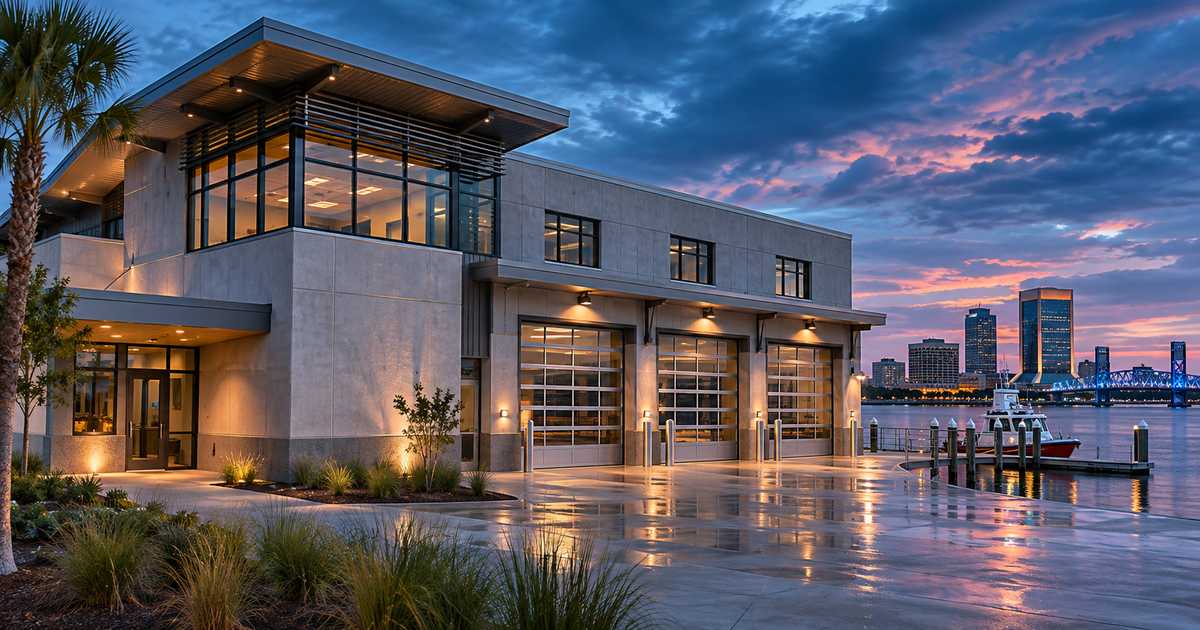
Jacksonville's Fire Station 39 is a two-story, 12,806-square-foot marine fire station at 115 Festival Park Avenue beside Metropolitan Park. The facility is designed to support both land and river response, including apparatus bays, marine operations, a Rescue District Chief, firefighter living areas, and special-event deployments around the downtown entertainment district. The Jacksonville Fire and Rescue Department broke ground in November 2025.
The construction-project record carries a $37.59 million value because the City of Jacksonville's capital program combines several related scopes: the fire station, the historic Fire Museum relocation, the dock and boathouse, and possible dredging. The city's adopted capital improvement plan confirms that combined program and identifies it as a public-safety priority. That total is useful for understanding the waterfront investment, but it is not an honest denominator for estimating the station's low-voltage package.
For the LV calculation, this spotlight uses the separately reported $7 million vertical building permit. That permit covers the new two-story, three-bay station itself. The distinction matters: dock work, dredging, museum repair, site work, boats, operational equipment, and land-related costs can inflate a program headline without increasing the cabling, security, life-safety, or communications package inside the station.
| Signal Project | Fire Museum Relocation & Station 39 - Metropolitan Park |
| Spotlight Scope | Marine Fire Station 39 vertical construction |
| Location | 115 Festival Park Avenue, Jacksonville, Florida |
| Station Permit Value | $7 million |
| Combined Capital Program | $37.59 million |
| Building Size | 12,806 square feet |
| LV Systems Tracked | 5 |
| Signal LV Score | 10/10 |
| Current Phase | Late construction / commissioning watch |
Key Players and Contract Position
The source trail resolves the core delivery team without relying on the polluted entity matches currently attached to the Signal row. Jacksonville procurement records identify Auld & White Constructors as the design-build contractor. The city's March 2025 procurement record increased the design-build not-to-exceed amount for the marine-station work, giving contractors a source-backed view of who controls the prime relationship.
LS3P is the architect. Its project page describes a resilient two-story facility with tilt-up concrete construction and critical living and utility spaces elevated for flood protection. Simes & Rosch Engineering identifies itself as part of the design-build team and names both LS3P and Auld & White. Jacksonville Fire and Rescue is the operating agency and the City of Jacksonville is the owner.
| Role | Organization | Why It Matters to LV Contractors |
|---|---|---|
| Owner / Operating Agency | City of Jacksonville / JFRD | Controls acceptance standards, public-safety operations, record documentation, and lifecycle service requirements. |
| Design-Build Contractor | Auld & White Constructors | Prime coordination point for subcontracting, closeout, punch work, schedule, and commissioning interfaces. |
| Architect | LS3P | Owns architectural coordination around elevated critical spaces, pathways, door hardware, equipment rooms, and resilient envelope details. |
| Engineering Team | Simes & Rosch Engineering | Coordinates electrical and building-system design that the LV package must integrate with. |
Low Voltage Systems Breakdown
Five systems are tracked for the station. They span data, physical security, life safety, and public-safety communications. A marine station creates coordination issues that a conventional office does not: flood exposure, wind-driven rain, corrosion, elevated critical rooms, emergency power, waterfront access, and 24-hour operations all affect device placement, pathways, enclosure selection, and test procedures.
| System | Category | Likely Station Scope | Complexity |
|---|---|---|---|
| Structured Cabling | Data / Voice | Backbone and horizontal cabling for dispatch support, administrative work areas, living quarters, wireless access points, building systems, and secure networked devices. Pathways must respect elevated critical functions and environmental separation. | High |
| Access Control | Security | Credentialed access at public, staff, apparatus, marine-operation, and restricted support areas. Door hardware coordination is especially important at large apparatus openings and exterior waterfront entries. | High |
| CCTV / Video Surveillance | Security | Coverage of the site perimeter, apparatus bays, dock approaches, public interfaces, equipment areas, and critical circulation routes. Waterfront glare, weather exposure, and after-dark identification drive camera and illuminator selection. | High |
| Fire Alarm | Life Safety | Addressable detection, notification, monitoring, elevator or mechanical interfaces where applicable, and coordination with emergency power. Acceptance requires documentation, sequence testing, and AHJ coordination. | High |
| In-Building Radio Coverage / DAS | Public Safety Communications | Coverage testing and any required bi-directional amplification or distributed antenna infrastructure so responders maintain radio service through concrete construction and elevated critical areas. | High |
Estimated Low Voltage Value
LVN estimates the station's low-voltage scope at approximately $320,000-$560,000. The calculation applies a 4%-7% municipal/public-safety benchmark to the $7 million vertical building permit and then applies a 1.15 complexity multiplier for five integrated systems. The resulting unrounded range is about $322,000-$563,500.
| Vertical Building Permit | $7,000,000 |
| Municipal / Public-Safety Base Range | 4%-7% |
| Five-System Multiplier | 1.15x |
| Effective Planning Range | 4.6%-8.05% |
| Estimated LV Contract Value | $320,000-$560,000 |
This is a planning range, not a published low-voltage award. The exact number depends on whether radio coverage requires active equipment, how much owner network hardware is furnished separately, whether access control and CCTV are carried under one security integrator, and how the design-builder divided fire alarm from electrical scope. The estimate deliberately excludes the museum move, dock construction, dredging, fireboats, SCBA and air-fill equipment, furniture, radios, servers, software subscriptions, and land or site-development costs.
The boundary is the useful part. Applying a percentage to the $37.59 million combined program would create a much larger number while quietly treating marine civil work and museum costs as if they were low-voltage-bearing building area. Contractors should price the station package from drawings, device counts, pathway conditions, and commissioning obligations—not from the waterfront program headline.
Skills and Certifications Required
This facility needs technicians who can work across security, life safety, networking, and radio coverage while producing public-owner closeout documentation. Florida licensing and local permit requirements should be verified before bidding or taking service work. The design-build team may also impose manufacturer qualifications, background requirements, safety orientation, and documentation standards beyond the statutory minimum.
| System | Useful Certifications | Critical Skills |
|---|---|---|
| Structured Cabling | BICSI INSTC/INSTF, TECH, RCDD oversight | Copper and fiber termination, pathway planning, labeling, Fluke certification, rack and grounding coordination. |
| Access Control | Manufacturer platform training, ASIS PSP for senior security roles | Door hardware, reader and controller wiring, credential logic, emergency egress interfaces, network coordination. |
| CCTV | VMS and camera manufacturer credentials, Network+ | PoE design, field of view, low-light performance, weather-rated mounting, storage and bandwidth calculations. |
| Fire Alarm | NICET Fire Alarm Level II+, Florida-qualified supervision | NFPA 72, SLC/NAC wiring, sequence testing, monitoring interfaces, AHJ acceptance and record documentation. |
| Public-Safety Radio Coverage | RCDD or RF engineering leadership, manufacturer training | Grid testing, antenna placement, donor isolation, fiber or coax installation, commissioning and responder-radio verification. |
Entry-level technicians can contribute to pathway preparation, cable placement, device mounting, labeling, and basic termination under supervision. Mid-level technicians should be able to certify copper and fiber links, commission IP devices, diagnose grounding and power issues, and maintain clean as-built records. Senior leadership is needed for fire-alarm acceptance, RF coverage design, system integration, owner training, and coordination with the design-builder and JFRD.
Schedule and Contractor Timing
The timing is late. LS3P's project information and local reporting place completion around late 2026 into 2027, while recent coverage described the station as nearing completion. That means the original installation packages are likely assigned. This is not a claim that a prime low-voltage bid is currently open.
The remaining contractor lanes are commissioning, deficiency correction, final labeling, test-result delivery, owner training, warranty response, monitoring, service agreements, and future expansion. Public-safety buildings also create recurring work when radio coverage is retested, cameras are added, credentials change, network standards evolve, or a waterfront environment accelerates device and enclosure wear. The useful BD move is to identify the current package holder and the owner's post-occupancy service path rather than treating the project as greenfield.
Market Signal
Station 39 is a compact example of a broader Jacksonville trend: public-safety systems are being rebuilt alongside major downtown and waterfront investment. The station sits near the stadium and entertainment district, where high-attendance events, marine activity, new development, and severe-weather exposure all raise the reliability bar. In that setting, low voltage is operational infrastructure, not finish work.
The design also shows why coastal municipal work rewards specialized coordination. Flood-resilient architecture moves critical spaces upward, concrete construction complicates radio propagation, apparatus bays stretch pathways and device coverage, and the riverfront adds weather and corrosion risk. Contractors that can document environmental ratings, backup-power behavior, radio coverage, and acceptance testing have a better position than firms competing only on cable price.
For business development, the named design-build team creates a practical account map. Auld & White controls the construction relationship, LS3P owns architectural coordination, Simes & Rosch sits close to system design, and JFRD becomes the long-term operator. None currently resolves to a verified LVN company account, so this spotlight preserves them as source-backed unresolved companies rather than forcing a bad CRM match.
Find Projects Like This on Signal
LVN Signal tracks thousands of construction projects with low-voltage opportunities across the country. Filter by city, system type, project value, and project phase to separate active bid lanes from commissioning and service work.
Join 35,000+ Low Voltage Pros
Get weekly permit updates, tool deals, job opportunities, and industry news. No spam, unsubscribe anytime.