
Join Low Voltage Nation — Find project opportunities and showcase your company to thousands of industry professionals
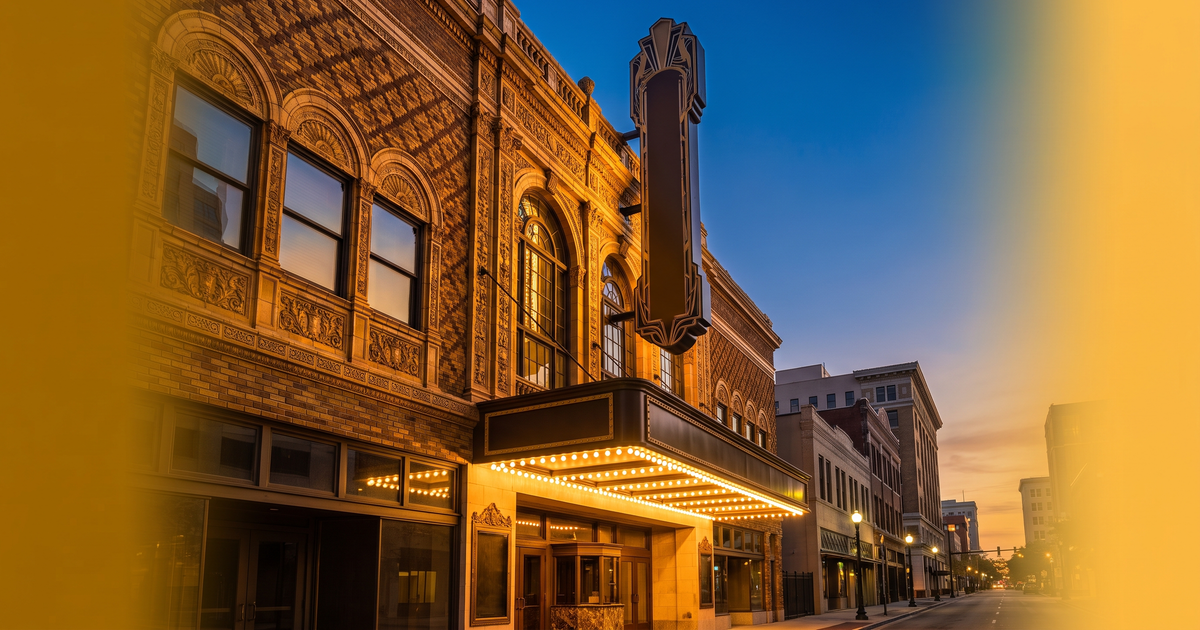
Jacksonville's $11.5 million Florida Theatre renovation lists stage lighting, sound, digital projection, and assistive listening as its lead scope items — meaning the low voltage is not a supporting trade, it is the project. An estimated $2.9 million in LV and AV work inside a 1927 building with restored decorative plaster, funded 50/50 by the city and the theatre's nonprofit, and aimed at a centennial in 2027 that will not move.
Most projects carry a little low voltage. This one is mostly low voltage. Jacksonville's $11.5 million Florida Theatre renovation names stage lighting, sound, digital projection, and assistive listening as its lead scope items — an estimated $2.9 million in LV and AV work inside a 1927 building that has to be ready for its centennial.
Project Overview
Project data from Jacksonville's capital program shows an $11,475,002 renovation of the Florida Theatre, the historic performing arts venue at 128 East Forsyth Street downtown. The scope, in the city's own order: upgrading the stage lighting system, sound system, digital projection system, and assistive listening system, plus theatre seating, plaster and paint restoration in the auditorium, HVAC replacement, marquee and canopy restoration, restroom improvements, roof replacement, elevator upgrades, and flooring repairs.
The city's justification is blunt: the equipment, fixtures, systems, and building components are original to the facility and past their useful life. The funding is structured as a 50% partnership between the City of Jacksonville and Florida Theater Performing Arts Center, Inc. (FTPAC), with FTPAC matching the city dollar for dollar across a five-year period.
This sits inside a longer effort. The Florida Theatre opened in 1927 and has been working through a Centennial Campaign since 2019, aimed at readying the building for its 100th anniversary in 2027. A 2023 closure from July to October already repaired flaking decorative plaster, repainted the lobbies and auditorium to the original 1927 color palette, replaced the HVAC system, moved the building's electrical vault from the first floor to the third, and rebuilt the public restrooms. A new artist greenroom and stage-left dressing room were carved out of a former boiler room and an abandoned mechanical space.
| Project | Florida Theatre Performing Arts Center Renovation |
| Location | 128 E Forsyth St, Jacksonville, FL |
| Project Value | $11,475,002 |
| Funding | 50/50 City of Jacksonville + FTPAC, over 5 years |
| Building | Opened 1927; Centennial Campaign since 2019 |
| Hard Date | 100th anniversary, 2027 |
| LV Score | 10/10 |
| Source | Jacksonville Capital Projects |
Do Not Price This at the Assembly Benchmark
This is the most important thing on the page, and it is a trap worth naming.
LVN normally estimates assembly and entertainment venues at roughly 7% of project value for low voltage. Applied here that produces about $800,000 — and it would be badly wrong.
That benchmark assumes a new build, where low voltage is one trade supporting a structure. This is a systems renovation. The building already exists. Nobody is pouring foundations or erecting steel. Four of the scope items the city lists first — stage lighting, sound, digital projection, assistive listening — are low voltage and AV work. The rest of the budget goes to seating, plaster, HVAC, roof, elevator, and restrooms.
| Project Value | $11,475,002 |
| LV/AV Share (performing arts systems renovation) | approximately 25% |
| Estimated LV/AV Contract Value | approximately $2.9 million |
| Planning Range | $2.3 million – $4.0 million (20–35%) |
Directionally, a theatrical lighting package with dimming, control, network, and fixtures on a house this size runs $1.5 million to $2.5 million on its own. A full sound system replacement — line array, DSP, amplification, monitor world, and the cabling infrastructure behind it — is another $1 million to $1.8 million. Digital projection, assistive listening, and the supporting structured cabling, fire alarm, access control, and video packages fill in the rest.
General rule worth carrying forward: in a renovation, ask whether the systems are the project or support the project. When an owner lists lighting and sound before roofing, your percentage is not 7%.
Assistive Listening Is a Code Requirement, Not an Add-On
The city named assistive listening explicitly, and it is the line item most likely to be under-quoted by a contractor who has not done assembly work.
Under the 2010 ADA Standards, assembly areas with audio amplification are required to provide an assistive listening system, and the number of receivers scales with seating capacity — with a defined portion required to be hearing-aid compatible, typically satisfied with neck loops rather than headsets. Sections 219 and 706 set the counts and the technical criteria.
Practically, that means the choice of technology is a design decision with real consequences: an induction hearing loop serves hearing aids directly and requires floor-level loop installation coordinated with seating replacement — which is exactly why replacing seats and upgrading assistive listening in the same phase is smart sequencing. Infrared and RF systems avoid the floor work but require receiver management and distribution. On a historic venue, the loop option can be far easier to justify while the seating is already out.
A 1927 Building Fights You
The auditorium's decorative plaster has already been repaired and repainted to the original 1927 color palette. That is a preservation asset and an installation constraint at the same time.
- You cannot core, chase, or surface-mount wherever convenient. Ornamental plaster, historic finishes, and restored paint mean routing works with existing chases and concealed paths, or it gets designed around. Every deviation is a conversation with the restoration team.
- Sightlines and acoustics govern device placement. Speaker positions, projector throws, and camera locations in a historic house are constrained by what can be seen from the seats and by an acoustic environment designed in 1927 for unamplified performance.
- The infrastructure has already moved once. The electrical vault was relocated from the first floor to the third during the 2023 phase. On a building of this age, assume as-builts are incomplete and budget for investigation.
- It is an operating venue. The 2023 precedent was a three-month summer closure. Work happens in dark windows against a show calendar, and load-in and load-out schedules are not negotiable around a touring act.
Low Voltage Systems Breakdown
| System | Category | Scope Description | Complexity |
|---|---|---|---|
| Audio/Visual | AV / Theatrical | The dominant scope. Stage lighting control and dimming with networked DMX and fixture replacement, a full house sound system with line array, DSP, amplification and monitor capability, and a digital projection system. This is theatrical systems work, which is a distinct discipline from conference-room AV — production workflow, touring-act compatibility, and operator ergonomics all drive design. | Very High |
| Structured Cabling | Data/Voice | The backbone under everything else: audio and control networks, lighting network, projection signal paths, production communications, and box office and administrative connectivity. Pathway in a historic building is the hard part, not the terminations. | High |
| Fire Alarm | Life Safety | Assembly occupancy with a large seated audience, a fly tower, and a stage. Voice evacuation with intelligible messaging in a highly reverberant 1927 auditorium is genuinely difficult, and intelligibility testing is where these projects fail inspection. Interfaces to house lighting and performance systems require coordination with the theatrical package. | Very High |
| Access Control | Security | Stage door, dressing rooms, the new artist greenroom, box office and cash handling, administrative offices, and equipment storage. Touring productions bring their own security expectations, and credentialing changes per show. | Medium |
| CCTV | Security | Lobbies, entries, box office, back of house, and the marquee and canopy exterior. Camera placement in restored public spaces is as much an aesthetic negotiation as a coverage problem. | Medium |
Skills and Certifications Required
| System | Key Certifications | Critical Skills |
|---|---|---|
| Theatrical Lighting | ETCP Entertainment Electrician, manufacturer certification (ETC, MA Lighting) | Dimming and networked DMX/sACN, console programming, fixture selection, rigging coordination, load-in workflow |
| Sound & AV | AVIXA CTS, CTS-I, CTS-D; manufacturer certification (Meyer, d&b, QSC, Biamp) | Line array design and prediction, DSP tuning in a reverberant historic room, monitor systems, production comms, projection throw and masking |
| Assistive Listening | ADA 2010 Standards §219/§706 literacy; hearing loop design (IEC 60118-4) | Receiver count calculation by capacity, hearing-aid-compatible provision, loop layout coordinated with seating replacement, field verification |
| Fire Alarm | NICET Fire Alarm Level II+, Florida alarm licensing | Assembly occupancy voice evacuation, speech intelligibility design and testing in reverberant space, NFPA 72, AHJ coordination |
| Structured Cabling | BICSI RCDD, INSTC, INSTF | Concealed pathway design in historic construction, AV-over-IP transport, production network segmentation |
Two qualifications separate bidders here. First, demonstrable historic and occupied-venue experience — an owner mid-way through a preservation campaign will not hand ornamental plaster to a contractor whose reference projects are warehouses. Second, theatrical systems credentials specifically. ETCP entertainment electrician certification and real production experience matter more than a general low voltage license, because the people operating this system are touring technicians who will judge it in one load-in.
Market Signal
The date is the leverage. The Centennial Campaign exists to have this building ready for 2027, and a 100th anniversary is not a milestone that slides a quarter. That produces the same dynamic LVN covered on the LA Convention Center: commissioning and AHJ acceptance have to land against a fixed external date, and schedule certainty is worth more to the owner than the lowest number.
The funding structure is the second signal. A 50/50 city and nonprofit match spread over five years means work is procured in tranches, not one award. A contractor who wins an early phase and performs is extremely well positioned for the rest — and reporting indicates roughly $12 million in further projects behind this one, including an artist hospitality suite, administrative offices, and a first-floor lobby restoration, with the theatre stating it will match whatever the city commits.
More broadly, performing arts venues are an underserved category for low voltage contractors. There are hundreds of historic theaters across the country running on original or near-original systems, most of them owned by nonprofits assembling public-private capital campaigns exactly like this one. The work is smaller than a data center and considerably more specialized, which is precisely why the competitive field is thinner. A contractor who builds a genuine theatrical systems capability is not competing with the firm that just bid a warehouse.
Find Projects Like This on Signal
LVN Signal tracks thousands of construction projects with low voltage opportunities across the country. Filter by city, system type, and project value to find your next bid.
Join 35,000+ Low Voltage Pros
Get weekly permit updates, tool deals, job opportunities, and industry news. No spam, unsubscribe anytime.