
Join Low Voltage Nation — Find project opportunities and showcase your company to thousands of industry professionals
DC BLOX's approved Thunderbird campus in Indianapolis carries a $2 billion headline — but the plan of operation splits it explicitly: $600-700 million of land, site, and building, and $1.2-1.3 billion of tenant servers and networking hardware. Two thirds of the number is computers nobody bids. Eleven low voltage systems and an estimated $45 million in LV work, on a two-building campus that was downsized from three after community opposition.
A $2 billion data center headline, and only about $650 million of it is a building. DC BLOX's approved Thunderbird campus on Indianapolis' east side needs eleven low voltage systems and an estimated $45 million in LV work — and the published cost breakdown is the clearest lesson in data center estimating we have seen all year.
Project Overview
Project data shows DC BLOX developing a data center campus at 305 Fintail Drive in the Thunderbird Commerce Center, Marion County, Indianapolis. It is DC BLOX's first development in Indiana.
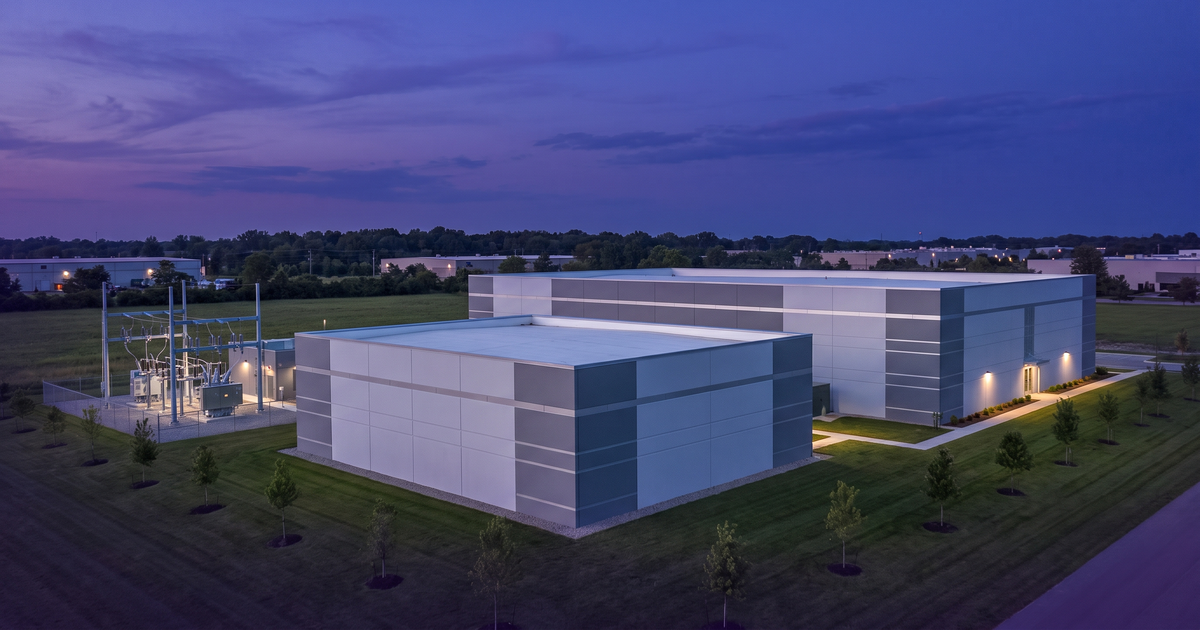
The approved plan of operation, dated July 14, 2026, describes a two-building campus: Building 1 at roughly 70,000 square feet and Building 2 at roughly 250,000 square feet. The site carries an existing substation, and the buildings will use closed-loop cooling. The Indianapolis Metropolitan Development Commission approved the project 6–1 on July 15, 2026 following a public hearing, after it cleared a hearing examiner in June.
Phase 1 can begin once variance and replat approvals are secured, with the first building expected within 24 months and full buildout running roughly five years.
| Project | DC BLOX Thunderbird Indianapolis Campus |
| Location | 305 Fintail Drive, Indianapolis, IN 46219 (Marion County) |
| Total Investment | $1.8B – $2.0B (including tenant hardware) |
| DC BLOX Land / Site / Building | $600M – $700M |
| Tenant IT Hardware | $1.2B – $1.3B |
| Approved Scale | 2 buildings, ~320,000 sq ft (70K + 250K) |
| Power | Existing substation on site |
| Status | MDC approved 6–1, July 15 2026; variance and replat pending |
| LV Score | 8/10 |
The Cost Breakdown Is Published. Use It.
LVN spends a lot of time warning against applying a percentage to a headline data center number, because those figures usually bundle land, buildings, and IT hardware into one press-release total. Normally you have to infer the split.
Here you do not have to infer anything. The plan of operation states it:
- $600 million to $700 million — DC BLOX land, site, and building investment
- $1.2 billion to $1.3 billion — tenant servers, networking equipment, and high-performance hardware
Roughly two thirds of the headline is computers. Servers, switches, and GPUs are bought by the tenant and racked by the tenant. They are not a construction package, they carry no cable tray, and no low voltage contractor bids them.
Apply LVN's 4% hyperscale rule to the $2 billion headline and you get $80 million. That number is wrong by roughly 70%, and a contractor who builds a business case on it is planning around revenue that does not exist.
| Correct Basis (building investment) | $600M – $700M |
| Data Center LV Percentage | 6% (construction-value basis) |
| System Count Multiplier | 1.25x (11 systems) |
| Calculated Range | $45M – $52.5M gross |
| Estimated LV Contract Value | approximately $45 million |
| Planning Range | $40 million – $52 million |
One further adjustment: the $600–700 million figure includes land, and land carries no low voltage. That argues for the lower half of the calculated range, which is why the headline estimate sits at $45 million rather than the $49 million midpoint.
The general rule this project illustrates cleanly: find the building number before you multiply anything. When a filing separates real property from IT equipment, that separation is the most valuable line in the document.
It Got Smaller — Bid the Approved Scope
The second lesson here is about which version of a project you are actually pricing.
Earlier filings described a three-building, roughly 410,000 square foot campus — an 80,000 square foot single-story building plus two-story buildings at 140,000 and 190,000 square feet. Following opposition from the neighboring Irvington community, DC BLOX downsized the plan, and what the Metropolitan Development Commission approved is the two-building, roughly 320,000 square foot campus described above.
That is a reduction of roughly 90,000 square feet and an entire building. A contractor who built a takeoff from the spring announcement is pricing a facility that no longer exists.
Data center entitlement is increasingly contested, particularly in residential-adjacent locations, and scope moves during that process. The practical discipline is simple: track the approved plan of operation, not the press release, and re-check it before you commit a number. Signal's record here reflects the July 14 approved plan for exactly that reason.
Low Voltage Systems Breakdown
Signal tracks eleven low voltage systems on this campus — the full mission-critical stack, delivered across two buildings over about five years.
| System | Category | Scope Description | Complexity |
|---|---|---|---|
| Fiber | Data | Single-mode backbone within and between the two buildings, MPO/MTP trunk architecture, and high-density patching. Smaller than a hyperscale campus, but the design discipline is identical. | Very High |
| Structured Cabling | Data/Voice | Horizontal and backbone copper, cabinet-level patching, overhead pathway and ladder rack across roughly 320,000 square feet plus admin and operations space. Note that DC BLOX is a colocation operator, so cabling has to support multiple tenants with separate cages and separate demarcation — a different problem from a single-tenant hyperscale hall. | High |
| Outside Plant | Data | Campus duct bank, handholes and vaults, carrier entrance, and diverse-path routing between buildings and to meet-me points. Carrier diversity is a selling point for a colocation provider, so entrance pathway design matters commercially, not just technically. | High |
| Access Control | Security | Perimeter-to-cage layered credentialing. Colocation raises the bar considerably: multiple customers in one building means cage-level access, auditable trails per tenant, and escort workflows that a single-tenant facility never needs. | Very High |
| CCTV | Security | Perimeter, yard, substation approach, entries, corridors, and data hall coverage with long retention. Colocation customers frequently require documented camera coverage of their own cages as part of their compliance posture. | High |
| Fire Alarm | Life Safety | Addressable detection with very early warning aspirating smoke detection in data halls, integrated with clean-agent or pre-action release and the electrical and mechanical shutdown matrix. Indianapolis AHJ coordination on a first-of-kind facility in the township adds review time. | Very High |
| BMS / Controls | Building Automation | Closed-loop cooling plant control, containment and thermal monitoring, generator and substation status integration, and EPMS tie-ins across two buildings sharing campus infrastructure. | Very High |
| Networking | Data | Facility, OT, and security network infrastructure separate from tenant compute — the layer that keeps the campus observable and manageable. | High |
| DAS | Wireless | In-building cellular for staff and visiting tenant technicians, plus public safety radio coverage verified by the fire authority. Colocation means a constant stream of outside personnel who expect their phones to work in a data hall. | Medium-High |
| Grounding & Bonding | Infrastructure | Signal reference and telecom bonding backbone, ground rings, cabinet and pathway bonding to IEEE and BICSI practice, coordinated with the existing substation's grounding system — which, because it already exists, must be verified rather than assumed. | High |
| Commissioning | Validation | Levels 1 through 5 including integrated systems testing, executed twice across a phased two-building delivery with roughly two years between them. | Very High |
Why This One Is More Winnable Than a Hyperscale Campus
DC BLOX is not a hyperscaler. It is a regional colocation and connectivity operator focused on underserved markets, and that changes the opportunity profile in ways worth naming.
The buildings are a normal size. A 70,000 square foot first building is a scope a strong regional integrator can staff and deliver. Compare that to the multi-million square foot campuses LVN has covered in Boling, Tulsa, and Effingham County, where the qualifying conversation starts with whether you can field hundreds of technicians.
The phasing is generous. Phase 1 is one building within 24 months. Phase 2 is the larger building starting roughly two years out. That is a sequence a mid-size contractor can grow into rather than a single overwhelming mobilization.
Nothing is awarded. Reviewed public sources name no general contractor or EPCM, no electrical contractor, no low voltage, fiber, or outside plant contractor, no structured cabling firm, no security integrator, no fire alarm contractor, no BMS or EPMS controls firm, no DAS or networking contractor, no grounding contractor, and no commissioning provider. Entitlement is essentially done; the build team is not.
The power question is already answered. The site carries an existing substation. LVN has covered what happens when it does not — finished buildings in Santa Clara sitting dark waiting on interconnection. A campus with power already on the parcel is a campus that will energize, commission, and close out.
Market Signal
Indianapolis is the second Indiana data center market LVN has tracked this summer, after Meta's $10 billion campus in Lebanon. Those two projects could not be more different in scale, and that contrast is the useful part: Indiana is now absorbing both hyperscale and regional colocation demand, which means the state is building a mission-critical contractor base rather than importing one for a single job.
The other signal is the entitlement fight itself. This project cleared a hearing examiner in June, drew organized neighborhood opposition, was voluntarily downsized, and then passed the Metropolitan Development Commission 6–1. That is becoming the standard path for data centers near residential areas, and it has a direct consequence for contractors: the gap between announcement and approved scope is widening, and the approved scope is the one that gets built. Reading the plan of operation rather than the press coverage is turning into a real estimating skill.
Find Projects Like This on Signal
LVN Signal tracks thousands of construction projects with low voltage opportunities across the country. Filter by city, system type, and project value to find your next bid.
Join 35,000+ Low Voltage Pros
Get weekly permit updates, tool deals, job opportunities, and industry news. No spam, unsubscribe anytime.