
Join Low Voltage Nation — Find project opportunities and showcase your company to thousands of industry professionals
Fort Worth ISD closed proposals on a $76 million middle-school consolidation with dedicated fire alarm, PA, AV, technology, security and controls sheets. The documented package supports an estimated $2.3 million to $3.8 million installed low voltage scope.
Fort Worth ISD's $76 million Northside Pyramid Middle School construction package documents at least seven low voltage workstreams across a new three-story campus, a retained annex and a sitewide rebuild. Based on the construction budget and the sheets visible in the bid set, the installed low voltage opportunity is estimated at $2.3 million to $3.8 million, with a working midpoint near $3.0 million.
Project Overview
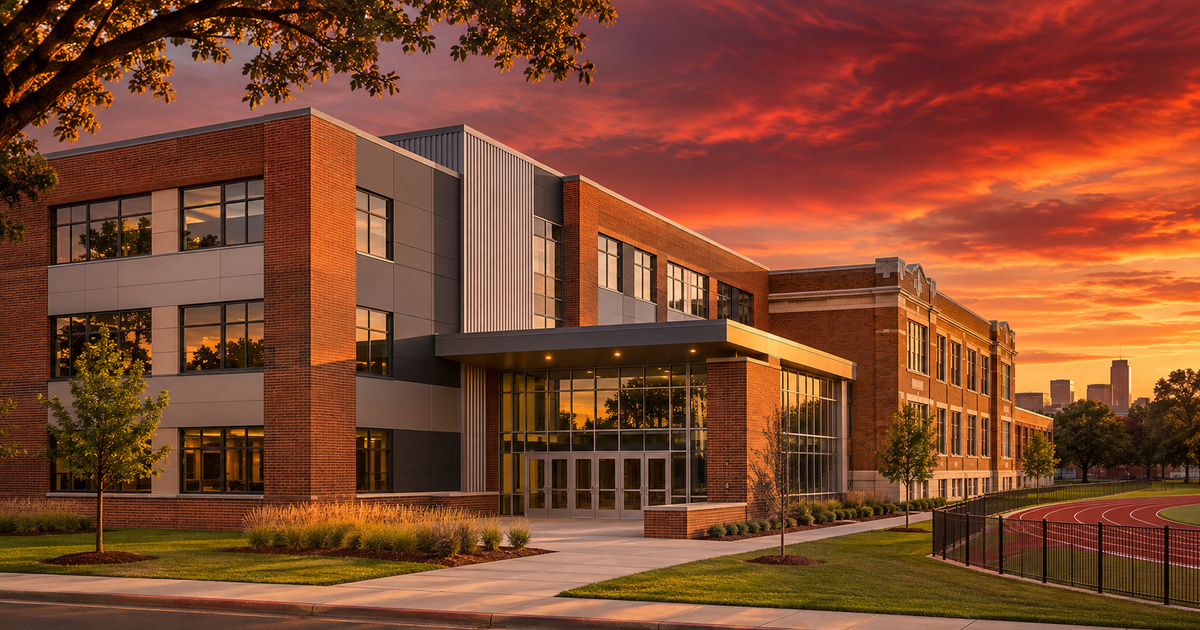
Fort Worth ISD is moving the Northside Pyramid Middle School consolidation from design into procurement at 709 NW 21st Street. The work attaches a new middle school to the existing J.P. Elder annex, while also rebuilding major portions of the surrounding site. The district plan room describes roughly 123,750 square feet of new construction, including a three-story classroom wing, science laboratories, a cafeteria and kitchen, athletics spaces, a storm shelter and supporting site structures.
The live Signal permit row carries a $57.165 million valuation and remained in plan review when last seen. The district's competitive sealed proposal package, however, identifies a $76 million construction budget, including owner contingency. The official 2021 Bond project page shows a broader program budget of $100.191 million, 115,075 square feet of new construction and 44,155 square feet of renovations. Those figures overlap, so they should not be added together. This spotlight uses the $76 million construction package as the denominator for installed systems work and treats the larger bond figure as program context.
Proposals closed November 11, 2026. Fort Worth ISD's vendor-opportunity page lists a tentative board action date of January 19, 2027, while the bond page forecasts construction from the first quarter of 2027 through the third quarter of 2029. That places the project in the post-bid evaluation window: the prime contract is not publicly awarded yet, but the technology scopes are far enough along for integrators to map the likely bidders and prepare package-specific follow-up.
| Project | North Side Pyramid Middle School Consolidation, TEA 044 |
| Location | 709 NW 21st St., Fort Worth, TX 76164 |
| Construction Budget | $76 million, including 5% owner contingency |
| Signal Permit Value | $57.165 million |
| Bond Program Budget | $100.191 million; overlapping program value, not additive |
| Scale | 115,075 SF new construction plus 44,155 SF renovations |
| Status | Proposals closed; tentative award action January 19, 2027 |
| Signal LV Score | 10/10 |
Key Players and the Post-Bid Window
Fort Worth Independent School District is the owner, with PROCEDEO serving as the owner's representative for the 2021 bond program. Kline Hardin is identified in the bid package as architect and engineer of record. The general contractor remained listed as TBD on the district project page when this article was prepared, so naming an awarded builder would be premature.
The public plan-holder roster provides the practical business-development map. It includes Cadence McShane, Joeris, Lee Lewis, Northridge Construction Group, Ratcliff Constructors, Reeder General Contractors, SEDALCO, Satterfield & Pontikes, Steele & Freeman and The Christman Company, among others. A listed plan holder is not the same thing as an award or even a confirmed proposal, but this is the right list for disciplined outreach while the district evaluates the competitive sealed proposals.
For low voltage firms, the useful message is specific: reference the published technology sheets, ask which bidder owns each Division 27 and 28 package, and be ready to separate furnish-and-install work from owner-furnished technology. Generic introductions are late at this stage. A sharper approach is to offer a complete takeoff for pathways, racks, cabling, testing, public address, AV, security and fire alarm interfaces, with alternates that can survive value engineering.
Low Voltage Systems Breakdown
The Signal record originally identified Structured Cabling, Access Control, CCTV, AV and Intercom. The district's public drawing index confirms a broader set of designed work: eleven dedicated fire alarm sheets, eleven PA floor sheets, thirteen AV sheets, five technology sheets, four security sheets and three mechanical-controls sheets. That is a real design package, not a percentage inferred from a generic school description.
| Workstream | Documented Basis | Likely Contractor Scope | Complexity |
|---|---|---|---|
| Structured Cabling and Fiber | Technology site plan and floor plans across three levels | Backbone pathways, telecom rooms, copper and fiber distribution, racks, patching, labeling and certification testing across the new building and retained annex | High |
| Security and Access Control | Security site plan plus first-, second- and third-floor plans | Secured vestibule, controlled doors, intrusion interfaces, door hardware coordination and head-end integration | High |
| Video Surveillance | Security drawings and sitewide campus coverage | Interior, perimeter and site cameras, PoE switching coordination, VMS commissioning, retention sizing and final views | High |
| Fire Alarm | Dedicated plans for every new-building area and level | Initiating and notification devices, panel and network interfaces, testing, inspection and phased tie-in to occupied existing areas | High |
| Public Address and Intercom | PA plans for six first-floor areas and upper levels | Speakers, paging zones, emergency messaging interfaces, bell schedules and campuswide intelligibility testing | High |
| Audio/Visual | AV device plans, risers, one-lines and rack elevations | Classroom and collaboration-room infrastructure, presentation systems, gym and cafetorium signal distribution, DSP and control commissioning | High |
| Building Automation | Three mechanical-controls sheets | DDC controllers, sensors, BACnet/IP integration, sequences, graphics, trend validation and turnover coordination | Medium-High |
Phasing raises the difficulty. The new school must connect to an existing annex, the current campus must retain enough parking during early work, and demolition follows the move into the new facility. Low voltage teams will need a migration plan that preserves life safety, communications and network service at each turnover boundary. Temporary links, early telecom-room energization, testing access and final cutover ownership should be settled before field mobilization.
Estimated Low Voltage Value
A comprehensive K-12 project commonly places installed low voltage systems near 4% of construction value, with a practical 3% to 5% band when the exact owner-furnished boundary is not public. Applied to the $76 million construction package, that produces a $2.28 million to $3.8 million range and a midpoint of $3.04 million. The breadth of the issued drawing index supports using the midpoint; it does not justify applying another multiplier on top of the already broad range.
| Construction Package | $76,000,000 |
| Estimated Installed LV Share | 3% to 5%; 4% midpoint |
| Estimated LV Range | $2.28 million to $3.8 million |
| Working Midpoint | $3.04 million |
The estimate covers installed pathways, cabling, racks, field devices, programming, integration, testing and commissioning for the documented workstreams. It does not assume that classroom displays, student devices, computers, loose AV equipment, software subscriptions or other FF&E are part of the trade contract. Those items may be owner-furnished, purchased through separate technology contracts or carried as allowances. Contractors should resolve that line item by line item before treating the range as backlog.
Package strategy matters as much as the total. Fire alarm may sit with the electrical contractor or a specialist. BAS may ride under mechanical controls. Security, AV, PA and structured cabling may be bundled, split or assigned to different prime bidders. A firm that cannot carry all seven workstreams can still compete by pairing a narrow specialty with documented testing, commissioning and closeout capability.
Skills and Certifications Required
| System | Useful Certifications | Critical Skills |
|---|---|---|
| Structured Cabling | BICSI INSTC/INSTF, TECH, RCDD oversight | Fiber splicing, copper termination, pathway planning, Fluke certification and standards-based labeling |
| Fire Alarm | Texas alarm licensing, NICET Fire Alarm II or higher | NFPA 72, SLC/NAC wiring, programming, phased testing and AHJ coordination |
| Security | Texas security licensing and manufacturer training | Door hardware, IP networking, controller wiring, VMS configuration and credential integration |
| AV and PA | AVIXA CTS/CTS-I; platform-specific training where specified | DSP programming, audio zoning, rack fabrication, control systems, AV-over-IP and intelligibility testing |
| Building Automation | BACnet and Tridium Niagara training | DDC controls, BACnet/IP, sequence validation, graphics and cross-trade commissioning |
Entry-level technicians can contribute to pathway installation, cable placement, device mounting and basic terminations under supervision. Mid-level technicians should own testing, labeling, rack work and device checkout. Senior staff will be needed for RCDD-level coordination, fire alarm programming, DSP and control logic, BAS integration, cybersecurity-conscious network handoff and final commissioning documentation.
Texas licensing depends on scope. Fire alarm, electronic access control and security work can trigger separate company and individual licensing requirements, while electrical connections and permits may sit with licensed electrical partners. Bidders should verify current state and local requirements, named manufacturers and the division responsible for permits before pricing labor.
Market Signal
This project is a repeatable Fort Worth signal, not a one-off campus refresh. The Northside consolidation is one package inside the district's 2021 capital program, and the district plan room already shows another $76 million pyramid middle-school consolidation in procurement. Firms that build a clean estimate, submittal library and closeout process for Northside can reuse the operating model on later bond work, even when the awarded prime changes.
The strongest near-term leverage is the award calendar. Proposals are closed, the contractor is still publicly TBD and the tentative board date sits in January. That creates a short period for qualified integrators to identify which plan holders submitted, get onto the correct estimator's scope sheet and make the owner-furnished boundary easy to evaluate. The public roster even shows a security contractor among the plan holders, which means generic security outreach will face competition. Differentiation has to come from package completeness, school phasing experience, testing capacity and a credible commissioning schedule.
For labor planning, the construction window extends into 2029. The new building, annex renovation, demolition and site reconfiguration will generate multiple mobilizations instead of one clean installation run. Contractors should price supervision and return trips accordingly, protect stored materials, and negotiate how temporary systems and phased inspections are handled. A low bid that ignores migration and commissioning is not a durable win.
Find Projects Like This on Signal
LVN Signal tracks thousands of construction projects with low voltage opportunities across the country. Filter by city, system type and project value to find the next bid before the prime contractor is locked.
Join 35,000+ Low Voltage Pros
Get weekly permit updates, tool deals, job opportunities, and industry news. No spam, unsubscribe anytime.