
Join Low Voltage Nation — Find project opportunities and showcase your company to thousands of industry professionals
Texas Health Southwest's Cramer Tower has a $150 million Fort Worth building permit under review for a 197,003-square-foot hospital addition. Five tracked low-voltage systems create an estimated $9.75 million planning midpoint, with scope, schedule, and award boundaries still to verify.
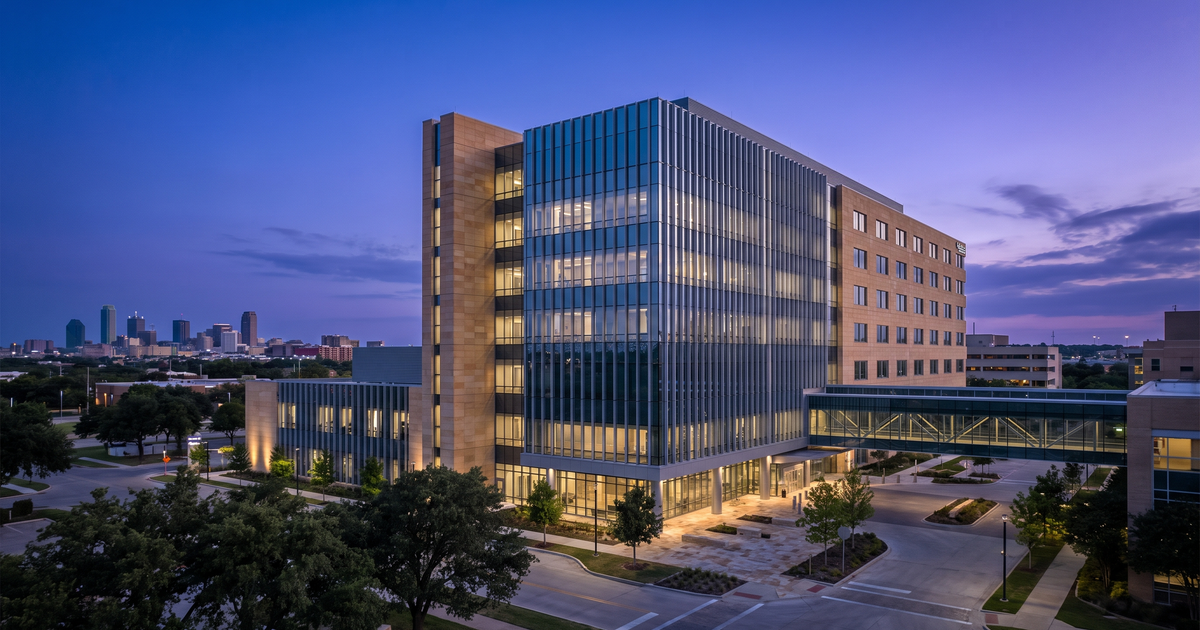
A $150 million hospital-tower permit in Fort Worth puts five low-voltage systems into a live planning lane. The City of Fort Worth record for PB26-13455 describes a new patient tower at Texas Health Harris Methodist Hospital Southwest Fort Worth, 6100 Harris Parkway. The filing carries 197,003 square feet, institutional hospital use, and an “Awaiting Client Reply” status. That is not an award notice, and it is not permission to treat every likely hospital technology package as bought. It is a current permit signal with enough scale, ownership, and schedule detail to start disciplined qualification.
The project is the Cramer Tower, part of Texas Health Southwest’s broader expansion. Texas Health has described the full expansion and renovation program as an estimated $223 million investment, including a new patient tower, 64 beds when the first two patient floors open, shell space for future growth, and modernization of six original operating rooms. The permit, accessibility filing, and owner announcement use different floor counts, areas, values, and dates. Those differences likely reflect measurement conventions or scope cuts, but contractors must reconcile them before carrying quantities or schedule assumptions into a proposal.
Project snapshot
| Field | Current source-backed detail |
|---|---|
| Project | THSW Cramer Tower / Texas Health Southwest patient tower |
| Location | 6100 Harris Parkway, Fort Worth, Texas 76132 |
| City building record | PB26-13455; 197,003 square feet; $150 million job value |
| City status | Awaiting Client Reply |
| TDLR record | TABS2027000590; $148,367,740; 215,000 square feet |
| Owner program | Estimated $223 million tower-and-renovation investment |
| Capacity | 64 beds planned when the first two patient floors open |
| Tracked LV systems | Nurse call, access control, CCTV, fire alarm, and DAS |
| Signal score | 9 out of 10 |
The municipal data comes from the Fort Worth permit service. It identifies Texas Health Resources as owner, records a September 26, 2026 filing, and calls the tower six stories. The Texas Department of Licensing and Regulation filing, registered September 9, lists HKS Inc. as design firm, calls the work a seven-story, 215,000-square-foot hospital bed tower, and gives a February 14, 2027 start with completion on March 13, 2029. Texas Health’s expansion announcement calls it five stories and says the first two patient floors are expected to open in 2028. The correct move is not to pick a favorite number; it is to qualify which drawing set, alternates, future shell floors, and enabling packages each record includes.
Program scope and bid boundaries
Texas Health says the tower will rise on the Virginia Clay Dorman Breast Care Center site, with that service moving into Pease Tower. The owner’s program also includes six operating-room modernizations intended to support higher-complexity and robotic procedures. Separate city records at the same campus cover a roughly $43.3 million central utility plant addition, a new parking area, and tower grading. Together they show a multi-package campus build, not one monolithic contract.
| Source or package | Published scope | Bid implication |
|---|---|---|
| PB26-13455 | $150M, 197,003-square-foot patient-tower permit | Best current base for the tower LV estimate |
| TABS2027000590 | $148.37M, 215,000-square-foot hospital addition | Confirms owner, designer, private funding, and schedule |
| Texas Health program | $223M tower plus six operating-room modernizations | Broader value; do not assign all of it to the tower |
| Central utility plant | Separate building and grading records | Related campus work with separate boundaries |
| Parking and enabling work | Separate municipal records | Phasing, access, pathway, and turnover constraints |
The Signal row does not name an electrical contractor, technology contractor, fire-alarm contractor, security integrator, DAS provider, nurse-call vendor, or commissioning agent. It does not establish that any tracked system has been awarded. The owner’s Cramer Tower naming announcement says construction was slated to begin in 2026, while the newer TDLR record starts in 2027. That tension is a direct RFI: identify enabling work already underway, the tower notice-to-proceed, and dates for technology submittals, rough-in, device trim, integrated testing, and phased occupancy.
Key players, with source boundaries
| Role | Organization | Verified relationship |
|---|---|---|
| Owner | Texas Health Resources | City permit and TDLR registration |
| Hospital | Texas Health Harris Methodist Hospital Southwest Fort Worth | Facility named by TDLR and owner |
| Design firm | HKS Inc. | TDLR design firm |
| Campus construction partner | Balfour Beatty | Named on related utility-plant grading record; tower role unconfirmed |
| Namesake | Karen Cramer | Naming gift; not a construction award |
Texas Health’s 2026 systemwide update still identifies the Southwest Fort Worth tower in its North Texas growth program. That owner update supports continued capital-program status but does not override newer regulatory scope. The existing campus map also matters: this is an operating hospital with emergency access, parking, Pease Tower, physician buildings, patient circulation, and active services to protect.
Five tracked low-voltage systems
The following scopes are planning interpretations based on hospital use and the named Signal categories—not awarded quantities, manufacturers, or final design. A bidder still needs issued technology drawings, specifications, device counts, risers, division boundaries, owner standards, and commissioning requirements.
| System | Planning questions | Complexity driver |
|---|---|---|
| Nurse call | Patient stations, staff workflow, code calls, escalation, reporting, and live-campus cutover | Clinical validation, manufacturer certification, owner acceptance |
| Fire alarm | Initiation, notification, emergency communication, elevator and smoke interfaces, monitoring | Hospital phasing, impairment control, acceptance testing, Texas licensing |
| Access control | Staff, patient, public, pharmacy, support, and after-hours zoning; credential migration | Egress, owner database integration, security licensing |
| CCTV | Approaches, corridors, restricted areas, service zones, retention, privacy, command integration | Coverage, storage, cybersecurity, operational policy |
| DAS | Carrier or public-safety requirements, pathways, head-end, antennas, testing, acceptance | RF design, ceiling coordination, late carrier decisions |
Structured cabling is absent from the five-system Signal list. That does not mean a 197,003- to 215,000-square-foot hospital tower has no network infrastructure. It means the current source data did not justify counting it. The same boundary applies to building automation, real-time location, infant protection, paging, audiovisual, digital signage, and medical-equipment networking. Put each on a verification log instead of quietly adding revenue.
Estimated low-voltage value
LVN uses a 5% to 8% planning benchmark for hospital construction, with 6.5% as the midpoint. Applied to the city’s $150 million tower permit, that produces a $9.75 million midpoint and a $7.5 million to $12 million range.
| Basis | Calculation | Planning value |
|---|---|---|
| Low | $150.0M × 5.0% | $7.50M |
| Midpoint | $150.0M × 6.5% | $9.75M |
| High | $150.0M × 8.0% | $12.00M |
| Broader-program sensitivity | $223.0M × 6.5% | $14.50M, excluded from the tower estimate |
This is market sizing, not a bid. It includes no vendor quote, device schedule, labor agreement, escalation factor, tax treatment, general-conditions allocation, or award data. The $223 million program produces a larger sensitivity number, but it includes operating-room work and may overlap other campus packages. Keeping the $150 million permit as the primary base avoids inflating the opportunity with separately procured scope.
Licensing, skills, and live-hospital execution
Texas does not regulate every low-voltage trade the same way. The State Fire Marshal’s Office says fire-alarm companies need applicable registration and individuals need role-appropriate licenses; its fire-alarm guidance separates planning, installation, certification, service, and monitoring authority. The team should verify company registration, Fire Alarm Planning Superintendent coverage, technician licenses, and final-certification responsibility.
Security is a separate lane. Texas DPS lists Alarm Installer and Electronic Access Control Device Installer among regulated licenses in its private-security guidance. Texas also exempts certain power-limited, signaling, fire-alarm, fiber, and communications work from state electrician licensing under the TDLR electrical exemptions. That exemption does not erase fire-alarm, security, project, manufacturer, healthcare, or authority requirements.
| Capability | Why it matters |
|---|---|
| Healthcare infection-control planning | Above-ceiling work and tie-ins occur around patient care |
| Manufacturer-authorized nurse-call staff | Programming, workflow, integration, and acceptance depend on the selected platform |
| Fire-alarm design and test leadership | Interfaces and phased impairments need documented responsibility |
| Security licensing and integration | Access and video must align with credentials, privacy, and policy |
| RF survey and DAS commissioning | Coverage must be demonstrated, not assumed |
| Structured closeout | The owner needs labels, test records, as-builts, training, and repeatable turnover |
What contractors should do next
First, reconcile the five-, six-, and seven-story references and the 197,003- versus 215,000-square-foot areas against the current design set. Second, identify contracting paths for the tower, utility plant, operating-room renovations, parking, and technology packages. Third, obtain the owner’s technology standards and interface matrix. Fourth, clarify whether two patient floors opening in 2028 create an early turnover package while shell floors and vertical-expansion provisions continue toward the TDLR completion date.
The opportunity is not merely five device categories. It is integration and phasing risk inside an operating hospital. Temporary pathways, shutdown windows, infection controls, credential migration, fire-alarm impairments, radio testing, owner training, and staged acceptance can move labor and schedule more than device counts. Teams that quantify those constraints early will be better positioned than teams that bid from square footage alone.
Market signal
Texas Health says Southwest Fort Worth and nearby communities are growing rapidly, and the tower is part of a wider North Texas capital program. For low-voltage contractors, healthcare references, owner-standard familiarity, and clean closeout are more valuable than a one-project relationship. A successful campus package can become evidence for later bed towers, surgical expansions, and renovations across the system.
Track projects like Cramer Tower before the technology packages become obvious. LVN Signal turns permit, bid, and construction data into qualified low-voltage opportunities so contractors can validate scope and enter the conversation earlier.
Join 35,000+ Low Voltage Pros
Get weekly permit updates, tool deals, job opportunities, and industry news. No spam, unsubscribe anytime.