
Join Low Voltage Nation — Find project opportunities and showcase your company to thousands of industry professionals
Fort Worth's $288.638M Phase 2 permit covers a four-story convention center addition plus renovations to exhibit, meeting, ballroom, and concourse space. Signal tracks five low-voltage lanes with a modeled $17.3M-$23.1M range as remaining bid packages move toward market.
A $288.638 million Phase 2 permit package at the Fort Worth Convention Center is in plan review with five low-voltage lanes tracked by Signal. Using the current permit value—not the larger program budget—the modeled building-systems opportunity is $17.3 million to $23.1 million across structured cabling, access control, CCTV, audiovisual, and fire alarm work.
Project Overview
The City of Fort Worth permit record PB26-13966 was filed October 12, 2026, for the second phase of the convention center expansion at 1201 Houston Street. The record is currently in Plan Review; it is not an issued permit or an awarded low-voltage contract. Its stated job value is $288,638,000.
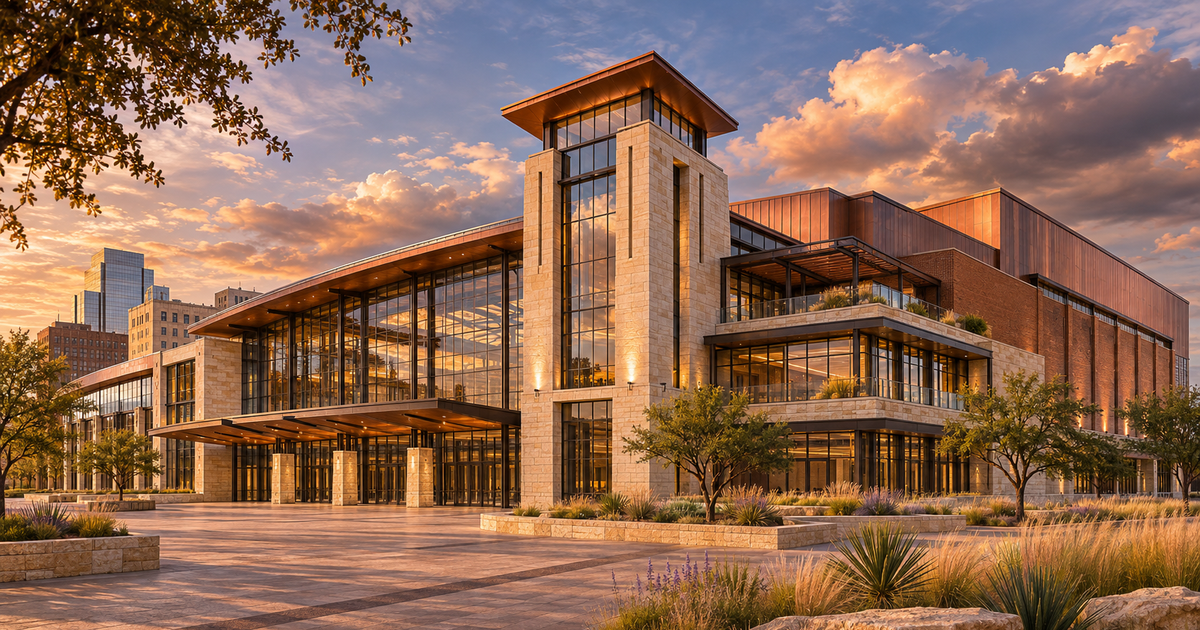
The permit describes a four-story addition with 74,000 square feet of new exhibit hall space, 37,000 square feet of additional meeting rooms, and a 40,000-square-foot ballroom. It also references a three-story renovation of existing exhibit halls, meeting rooms, ballrooms, administrative space, and public concourses, plus site work south of Ninth Street along Commerce and Houston streets.
That permit sits inside the City of Fort Worth's broader $606 million Phase 2 expansion and modernization program. The two figures are different pricing layers and are not additive. A separate $63.93 million remodel permit at the same address also describes overlapping Phase 2 renovation work, so it is excluded from this spotlight's low-voltage calculation rather than stacked onto PB26-13966.
| Project | Fort Worth Convention Center Phase 2 |
| Location | 1201 Houston Street, Fort Worth, Texas 76102 |
| Permit | PB26-13966 |
| Permit Status | Plan Review |
| Permit Value | $288,638,000 |
| Phase 2 Program | $606,000,000 reference budget; not added to permit value |
| New Space | 151,000 square feet across exhibit, meeting, and ballroom additions |
| Target Completion | Late 2029 to early 2030 |
| LV Score | 10/10 |
| Source | Fort Worth Commercial Building Permits (CIVIC) |
Key Players and the Bid Path
The City's Phase 2 announcement identifies the project team and confirms that the convention center will remain operational during construction. That occupied-event environment is a major coordination condition: temporary routes, phased shutdowns, testing windows, and turnover sequencing matter as much as device counts.
| Role | Organization | Project Relevance |
|---|---|---|
| Owner / Operator | City of Fort Worth | Public owner and operator of the active convention center |
| Construction Manager at Risk | AECOM Hunt, Byrne Construction Services, and E.J. Smith Construction joint venture | Returning Phase 1 team responsible for Phase 2 construction management |
| Lead Design | TVS with Bennett Partners | Architecture, interiors, planning, and local design collaboration |
| Project Management | Broaddus & Associates with Elements of Architecture | Owner-side project management and local coordination |
The commercial opening is not theoretical. An October 2026 Fort Worth Chamber contractor notice says remaining Phase 2 work is moving toward bid and directs certified Small Business Enterprises to an interest form. The CMAR joint venture is working against a 30% SBE utilization goal for contracts above $100,000, with more than 60 trade packages represented in the outreach. Contractors should treat that as an entry point to the bid list—not as proof that any specific low-voltage package has already been released or awarded.
Low-Voltage Systems Breakdown
Signal tracks five planning lanes on the project. These lanes are supported by the building type and permit scope, but they remain opportunity modeling until the design documents and trade packages define procurement boundaries. A convention center combines large public spaces, divisible rooms, dense event connectivity, life safety, and continuous operations, so interface management will drive risk.
| System | Category | Likely Scope and Coordination | Complexity |
|---|---|---|---|
| Structured Cabling | Data / Voice | Fiber backbone, copper horizontal distribution, telecom rooms, exhibit-floor service points, ballroom and meeting-room connectivity, testing, labeling, and phased migration between existing and new spaces. | High |
| Audio/Visual | Event Technology | AV-over-IP transport, divisible-room routing, ballroom reinforcement, meeting-room presentation, digital signage interfaces, control, DSP, and commissioning around changing room configurations. | Very High |
| Access Control | Security | Credentialed staff and service entries, loading and back-of-house doors, event-mode schedules, elevator and public-space interfaces, and integration with the operating center's security procedures. | High |
| CCTV | Security | Public concourse, exhibit, loading, service, and perimeter coverage with PoE switching, retention planning, analytics policy, VMS integration, and temporary coverage during phased construction. | High |
| Fire Alarm | Life Safety | Notification and initiating devices across the addition and renovation, networked panel coordination, phased impairments, sequence testing, mass-notification interfaces, and AHJ acceptance while the venue remains open. | Very High |
The most important boundary is between installed building infrastructure and event-production inventory. This estimate includes passive cabling and fiber, pathways, installed AV cabling and fixed endpoints, security field devices, fire alarm devices, programming, testing, and integration labor. It excludes temporary show equipment, broadcast trucks and cameras, touring production systems, event-rental inventory, carrier services, software subscriptions, and owner-furnished active network electronics. Displays, control processors, production switchers, wireless microphone systems, and other AV hardware must stay outside the subcontract estimate when the owner or specialty vendor furnishes them.
Estimated Low-Voltage Value
Convention centers carry more technology density than standard commercial buildings because audiovisual, security, life safety, and network infrastructure converge across large flexible rooms. For this permit, a 6% to 8% planning range produces a modeled low-voltage opportunity of approximately $17.3 million to $23.1 million, with a 7% midpoint of about $20.2 million.
| Permit Value Used | $288,638,000 |
| Planning Benchmark | 6% to 8% for integrated convention and event facilities |
| Modeled LV Range | $17.3 million to $23.1 million |
| Modeled Midpoint | $20.2 million at 7% |
| Program Cross-Check | $606 million Phase 2 budget, shown separately and not used in the calculation |
The range is intentionally broad. Structured cabling and fixed AV infrastructure may each command roughly a quarter of the building-systems budget, while fire alarm, access control, and CCTV divide much of the remainder. Final allocation will depend on whether active electronics and AV equipment are inside the CMAR trade packages, procured directly by the owner, or delivered through an exclusive service provider.
The Texas architectural-barriers registration lists a $352.57 million estimated construction cost and 742,118 square feet for the combined renovation and addition. That is a useful scope cross-check, but it is not substituted for the City permit's $288.638 million job value. Mixing those records would turn a planning estimate into false precision.
Skills and Certifications Required
This job needs contractors who can staff both installation and integration. The field workforce must handle large pathway and cable quantities, but senior technical leadership will own topology, interoperability, sequence testing, change control, and commissioning in an operating venue.
| System | Useful Certifications | Critical Skills |
|---|---|---|
| Structured Cabling | BICSI INSTC / INSTF, TECH, RCDD | Fiber splicing, copper termination, Fluke certification, backbone design, labeling, and cutover planning |
| Audio/Visual | AVIXA CTS, CTS-I, CTS-D | AV-over-IP, DSP, control programming, room-combine logic, loudspeaker commissioning, and network coordination |
| Access Control | Manufacturer training; PSP for senior security leadership | Door hardware, controller wiring, credential logic, elevator interfaces, schedules, and database migration |
| CCTV | VMS and camera-platform training; Network+ | PoE design, camera placement, storage sizing, VMS configuration, privacy zones, and temporary coverage |
| Fire Alarm | NICET Fire Alarm Level II+ and required Texas credentials | NFPA 72, SLC/NAC wiring, networked panels, phased impairment planning, testing, and AHJ coordination |
Entry-level technicians can contribute to pathway work, cable placement, device mounting, and supervised termination. Mid-level technicians should be ready to certify copper and fiber, configure edge devices, and document room-by-room turnover. Senior leads need RCDD, CTS-D/CTS-I, NICET, security-platform, and network-integration depth across multiple vendors.
Contractors should verify all Texas and local licensing requirements before bidding. The project also rewards a disciplined documentation team: an occupied venue needs accurate as-builts, impairment logs, test records, change tickets, and clear handoff from temporary conditions to permanent systems.
Market Signal: The Bid Window Is Opening
Fort Worth is not merely announcing a future concept. The permit is fresh, plan review is active, and current contractor outreach says remaining Phase 2 packages are moving toward bid. The strongest business-development move is to register interest with the CMAR team, document SBE status and bonding capacity, and show completed work in occupied convention, arena, airport, hotel, or large public-assembly facilities.
The operating constraint is the sales angle. According to the official convention-center expansion update, the facility remains open during construction and is already booking business into 2030. A low-voltage bidder should lead with phased cutover methods, temporary life-safety and security coverage, after-hours testing capacity, AV commissioning resources, and a plan for maintaining guest-facing service during demolition and tie-ins.
For second-tier firms, the 30% SBE target creates a route into a very large public project without pretending every package is still unclaimed. Cabling, fire alarm, electronic security, AV integration, testing, commissioning, and specialty labor may land under different primes. The practical play is to map the CMAR package structure early, identify which scopes are owner-furnished, and get qualification documents in before pricing windows compress.
Find Projects Like This on Signal
LVN Signal tracks thousands of construction projects with low voltage opportunities across the country. Filter by city, system type, and project value to find your next bid.
Join 35,000+ Low Voltage Pros
Get weekly permit updates, tool deals, job opportunities, and industry news. No spam, unsubscribe anytime.