Join Low Voltage Nation — Find project opportunities and showcase your company to thousands of industry professionals
OpenAI's $20 billion Project Camellia will put four data center buildings and 3.2 gigawatts of Georgia Power capacity on a 1,400-acre site in Effingham County, requiring eleven low voltage systems with an estimated $800 million in LV work. No general contractor, electrical prime, or technology package holder has been named — the entire buyout is open.
OpenAI's $20 billion Project Camellia campus in Effingham County, Georgia requires eleven low voltage systems, creating an estimated $800 million opportunity — and unlike almost every other megaproject on the board, not one package has been awarded.
Project Overview
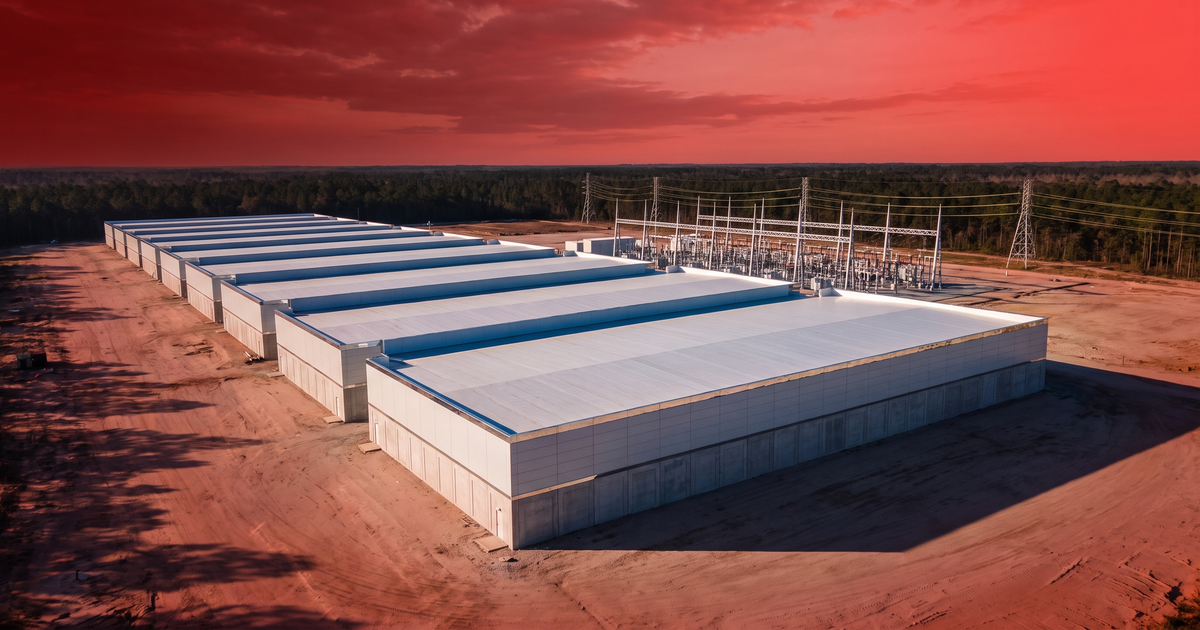
OpenAI has announced Project Camellia, a 3.2 gigawatt AI infrastructure campus in Effingham County, Georgia, roughly a 30-minute drive from downtown Savannah. Project data shows four buildings covering approximately 101 acres of footprint on a 1,400-acre site inside The Broe Group's 2,600-acre Savannah Gateway Industrial Hub.
The power agreement is the anchor fact. OpenAI has contracted with Georgia Power for approximately 3,200 MW under a 25-year service agreement, delivered in phases between 2028 and 2032. OpenAI has also committed up to 1,000 MW of flexible demand response, letting Georgia Power curtail delivery during peak grid stress, and has agreed to pay the full cost of the electric infrastructure and service the project requires so existing ratepayers are not exposed.
Effingham County agencies put the capital investment at a minimum of $20 billion, with reporting suggesting the figure exceeds $30 billion at full buildout. The campus is projected to open in 2028 with roughly 400 permanent positions and scale to about 1,000 by 2032, alongside thousands of construction jobs that OpenAI has specifically described as including electricians, equipment operators, mechanics, and technicians. Cooling will use a closed-loop water system that OpenAI says avoids diverting water from local communities.
| Project | Project Camellia — OpenAI AI Infrastructure Campus |
| Location | Savannah Gateway Industrial Hub, Effingham County (Rincon), GA |
| Capital Investment | $20 billion minimum (reported above $30 billion at full buildout) |
| Scale | 4 buildings, ~101 acres of footprint on a 1,400-acre site |
| Power | 3.2 GW phased 2028–2032, plus up to 1,000 MW demand response |
| Project Type | Hyperscale AI Data Center |
| Status | Announced — build/operate partner selection in progress |
| LV Score | 10/10 |
The Part That Matters: Nothing Has Been Awarded
Most megaproject spotlights are an exercise in finding the crack in an already-assembled team. This one is different. OpenAI has stated it is running a competitive process to select the partner that will construct and operate the campus, and that significant work remains on site planning, infrastructure, phasing, design, permitting, financing, and the operating model.
Reviewed primary sources do not name a development or finance partner, a general contractor or EPCM, an architect or engineer of record, an electrical prime, or the holder of any technology package — not fiber and outside plant, not structured cabling, not security, not fire alarm, not building controls, not DAS or networking, not grounding, not commissioning.
For a $20 billion program, that is an unusually clean sheet. The practical consequence for contractors is that positioning happens now, at the relationship and prequalification stage, rather than in a bid room eighteen months from now. When the build-and-operate partner is named, that firm will arrive with a shortlist already forming.
| Role | Company | Status |
|---|---|---|
| Owner / Operator / Developer | OpenAI | Leading design and development; selecting a build/operate partner |
| Utility | Georgia Power | ~3,200 MW, 25-year service agreement, phased 2028–2032 |
| Industrial Hub Developer | The Broe Group | Owner/developer of the 2,600-acre Savannah Gateway Industrial Hub |
| Economic Development | Effingham County Development Authority | Announced the investment and job commitments |
| Utility Regulator | Georgia Public Service Commission | Oversight of the service agreement and demand response terms |
| General Contractor / EPCM | Not announced | Open |
| Electrical Prime | Not announced | Open |
| Low Voltage / Technology Packages | Not announced | Open |
Low Voltage Systems Breakdown
Signal tracks eleven low voltage systems on this campus — the full hyperscale stack, spanning data infrastructure, security, life safety, building controls, and commissioning. On a four-building phased program, each of these is bought as a campus-wide package with per-building releases.
| System | Category | Scope Description | Complexity |
|---|---|---|---|
| Fiber | Data | Single-mode backbone between and within buildings, MPO/MTP trunk architecture, high-density patching, and the fiber plant that carries GPU cluster east-west traffic. Fusion splicing volume on a campus this size runs into tens of thousands of splices. | Very High |
| Structured Cabling | Data/Voice | Horizontal and backbone copper, cabinet-level patching, overhead pathway and ladder rack across four data halls plus admin and support space. Repetitive at enormous volume — the definition of a production-labor package. | High |
| Outside Plant | Data | Campus duct bank, handholes and vaults, inter-building and carrier entrance conduit, diverse-path fiber routes to meeting points. Coordinated with civil and the utility phasing. | High |
| Access Control | Security | Layered perimeter-to-cage credentialing, mantraps, turnstiles, biometric readers at data hall entries, and cabinet-level control. Hyperscale tenants drive strict audit and compliance requirements. | High |
| CCTV | Security | Perimeter, yard, entry, corridor, and data hall coverage with long retention windows and analytics. Camera counts on a campus of this scale reach into the thousands. | High |
| Fire Alarm | Life Safety | Addressable detection with very early warning aspirating smoke detection in data halls, integrated with clean-agent or pre-action suppression release, plus mass notification. Sequenced with the electrical and mechanical shutdown matrix. | Very High |
| BMS / Controls | Building Automation | Controls for the closed-loop cooling plant, CRAH/CDU-level control, containment monitoring, and the sequences that keep dense AI racks within thermal limits. Tightly coupled to commissioning. | Very High |
| Networking | Data | Building and campus network infrastructure supporting OT, security, and facility systems — separate from the compute fabric but responsible for everything that keeps the site observable. | High |
| DAS | Wireless | In-building cellular coverage across large steel-and-concrete structures plus public safety radio coverage, which is code-driven and AHJ-verified. | Medium-High |
| Grounding & Bonding | Infrastructure | Signal reference and telecom bonding backbone, ground rings, cabinet and pathway bonding to IEEE and BICSI practice. Unforgiving work — errors surface as intermittent faults years later. | High |
| Commissioning | Validation | Levels 1 through 5 commissioning including integrated systems testing and pull-the-plug scenarios across four phased buildings. On hyperscale work this is a standalone, well-funded scope. | Very High |
Estimated Low Voltage Value
Signal does not carry a contracted low voltage figure for Camellia, so the estimate below applies the hyperscale AI data center benchmark to announced capital investment.
| Announced Capital Investment | $20,000,000,000 (minimum) |
| Hyperscale LV Benchmark | approximately 4% |
| Estimated LV Contract Value | approximately $800 million |
Read that number correctly. It is not a bid. It is the estimated total low voltage and technology spend across four buildings over roughly five years of phased delivery, and it will be split into a dozen or more package awards released building by building as power arrives between 2028 and 2032. A realistic single-building, single-system package on this campus is in the tens of millions — still far beyond what most regional integrators self-perform, which is why teaming and joint ventures matter here.
It is also worth being precise about what the 3.2 GW figure is: contracted utility capacity for full buildout, not a disclosed building-level IT critical load. Contractors sizing scope off gigawatts should wait for building-level design releases before extrapolating device counts.
Skills and Certifications Required
Hyperscale AI work has a specific credential stack, and on a first-of-its-kind campus in a market with no existing data center workforce, having it on paper is the differentiator.
| System | Key Certifications | Critical Skills |
|---|---|---|
| Fiber & Outside Plant | BICSI INSTF, BICSI OSP, FOA CFOT/CFOS, BICSI RCDD | Mass fusion splicing, MPO/MTP polarity management, OTDR and Tier 2 testing, duct bank and vault coordination |
| Structured Cabling | BICSI RCDD, BICSI DCDC, INSTC, manufacturer certification | High-volume production installation, containment and pathway design, Fluke certification at scale, as-built discipline |
| Fire Alarm | NICET Fire Alarm Level III+, Georgia state license | VESDA/aspirating detection, clean-agent and pre-action release logic, NFPA 72, AHJ coordination, shutdown matrices |
| Access Control & CCTV | ASIS PSP, manufacturer certification (Genetec, Lenel, Software House, Axis) | Multi-layer credentialing, mantrap and turnstile integration, large-scale VMS architecture, retention and storage design |
| BMS / Controls | Tridium Niagara N4, BACnet, manufacturer certification | Cooling plant sequences, containment and thermal monitoring, EPMS integration, high-density rack control |
| Grounding & Commissioning | BICSI/IEEE bonding practice, ACP/CxA credentials, IEC 62443 for OT security | Telecom bonding backbone, signal reference grids, Level 4-5 integrated systems testing, scripted failure scenarios |
There is a workforce story here that contractors should not miss. OpenAI has committed $80 million to an Effingham County community benefits fund covering education, public safety, healthcare, and small business resources, and has pledged up to $71 million in Codex software credits to Georgia colleges, universities, and technical schools. Georgia's technical college system is exactly where low voltage and electrical talent is produced. A contractor that plugs into those programs early — apprenticeships, instructor relationships, equipment donations — is building the crew it will need in 2028 while everyone else is still reading press releases.
Contractors should also confirm Georgia licensing before pursuing this work. Georgia regulates low voltage contracting through the Construction Industry Licensing Board with separate classifications including alarm, telecommunications, and general low voltage.
Market Signal
Georgia is now the most aggressive data center market in the United States, and Camellia marks the moment that market stops being an Atlanta story.
Metro Atlanta's installed IT power is estimated at 1.82 GW in 2026, up from 0.92 GW in 2025, with forecasts reaching 7.68 GW by 2031 — a 26.95% compound annual growth rate. Vacancy ended March at roughly 1%. Annual net absorption hit 705.8 MW in 2024, outpacing Northern Virginia for the first time, and more than 2,100 MW is under construction. Georgia hosts over 200 data center facilities statewide.
Camellia opens a second front. Coastal Georgia has no meaningful data center construction workforce today, no established roster of qualified low voltage integrators with hyperscale references, and no incumbent relationships to displace. Every one of those absences is an opening. The Savannah Gateway Industrial Hub is 2,600 acres and Camellia occupies roughly half of it, which means the site owner has substantial remaining land in a location that just proved it can deliver gigawatt-scale power.
The strategic read: this is a rare chance to enter a hyperscale program at announcement rather than at buyout. The build-and-operate partner has not been chosen, the design team has not been named, and the technology packages do not exist on paper yet. Contractors who want coastal Georgia work in 2028 should be introducing themselves in 2026 — to The Broe Group, to the Effingham County Development Authority, and to every national data center builder currently competing for the partner role.
Find Projects Like This on Signal
LVN Signal tracks thousands of construction projects with low voltage opportunities across the country. Filter by city, system type, and project value to find your next bid.
Join 35,000+ Low Voltage Pros
Get weekly permit updates, tool deals, job opportunities, and industry news. No spam, unsubscribe anytime.