
Join Low Voltage Nation — Find project opportunities and showcase your company to thousands of industry professionals
Durham's new 42,482-square-foot emergency operations and backup 911 center carries a $44.1 million construction GMP and six tracked low-voltage systems. Awarded communications, AV, and electronic-security packages alone total $2.48 million, before fire alarm and radio-tower integration.
Durham's $44.1 million Emergency Operations Center and backup 911 call-center build carries six tracked low-voltage systems and at least $2.48 million in named communications, AV, and electronic-security packages. Once Fire Alarm, DAS, radio-tower interfaces, integration, and commissioning are included, the building-level LV opportunity reasonably lands in the $3.0 million to $4.0 million range.
Project Overview
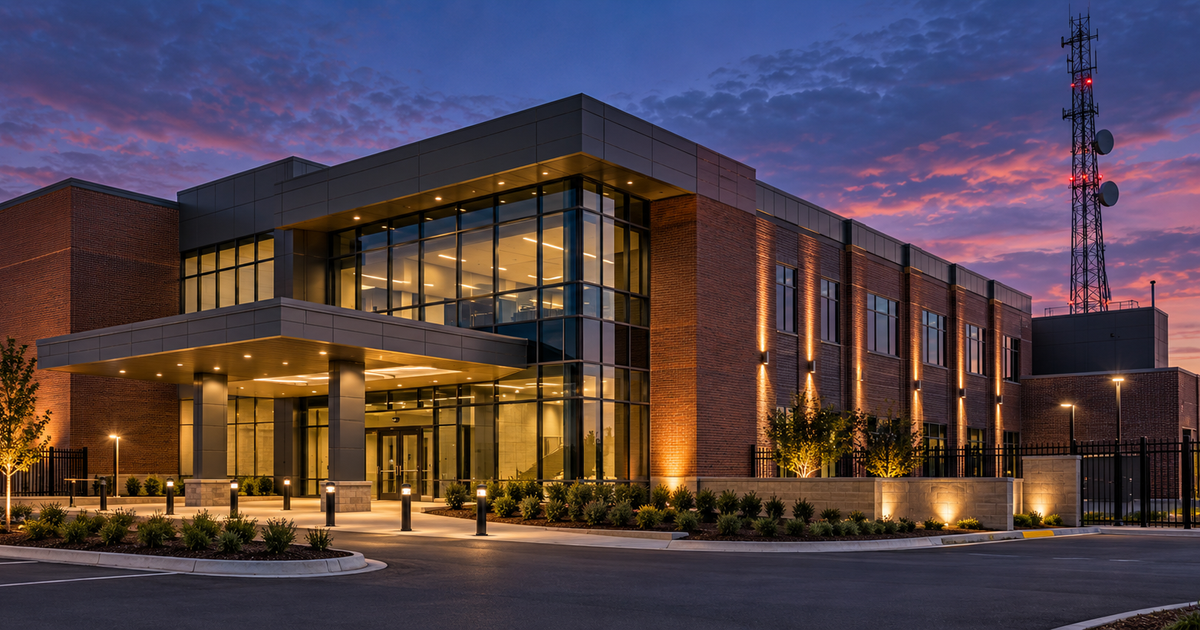
Durham County and the City of Durham are replacing an undersized emergency-operations facility with a secure, purpose-built complex at 2422 Broad Street. The program combines the county Emergency Operations Center, Emergency Management offices, a Fusion Center, the City/County backup 911 center, and the Sheriff's backup call center under one roof. The City of Durham project page describes a new two-story facility, while the current cost-share schedule puts the programmed building at 42,482 square feet.
Signal's Durham building-permit source carries permit record D2500223 at $25,909,611. That figure should not be added to the later contract award. The more current August 2026 guaranteed-maximum-price packet sets Bordeaux Construction's GMP at $44,099,065, including contingencies, general conditions, fee, bonds, insurance, and allowances. The owner cost schedule separately places total project cost at $55,156,315 after design, owner services, FF&E, and departmental provisions; these are overlapping views of the same program, not separate construction packages.
The GMP schedule anticipated notice to proceed on September 28, 2026 and final completion on July 28, 2029, a 34-month duration. The existing EOC stays operational while the new building is constructed, then users move into the new facility before the old structure is demolished. That live-campus sequencing makes outages, cutovers, temporary pathways, commissioning, and documentation part of the sell—not cleanup work at the end.
| Project | Durham County/City EOC & 911 Backup Center |
| Location | 2422 Broad Street, Durham, NC 27704 |
| Construction GMP | $44,099,065 |
| Total Project Estimate | $55,156,315, including design, owner services, FF&E, and provisions |
| Signal Permit Record | D2500223; $25,909,611 source-side value |
| Facility | 42,482 square feet; two stories; secure public-safety use |
| Schedule | September 2026 notice to proceed; July 2029 planned final completion |
| LV Score | 10/10 |
Key Players and Package Holders
The delivery structure matters more than a generic lead list because this project has already moved through CMAR pricing. Durham County and the City are the owners; Bordeaux holds the construction-management-at-risk contract; O'Brien Atkins Associates is the architect and engineer of record. The official GMP packet also names the package holders closest to LV subcontracting and integration decisions.
| Role | Company | What the source says |
|---|---|---|
| Owner | Durham County & City Governments | Joint emergency operations, backup 911, and Sheriff's backup call-center program. |
| CMAR / General Contractor | Bordeaux Construction Company | $44.099 million GMP; occupied campus; existing EOC remains live through move-in. |
| Architect / Engineer | O'Brien Atkins Associates | Design team for the building and radio-tower coordination, supported by Mission Critical Partners. |
| Communications & AV | Peerless Communications | $705,909 communications package plus $1,399,726 AV package. |
| Electronic Security & Controls | A3 Communications | $374,245 reconciled security package in the GMP. |
For business development, Peerless and A3 are the immediate doors. Bordeaux is still the coordination authority, but the source-backed package awards show where scope ownership already sits. A contractor approaching this job should lead with a specific gap—fiber testing, pathway recovery, DAS support, fire-alarm interface labor, commissioning, documentation, or surge staffing—not a broad “we do low voltage” pitch.
Low Voltage Systems Breakdown
The Signal record tracks six systems: Structured Cabling, Access Control, CCTV, Audio/Visual, Fire Alarm, and DAS. The package schedule proves that several are already budgeted as standalone scopes, while Fire Alarm remains inside the much larger electrical and radio-tower package. A mission-critical facility also forces those systems to operate as one environment during normal operations, incident activation, failover, and post-event recovery.
| System | Package / Scope | Mission-Critical Requirement | Complexity |
|---|---|---|---|
| Structured Cabling | Part of the $705,909 communications package; copper and fiber backbone, racks, pathways, labeling, and certification. | Redundant pathways, disciplined administration, and test records that support 911 and EOC cutover. | High |
| Audio/Visual | $1,399,726 AV package, including EOC display, routing, control, conferencing infrastructure, and integration. | Operators need shared situational awareness without losing content during an incident or room reconfiguration. | Very High |
| Access Control | Part of the $374,245 electronic-security package, plus owner provisioning allowances. | Role-based access, secure-area separation, door hardware coordination, badging, and auditability. | High |
| CCTV / Video Surveillance | Electronic-security package with cameras, recording, network, and control interfaces. | Coverage must respect public, staff, evidence-sensitive, and hardened zones while remaining available during incidents. | High |
| Fire Alarm | Carried in the electrical and radio-tower package; the GMP packet identifies a specified base system with a Siemens alternate. | NFPA 72 sequence, mass-notification interfaces, monitoring, survivability, testing, and AHJ acceptance. | Very High |
| DAS / Radio Interfaces | Distributed antenna coverage and interfaces around a separately designed communications tower and microwave implementation. | Coverage verification, grounding, pathways, RF coordination, and separation from public-safety radio active equipment. | Very High |
Estimated Low Voltage Value
This project provides a better basis than a generic construction percentage. Three reconciled packages total $2,479,880: $705,909 for Communications, $1,399,726 for Audio Visual Systems, and $374,245 for Security Electronic & Controls. That is the source-backed floor before the Fire Alarm share of the electrical package, DAS and radio-tower interfaces, owner provisioning, systems integration, testing, commissioning, and closeout.
| Communications Package | $705,909 |
| Audio/Visual Package | $1,399,726 |
| Electronic Security Package | $374,245 |
| Named Package Floor | $2,479,880 |
| Estimated Building-LV Range | $3.0 million to $4.0 million |
The $3.0 million to $4.0 million range is deliberately narrower than a blind public-safety benchmark. It starts with awarded package values and adds only a reasonable allowance for Fire Alarm, DAS, radio interfaces, and cross-system commissioning. It does not count the entire $13.5 million electrical/radio-tower placeholder as LV, and it does not treat the $25.91 million permit value and $44.10 million GMP as additive.
The owner cost-share schedule is equally important because it defines what is not in the contractor opportunity. It says only furniture for the call center is included and operator equipment is excluded. In other words, CAD consoles, 911 operator positions, active radio or microwave hardware, carrier services, and owner-furnished operational technology should not be padded into a building-LV estimate unless later procurement documents explicitly place them in the contract.
Skills and Certifications Required
This is not a cable-pull-only job. Entry-level technicians can support pathway installation, device mounting, labeling, and controlled pulls, but the project needs senior staff who can coordinate protected pathways, live-site cutovers, functional testing, integrated commissioning, and turnover evidence across six disciplines.
| Discipline | Relevant Credentials | Critical Skills |
|---|---|---|
| Structured Cabling | BICSI INSTC/INSTF; TECH; RCDD oversight | Fiber splicing, Cat 6A termination, DSX certification, rack buildout, pathway diversity, labeling. |
| Fire Alarm | NICET Fire Alarm Level II or higher; North Carolina SP-FA/LV | NFPA 72, SLC/NAC circuits, sequence testing, emergency-control interfaces, AHJ coordination. |
| Access Control & CCTV | Manufacturer credentials; Network+ or equivalent; PSP for senior security design | Door hardware, PoE, VMS, retention design, credential databases, alarm and video integration. |
| Audio/Visual | AVIXA CTS, CTS-I, CTS-D | AV-over-IP, control programming, DSP, display systems, conferencing, EOC-room acceptance testing. |
| DAS & Radio Interfaces | RCDD; RF experience; carrier or public-safety radio training | Coverage testing, antenna and fiber coordination, grounding, tower pathways, FCC-aware documentation. |
North Carolina contractors should verify licensing before offering or performing this work. The North Carolina State Board of Examiners of Electrical Contractors defines a special restricted Fire Alarm/Low Voltage classification, SP-FA/LV, for qualifying low-voltage and related wiring. The board's rules state that special restricted licenses have no project-value cap within their authorized scope, but they do not authorize general electrical work outside that scope.
Market Signal
The opportunity is no longer “who gets the prime.” The useful signal is that Durham has committed to a multi-year, mission-critical build and the GMP exposes actual package holders and package values. That makes the next targets coordination labor, qualified workforce, product substitutions, commissioning support, change-order response, owner-training documentation, and the long tail between device installation and operational acceptance.
The occupied-site condition is the commercial angle. The current EOC cannot simply go dark while the new center is built. Contractors that can demonstrate rehearsed cutover plans, rollback procedures, labeling discipline, test baselines, and clean as-built records can sell risk reduction to Bordeaux, Peerless, A3, the electrical contractor, and the owner team. In emergency communications, avoiding one failed transition is worth more than squeezing the last percentage point from labor.
The owner-furnished boundary is another lead generator. The building team still has to provide pathways, grounding, racks, power, environmental conditions, network handoff points, display infrastructure, and commissioning support for equipment bought elsewhere. Those interfaces create real scope even when the active 911, CAD, radio, or microwave equipment sits under a separate procurement. Ask who owns each interface, who certifies it, and who stays through move-in.
Durham also shows why public-safety work rewards specialists. A two-story building can carry the integration density of a much larger campus because every system supports continuity, security, and incident command. Firms with NICET, BICSI, AVIXA, security-platform, and RF depth can compete on coordination and proof, not just labor rate.
Find Projects Like This on Signal
LVN Signal tracks thousands of construction projects with low voltage opportunities across the country. Filter by city, system type, and project value to find your next bid.
Join 35,000+ Low Voltage Pros
Get weekly permit updates, tool deals, job opportunities, and industry news. No spam, unsubscribe anytime.