
Join Low Voltage Nation — Find project opportunities and showcase your company to thousands of industry professionals
Dayton is converting an existing Water Reclamation Facility odor-control building into server and electrical rooms under a $3.455 million construction award. The three tracked low-voltage systems represent an estimated $210,000-$350,000 full-project opportunity.
Dayton, Ohio is converting an existing Water Reclamation Facility utility building into server and electrical rooms under a $3.455 million construction award. The project tracks three core low-voltage systems and an estimated $210,000 to $350,000 in structured cabling, access control, and video-surveillance opportunity.
Project Overview
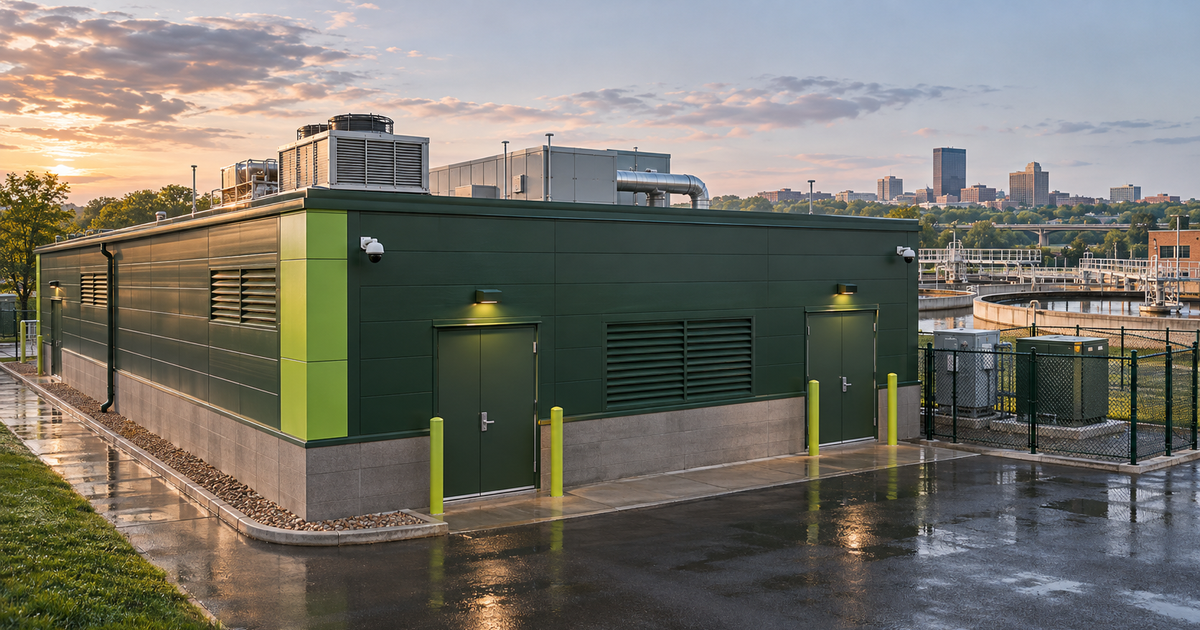
The Water Reclamation Facility Data Center is a municipal renovation, not a hyperscale shell. Dayton's source record says the project converts the existing Odor Control Building, also described in bid coverage as the Air Scrubber Building, into a new server room and electrical room. The work sits at the city's Water Reclamation Facility at 2800 Guthrie Road, an active treatment campus that has operated on the same southwest Dayton site since 1929.
The source record is more useful than the summarized Signal row. Signal originally carried the city's $803,400 estimated construction cost. The live Dayton Active Capital Improvement Projects layer now lists a $3,455,100 awarded construction cost, identifies Peterson Construction Company as contractor, names Tetra Tech as designer and consultant, and places the project in “Bidding & Award.” The public bid date was September 4, 2025, and current construction-market coverage classifies the project at award stage with completion targeted for late 2026.
This changes the sales motion. The prime award is no longer an open general-construction bid, but named specialty packages, suppliers, and integrators are not visible in the reviewed public record. Low-voltage contractors should qualify the remaining opportunity through Peterson, Tetra Tech, and the City of Dayton project team instead of treating the expired owner solicitation as a fresh public bid.
| Project | Water Reclamation Facility Data Center |
| Location | 2800 Guthrie Road, Dayton, Ohio |
| Scope | Convert existing odor-control / air-scrubber building into server and electrical rooms |
| Awarded Construction Cost | $3,455,100 |
| Phase | Bidding & Award |
| Tracked LV Systems | Structured Cabling, Access Control, CCTV |
| LV Score | 10/10 |
| Owner Source | City of Dayton Active Capital Improvement Projects |
Key Players
The owner is the City of Dayton Department of Water. Its Water Reclamation Facility treats an average of roughly 48 million to 55 million gallons per day and supports a 72 MGD advanced treatment plant. That operational context raises the standard for change control, access, documentation, and shutdown coordination: this is critical municipal infrastructure inside a live process facility.
| Role | Organization | Source-Backed Context |
|---|---|---|
| Owner | City of Dayton Department of Water | Owns and operates the Water Reclamation Facility and publishes the capital-project record. |
| Designer / Consultant | Tetra Tech | Named designer and consultant in the live Dayton capital-project attributes. |
| Contractor | Peterson Construction Company | Named contractor against the $3.455 million awarded construction value. |
| Bid Document Platform | Quest CDN / OhioBids listing | Publishes the owner solicitation number, renovation scope, bid date, set-aside goals, and prevailing-wage requirement. |
Peterson is not a guessed entity match. The city's own project attributes name the contractor, and Peterson's portfolio shows an established relationship with Dayton's water-reclamation program on other major improvements. Tetra Tech is likewise named directly in the city record. No exact CRM match exists for either organization in LVN's contractor-directory companies table, so this post remains correctly unrolled at the company level while preserving both names for outreach.
Low Voltage Systems Breakdown
The project is small compared with a commercial colocation campus, but its three systems touch the facility's reliability and physical-security boundary. Renovating an existing utility building means installers must work around unknown pathway conditions, active plant traffic, moisture and corrosion exposure, legacy electrical systems, and the owner's operational controls. Good closeout documentation may be as valuable as the installed cable.
| System | Category | Likely Project Scope | Complexity |
|---|---|---|---|
| Structured Cabling | Data / Voice | Fiber and copper backbone extensions, equipment-room racks and pathways, server-room horizontal cabling, labeling, grounding coordination, and certification testing. Existing-building routes must be surveyed before final quantities are trusted. | High |
| Access Control | Security | Controlled entry to the converted server and electrical rooms, door contacts, readers, request-to-exit devices, alarm integration, credential administration, and coordination with hardened door hardware. | Medium-High |
| CCTV / Video Surveillance | Security | Coverage of entrances, the converted building perimeter, equipment access points, and circulation routes, with PoE switching, VMS licensing, storage sizing, and integration into the city's security operations. | Medium-High |
The public summary does not identify fire alarm, UPS monitoring, environmental monitoring, SCADA, or building controls as separate low-voltage packages. Those interfaces may appear in the construction documents because the project includes an electrical room, but they are not counted in this spotlight without source support. Contractors should request the responsibility matrix and Division 26, 27, and 28 specifications before assuming where monitoring and controls land.
Estimated Low Voltage Value
LVN priced the opportunity from the $3,455,100 awarded construction cost, not the earlier $803,400 estimate. For an edge-scale data-center conversion under $100 million, a practical planning range is 6% to 10% of construction value. That produces approximately $207,000 to $346,000, rounded to $210,000 to $350,000, with a midpoint near $280,000.
| Original City Estimate | $803,400 |
| Awarded Construction Cost | $3,455,100 |
| Planning Benchmark | 6% to 10% for a small mission-critical / edge conversion |
| Estimated LV Midpoint | Approximately $280,000 |
| Estimated LV Range | $210,000 to $350,000 |
The estimate covers passive structured cabling, pathways normally carried with the LV package, access-control field devices and controllers, CCTV cameras and related VMS work, testing, documentation, and integration labor. It excludes servers, storage, switches and routers purchased by the owner, major electrical distribution, UPS equipment, generators, HVAC, process-control equipment, and owner-furnished software. If the owner provides security platforms or active network electronics, the installable subcontract moves toward the low end.
This is also a retrofit, so contingency matters. Limited above-ceiling access, undocumented penetrations, grounding corrections, hazardous-area boundaries elsewhere on the treatment campus, and work-hour restrictions can move labor faster than device counts do. A contractor should walk the building, verify routes, confirm whether the server room is live during cutover, and price testing and as-builts as deliverables rather than overhead.
Skills and Certifications Required
The crew mix is straightforward but cannot be casual. Structured cabling technicians need reliable fiber and copper testing discipline. Security technicians need network fluency and door-hardware competence. The lead needs enough municipal and industrial experience to coordinate work inside an operating treatment facility without creating an outage or an uncontrolled access condition.
| System | Useful Certifications | Critical Skills |
|---|---|---|
| Structured Cabling | BICSI INST1/INSTC/INSTF, BICSI TECH, RCDD oversight | Fiber splicing, Cat6A termination, Fluke certification, rack buildout, bonding, labeling, and as-built documentation |
| Access Control | Platform-specific training, PSP for senior oversight, applicable Ohio licensing | Door hardware, reader and controller wiring, credential workflows, alarm integration, and IP networking |
| CCTV | VMS and camera-manufacturer credentials, CompTIA Network+ | PoE design, camera placement, storage calculation, video analytics, VLAN coordination, and acceptance testing |
Entry-level technicians can pull, dress, label, and mount under supervision. Mid-level technicians should own terminations, certification results, device addressing, and punch-list corrections. The senior technician or project manager should control cutover planning, cybersecurity handoffs, security permissions, owner training, and final document turnover. Contractors should verify Ohio and local licensing requirements before accepting alarm or security scope.
Market Signal
This job is a useful reminder that “data center” does not always mean a new hyperscale campus. Municipal utilities are converting existing buildings into hardened computing and electrical spaces to support resilient operations, security, records, and plant technology. Those projects are smaller, but they can move with public funding, named designers, known primes, and a defined facility relationship.
Dayton now has two recent Department of Water technical-facility signals in the LVN catalog: the Water Quality Laboratory expansion published October 28 and this WRF data-center conversion. The common account matters more than city novelty. Contractors serving one project can use performance, badging, safety compliance, and closeout quality to pursue the next City of Dayton water, wastewater, laboratory, controls, or security package.
The near-term business-development route runs through Peterson Construction, Tetra Tech, and the city's Water Reclamation project team. Outreach should lead with retrofit route surveys, mission-critical cutover planning, industrial fiber testing, security integration, and documented work inside active facilities. Since the public owner bid has passed, asking for “the bid” is late; asking who holds Division 27 and 28, whether buyout is complete, and where alternates remain is the sharper move.
Find Projects Like This on Signal
LVN Signal tracks thousands of construction projects with low voltage opportunities across the country. Filter by city, system type, and project value to find your next bid.
Join 35,000+ Low Voltage Pros
Get weekly permit updates, tool deals, job opportunities, and industry news. No spam, unsubscribe anytime.