
Join Low Voltage Nation — Find project opportunities and showcase your company to thousands of industry professionals
Dayton's $11.56 million Central Water Quality Laboratory expansion will modernize roughly 16,000 square feet and add about 3,240 square feet for PFAS and regional testing. Five low-voltage systems represent an estimated $650,000 to $950,000 opportunity, with an $800,000 planning midpoint.
Dayton's $11.56 million Central Water Quality Laboratory expansion puts five low-voltage systems inside a public-health project built around PFAS and regional water testing. Using the current funded project total rather than Signal's blended capital-program value, the likely low-voltage package lands between $650,000 and $950,000, with an approximately $800,000 planning midpoint.
Project Overview
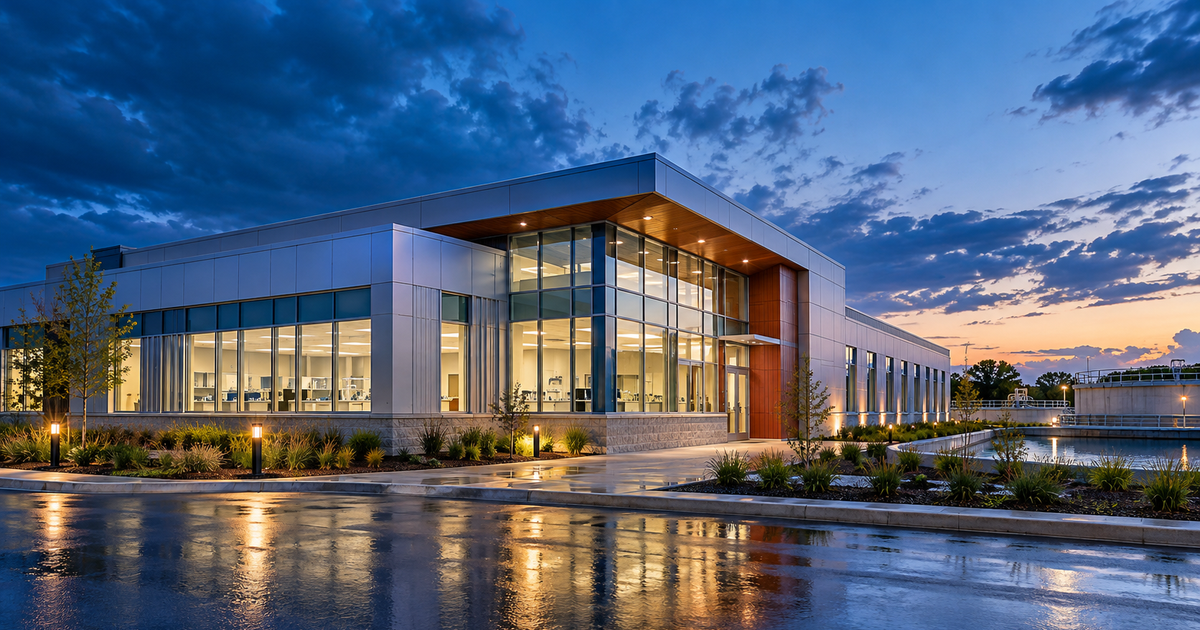
The City of Dayton is renovating roughly 16,000 square feet of its existing Central Water Quality Laboratory and adding approximately 3,240 square feet at 3210 Chuck Wagner Lane. The work is more than a cosmetic laboratory refresh. Public bid information describes demolition, new walls, electrical work, plumbing, HVAC, fire protection, and a full renovation of the operating laboratory environment.
The most current financing record is the May 2026 Ohio Water Development Authority meeting book. It puts total project cost at $11,556,550.21: $9.97 million of construction, about $1.49 million of contingency, and a $100,655 loan fee. Funding combines a $7.56 million zero-interest OWDA loan with $4 million of congressional funding. Current project tracking lists the job in the award and construction-start phase during 2026.
Signal's stored $47 million value is not used here. The source program lists a separate $47 million Miami Well Field recharge-lagoon project, and that amount appears to have crossed into this laboratory row during enrichment. The laboratory's own description called the work a $10 million project; the OWDA closing record now supplies the better $11.56 million total.
| Project | Dayton Central Water Quality Laboratory Expansion |
| Location | 3210 Chuck Wagner Lane, Dayton, Ohio |
| Current Project Total | $11,556,550.21 |
| Construction Budget | $9,970,126.27 |
| Facility Scope | Approximately 16,000 SF renovated plus 3,240 SF added |
| Status | Award / construction underway in 2026 |
| LV Score | 8/10 |
| Signal Systems | 5 |
Why This Laboratory Is Expanding
Dayton's laboratory was built in 1991, while the volume and complexity of required water analyses have continued to grow. The City's original design request describes organic, metals, wet chemistry, microbiology, bacteriology, and lime-quality-control laboratories operating within the building. It also identifies the need for PFAS-specific analysis, extraction, sample preparation, purge-water storage, external-client intake, and HVAC control that reduces environmental contamination.
The Ohio EPA environmental review connects the expansion directly to monitoring emerging contaminants, including PFAS compounds. Dayton's two water-treatment plants serve roughly 400,000 people across Montgomery County, so the laboratory is part of a regional compliance and source-water-protection system rather than a back-office amenity.
That operating mission changes the low-voltage brief. Network availability, controlled access, alarm reporting, environmental data, and documented commissioning affect the reliability of test results. Cable pathways and device placement also have to coexist with laboratory airflow, chemical-storage rules, sensitive instruments, and areas where contamination control is a design constraint.
Key Players and Procurement Context
The City of Dayton Department of Water is the owner and operator. A public bid listing identifies E. Lynn App Architects as designer. The reviewed public sources did not reliably identify the awarded general contractor, so this spotlight does not guess. Contractors should confirm the prime and current trade-buyout contacts from the City's award documents before treating the project as an open solicitation.
| Role | Organization | What Matters to LV Contractors |
|---|---|---|
| Owner / Operator | City of Dayton Department of Water | Owns the laboratory mission, network, security, monitoring, and commissioning standards. |
| Designer | E. Lynn App Architects | Coordinates architectural, laboratory, MEP, fire-protection, and technology interfaces. |
| Funding | Ohio Water Development Authority + federal funding | Public funding drives documentation, compliance, closeout, and domestic-content requirements. |
| General Contractor | Not confirmed in reviewed sources | Verify the award and buyout status before outreach. |
A subcontractor bid-room listing also flagged prevailing wage, a project labor agreement, tax-exempt purchasing, and Build America, Buy America requirements. Those conditions can affect labor eligibility, submittal timing, and material selection. They belong in the go/no-go review before a low-voltage firm spends estimating hours.
Low Voltage Systems Breakdown
Signal identifies five systems, but the useful scope is in their interfaces. This is an occupied scientific environment with specialized ventilation and instrument loads, so pathways, shutdowns, testing windows, and commissioning records may matter as much as device quantities.
| System | Likely Scope | Complexity |
|---|---|---|
| Structured Cabling | Backbone and horizontal connectivity for staff work areas, laboratory data capture, instrument interfaces, wireless access points, printers, and building-system gateways. Include labeling, test records, rack coordination, and migration sequencing. | High |
| Access Control | Controlled entry at laboratory suites, chemical and gas storage, sample-intake areas, administrative zones, and exterior doors. Door hardware and life-safety release coordination are central. | High |
| CCTV | Exterior, receiving, circulation, and chain-of-custody coverage with attention to privacy and laboratory operating policy. Storage, retention, and network segmentation require owner decisions. | Medium |
| Fire Alarm | Extension or replacement of notification, initiating devices, interfaces, and monitoring across renovated and added areas, coordinated with HVAC shutdowns and the existing campus system. | High |
| Environmental Monitoring | Room-condition sensors, alarm points, and BAS integration for temperature, humidity, pressure relationships, and equipment-space conditions. PFAS work makes stable environments and clean commissioning especially important. | High |
Estimated Low Voltage Value
The value model uses the verified $11.56 million total project cost, not the $47 million field currently stored in Signal. A specialized research and testing laboratory typically carries a low-voltage share near 6% before system-complexity adjustment. Five coordinated systems justify a 1.15 multiplier, producing an approximately $797,000 midpoint, rounded to $800,000.
| Verified Project Total | $11,556,550 |
| Laboratory LV Benchmark | Approximately 6% |
| Five-System Multiplier | 1.15x |
| Planning Midpoint | Approximately $800,000 |
| Planning Range | $650,000-$950,000 |
The lower end assumes the City reuses substantial backbone, head-end, and enterprise-platform capacity. The upper end assumes broader replacement, tighter laboratory controls, additional fiber, and significant integration with security, fire alarm, and building automation. Exact trade boundaries will decide whether controls and monitoring sit with the controls contractor, electrical contractor, or a low-voltage integrator.
Owner-Furnished Boundary
The estimate excludes owner-furnished analytical instruments, chromatography and mass-spectrometry equipment, laboratory casework, process-water equipment, and specialized scientific software. It includes the pathways, network drops, alarm interfaces, security devices, monitoring points, and commissioning labor needed to connect the facility. Estimators should require an instrument responsibility matrix so that vendor cabling, network addressing, UPS power, and final data connections do not become unpriced handoffs.
Skills and Certifications Required
| Discipline | Useful Credentials | Critical Field Skills |
|---|---|---|
| Structured Cabling | BICSI INSTC/INSTF, TECH, RCDD oversight | Fiber and copper testing, pathway planning, labeling, rack migration, Fluke certification |
| Access Control | Manufacturer training for the owner's platform; PSP for senior design staff | Door hardware, egress interfaces, credentialing, controller wiring, IP segmentation |
| CCTV | VMS and camera-manufacturer certification; Network+ | Camera placement, PoE design, storage calculations, privacy-aware commissioning |
| Fire Alarm | NICET Fire Alarm Level II or higher; applicable Ohio licensing | NFPA 72 testing, SLC/NAC work, HVAC interfaces, AHJ documentation |
| Environmental Monitoring | BACnet training, Niagara N4 or specified controls-platform certification | Sensor placement, calibration, trending, alarm mapping, sequence verification |
Entry-level technicians can support pathway installation, cable placement, labeling, and device mounting under supervision. Senior technicians should own testing, live-system migration, network and controls integration, and closeout documentation. A laboratory renovation also rewards crews that understand dust control, sealed penetrations, occupied-facility scheduling, and the difference between a device being online and a measurement point being validated.
Contractors should verify Ohio and City of Dayton licensing and permit requirements before mobilization. Public funding and project-specific labor terms may also affect workforce eligibility, certified payroll, product documentation, and approved-equals procedures.
Market Signal
Dayton's expansion is a compact example of a broader water-sector shift: emerging-contaminant rules are creating technology work inside facilities that rarely look like conventional smart buildings. The City's water-quality program reports more than 200 samples analyzed each day, while its laboratory has taken on PFAS and regional testing responsibilities. That combination increases data, monitoring, environmental-control, and security requirements even when the building footprint is modest.
For low-voltage firms, the repeatable opportunity is not merely pulling Category cable into a laboratory. It is coordinating networks, sensors, access, video, fire alarm, and validation around scientific workflows. Firms with water-utility references, clean laboratory practices, controls integration, and disciplined documentation can carry that capability into municipal labs, treatment plants, well fields, and environmental facilities across the Ohio River Valley.
The business-development angle is equally practical. The City is already past the public bid deadline and into delivery, so blind bidding is late. The useful outreach is to identify the awarded prime, confirm remaining technology buyout and change-order channels, and offer commissioning, integration, testing, or closeout support where a five-system lab renovation creates gaps between trades.
Find Projects Like This on Signal
LVN Signal tracks thousands of construction projects with low voltage opportunities across the country. Filter by city, system type, and project value to find your next bid.
Join 35,000+ Low Voltage Pros
Get weekly permit updates, tool deals, job opportunities, and industry news. No spam, unsubscribe anytime.