
Join Low Voltage Nation — Find project opportunities and showcase your company to thousands of industry professionals
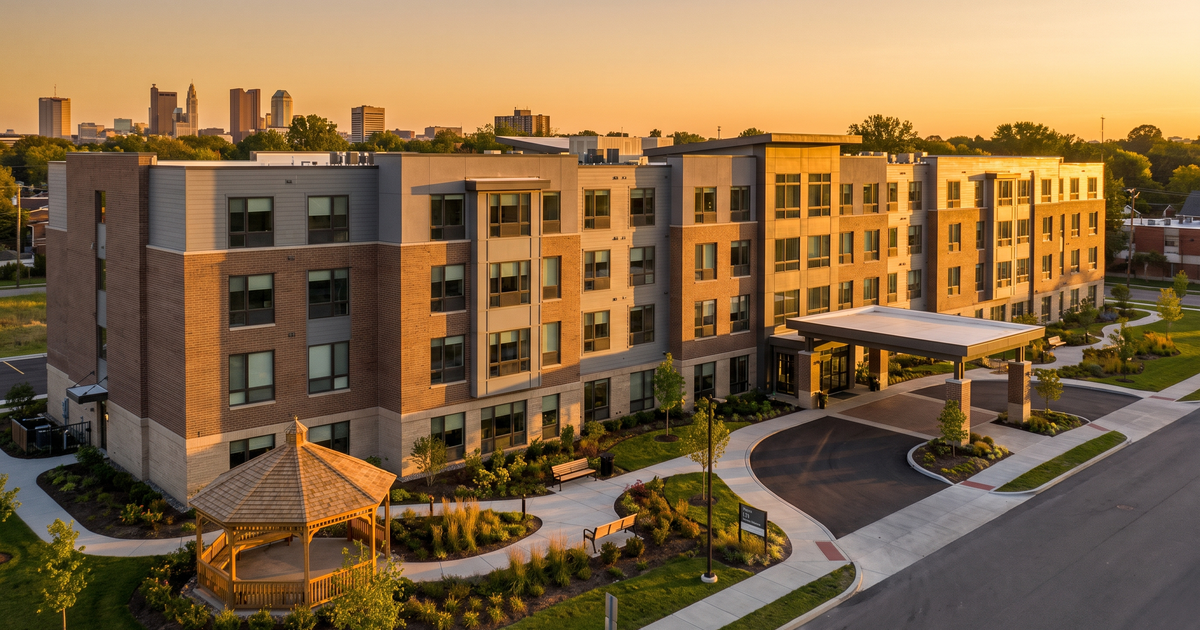
Green Oaks of Walnut Creek is a $22 million, 120-unit affordable assisted-living community under construction in Columbus. Signal tracks eight low-voltage system lanes and a modeled $1.4 million LV opportunity.
Green Oaks of Walnut Creek is a $22 million affordable assisted-living project in Columbus with 120 residences and eight low-voltage system lanes tracked by Signal. Using the senior-living benchmark and the current system count, the modeled low-voltage opportunity is approximately $1.4 million. That is an estimating benchmark, not a released contract value.
Project Overview
Construction is underway at 4000 Westerville Road for a four-story assisted-living community serving seniors across a range of income levels, including residents who qualify for Medicaid benefits. Evergreen Real Estate Group says Green Oaks of Walnut Creek will contain 120 apartments: 67 studios and 53 one-bedroom units. The owner describes an emergency alert system in each residence, while common areas include dining, activity, fitness, library, salon, therapy, laundry and outdoor gathering spaces.
The Douglas Company, the general contractor, lists a $22 million contract value, 92,279 square feet and a November 2027 completion target. The Signal construction record carries a lower $19.81 million estimated permit value from Columbus building-permit data. Those figures should not be blended: the contractor's current contract figure is the stronger program number, while the permit estimate remains the database anchor that surfaced the opportunity.
The Ohio Housing Finance Agency application identifies the project as one new, elevator-served building on 4.32 acres. The agency's later financing action authorized up to $39 million in multifamily revenue bonds and a 4% Low-Income Housing Tax Credit reservation. Bond authorization is financing capacity, not a construction-cost claim, so the LV estimate below uses the contractor's $22 million figure.
| Project | Green Oaks of Walnut Creek |
| Location | 4000 Westerville Road, Columbus, Ohio |
| Current Contract Value | $22 million, reported by the general contractor |
| Signal Permit Estimate | $19.81 million |
| Program | 120-unit affordable assisted living |
| Area | 92,279 square feet |
| Target Completion | November 2027 |
| LV Score | 10/10 |
| Source | Columbus Building Permits |
Key Players
This is a repeatable delivery team, not a one-off collection of names. Evergreen is building three Green Oaks communities in Ohio on the same 120-unit model, Gardant Management Solutions will operate them, WJW Architects designed them and The Douglas Company is the general contractor. That portfolio pattern matters to low-voltage firms because standards established on one property can influence device selection, network design, documentation and commissioning on the others.
| Role | Company | Project Evidence |
|---|---|---|
| Owner / Developer | Evergreen Real Estate Group | Announced active construction and the three-project Ohio program. |
| General Contractor | The Douglas Company | Publishes contract value, area, unit mix and November 2027 completion. |
| Architect | WJW Architects | Named by Evergreen, OHFA and The Douglas Company. |
| Operator | Gardant Management Solutions | Will operate the licensed residential-care community. |
| Public Finance | Ohio Housing Finance Agency | Approved bond authority and the 4% LIHTC reservation. |
The Signal entity link labeled WJW as the general contractor, but the primary sources consistently identify WJW as architect and The Douglas Company as GC. This spotlight uses the source-backed roles and records the scraped-role mismatch as a data-quality flag rather than repeating it.
Low Voltage Systems Breakdown
Signal tracks eight system labels on the project. They describe likely coordination lanes based on the assisted-living program and permit classification; they are not evidence that eight standalone bid packages have been released. The final drawings, specifications, addenda and subcontractor scopes control. In senior living, the important commercial question is often less about how many devices exist and more about how reliably life-safety, resident-response, security and network systems share pathways, power, locations and turnover procedures.
| System | Category | Likely Project Scope | Complexity |
|---|---|---|---|
| Structured Cabling | Data / Voice | Backbone and horizontal cabling for resident, staff, common-area and building-system connectivity; telecom rooms, labeling and test records become portfolio standards. | High |
| Access Control | Security | Controlled staff, service and resident-area doors, credential management and interfaces to life-safety egress requirements. | High |
| CCTV / Video Surveillance | Security | Coverage at entrances, common spaces, parking and service zones with privacy-aware placement, recording, retention and network coordination. | Medium |
| Fire Alarm | Life Safety | Addressable detection, notification, monitoring and elevator or door interfaces coordinated with the residential-care occupancy and the local authority having jurisdiction. | High |
| Nurse Call / Emergency Response | Life Safety | The owner confirms an emergency alert system in residences. Final documents must establish call points, staff notification, escalation, coverage and integration boundaries. | High |
| DAS / Emergency Responder Coverage | Wireless | Testing-led in-building radio coverage work if required by the AHJ, with pathways, donor or head-end location and acceptance testing defined before closeout. | High |
| Audio / Visual | Resident Experience | Displays, audio, control and connectivity for dining, activity, fitness, library, game, community and therapy rooms. | Medium |
| Patient Monitoring | Care Technology | Infrastructure allowance for resident-care monitoring and staff workflows. Equipment, platform and exact clinical use remain unconfirmed in public sources. | High |
The emergency-response scope deserves early ownership. An apartment alert device may look simple, but the system is only useful when the call reaches the correct staff member, coverage survives throughout the building, events are logged and the response workflow is tested. The low-voltage contractor should obtain the operator's sequence, escalation rules, device standard, network requirements and acceptance script before rough-in. Otherwise a late operator standard can force new cable, different mounting or additional wireless infrastructure after finishes are underway.
The security scope has the same coordination risk. Assisted living requires resident independence while protecting staff-only, medication, service and exterior areas. Door hardware, fire-alarm release, elevator behavior and credential administration cross multiple trades. A clean proposal should state who furnishes electrified hardware, who provides power supplies, who programs access levels and who owns the end-to-end test at each opening.
Estimated Low Voltage Value
Senior-living construction commonly carries a modeled low-voltage share of 4% to 6% before complexity adjustment. Eight tracked system lanes put this project in the 7-plus-system tier, which uses a 1.25 coordination multiplier. Applied to the current $22 million contract value, the model produces a range of approximately $1.1 million to $1.65 million and a midpoint near $1.4 million.
| Current Contract Value | $22,000,000 |
| Senior-Living Benchmark | 4% to 6%; 5% midpoint |
| System Count Multiplier | 1.25x for 7+ systems |
| Modeled LV Range | $1.1 million to $1.65 million |
| Modeled LV Midpoint | $1.375 million, rounded to $1.4 million |
This is not a quotation and should not be used as a substitute for takeoff. The result includes the combined low-voltage opportunity across the tracked systems and may span several subcontractors, direct vendors or owner-furnished platforms. It also depends on whether active electronics, software, monitoring, training and long-term service are carried in the construction contract. Contractors should separate material, installation, programming, testing, documentation and recurring service so the owner can see where scope lives.
The portfolio angle is more valuable than the midpoint alone. Evergreen announced simultaneous Green Oaks work in Walnut Creek, Grove City and Fairborn, while the same architect, GC and operator repeat across the program. A contractor that standardizes submittals, room templates, labeling, testing and turnover on one site can reduce execution risk on the others. That creates an account-level pursuit even when each individual LV package is modest compared with a hospital or data center.
Skills and Certifications Required
The project calls for crews that can work across residential finishes, care workflows and regulated life-safety systems. Entry-level technicians can support pathway installation, cable placement, device rough-in and labeling under supervision. Mid-level technicians should own termination, certification, rack work, door coordination and device testing. Senior leads must manage design interpretation, programming, AHJ coordination, operator acceptance and integrated turnover.
| System | Useful Certifications | Critical Skills |
|---|---|---|
| Structured Cabling / Network | BICSI INST1, INSTC, INSTF; RCDD oversight | Copper and fiber termination, Fluke certification, telecom-room buildout, labeling and as-builts |
| Fire Alarm | NICET Fire Alarm Level II+; applicable state and local credentials | NFPA 72, SLC and NAC wiring, testing, inspection records and AHJ coordination |
| Access Control / CCTV | Manufacturer credentials; ASIS PSP for senior leadership | Door hardware, IP networking, camera placement, credential databases, VMS and privacy-aware commissioning |
| DAS / Radio Coverage | RCDD or RF engineering leadership; manufacturer training | RF survey, antenna placement, fiber, pathway, acceptance testing and jurisdiction coordination |
| Nurse Call / Resident Response | Selected-platform manufacturer certification | Resident-room wiring, staff workflow, escalation, coverage, logging, training and witnessed acceptance |
| Audio / Visual | AVIXA CTS, CTS-I or CTS-D as role requires | Display and speaker placement, DSP, control, AV-over-IP and user training |
Contractors should verify all Ohio and Columbus licensing, permit and inspection requirements before bidding. They should also ask which systems require manufacturer-authorized programming and whether the owner or operator has an incumbent national standard. A resident-response platform, access-control head end or VMS chosen late can change cable types, device locations, server requirements and training obligations.
Closeout should be priced as production work, not clerical cleanup. Senior-living turnover involves staff who must respond correctly to alarms and resident calls on day one. Include point-to-point test records, cable certification, device inventories, floor-plan markups, database backups, warranty contacts, administrator credentials and role-based training. For any system tied to life safety or resident response, define the witnessed test script and who signs acceptance.
Market Signal
Green Oaks of Walnut Creek is a housing project, a care project and a public-finance project at the same time. Columbus approved the site for assisted living, OHFA backed the financing structure and the development team moved into active construction as part of a three-community Ohio program. That combination creates repeatable work for contractors who can deliver a consistent technology standard without losing the local code and inspection details.
The project also shows why raw permit categories need research. The Signal record arrived as a generic new institutional structure with no named owner and a linked architect mislabeled as GC. Primary sources turned that row into a named 120-unit community with an active schedule, a confirmed contractor, a confirmed operator and a portfolio relationship. Contractors using permit feeds should treat generic institutional permits as the beginning of qualification, not the end.
The practical pursuit is to find the current package owner. Ask The Douglas Company whether fire alarm, structured cabling, security, resident response, AV and radio coverage are separate scopes or bundled; ask Evergreen and Gardant which platforms repeat across Green Oaks; and ask WJW where technology responsibility sits in the documents. The strongest bid will distinguish confirmed requirements from allowances and will document every interface that crosses electrical, door hardware, elevator, fire protection, IT and operator-furnished systems.
Find Projects Like This on Signal
LVN Signal tracks thousands of construction projects with low-voltage opportunities across the country. Filter by city, system type and project value to find your next bid.
Join 35,000+ Low Voltage Pros
Get weekly permit updates, tool deals, job opportunities, and industry news. No spam, unsubscribe anytime.