
Join Low Voltage Nation — Find project opportunities and showcase your company to thousands of industry professionals
Charleston's issued $33.5 million permit for the W.L. Stephens Aquatic Center covers a new competition pool, therapy pool, support spaces, and Forest Park upgrades. Four tagged systems point to an estimated $1.34 million to $2.01 million construction-side low-voltage opportunity.
Charleston's $33.5 million W.L. Stephens Aquatic Center replacement has moved from planning into an issued construction permit, with four low-voltage systems tagged in Signal and an estimated $1.34 million to $2.01 million in construction-side LV scope.
Project Overview
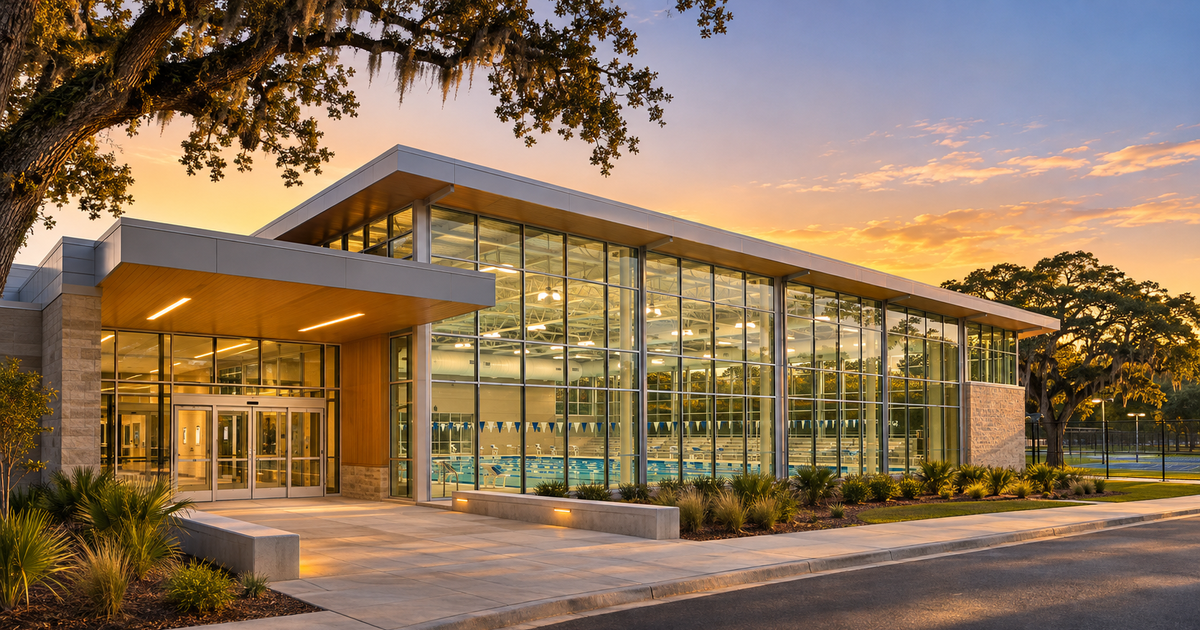
The City of Charleston is replacing the aging W.L. Stephens Aquatic Center at Forest Park with a year-round municipal recreation facility at 780 W. Oak Forest Drive. Charleston permit record BC2026-06292, issued October 14, 2026, values the new commercial construction at $33.5 million. The permit describes a single-story, 21,207-square-foot building with a natatorium, competition pool, therapy pool, locker rooms, recreation offices, multipurpose space, parking, and landscaping.
The permit value and the City's final guaranteed maximum price describe the same overall construction program and should not be added together. City records set the final construction GMP at approximately $33.53 million, closely corroborating the permit valuation. The broader contract documents describe a 25,753-square-foot gross aquatic center plus exterior concessions, a picnic shelter, new courts, athletic fields, playgrounds, site lighting, and upgrades around the existing Miracle League field.
The City of Charleston project page says the 1970 facility is being replaced by a modern center with a 25-meter by 25-yard indoor pool and a dedicated therapy pool. The project is funded through Charleston's parks and recreation bond program. For low-voltage contractors, the important signal is not just the size of the building: it is the mix of public access, wet environments, athletics, community rooms, staff areas, and an active park campus that must remain coordinated as construction advances.
| Project | W.L. Stephens / West Ashley Aquatic Center and Forest Park improvements |
| Location | 780 W. Oak Forest Drive, Charleston, SC 29407 |
| Permit | BC2026-06292, issued October 14, 2026 |
| Permit Value | $33.5 million |
| Final Construction GMP | $33.53 million; corroborating program value, not additive |
| Facility | Competition pool, therapy pool, locker and support rooms, offices, multipurpose space, and park improvements |
| LV Score | 9/10 |
| Signal Systems | 4 tagged systems |
| Source | City of Charleston issued permit and project contract documents |
Key Players and the Contracting Path
The City's 100 percent design-development project manual identifies the team that controls the construction and design path. The City of Charleston is the owner. LS3P is the architect, and Hill Construction is the construction manager and project constructor. The same manual names Stage Front as the LV telecom, security, AV, and acoustical consultant.
That consultant assignment matters. It means the low-voltage package is not a generic allowance inferred from the building type; the owner has a named specialist shaping telecom, security, audiovisual, and acoustical design. A June 2026 City Council agenda separately approved a design-contract amendment to add audiovisual and low-voltage design services. Contractors approaching this project should treat Hill Construction's trade-partner channel and Stage Front's design intent as the practical doors into the opportunity.
The remaining consultants also define coordination boundaries. Constantine Engineering Associates carries mechanical, plumbing, electrical, and fire-protection engineering; Aqua Blue Pools is the pool consultant; SeamonWhiteside handles civil and landscape work; and ADC Engineering is the structural engineer. LV bidders will need to distinguish their pathway, device, head-end, and integration responsibilities from pool controls, electrical power, fire protection, and owner-provided operational technology before pricing.
Low-Voltage Systems Breakdown
Signal tags four core low-voltage systems on the issued permit. Those systems cross public-facing, staff-only, indoor wet, exterior park, and multipurpose environments. The work is coordination-heavy even without a data-center-scale equipment count because device selection, mounting, penetrations, grounding, and enclosure ratings must survive high humidity, chlorinated air, heavy public use, and frequent cleaning.
| System | Likely Construction Scope | Aquatic-Center Constraint | Complexity |
|---|---|---|---|
| Structured Cabling | Telecom rooms, backbone fiber, copper horizontal cabling, wireless-access-point backhaul, office and multipurpose-room outlets, equipment connections, testing, labeling, and closeout records. | Pathways and terminations near the natatorium need separation from corrosive air and moisture migration; equipment locations should favor conditioned support spaces. | High |
| Access Control | Credentialed staff entrances, controlled equipment and chemical rooms, perimeter and after-hours doors, door-position monitoring, request-to-exit devices, and coordination with locking hardware. | Public egress, ADA operation, emergency access, pool-deck traffic, and corrosion-resistant door hardware must be reconciled in the sequence of operations. | High |
| CCTV / Video Surveillance | Coverage for entries, lobby, circulation, parking, courts, playground approaches, equipment areas, and exterior park interfaces, with network switching, recording, and owner handoff. | Camera placement must protect public areas without creating inappropriate views into locker, changing, or therapy spaces. Exterior and natatorium-adjacent devices need suitable environmental ratings. | High |
| Audio/Visual | Multipurpose-room presentation, distributed audio, assistive listening, staff control, equipment racks, displays, and interfaces to community programming and announcements. | Reverberant hard surfaces, humidity, ambient mechanical noise, and the acoustics of a competition pool make intelligibility and loudspeaker placement design-critical. | High |
Integration Work That Can Decide the Bid
The project manual keeps parts of the existing park operational and calls for coordination with occupied or owner-used areas. That makes cutover planning more important than it would be on an isolated greenfield site. Temporary access, utility interruptions, exterior camera coverage, field interfaces, and the handoff between the existing Miracle League assets and new park work all need a written phasing plan.
Aquatic facilities also expose weak product substitutions quickly. Standard indoor cameras, untreated fasteners, poorly located racks, and unsealed pathways can fail early in chloramine-rich air. A credible proposal should identify environmental ratings, corrosion-resistant mounting, conditioned head-end locations, fiber use where appropriate, network segregation, and the testing method for every copper and fiber link. The winning number is likely to be the one that closes these coordination gaps rather than merely multiplying device counts.
Estimated Low-Voltage Value
Using the City's $33.53 million final construction GMP as the denominator, a municipal aquatic-center benchmark of roughly 4% to 6% produces a construction-side LV range of approximately $1.34 million to $2.01 million. The 5% midpoint is about $1.68 million. This is an estimating range, not a disclosed low-voltage contract value.
| Construction Value Basis | $33,532,580 final GMP; permit valuation is $33,500,000 |
| Estimated LV Share | 4% to 6% |
| Estimated Construction-Side LV Range | $1.34 million to $2.01 million |
| Planning Midpoint | $1.68 million |
The range covers contractor-installed pathways, cabling, security, CCTV, AV, racks, terminations, testing, commissioning support, and normal integration labor associated with the four tagged systems. It deliberately excludes owner IT hardware, end-user computers, operational software subscriptions, pool mechanical controls carried by other trades, and owner-furnished specialty equipment.
Competition timing, scoreboard hardware, aquatic-program equipment, and owner-selected broadcast or event-production gear should not be assumed inside the core LV number without a responsibility matrix. Those packages may still create interface work for power, data, control, mounting, or network handoff, but treating their full equipment value as an LV construction award would inflate the opportunity. Fire alarm and other life-safety work should likewise be priced only from the final division-of-work documents because the permit's four Signal tags do not identify fire alarm as part of this spotlight's core package.
Skills and Certifications Required
This project needs crews that can work across conventional ICT, electronic security, and audiovisual scopes while respecting public-facility and wet-environment constraints. South Carolina licensing, alarm qualifications, and the project's subcontractor requirements should be verified before bid submission.
| System | Useful Certifications | Critical Field Skills |
|---|---|---|
| Structured Cabling | BICSI Installer 2, BICSI TECH, RCDD oversight, manufacturer certification | Fiber and copper installation, pathway planning, Fluke certification, labeling, rack build, and as-built documentation |
| Access Control | Manufacturer certification, ASIS PSP for senior design/security staff, applicable alarm or LV license | Door hardware coordination, supervised inputs, IP networking, credential databases, egress logic, and functional testing |
| CCTV | VMS and camera manufacturer certification, Network+ or equivalent networking experience | Coverage design, PoE switching, environmental housings, storage calculation, privacy-aware placement, and commissioning |
| Audio/Visual | AVIXA CTS, CTS-I, and CTS-D or equivalent senior design support | DSP programming, loudspeaker commissioning, assistive listening, control systems, rack fabrication, acoustical coordination, and owner training |
Entry-level technicians can contribute to pathway preparation, cable pulling, device mounting, labeling, and supervised terminations. Mid-level technicians should own testing, rack work, camera focus, access-control point checks, and AV installation. Senior personnel need to manage shop drawings, product substitutions, network coordination, acoustical decisions, commissioning scripts, and the responsibility matrix across Hill Construction, Stage Front, the electrical engineer, the pool consultant, and City IT stakeholders.
Business Development Signal
The strongest outreach angle is not a cold pitch to the City. The project already has an architect, constructor, and specialist LV consultant. Contractors should use the named team to determine whether trade packages are still open, which scopes are delegated, what prequalification Hill Construction requires, and whether Stage Front's design is being bid as one integrated package or split among telecom, security, and AV subcontractors.
Charleston's council record confirms that AV and low-voltage design were planned budget items rather than late add-ons. That reduces the risk that the entire scope disappears into a generic electrical allowance, but it raises the documentation bar. A useful first contact should lead with aquatic-center experience, corrosion-resistant product standards, public-facility security, AV intelligibility, certified testing, and commissioning capacity. Generic “we do low voltage” messaging will be wallpaper.
Market Signal
This project shows municipal recreation spending turning into designed, permitted work in Charleston. The 2023 parks bond created the funding path, the City added dedicated AV/LV design services, the final GMP was established, and the building permit is now issued. That sequence is a repeatable lead pattern for contractors tracking public capital programs: bond approval creates the map, design amendments expose specialty scope, and permit issuance marks the point when trade-package timing becomes urgent.
It also broadens the Lowcountry opportunity beyond the usual hospitality, multifamily, and office stories. Recreation facilities combine public safety, accessibility, security, community programming, acoustics, wireless connectivity, and durable outdoor coverage. Contractors that can document performance in natatoriums, gyms, public parks, or coastal environments can reuse that proof on upcoming municipal and school recreation work across the region.
The practical takeaway is simple: follow the construction manager and named LV consultant now. The project is no longer conceptual, and the four tagged systems carry enough coordination risk to reward specialty experience. The best position is a clearly bounded scope with environmental ratings, interface ownership, testing, and commissioning written into the proposal before procurement pressure compresses the schedule.
Find Projects Like This on Signal
LVN Signal tracks thousands of construction projects with low voltage opportunities across the country. Filter by city, system type, and project value to find your next bid.
Join 35,000+ Low Voltage Pros
Get weekly permit updates, tool deals, job opportunities, and industry news. No spam, unsubscribe anytime.