
Join Low Voltage Nation — Find project opportunities and showcase your company to thousands of industry professionals
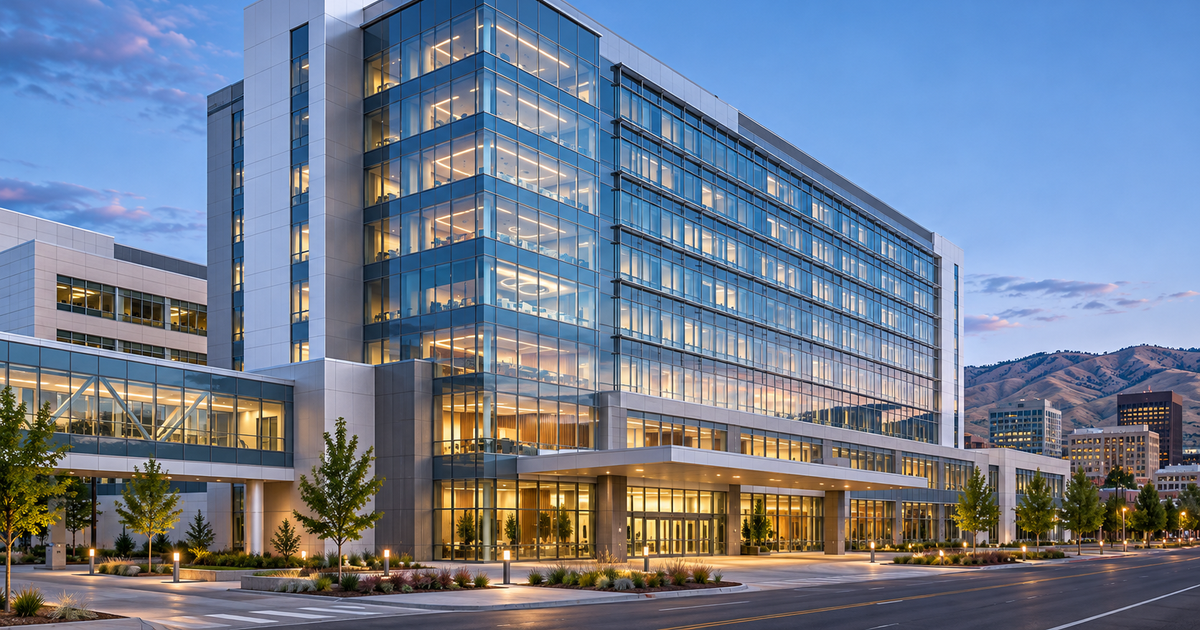
St. Luke’s $514.37 million North Tower interior package in Boise covers an 841,088-square-foot hospital expansion with six tracked low-voltage systems. The built-in LV scope benchmarks at roughly $25.7 million to $41.1 million, excluding owner-furnished clinical equipment and overlapping early construction packages.
St. Luke’s $514.37 million North Tower package in Boise covers the curtain wall and remaining hospital interior build-out across an 841,088-square-foot expansion. Six tracked low-voltage systems put the built-in technology scope at an estimated $25.7 million to $41.1 million—before owner-furnished clinical equipment and without adding the tower’s separate foundation or structural-steel permits.
Project Overview
Boise permit BLD24-02385 is the package that matters for low-voltage contractors. The City of Boise describes it as the exterior curtain walls, the remaining entire new North Tower hospital expansion, and interior improvements on multiple levels. The live permit record carries a job value of $514,372,011, an issued date of August 8, 2025, and an active revision trail that included a helipad deferred-submittal plan modification as recently as November 2, 2026. That is fresher evidence than the synthesized project summary in Signal and confirms this is active work, not a stale concept.
The package sits inside St. Luke’s Downtown Campus Improvement Project at 190 E. Bannock Street. The city’s green-building summary records an 841,088-square-foot hospital tower, while St. Luke’s public program material describes roughly 860,000 square feet of patient-centered space. The difference is best treated as permit measurement versus rounded program messaging—not two scopes to add together. Public plans call for 80 additional beds, seven new operating rooms, and two neurointerventional biplane imaging systems, with construction running through 2029 and patient care projected to begin in 2030.
This spotlight is deliberately scoped to NT3. The earlier North Tower foundation permit BLD24-00303 and steel-superstructure permit BLD24-01131 are separate packages, and their values are not stacked on top of the $514.37 million figure. The Medical Office Plaza is also a separate building. That distinction keeps the low-voltage estimate tied to the permit containing the remaining tower and interiors rather than inflating the opportunity with overlapping campus work.
| Project | St. Luke’s DCIP North Tower NT3 |
| Location | 190 E. Bannock Street, Boise, Idaho |
| Permit | BLD24-02385 |
| NT3 Permit Value | $514,372,011 |
| Tracked Area | 841,088 square feet |
| Project Type | Hospital expansion |
| Status | Issued; active plan modifications |
| Target Completion | Construction through 2029; patient opening projected for 2030 |
| LV Opportunity Score | 10/10 |
| Primary Source | City of Boise permit summary |
Key Players and the Real Contract Path
St. Luke’s Health System is the owner behind the Boise campus expansion. The city’s project summary identifies St. Luke’s Regional Medical Center Ltd. as the formal owner. For business development, that means the owner controls campus standards, clinical integrations, security policy, and operational acceptance—but the immediate construction path runs through the construction manager and design team.
Layton Construction is the construction manager at risk and general contractor. Layton describes a broader one-million-square-foot, two-phase campus program spanning the North Tower, Medical Office Plaza, utilities, tunnels, parking, and renovations. Contractors should not pitch this as a greenfield job just hitting the street: the tower is well into construction. The useful angle is late-phase trade coordination, approved-manufacturer coverage, commissioning labor, change work, and any remaining package gaps that surface as interiors and systems are installed.
The City of Boise green-building summary names Hummel Architects and Architectural Nexus as architects, Jacobs as electrical engineer, Cator Ruma as mechanical/plumbing engineer, Reaveley Engineers as structural engineer, and The Land Group for civil and landscape work. No public source reviewed for this spotlight identifies a low-voltage integrator. That is the important blank—not a license to invent one.
| Role | Company | Why It Matters |
|---|---|---|
| Owner | St. Luke’s Regional Medical Center Ltd. | Controls hospital standards, operational acceptance, clinical workflow, and owner-furnished technology. |
| CM/General Contractor | Layton Construction | Primary trade-partner and coordination path for remaining construction scope. |
| Architects | Hummel Architects; Architectural Nexus | Coordinate room programs, pathways, device locations, and architectural interfaces. |
| Electrical Engineer | Jacobs | Key design authority for raceways, life-safety interfaces, power, and communications coordination. |
| Low-Voltage Integrator | Not publicly identified | Verify award status directly; do not assume the package is unawarded. |
Low-Voltage Systems Breakdown
Signal tracks six systems on the NT3 package. In a hospital tower this large, the difficulty is not just device count. Every discipline has to work across infection-control constraints, life-safety zones, clinical workflows, redundant pathways, and phased connections to an operating campus. The interfaces are where schedule and margin are won or lost.
| System | Category | Likely Built-In Scope | Complexity |
|---|---|---|---|
| Nurse Call | Clinical Communications | Patient stations, staff consoles, corridor indicators, code-call functions, pillow-speaker interfaces, workflow programming, testing, and integration with hospital communications. | Very High |
| Structured Cabling | Data/Voice | Fiber backbone, copper horizontal cabling, MDF/IDF build-outs, equipment-room pathways, wireless support cabling, labeling, certification, redundancy, and turnover documentation. | Very High |
| Access Control | Security | Controlled public and staff entries, clinical and pharmacy restrictions, door hardware interfaces, credentialing, elevator/connector coordination, and emergency-release logic. | High |
| CCTV / Video Surveillance | Security | IP cameras at entrances, public circulation, restricted areas, loading/service zones, and connectors, with PoE switching, VMS programming, retention planning, and privacy-aware placement. | High |
| Fire Alarm | Life Safety | Addressable detection and notification, smoke-control and elevator interfaces, phased connection to the live campus, acceptance testing, NFPA 72 documentation, and AHJ coordination. | Very High |
| Audio/Visual | AV | Clinical education and conference spaces, displays, room scheduling, collaboration, control, digital distribution, and accessible listening where included in the construction documents. | High |
Estimated Low-Voltage Value
Hospital construction typically places built-in low-voltage systems in a broad 5% to 8% band of construction value. Applying that range to the $514,372,011 NT3 permit produces approximately $25.7 million to $41.1 million. The midpoint is about $33.4 million. On an area basis, the range works out to roughly $31 to $49 per permitted square foot, a useful second check for an acute-care tower with six integrated systems.
| NT3 Permit Value | $514,372,011 |
| Hospital LV Benchmark | 5% to 8% |
| Estimated Built-In LV Range | $25.7 million to $41.1 million |
| Midpoint | Approximately $33.4 million |
| Area Cross-Check | Approximately $31 to $49 per square foot |
This is a market estimate, not a disclosed subcontract value. The range includes installed pathways, cabling, devices, head-end infrastructure, programming, testing, coordination, and commissioning for the six tracked systems. It excludes the separate foundation and steel permits, the Medical Office Plaza, major electrical and mechanical equipment, furniture, and owner-furnished clinical technology.
The owner-furnished boundary matters here. St. Luke’s has publicly identified two neurointerventional biplane systems, and the 2025 bond document separates equipment funding from the Downtown Campus Improvement Project allocation. Imaging equipment, clinical devices, EHR applications, enterprise servers, and vendor-direct medical systems should not be counted as low-voltage construction revenue unless the contract documents explicitly put installation or integration under the LV trade.
Skills and Certifications Required
A tower of this scale needs more than a large pulling crew. It needs senior design oversight, hospital-qualified foremen, life-safety leadership, manufacturer-certified programmers, and technicians who can document every permanent link and device. Contractors bidding or staffing the work should verify Idaho licensing and any City of Boise registration requirements before mobilization.
| System | Useful Certifications | Critical Skills |
|---|---|---|
| Nurse Call | Manufacturer certification; NICET-related life-safety experience | Clinical workflow, patient-room wiring, code-call testing, staff-console programming, integration turnover |
| Structured Cabling | BICSI INSTC/INSTF, TECH, RCDD; manufacturer warranty credentials | Cat 6A, fiber splicing, pathway fill, Fluke DSX certification, labeling, as-builts |
| Access Control | Manufacturer platform certification; ASIS PSP for senior security leads | Door hardware, IP networking, database configuration, elevator interfaces, emergency release |
| CCTV | VMS/camera manufacturer certification; CompTIA Network+ | PoE design, camera placement, storage calculations, privacy zones, analytics commissioning |
| Fire Alarm | NICET Fire Alarm II-III+, state/local licensing, manufacturer certification | NFPA 72, SLC/NAC wiring, smoke-control interfaces, testing, AHJ coordination |
| Audio/Visual | AVIXA CTS, CTS-I, CTS-D; platform-specific credentials | AV-over-IP, DSP, control programming, display systems, commissioning |
Entry-level technicians can support pathway work, cable placement, device rough-in, labeling, and supervised testing. Mid-level technicians should own terminations, certification, rack quality, and device commissioning. Senior staff need to lead RFI control, infection-control planning, shutdown windows, system integration, test scripts, owner training, and the turnover package. On an operating medical campus, the quality of the documentation is part of the system.
Market Signal: The Work Is in Integration and Turnover
St. Luke’s is building while the existing Boise medical center remains operational. That changes the risk model. New systems must connect to campus standards without compromising patient care, emergency operations, cybersecurity, or life-safety coverage. Temporary conditions, migration sequencing, outage planning, and after-hours cutovers can consume as much management attention as device installation.
The schedule also changes the sales strategy. St. Luke’s reported the tower and Medical Office Plaza under active construction, with the program expected to continue through 2029. Contractors should verify what is already awarded before treating the $25.7 million to $41.1 million estimate as open backlog. The warm route is through Layton’s trade-partner organization, the electrical/design team, and manufacturers supporting hospital-standard systems—not a blind pitch to the owner for an imaginary untouched package.
For Boise-area integrators, the durable signal is bigger than one permit. This campus requires a long commissioning tail, detailed closeout, and ongoing moves-adds-changes after patient activation. Firms that can staff healthcare-certified technicians, document at enterprise scale, and support a live campus after turnover have leverage beyond the initial install. The opportunity is not just cable footage; it is being the team trusted when six systems have to behave like one building.
Find Projects Like This on Signal
LVN Signal tracks thousands of construction projects with low-voltage opportunities across the country. Filter by city, system type, and project value to find your next bid.
Join 35,000+ Low Voltage Pros
Get weekly permit updates, tool deals, job opportunities, and industry news. No spam, unsubscribe anytime.