
Join Low Voltage Nation — Find project opportunities and showcase your company to thousands of industry professionals
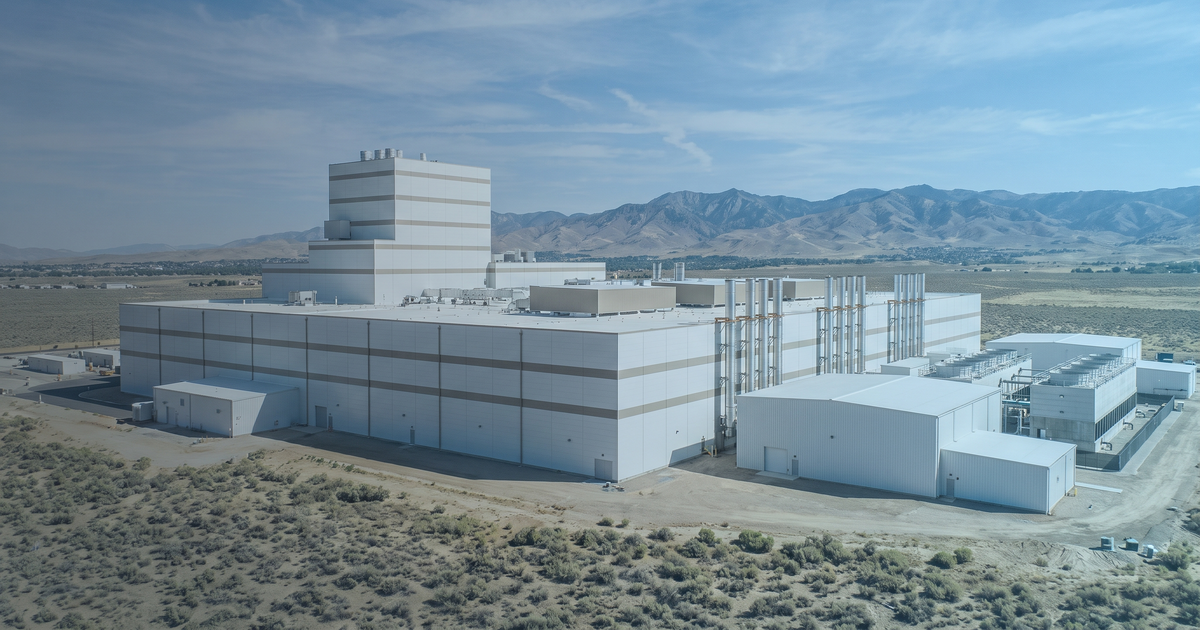
Micron's ID1 memory fab in Boise carries a $707 million superstructure permit for a 151-foot, H-5 classified fabrication building — and it anchors a $2.89 billion permitted program Signal tracks across 33 permits. The cleanroom already hit blowdown, which changes how every trade works inside it. Five low voltage systems, an estimated $100 million in LV work, union-built under a PLA with IBEW Local 291 dispatching.
Micron's ID1 memory fab in Boise carries a $707 million superstructure permit — and it anchors a $2.9 billion permitted program that Signal is already tracking across 33 separate permits. Five low voltage systems, an estimated $100 million in LV work, and a cleanroom that has already passed the milestone that changes how you work inside it.
Project Overview
Permit records filed with the City of Boise show a $707,490,932 permit for the superstructure of Micron Technology's ID1 fabrication facility — all precast concrete and structural steel for a three-story Type IB building standing 151 feet tall, classified H-5 with H-2, H-3, and H-4 occupancies.
Those occupancy classifications are the tell. H-5 is the code classification for semiconductor fabrication using hazardous production materials, and H-2 through H-4 cover the flammable, toxic, and corrosive material storage that supports it. This is not an office building with a server room. It is a chemical plant that happens to make DRAM.
The wider Boise program is a $15 billion investment in two high-volume manufacturing fabs, each with roughly 600,000 square feet of cleanroom, producing leading-edge DRAM. It is backed by CHIPS and Science Act funding — Micron secured up to $6.4 billion in direct federal funding across two Idaho and two New York fabs. ID1 broke ground in 2023, passed 70,000 tons of structural steel by mid-2025, and targets first DRAM wafer output in the second half of 2027.
| Project | Micron ID1 Fabrication Facility — Superstructure |
| Location | Boise, Idaho |
| Tracked Permit Value | $707,490,932 (precast + structural steel only) |
| Visible Permitted Program | $2.89 billion across 33 Micron Boise permits in Signal |
| Announced Investment | $15 billion (two Idaho HVM fabs) |
| Building | 3 stories, 151 ft, Type IB, H-5 with H-2/H-3/H-4 |
| General Contractor | Hoffman Construction Company |
| First Wafers | Second half of 2027 |
| LV Score | 8/10 |
| Source | Boise High Impact Building Permits |
Blowdown Already Happened — and That Changes the Job
In spring 2026 the ID1 cleanroom reached blowdown: the envelope is sealed and the space is pressurized and flushed to drive particle counts down in preparation for process tool installation.
If you have only worked commercial and institutional buildings, this is the single most important thing to understand about fab work. Before blowdown, a fab is a construction site. After blowdown, it is a controlled environment, and every habit you have is wrong.
- Garmenting and protocol. Crews gown in. Entry is through airlocks with staged material transfer. Headcount inside is capped, which means productivity per person matters far more than throwing bodies at a schedule.
- Materials are qualified, not just specified. Cable jacket compounds, cable ties, labels, and lubricants all get evaluated for outgassing and particle shed. A perfectly code-compliant cable can be rejected because of what it off-gasses. You cannot substitute at the counter.
- No particle-generating work. Drilling, cutting, and grinding inside a qualified space are heavily restricted or prohibited. Pathway and penetration coordination has to be right the first time, because the usual fix — drill another hole — is not available.
- Tool install owns the schedule. Once the tools arrive, everything else works around them. Structured cabling to tool locations, hookup coordination, and the sequencing of your work against a tool-move plan become the whole project.
Contractors who have done fab work know this. Contractors who have not will underbid it, because the labor productivity assumptions from a hospital or a data center do not survive contact with a Class 1000 space.
The Permit You See Has Almost No Low Voltage In It
Worth being explicit: a precast and structural steel package contains essentially zero low voltage scope. The $707 million permit Signal caught is a leading indicator, not an opportunity in itself.
The low voltage lives in the fit-out permits behind it — and several are already visible in Signal's data on this same campus:
| Permit | Value | Why It Matters |
|---|---|---|
| ID1 B100 Fab — MEP and CSA turnkey | $149.2M | Mechanical, electrical, plumbing and structural fit-out — the package LV rides alongside |
| ID1 B51U Support Building | $101.8M | Support building, conventional occupancy, more accessible LV scope |
| B51.3/4 R&D Buildout | $82.2M | Tenant improvement in an existing building |
| ID1 HPM Foundation | $36.8M | Hazardous production materials facility |
| Building 37 Fit-Out | $32.3M | Interior fit-out |
| ID1 B141 Probe Building | $26.5M | Wafer probe / test facility |
Across all 33 Micron Boise permits Signal currently tracks, the visible permitted value is $2.89 billion — and against a $15 billion announced program, more permits are still coming.
Low Voltage Systems Breakdown
Signal tracks five low voltage systems on this permit. The count is modest; the environment is not.
| System | Category | Scope Description | Complexity |
|---|---|---|---|
| Structured Cabling | Data/Voice | Backbone and horizontal distribution across fab, subfab, support buildings, and office space, plus dense cabling to tool locations. Cleanroom-qualified cable and pathway materials, and installation sequenced against the tool-move plan. Subfab routing under an operating cleanroom is its own discipline. | Very High |
| Fire Alarm | Life Safety | The hardest scope here. H-2 through H-5 occupancies drive continuous gas detection for toxic, flammable, and pyrophoric materials, emergency power off systems, cross-zoned detection, and interfaces to exhaust, scrubbers, and process shutdown. This is fire alarm integrated with process safety, reviewed by an AHJ that treats the building as a hazardous materials facility. | Very High |
| Access Control | Security | Leading-edge DRAM process technology is among the most valuable intellectual property in manufacturing. Expect layered credentialing, gowning-room control, tool-level restrictions, visitor escort enforcement, and audit requirements driven by IP protection rather than ordinary building security. | Very High |
| CCTV | Security | Perimeter, chemical storage and delivery areas, dock and loading, gowning rooms, and cleanroom corridors. Camera selection inside classified space is constrained by cleanroom compatibility, not just optics. | High |
| DAS | Wireless | In-building cellular and public safety radio coverage through a 151-foot structure with extensive metal, dense mechanical infrastructure, and shielded areas. On an H-occupancy building, emergency responder coverage is a code requirement verified by the fire authority, and the RF environment is genuinely hostile. | High |
Estimated Low Voltage Value
| Visible Permitted Program | $2,890,058,832 (33 permits) |
| Estimated LV Percentage | 3% (semiconductor / high-tech industrial) |
| System Count Multiplier | 1.15x (5 systems) |
| Estimated LV Contract Value | approximately $100 million |
The 3% base is deliberately low relative to the 6-7% LVN uses for institutional buildings, and the reason is where fab money goes. Process tools, cleanroom mechanical systems, ultrapure water, chemical delivery, and exhaust abatement consume an enormous share of a fab budget, and almost none of that is building low voltage. The percentage is smaller because the denominator is inflated by scope that has nothing to do with your trade.
The offsetting factor is that $100 million against a permitted program still growing toward a $15 billion announced investment is a large, multi-year, single-owner pipeline in a metro of roughly 800,000 people. Applied to the permit in this spotlight alone it would be misleading — there is no low voltage in precast and steel — which is exactly why the estimate is scoped to the program.
Skills, Certifications, and How You Actually Get On This Job
| System | Key Certifications | Critical Skills |
|---|---|---|
| Structured Cabling | BICSI RCDD, INSTC, INSTF, FOA CFOT, manufacturer certification | Cleanroom protocol and gowning, qualified-material discipline, tool-hookup cabling, subfab routing, Fluke certification at volume |
| Fire Alarm | NICET Fire Alarm Level III+, Idaho licensing, hazardous-occupancy experience | Toxic and flammable gas detection, EPO systems, cross-zoned detection, process shutdown interfaces, NFPA 72 and NFPA 318, AHJ coordination |
| Access Control & CCTV | ASIS PSP, manufacturer certification (Genetec, Lenel, Software House, Axis) | IP-protection-driven credentialing, gowning-room and tool-level control, audit reporting, cleanroom-compatible device selection |
| DAS | BICSI RCDD, RF background, carrier training, IFC public safety radio | RF design in heavy-metal and shielded environments, distributed antenna layout, fire authority acceptance testing |
Now the part that matters most in Boise. Micron's campus is union-built under a project labor agreement, and IBEW Local 291 is the dispatching local. The reported work pipeline extends through at least 2027 to 2030, with peak construction around 4,000 workers and more than 17,000 new Idaho jobs projected including roughly 2,000 direct Micron positions.
That structure determines who can bid. A non-signatory contractor does not solve this with a competitive number. If you want fab work in Boise, the path runs through the PLA and Local 291, and that is a business decision to make well before an invitation to bid arrives.
One more piece of intelligence worth holding: Hoffman Construction is the general contractor, and it took that role after Micron discontinued cleanroom contractor Exyte in September 2025. When a GC changes mid-project on a job this size, subcontractor relationships get re-formed. That is a window, and it is open now rather than in 2028.
Market Signal
The clearest signal in this project is where the money moved. Micron has been re-timing its New York megafab while accelerating Boise, and reporting indicates roughly $1.2 billion in federal funding was redirected from the New York project to Idaho. Federal semiconductor money is not evenly distributed across announcements, and it is currently flowing toward the site that is actually building.
For low voltage contractors, Boise is an unusual market. It is not a traditional mission-critical hub, it has a modest contractor base relative to a $15 billion program, and it now has a single owner generating a decade of permits. Signal already sees 33 of them. That combination — enormous concentrated demand, limited local supply, union-gated access — favors contractors who commit early and structurally rather than opportunistically.
It also fits a pattern LVN has tracked all summer. The projects reshaping the low voltage market are increasingly enormous single-owner industrial programs in mid-size cities: Meta in Tulsa, St. Jude in Memphis, Brookfield in Paducah, and now Micron in Boise. In each case the constraint is not demand. It is whether the local trade base can staff it.
Find Projects Like This on Signal
LVN Signal tracks thousands of construction projects with low voltage opportunities across the country. Filter by city, system type, and project value to find your next bid.
Join 35,000+ Low Voltage Pros
Get weekly permit updates, tool deals, job opportunities, and industry news. No spam, unsubscribe anytime.