
Join Low Voltage Nation — Find project opportunities and showcase your company to thousands of industry professionals
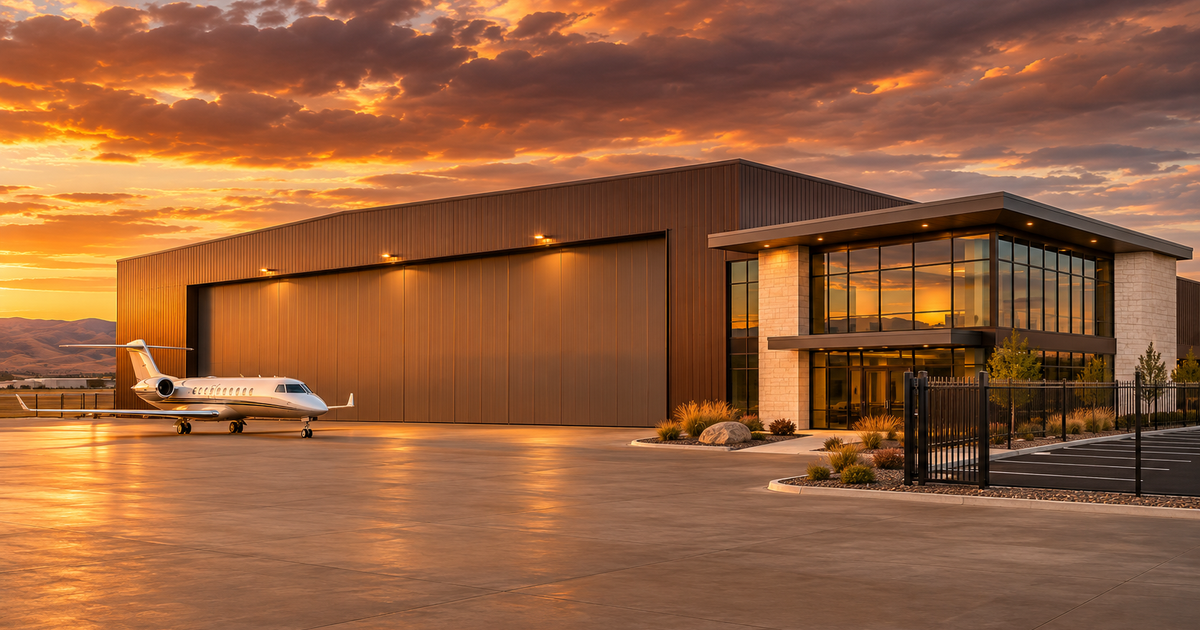
Boise permit BLD26-00855 covers Micron’s 56,445-square-foot aircraft hangar, office, and service facility at Boise Airport. Signal tracks four building low voltage packages with an estimated $500,000-$830,000 opportunity, excluding aircraft avionics and owner-furnished flight equipment.
Boise permit BLD26-00855 values Micron Technology’s new aircraft hangar at $16.68 million. The issued permit covers a 56,445-square-foot aviation building with hangar, office, and service space at Boise Airport. Signal tracks four building low voltage systems across that footprint, supporting an estimated $500,000 to $830,000 opportunity for structured cabling, access control, video surveillance, and fire alarm contractors.
Project Overview
The City of Boise’s open permit record shows a new commercial structure at 1250 W. Gowen Road. The city received the application on March 31, 2026, issued the permit on July 2, 2026, and lists a $16,683,412 job value. The record classifies the work as a new 56,445-square-foot commercial building in the airport planning area. It also identifies the building as the Micron Hangar and notes associated office and storage spaces.
Earlier planning coverage helps explain the building program behind the permit. Idaho News 6 reported a 43,200-square-foot aircraft storage area, approximately 7,500 square feet of lobby and office space, and more than 5,000 square feet of service-shop space. Those components align closely with the 56,445-square-foot total later carried by the issued building permit. The office program includes workspaces, a conference room, support areas, and an information technology room, while the aviation side is planned to store and maintain Micron’s corporate aircraft.
This is a building-permit opportunity, not a bid award notice. The permit confirms the construction value, location, scale, and issued status, but it does not identify the low voltage subcontractors or a verified general contractor. Contractors should treat the four systems below as a planning model drawn from Signal’s project classification and the documented building program, then confirm package boundaries against current drawings and procurement documents.
| Project | Micron Aircraft Hangar |
| Permit | BLD26-00855 |
| Location | 1250 W. Gowen Road, Boise, Idaho |
| Permit Value | $16,683,412 |
| Permitted Area | 56,445 square feet |
| Permit Status | Issued July 2, 2026 |
| Project Type | Corporate aviation hangar with office and service space |
| LV Score | 10/10 |
| Source | City of Boise High Impact Building Permits |
Key Players
The source trail resolves the owner and design team, but not the current general contractor or any technology subcontractor. That distinction matters because unrelated and older Micron hangar references exist online; they should not be treated as awards on this 2026 permit without a project-specific source.
| Role | Organization | What the record supports |
|---|---|---|
| Owner / Occupant | Micron Technology | Micron submitted the facility to consolidate its corporate aviation operations and will store and maintain company aircraft at the site. |
| Architect / Applicant | CSHQA | Planning coverage identifies CSHQA as the firm that submitted the proposal to Boise on Micron’s behalf. |
| Airport / Site Owner | Boise Airport / City of Boise | The project is on airport-owned land. A separate taxilane widening is being managed through the airport and reimbursed by Micron. |
| General Contractor | Not verified | No project-specific source reviewed for this spotlight confirms the current GC. Integrators should verify the contract holder before outreach. |
Low Voltage Systems Breakdown
The project combines a large industrial hangar with a smaller but technology-dense office, passenger, service, and IT program. That hybrid layout creates different installation conditions under one roof: long pathways and tall clear spans in the hangar, higher outlet density in offices, controlled transitions between public and restricted areas, and life-safety coverage that must coordinate with aircraft-maintenance operations.
| System | Category | Likely Building Scope | Complexity |
|---|---|---|---|
| Structured Cabling | Data / Voice | Backbone and horizontal cabling for the IT room, administrative offices, conference spaces, service-shop workstations, wireless access points, building systems, and secure operational areas. Hangar distances may require fiber between equipment locations rather than copper-only distribution. | High |
| Access Control | Security | Credentialed entry at office, service, executive parking, apron, and hangar transition points. The design must coordinate readers, door position switches, request-to-exit devices, gate interfaces, and airport perimeter rules without confusing airport-wide systems with the building contract. | High |
| CCTV / Video Surveillance | Security | Coverage for the apron-facing exterior, vehicle approaches, aircraft storage floor, service areas, office entries, and other high-value zones. Wide hangar spans make camera elevation, lens selection, backlighting, and maintenance access more demanding than a standard office installation. | High |
| Fire Alarm | Life Safety | Detection, notification, sprinkler monitoring, and interfaces required for a new aircraft hangar and its attached business areas. Final device types and releasing or special-hazard interfaces depend on the approved fire-protection design and authority-having-jurisdiction review. | High |
Several technology categories sit outside this four-system model unless the construction documents place them in the building package. Aircraft avionics, maintenance diagnostic equipment, flight-operations software, radios, active network electronics, corporate devices, and owner-furnished aviation systems are excluded. The separate airport taxilane project is also excluded from the $16.68 million permit basis and from the LV estimate below.
Estimated Low Voltage Value
LVN models the building low voltage scope at approximately $500,000 to $830,000. The range uses a 3% to 5% allowance against the $16,683,412 permit value. That is intentionally below a passenger-terminal benchmark because most of the permitted area is an aircraft storage and service environment, while still recognizing that the attached office, IT, executive-access, and perimeter-security areas carry more technology density than a basic warehouse.
| Permit Value | $16,683,412 |
| Modeled Building LV Percentage | 3% to 5% |
| Tracked Building Systems | 4 |
| Estimated LV Contract Range | $500,000 to $830,000 |
| Modeled Midpoint | Approximately $670,000 |
Structured cabling and security infrastructure will likely account for the largest combined share, but the final mix depends on whether pathway, fiber backbone, cameras, readers, and airport-interface work are bundled or divided. Fire alarm could be held by the electrical contractor, a fire-protection contractor, or a dedicated life-safety integrator. The estimate is a market-planning range, not a disclosed subcontract value.
For a regional integrator, the practical opportunity may be one complete package or a specialty slice. A contractor with airport badging experience and a strong security bench can pursue access control and surveillance. A cabling firm can position for the IT room, office distribution, fiber, testing, and documentation. A licensed fire alarm contractor can pursue the life-safety package while coordinating around the hangar’s suppression design.
Skills and Certifications Required
The project needs technicians who can work across conventional office environments and a tall, operationally sensitive aviation building. Quality control matters because long pathways, high mounting locations, secure boundaries, and multiple building uses make late rework expensive.
| System | Useful Certifications | Critical Skills |
|---|---|---|
| Structured Cabling | BICSI INSTC, INSTF, TECH; RCDD oversight | Fiber and copper installation, pathway planning, Fluke certification, rack and IT-room buildout, as-built documentation |
| Access Control | Manufacturer platform training; Idaho-required contractor licensing | Door hardware coordination, reader and controller wiring, gate interfaces, credential workflows, IP networking |
| CCTV | VMS and camera manufacturer training; Network+ | PoE design, lens selection, low-light placement, storage calculations, exterior mounting, lift planning |
| Fire Alarm | NICET Fire Alarm Level II or higher; applicable Idaho licenses | NFPA 72, sprinkler monitoring, notification design, testing, inspection, and AHJ coordination |
Entry-level technicians can support cable placement, device mounting, labeling, and basic terminations under supervision. Mid-level copper, fiber, security, and fire alarm technicians will own testing and device-level quality. Senior leadership should include an RCDD or equivalent design resource for backbone and pathway decisions, plus a NICET-qualified fire alarm lead for life-safety coordination.
Airport work may also require badging, background checks, controlled access procedures, escort planning, and limits on tools or vehicles near secure areas. Those requirements are logistics gates, not line items to discover after mobilization. Contractors should verify Idaho licensing, Boise permitting, airport security, lift, and site-access rules before pricing labor productivity.
Market Signal
The strongest signal is not simply that Boise is getting another hangar. Micron is consolidating corporate aviation into a purpose-built facility while its semiconductor footprint in the region expands. That creates account leverage across distinct facilities: manufacturing, research, administration, and now aviation. The systems are not interchangeable, but the owner’s expectations for cybersecurity, physical security, documentation, and reliable operations can travel from one facility type to another.
The building’s mixed program is also useful for contractors watching airport-adjacent development. The large hangar floor looks industrial, but the attached passenger, office, service, IT, parking, and perimeter spaces create a much broader integration map. Winning these projects requires more than pricing cable by the drop. It requires early coordination with the architect, airport, door hardware team, fire-protection designer, electrical contractor, and the owner’s IT and security standards.
BoiseDev reported that the airport plans a separate taxilane widening to support the hangar and that Micron will reimburse the city. Contractors should keep those scopes separate: the taxilane is market context and a possible adjacent lead, but it is not evidence that roadway or airfield infrastructure belongs in permit BLD26-00855. Clean scope boundaries are the difference between a useful pursuit model and a padded number.
The immediate business-development angle is straightforward. Micron and CSHQA are source-backed, the building permit is issued, and the GC and low voltage awards remain unverified. Integrators with aviation-security, industrial fiber, or complex fire-alarm experience have a reason to qualify the active contract holder now, ask whether technology packages are still open, and lead with airport-access readiness rather than a generic capabilities deck.
Find Projects Like This on Signal
LVN Signal tracks thousands of construction projects with low voltage opportunities across the country. Filter by city, system type, and project value to find your next bid.
Join 35,000+ Low Voltage Pros
Get weekly permit updates, tool deals, job opportunities, and industry news. No spam, unsubscribe anytime.