
Join Low Voltage Nation — Find project opportunities and showcase your company to thousands of industry professionals
A $35.75 million QTS DEN1 DC1 filing in Aurora covers a 22.5 MW tenant-improvement package and tracks five low-voltage systems. The ESB record remains unissued while a companion two-data-hall fit-out has moved to an issued permit.
A $35.75 million, 22.5 MW filing at QTS DEN1 DC1 in Aurora tracks five low-voltage systems and creates a modeled $2.5 million low-voltage planning opportunity inside an active data-center build-out.
Project Overview
The selected City of Aurora record is a tenant-improvement filing at 1160 North Gun Club Road identified as “QTS DEN1 DC1, 22.5MW ESB.” Online Building Folder 26-2636081-000-00 was filed July 1, 2026 with a reported value of $35.75 million. A paired Limited Building Permit, 26-2648292-000-00, was filed August 20 at the same value. As of LVN's October 25 source check, neither row showed an issue date, and the online folder still carried a municipal workflow note stating that a general contractor was needed.
The public record does not expand “ESB,” so LVN does not convert that acronym into an invented scope. The defensible facts are the stated 22.5 MW capacity, tenant-improvement classification, address, valuation, permit identifiers and current issue status. That boundary matters because the same address contains many releases for different data halls, offices, life-safety revisions and utility packages.
A companion filing submitted the same day is more descriptive. The $19.25 million “22.5MW TFO” package covers two data-hall spaces, including data racks, conveyance equipment and tenant storage. Its Limited Building Permit, 26-2648528-000-00, shows an October 5 issue date. The ESB and TFO records are presented separately and are not added together: they may divide one tenant program into different packages, and the public data does not establish a clean, non-overlapping combined contract value.
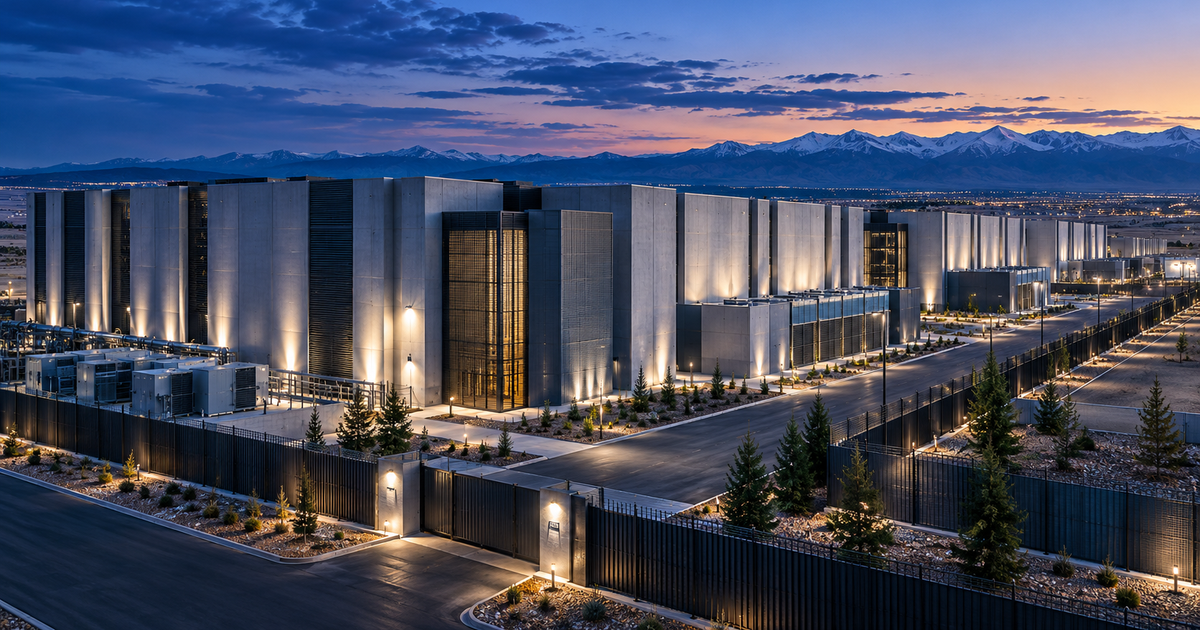
QTS identifies Denver 1 as a 65-acre Aurora campus planned for more than 160 MW of critical capacity. The selected spotlight is limited to the pending $35.75 million DC1 filing at 1160 North Gun Club Road. It is not the previously covered 60 MW DC2 tenant-fit-out revision at the adjacent 1140 address.
| Project | QTS DEN1 DC1 22.5 MW ESB Tenant Improvement |
| Location | 1160 N Gun Club Road, Aurora, Colorado |
| Selected Filing Value | $35.75 million |
| Capacity Named in Record | 22.5 MW |
| Permit Records | 26-2636081-000-00 and 26-2648292-000-00 |
| Issue Status Checked October 25 | No issue date shown |
| Signal Status | Active; last tracked August 26, 2026 |
| LV Score | 10/10 |
| Source | City of Aurora Building Permits |
Key Players and Package Boundaries
QTS Data Centers is the source-backed owner and operator. Its official campus page confirms the address, 160 MW-plus planned critical capacity, 65 acres and a standardized data-center platform. It does not disclose the DC1 tenant, the tenant's technology standard or a specialty low-voltage award for the selected filing.
Wells identifies Holder Construction as the campus contractor, Corgan as architect and L.A. Fuess Partners as structural engineer for a 139,261-square-foot Denver 1 building delivered in 2025. That is credible campus-level team evidence, but the municipal ESB filing does not name any of those firms for this exact $35.75 million package. Contractors should treat the team as an access map, not as proof of a current subcontract award.
| Role | Company | What the Record Supports |
|---|---|---|
| Owner / Operator | QTS Data Centers | DEN1 operator; official campus page confirms location, land and planned critical capacity |
| Campus General Contractor | Holder Construction | Named by Wells for Denver 1; exact ESB package relationship is not disclosed |
| Campus Architect | Corgan | Named by Wells for the campus building; current tenant-improvement scope is unconfirmed |
| Campus Structural Engineer | L.A. Fuess Partners | Named by Wells for the campus building; not a disclosed low-voltage award |
| Tenant | Not publicly named | The filing identifies a tenant improvement but not the customer's standards or procurement contacts |
What the DC1 Permit Trail Actually Reveals
The broader DC1 permit history contains useful system evidence, but it must not be mislabeled as part of the selected ESB filing. A 7.5 MW expansion fire-alarm permit issued in 2025 called for 71 notification appliances, 133 initiating devices and 13 VESDA systems. Later revisions modified below-ceiling VESDA and SLC-loop work, then removed a clean-agent update in favor of a pre-action-system revision. Those records prove that DC1 has active, technically dense fire-alarm coordination; they do not prove that the same device counts belong in the 22.5 MW ESB package.
An earlier building record at 1160 North Gun Club Road also identifies emergency-responder radio coverage with 35 antennas. Another record covers gates across fire-apparatus access roads and an eight-foot steel fence. Together, those filings show the campus's life-safety and perimeter-security interfaces. They support targeted questions about system expansion, monitoring, acceptance and spare capacity, but they are not permission to represent DAS, access control or CCTV as awarded work.
The permit trail also exposes sequencing. The issued companion TFO package advances racks, conveyance and storage inside two data halls while the selected ESB record remains without an issue date. That is a coordination warning: infrastructure, tenant equipment, fire protection and monitoring may move on different permit clocks. A bidder needs the interface matrix and current drawing index before deciding which pathways, devices, testing or controls belong in each package.
Low Voltage Systems Breakdown
Signal tracks five systems for this project. Fire Alarm and emergency-responder radio have direct support elsewhere in the DC1 municipal record. Structured Cabling, Access Control and CCTV remain planning lanes inferred from the data-center use, the companion data-hall scope and campus security requirements. None should be described as a disclosed subcontract award.
| System | Category | Scope Question for This Filing | Complexity |
|---|---|---|---|
| Structured Cabling | Data / Voice | Define backbone, tenant white-space and equipment-monitoring cabling. Confirm whether racks, patching, fiber trunks and certification belong to the TFO package, ESB package or an owner-furnished technology contract. | High |
| Access Control | Security | Map credential boundaries at data halls, tenant storage, electrical rooms and perimeter gates. Establish which doors report to QTS base-building systems versus the undisclosed tenant platform. | High |
| CCTV / Video Surveillance | Security | Coordinate cameras at technical rooms, circulation, loading and restricted tenant zones. VMS ownership, retention, analytics and tenant access remain undisclosed. | High |
| Fire Alarm | Life Safety | DC1 records confirm VESDA, initiating and notification devices plus revisions affecting clean-agent and pre-action coordination. Obtain the current cause-and-effect matrix and identify which existing loops are extended. | High |
| DAS / ERRCS | Wireless / Life Safety | A prior DC1 record confirms a 35-antenna emergency-responder coverage system. Determine whether the 22.5 MW build changes coverage, survivability, monitoring or acceptance testing. | High |
Estimated Low Voltage Value
The selected $35.75 million figure is a reported construction value for one tenant-improvement filing. LVN applies the current reported-value data-center method: a 6% base multiplied by 1.15 for five coordinated systems. That produces a modeled midpoint of approximately $2.5 million. A practical planning band is $2.15 million to $3.58 million before tenant standards, owner-furnished equipment, existing-system reuse and package boundaries are known.
| Selected Filing Value | $35.75 million |
| Base LV Percentage | 6% for reported data-center construction value |
| Five-System Multiplier | 1.15x |
| Modeled LV Midpoint | $2.5 million |
| Planning Range | $2.15 million to $3.58 million |
A separate capacity check at roughly $500,000 per compute megawatt would imply about $11.25 million for a complete 22.5 MW low-voltage architecture. That figure is not assigned to this permit. The gap is useful because it shows the selected $35.75 million filing is a slice of a larger tenant and campus stack, not a complete measure of network, security, life-safety, controls and commissioning scope.
The $19.25 million TFO package is also excluded from the estimate. Its racks, conveyance and tenant-storage work may contain owner-furnished equipment and may overlap the same 22.5 MW program. Adding it to the ESB value without package documents would create false precision. Contractors should price the issued or bid set in front of them, then list excluded systems and owner-furnished equipment explicitly.
Skills and Certifications Required
| Discipline | Useful Certifications | Critical Field Skills |
|---|---|---|
| Structured Cabling | BICSI TECH, INSTC/INSTF, RCDD | High-density pathway planning, fiber splicing, polarity control, loss testing, labeling and tenant-format turnover |
| Access Control | Manufacturer platform certification, ASIS PSP for design leadership | Door hardware interfaces, controller networks, credential segmentation, gate coordination and fail-safe sequences |
| CCTV | VMS and camera-manufacturer certification, CompTIA Network+ | PoE networking, coverage design, storage calculation, isolated networks and analytics commissioning |
| Fire Alarm / VESDA | NICET Fire Alarm Level II or higher, applicable Colorado licensing | NFPA 72, aspirating detection, SLC/NAC modifications, pre-action interfaces, sequence testing and AHJ coordination |
| ERRCS | RCDD, RF-system training, manufacturer certification | Coverage testing, antenna and pathway coordination, survivability, monitoring and fire-code acceptance |
Entry-level technicians can support pathway installation, cable placement, labeling and device rough-in under supervision. Mid-level technicians will own terminations, fiber testing, controller installation, VESDA piping and deficiency correction. Senior leads need enough data-center experience to separate base-building, tenant, life-safety and owner-furnished requirements while maintaining redlines and test evidence across parallel permit packages.
Contractors should verify Colorado and Aurora licensing requirements for each discipline before bidding. Fire Alarm and emergency-responder radio work can trigger different contractor, technician, inspection and acceptance requirements than general communications cabling.
Procurement Signal for Contractors
This is active permit intelligence, not a public invitation to bid. The selected ESB rows showed no issue date on October 25, and the original online folder carried a “needs GC” condition. That condition is a municipal workflow marker, not proof that QTS is openly soliciting a prime contractor. The companion TFO permit's October 5 issue date does show that the 22.5 MW tenant program is moving through construction approvals.
The first request for information should ask QTS or the construction manager to define ESB and identify the current package owner. The second should request an interface matrix covering the ESB, issued TFO, existing DC1 fire-alarm system, emergency-responder coverage and tenant network/security standards. The third should lock the testing and turnover format before labor is priced. On an unnamed-tenant data-center job, documentation can become a major unpriced scope if it arrives after award.
Contractors should also avoid quoting a campus relationship as a package award. Holder, Corgan and L.A. Fuess are source-backed members of the Denver 1 campus team, but the reviewed ESB row names none of them. The correct outreach angle is that LVN has mapped the public permit sequence and the unresolved interfaces, not that any company has won the low-voltage package.
Market Signal
The DC1 filing sits inside Colorado's first data-center campus operating at this scale. Colorado Public Radio reported in July that one of three large buildings was complete, a second appeared nearly finished and site work was preparing the third. QTS's own page lists at least 160 MW of planned critical capacity, making a 22.5 MW package meaningful without pretending it represents the whole campus.
The same reporting says QTS sought permission to add 98 backup generators to 40 already installed and planned pollution controls for the new units. It also describes a closed-loop cooling approach using roughly 2,400 gallons per day. For low-voltage contractors, the lesson is not an environmental talking point pasted onto a bid. Generator controls, fire detection, emergency communications, monitoring, testing windows and outage procedures sit at the intersection of tenant acceptance and regulatory scrutiny.
Aurora also demonstrates why address-level and building-level tracking matter. DC1 at 1160 and DC2 at 1140 share a campus, operator and portions of the delivery team, but their permit values, megawatt figures, issue status and system evidence differ. Treating every Gun Club Road filing as one project would double count value and blur live procurement signals. Treating each permit as unrelated would miss the repeat-work advantage. The commercially useful view holds both facts at once.
For integrators, the repeatable opportunity is standardization across releases: approved products, naming, testing, security interfaces and turnover can carry forward, while tenant-specific requirements remain bounded allowances until disclosed. That is where prior DEN1 experience becomes leverage without becoming an assumption.
For the adjacent 60 MW DC2 permit analysis, see LVN's QTS DEN1 DC2 spotlight.
Find Projects Like This on Signal
LVN Signal tracks thousands of construction projects with low voltage opportunities across the country. Filter by city, system type, and project value to find your next bid.
Join 35,000+ Low Voltage Pros
Get weekly permit updates, tool deals, job opportunities, and industry news. No spam, unsubscribe anytime.