
Join Low Voltage Nation — Find project opportunities and showcase your company to thousands of industry professionals
A $7.5 million Phase 3 permit at Howard Johnson Anaheim covers 93 guestrooms, elevated walkways, a new elevator and courtyard work while the hotel stays open. Signal tracks seven low-voltage systems and an estimated $300,000 to $500,000 construction-LV range.
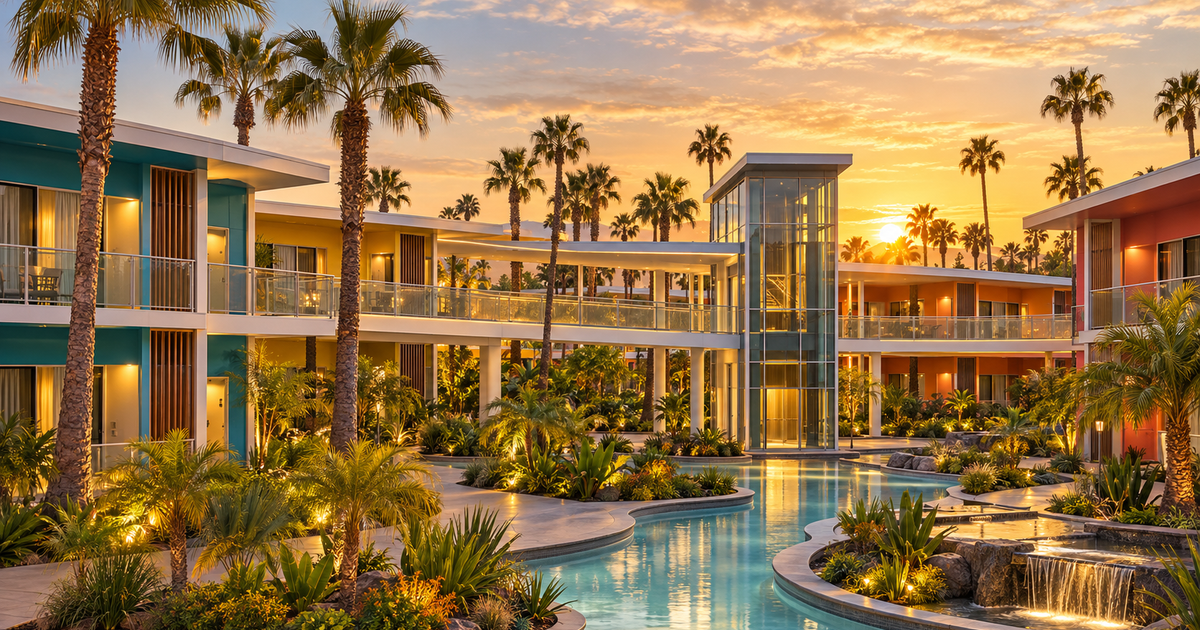
A $7.5 million Phase 3 package at Howard Johnson Anaheim Hotel and Water Playground covers 93 guestrooms, new elevated walkways, an elevator tower and exterior gathering spaces while the resort remains open. Signal tracks seven low voltage systems across the permit, creating an estimated $300,000 to $500,000 construction-LV opportunity in one of Southern California's busiest hospitality districts.
Project Overview
City of Anaheim permit data describes a non-residential addition at 1380 South Harbor Boulevard. The selected record covers three covered elevated walkways, a new elevator tower, stair and storage work in four buildings, and more than 47,000 square feet of guestroom modifications across Buildings 3 through 6. The permit carries a $7.5 million construction value and references the broader plan set identified as BLD2025-06591.
That permit is one package inside a larger program. Orange County Business Journal reports that owner Northwest Hotel Corporation is investing $30 million across the property, with construction beginning in July 2026 and completion targeted for June 2027. The program renovates all rooms and suites, public spaces and amenities, while this Signal spotlight values only the selected $7.5 million Phase 3 permit. The figures overlap and must not be added together.
The active package focuses on 93 rooms in four two-story buildings. Eighteen standard rooms are being reorganized into 10 larger one-bedroom suites, and the property is adding bridges, walkways and elevator access to make movement across the seven-acre site easier. Disneyland's Good Neighbor hotel listing confirms that the hotel is operating through the work and warns guests of daytime construction through summer 2027. For low voltage crews, an occupied resort changes the job: access windows, noise, dust control, temporary life-safety coverage and daily turnover all become production constraints.
| Project | HoJo Anaheim Reimagined, Phase 3 |
| Location | 1380 S Harbor Blvd, Anaheim, CA 92802 |
| Selected Permit Value | $7.5 million |
| Reported Program Value | $30 million, separate context only |
| Selected Scope | 93 rooms, four buildings, elevated walkways, elevator tower, courtyard and site features |
| Status | Under construction; occupied hotel remains open |
| LV Opportunity Score | 9/10 |
| Source | Anaheim Accela Building Permits |
Key Players
The permit record names R.D. Olson Construction as general contractor. Independent project coverage confirms the company has started the third renovation phase after completing two earlier phases at the same property. That repeat relationship matters to specialty contractors: R.D. Olson already knows the hotel's phasing, site logistics, brand expectations and occupied-property constraints, so bidders should arrive with a concrete cutover and guest-impact plan rather than a generic hospitality proposal.
| Role | Company | Project Context |
|---|---|---|
| Owner / Operator | Northwest Hotel Corporation / Howard Johnson Anaheim | Investing in the multi-phase resort modernization while keeping the property operational. |
| General Contractor | R.D. Olson Construction | Permit-linked GC and repeat builder for prior renovation phases. |
| Architect | Lee & Sakahara Architects | Reported design partner for the broader $30 million program. |
Current construction reporting describes the design as a California Garden Resort that preserves the property's mid-century identity while rebuilding circulation and exterior spaces. The practical low voltage implication is a distributed renovation rather than a clean-sheet hotel: technicians will work across multiple small buildings, outdoor paths and occupied guest areas, with existing pathways and systems remaining live around them.
Low Voltage Systems Breakdown
Signal tracks seven systems for this project. The permit record does not disclose awarded low voltage contracts, named manufacturers or final device counts, so these are planning lanes rather than claims of completed buyout. Contractors should validate each lane against Division 27, Division 28, fire-alarm and owner-furnished technology schedules before pricing.
| System | Category | Likely Phase 3 Scope | Complexity |
|---|---|---|---|
| Structured Cabling | Data / Voice | Guestroom, back-office, elevator and outdoor-area pathways; copper and fiber backbone extensions between four buildings; certification and labeling against the live property standard. | High |
| Wi-Fi Infrastructure | Wireless | Access-point moves or additions for changed room layouts, suites, bridges and courtyard coverage, followed by predictive design validation and an occupied-site survey. | High |
| Access Control | Security | Coordination at new stairs, elevator access, service/storage rooms and staff-only boundaries. Guestroom locks may remain under the hotel operator or a brand vendor. | Medium |
| CCTV / Video Surveillance | Security | Coverage changes at elevated walkways, courtyard paths, elevator approaches and reconstructed building entries, with attention to backlight, landscaping and privacy zones. | Medium |
| Fire Alarm | Life Safety | Device relocation and additions for revised guestrooms, suites, stairs, storage and elevator interfaces while maintaining protection in occupied portions of the hotel. | High |
| Audio/Visual | Guest Technology | Room display pathways, public-area audio and possible digital guest information interfaces. Displays and head-end equipment are common owner-furnished boundaries. | Medium |
| Distributed Antenna System | Wireless / Life Safety | Coverage verification after new elevator, bridge and building work; remediation only if testing shows public-safety or carrier coverage has changed. | High |
The Owner-Furnished Boundary Matters
Hotel technology packages routinely mix construction scope with owner-, brand- and vendor-furnished equipment. Electronic guest locks, televisions, casting gateways, property-management interfaces, Wi-Fi electronics, carrier equipment and portions of the AV package may be procured outside the electrical subcontract. A serious bid should name those exclusions, identify who supplies licenses and head-end hardware, and still carry the pathways, power coordination, mounting, cabling, testing and commissioning work required to make the systems operational.
The occupied-property condition also makes temporary work part of the low voltage plan. Fire alarm impairments need documented notification and restoration procedures. Network and lock cutovers should be sequenced by building or room block. Cameras and access-controlled openings may require temporary coverage when exterior circulation changes. These activities consume supervision hours even when the device count looks modest.
Estimated Low Voltage Value
The selected permit has no database LV estimate, so this spotlight uses a hospitality construction benchmark. A standard hotel renovation midpoint of approximately 4% of construction value, adjusted by the 1.25 multiplier for seven tracked systems, produces a modeled midpoint of $375,000. Allowing for package boundaries and occupied-site complexity, a practical early range is $300,000 to $500,000.
| Selected Permit Value | $7.5 million |
| Hospitality LV Base | Approximately 4% |
| Seven-System Multiplier | 1.25x |
| Modeled Midpoint | $375,000 |
| Planning Range | $300,000-$500,000 |
A full hotel technology allowance of roughly $8,000 to $15,000 per renovated key would yield $744,000 to $1.395 million across 93 rooms, but that cross-check is not assigned to this construction permit. It can include televisions, electronic locks, network electronics, software, hospitality integrations and other owner-furnished items. The lower construction-LV range is the defensible figure until drawings or bid packages define which systems actually sit under the electrical and low voltage contracts.
Contractors should also avoid applying the reported $30 million program value to this permit. The program includes earlier and broader work across the full property, while the selected record is a defined Phase 3 package. Pricing the larger number would overstate the opportunity and blur the exact package that Signal is tracking.
Skills and Certifications Required
This renovation rewards technicians who can work cleanly in occupied hospitality space and coordinate multiple trades across existing buildings. The project needs more than cable-pulling capacity: testing, documentation, phased commissioning and fast restoration of guest-facing services are central to production.
| System | Useful Certifications | Critical Skills |
|---|---|---|
| Structured Cabling / Wi-Fi | BICSI INSTC or INSTF; RCDD oversight; wireless-vendor training | Pathway surveys, fiber splicing, Cat6A termination, certification testing, RF surveys and as-built labeling |
| Fire Alarm | NICET Fire Alarm Level II+; manufacturer training; applicable state licensing | NFPA 72 coordination, elevator recall interfaces, impairment planning, testing and AHJ closeout |
| Access Control / CCTV | Manufacturer platform certifications; ASIS PSP for design leadership | Door hardware coordination, IP networking, camera placement, privacy masking, credential and VMS integration |
| Audio/Visual | AVIXA CTS or CTS-I | Display and audio pathways, control interfaces, commissioning and coordination with owner-furnished equipment |
| DAS | BICSI RCDD; RF engineering or integrator training | Public-safety coverage testing, antenna placement, fiber/RF troubleshooting and authority coordination |
Entry-level technicians can contribute to pathway work, device mounting and basic terminations under close supervision. Mid-level technicians should own testing, labeling, room-block closeout and daily restoration. Senior leads need to coordinate fire alarm, elevator, network, security and hospitality vendors without disrupting guest operations. Contractors should verify current California and local licensing requirements before bidding because responsibility varies by system and contract structure.
Market Signal
This project is a useful signal because it is renovation work driven by guest expectations rather than new room inventory. HVS reports that Anaheim lodging demand is being supported by continued theme-park investment, convention activity and a growing entertainment district. Existing hotels close to those demand drivers cannot compete on location alone; they have to renew rooms, circulation, connectivity and guest-facing technology while continuing to sell rooms.
For low voltage firms, the repeatable opportunity is not one giant greenfield package. It is a steady pipeline of phased renovations with difficult logistics: legacy cabling, occupied floors, short shutdowns, brand standards, owner-furnished electronics and exterior wireless/security coverage. Firms that can document cutovers and coordinate with hotel operations become easier to rehire on the next building or phase.
R.D. Olson's repeat role at this property is also the business-development door. The builder has already completed earlier phases and is now delivering another active package. A subcontractor approaching the account should lead with occupied-hotel sequencing, guest-impact controls, fire-alarm impairment procedures and a clean owner-furnished responsibility matrix. That is more useful than leading with a generic list of systems.
Find Projects Like This on Signal
LVN Signal tracks thousands of construction projects with low voltage opportunities across the country. Filter by city, system type, and project value to find your next bid.
Join 35,000+ Low Voltage Pros
Get weekly permit updates, tool deals, job opportunities, and industry news. No spam, unsubscribe anytime.