
Join Low Voltage Nation — Find project opportunities and showcase your company to thousands of industry professionals
Empire AI's 46,000-square-foot research computing center broke ground at the University at Buffalo with Gilbane as construction manager. LVN models $4.5M-$7.5M in construction-side low-voltage scope across eight planning lanes while excluding compute hardware and the wider $500M statewide initiative.
Empire AI’s $74.5 million research computing center is now under construction on the University at Buffalo’s North Campus in Amherst. The 46,000-square-foot facility carries eight Signal low-voltage planning lanes and source-backed procurement categories for Tel/Data, communications and security, fire alarm, HVAC controls, and electrical site utilities. LVN models approximately $4.5 million to $7.5 million in construction-side low-voltage scope, separate from the compute hardware and the statewide Empire AI initiative.
Project Overview
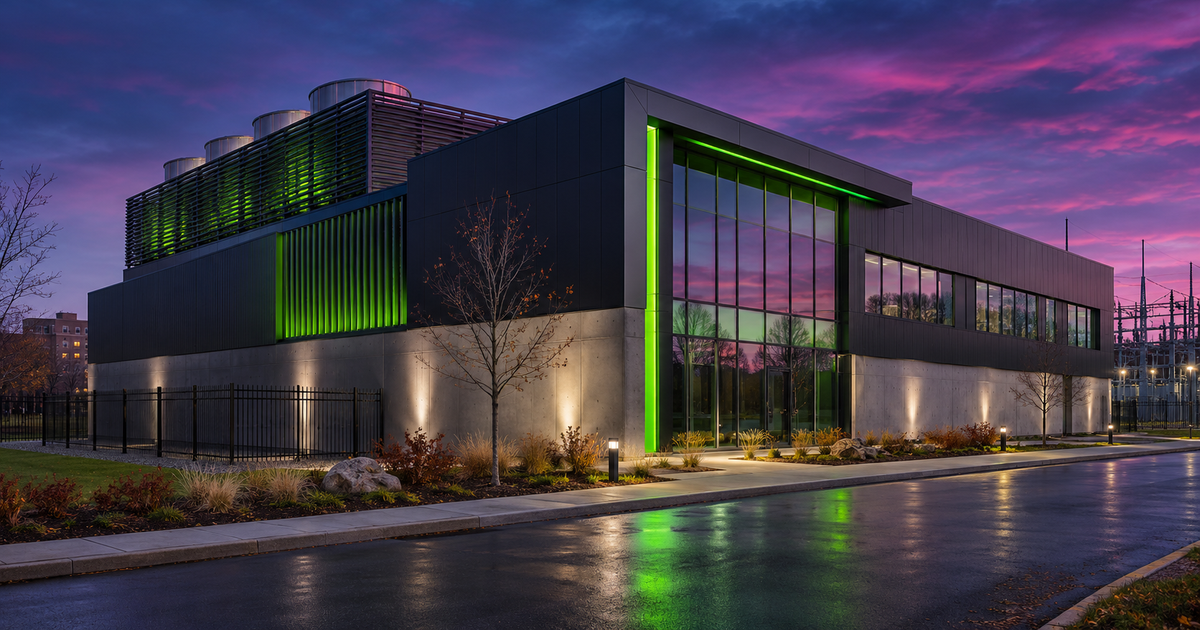
The Empire AI Research Computing Center, also called Empire AI Gamma, broke ground November 19, 2026 on Service Center Road at the University at Buffalo’s North Campus. The University at Buffalo’s project announcement describes a permanent academic computing facility intended to support public-interest AI research across New York. The building is planned as the next home for a program that already supports work in medicine, climate science, education, manufacturing, and other research fields.
Gilbane’s project page identifies a $74.5 million estimated construction budget and a 46,000-square-foot facility designed for up to 15 megawatts of computing power. Gilbane targets substantial completion in late 2027. SUNY has cited early 2028 completion, while UB expects the center to become operational in late summer 2028. Those dates describe different milestones and should not be treated as a single guaranteed turnover date.
The building is designed around a closed-loop cooling and heat-recovery strategy. Waste heat from computing equipment is intended to support the campus thermal network, and UB says dry coolers will reduce dependence on water-intensive cooling. Those energy features make the controls, monitoring, fiber, and commissioning interfaces unusually important even before the owner’s compute stack is installed.
| Project | Empire AI Research Computing Center / Empire AI Gamma |
| Location | Service Center Road, University at Buffalo North Campus, Amherst, New York |
| Construction budget | $74,500,000 estimated |
| Building area | 46,000 square feet |
| Status | Groundbreaking completed November 19, 2026; under construction |
| Construction manager | Gilbane Building Company |
| Signal LV score | 10/10 |
| Signal planning lanes | 8 |
Key Players and Procurement Signal
Three organizations are directly source-backed. Empire AI Consortium is the developer and operator, the University at Buffalo is the host institution, and Gilbane Building Company is the construction manager. Public material reviewed for this spotlight does not identify an architect, engineer of record, electrical contractor, low-voltage integrator, fire-alarm contractor, controls contractor, or security contractor, so no specialty award is inferred.
| Role | Organization | Source-backed context |
|---|---|---|
| Owner / developer | Empire AI Consortium Inc. | Developing the permanent Gamma research computing facility as part of New York’s academic AI consortium. |
| Host institution | University at Buffalo | Hosting the facility on North Campus and integrating it with campus energy infrastructure. |
| Construction manager | Gilbane Building Company | Confirmed construction manager and publisher of the contractor-interest and procurement information. |
Gilbane’s procurement information lists indicative October, November, and December 2026 release windows. The schedule names Tel/Data, Low Voltage – Communications/Security, Fire Alarm, HVAC – Controls, Electrical – Site Utilities, and Electrical & Lighting. The page says the schedule is subject to change, and the public material does not establish which packages remain open or whether any have been awarded. Contractors should treat the live interest form as a route into Gilbane’s package process, not as proof of an open bid deadline.
The commercial angle is still clear. Prime and Tier-1 firms are expected to prequalify, while Gilbane says second-tier subcontractors and suppliers do not need to submit that prequalification information. A low-voltage contractor should confirm its intended tier, package holder, bonding requirements, and current release status before pricing. The named package categories make this more actionable than a generic data-center announcement, but only current bid documents can define the actual scope.
Low Voltage Systems Breakdown
Signal tracks eight planning lanes on this project. They span data transport, campus outside plant, security, life safety, and building controls. The public procurement schedule confirms the relevance of several categories, but it does not prove that each Signal system is a standalone package or that an award remains available.
| System | Category | Likely construction-side scope | Complexity |
|---|---|---|---|
| Structured Cabling | Data / Voice | Pathways, copper distribution, equipment-area connectivity, labeling, testing, and turnover documentation. Owner network electronics are excluded. | High |
| Fiber Optic | Data / Voice | High-count backbone, diverse routing, splice and termination work, optical-loss testing, and links between campus entry points and computing areas. | High |
| Networking | Data / Voice | Physical-layer coordination, rack connectivity, patching standards, port documentation, and commissioning support. Switches, routers, servers, and compute fabrics are owner-furnished unless documents say otherwise. | High |
| Outside Plant | Campus Infrastructure | Ductbank, handholes, campus fiber entry, service-road crossings, grounding coordination, and protection of diverse pathways around electrical site utilities. | High |
| Access Control | Security | Controlled doors, equipment-zone permissions, reader and controller wiring, alarm interfaces, and integration with the host campus credential environment. | High |
| CCTV / Video Surveillance | Security | Exterior and critical-room coverage, PoE pathways, camera mounting, VMS integration, storage policy coordination, and acceptance testing. | High |
| Fire Alarm | Life Safety | Detection, notification, monitoring, equipment shutdown and release interfaces, programming, testing, and AHJ acceptance. Exact suppression interfaces require drawings. | High |
| BMS Controls | Building Automation | Instrumentation and controls for cooling, heat recovery, environmental conditions, alarming, trending, and integration with campus operations. | High |
Coordination is the real scope multiplier. Outside-plant fiber must arrive through a secure and resilient entrance strategy. Inside the building, pathways, firestopping, equipment clearances, access-control zones, surveillance coverage, detection, cooling controls, and test plans all intersect. A bidder that treats these as eight independent device lists will miss the commissioning and documentation burden that makes a research computing center operate reliably.
Estimated Low Voltage Value
LVN uses the $74.5 million construction estimate as the denominator. It does not add the more-than-$500 million statewide Empire AI initiative, the $40 million Beta supercomputer, future compute purchases, financing, campus energy programs, or other buildings. Those values overlap or belong to equipment and programs outside this facility’s construction contract.
For a reported construction value on a data-center project, a 6% low-end benchmark produces approximately $4.47 million. Applying the eight-system coordination multiplier of 1.25 to that low-end benchmark produces a working model of approximately $5.59 million. A separate capacity cross-check at roughly $500,000 per megawatt against Gilbane’s 15-megawatt computing-design figure produces approximately $7.5 million. Because UB separately describes an initial 5-megawatt electrical use and later upgrades toward 20 megawatts, those capacity figures are not additive or directly interchangeable.
| Construction budget | $74,500,000 |
| Low-end construction benchmark | 6%, or approximately $4,470,000 |
| Eight-system coordination multiplier | 1.25x applied to the low-end benchmark |
| Working construction model | Approximately $5,590,000 |
| 15 MW capacity cross-check | Approximately $7,500,000 |
| Published planning range | $4,500,000 to $7,500,000 |
The range is a planning estimate, not an identified contract value. It includes construction-side pathways, cabling, fiber, security, alarm, controls interfaces, testing, documentation, and commissioning. It excludes GPUs, compute servers, storage systems, switches, routers, software, carrier services, owner network electronics, generators, major electrical distribution, mechanical cooling equipment, and the campus thermal-energy program. Package boundaries could move meaningful dollars between the electrical contractor, controls contractor, security integrator, fire-alarm contractor, and dedicated communications firms.
Skills and Certifications Required
The job needs technicians who can work inside a mission-critical construction process, not just terminate cable. Quality plans, method-of-procedure discipline, clean testing records, secure material handling, and coordinated turnover will matter alongside installation production. The project’s academic mission does not reduce the reliability standard of the facility that will host the research compute stack.
| Workstream | Useful certifications | Critical skills |
|---|---|---|
| Structured Cabling and Networking | BICSI INST1 / INSTC, BICSI TECH, RCDD oversight | Pathway planning, copper termination, certification testing, rack and patch-field documentation |
| Fiber and Outside Plant | BICSI INSTF, RCDD / OSP design experience, manufacturer training | Splicing, OTDR and OLTS testing, diverse routes, ductbank and handhole coordination |
| Access Control | State and local licensing as applicable, manufacturer certification, PSP for senior design roles | Door hardware, controllers, credential integration, secure-zone programming, acceptance testing |
| CCTV | Manufacturer VMS and camera training, Network+ or equivalent networking knowledge | PoE, camera placement, bandwidth and storage coordination, VMS commissioning |
| Fire Alarm | NICET Fire Alarm Level II+, required jurisdictional licensing | NFPA 72, SLC and NAC wiring, shutdown interfaces, programming, testing, AHJ coordination |
| BMS Controls | BACnet training, Tridium Niagara N4 or specified manufacturer credentials | DDC controls, sensor validation, sequences, trending, alarming, network integration |
Entry-level technicians can contribute to pathway preparation, cable placement, labeling, device mounting, and supervised terminations. Mid-level technicians should own copper and fiber testing, security and alarm wiring, and punch-list correction. Senior staff will be needed for RCDD-level pathway and backbone decisions, NICET-led fire-alarm work, controls integration, cybersecurity coordination, commissioning, and final records.
Contractors should verify New York and local licensing requirements before bidding because fire-alarm, security, electrical, and low-voltage requirements can vary by jurisdiction and contract tier. Manufacturer credentials should be matched to the issued specifications; public sources reviewed for this spotlight do not name the selected fire-alarm, access-control, video, cabling, or controls platforms.
Market Signal
This project is different from a speculative hyperscale campus. It is a public-interest research facility on an operating university campus, funded in part through Empire State Development and tied to a statewide consortium. That changes the sales motion. Contractors should expect public-goal reporting, diverse-supplier participation, campus coordination, and a formal construction-manager process alongside the usual mission-critical requirements.
The schedule is also a useful signal for Western New York. Gilbane is publishing package-level categories and an interest route while the facility moves from groundbreaking into construction. That creates a near-term opening for qualified firms to establish their tier, document mission-critical experience, and identify the actual package holder. The strongest outreach is not “we do low voltage.” It is a concise capability statement covering secure campus OSP, high-count fiber, fire-alarm interfaces, controls integration, clean test records, and commissioning support.
The energy design matters beyond this one building. UB’s facility FAQ links the computing center to dry cooling and campus heat reuse. Data centers that export heat into institutional thermal networks create more dependencies between facilities controls, instrumentation, communications, and operations. Contractors that can document those interfaces may be better positioned for the broader pipeline of campus electrification and research infrastructure work.
The caveat is package status. The indicative schedule is subject to change, and no public source reviewed here confirms a current specialty bid deadline or installer award. Contractors should use the source-backed names and package categories to reach the right construction team, then verify the live documents before assigning estimating labor.
Find Projects Like This on Signal
LVN Signal tracks thousands of construction projects with low voltage opportunities across the country. Filter by city, system type, and project value to find your next bid.
Join 35,000+ Low Voltage Pros
Get weekly permit updates, tool deals, job opportunities, and industry news. No spam, unsubscribe anytime.